

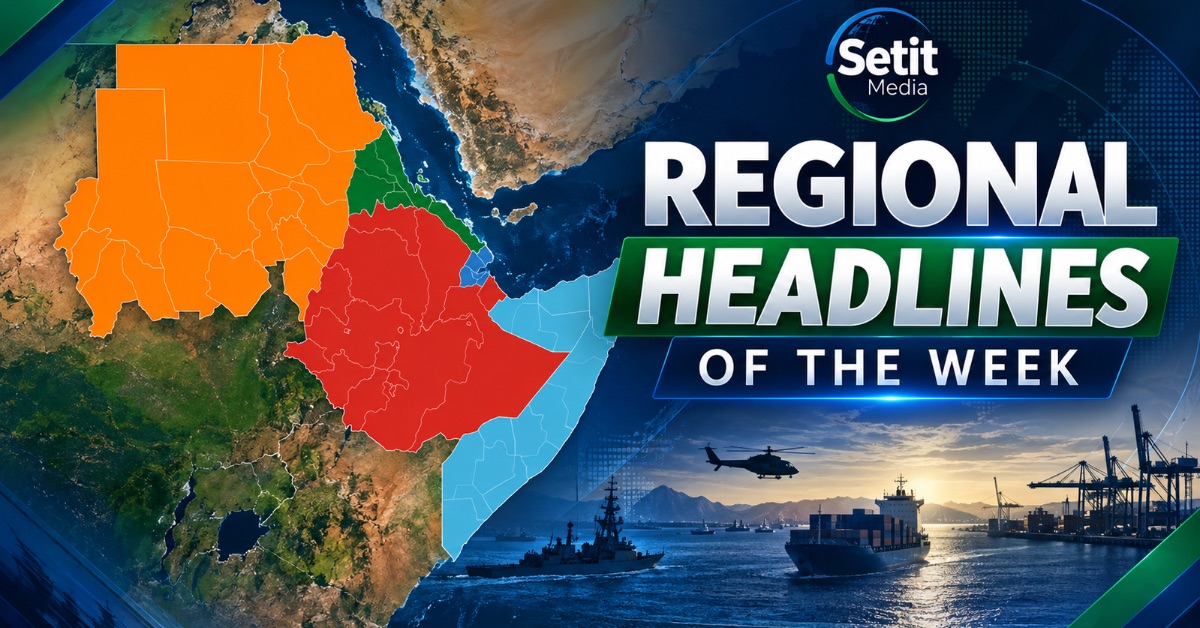
Setit Media | October 8–12, 2026
Eritrea, Ethiopia, the Horn of Africa and the Red Sea
1. Ethiopia and Eritrea Trade Invasion Accusations as Fighting Reaches Border Areas
Tensions between Eritrea and Ethiopia intensified this week as both governments exchanged accusations over military activity in northern Ethiopia, raising fears of a wider confrontation.
Ethiopia informed the United Nations Security Council that Eritrean forces had entered Tigray, alleging an advance of up to 60 kilometers into Ethiopian territory. Addis Ababa invoked its right to self-defense, while Eritrea rejected the accusations and argued that Ethiopia was attempting to create a justification for military aggression.
Reuters reported eyewitness accounts of Eritrean soldiers in Adigrat and cited conflict-monitoring organization ACLED concerning reported drone attacks on vehicles identified as Eritrean. However, the extent of the alleged deployments and responsibility for individual attacks could not be independently established.
By October 10, Ethiopian government forces and allied fighters had reportedly entered Adigrat. The developments unfolded against a background of deteriorating diplomatic relations and Ethiopia’s repeated demands for access to the Red Sea.
For Eritrea, the confrontation raises immediate questions about border security, territorial integrity and the possibility of direct military conflict.
Sources:
2. Eritrea Takes Ethiopia’s Accusations to the United Nations Security Council
The growing confrontation between Eritrea and Ethiopia has moved beyond competing battlefield accounts into a formal diplomatic dispute at the United Nations.
Ethiopia presented its allegations of an Eritrean incursion to the Security Council, citing Article 51 of the UN Charter, which recognizes the inherent right of self-defense following an armed attack.
Eritrea responded by requesting that the Security Council condemn Ethiopia and consider deterrent measures under Chapter VII of the Charter.
According to Reuters, Eritrea described Ethiopia’s allegations as a declaration of war and warned against their use as justification for further military action.
Chapter VII allows the Security Council to adopt measures ranging from sanctions to enforcement action. However, Eritrea’s request does not mean that the Council has approved sanctions or authorized military intervention.
The diplomatic exchange places international attention on the conflicting accounts of military developments near the Eritrean border.
It also raises important questions about how international law can be applied to prevent escalation while respecting the sovereignty and territorial integrity of both countries.
Sources:
3. Northern Ethiopia’s Changing Front Lines Leave Civilians Facing Uncertainty
The renewed conflict in northern Ethiopia continued to reshape the security situation across Tigray, with reported military advances and withdrawals in several towns, including Adigrat and Shire.
Associated Press reported serious difficulties facing civilians, including shortages of food and medical supplies, disruptions to banking services and interruptions to basic infrastructure.
Some telecommunications and public utilities have reportedly begun returning in Mekelle, but these developments do not establish that the fighting has ended or that normal life has resumed.
The latest confrontation has also renewed questions about the implementation and durability of the November 2022 Pretoria peace agreement.
Although military control over particular towns has changed, the broader political disputes remain unresolved.
For Eritrea, developments in Tigray carry direct security implications because of the region’s proximity to its southern border. The humanitarian situation also deserves sustained attention, particularly where renewed fighting threatens civilians and essential services.
Source:
4. Somalia Declares Neutrality Amid Ethiopia–Eritrea Tensions
Somalia has publicly reaffirmed its intention to remain neutral in the escalating confrontation between Eritrea and Ethiopia.
Deputy Foreign Minister Hassan Mohamed Ali Nadara told BBC Somali that Mogadishu seeks to maintain relations with regional partners while avoiding involvement in another conflict.
The remarks followed the October 4 summit in Egypt, where the leaders of Eritrea, Somalia, Sudan and Egypt discussed regional security, sovereignty and cooperation.
The summit’s declaration emphasized territorial integrity, non-interference in domestic affairs and the importance of Red Sea governance involving coastal states.
Somalia’s participation in that diplomatic initiative did not amount to a commitment to enter a military confrontation with Ethiopia.
Mogadishu’s position reflects the complicated security relationships across the Horn of Africa, where countries maintain overlapping diplomatic, military and economic interests.
For Eritrea, Somalia’s position highlights the distinction between regional diplomatic cooperation and military alliances.
Sources:
5. Houthi Attacks in Saudi Arabia Raise New Concerns About Red Sea Security
Renewed attacks attributed to Yemen’s Houthi movement have increased concerns about security across the Arabian Peninsula and the wider Red Sea region.
Reuters reported deadly attacks involving Riyadh’s international airport on October 10 and 11, including a Houthi-claimed strike that killed 13 people and injured more than 300.
Further attacks reportedly caused additional casualties and disruptions to international flights.
Separately, an October 12 assessment by the Soufan Center described Houthi territorial advances near the Bab el-Mandeb Strait and growing involvement by outside powers in Yemen’s conflict.
The Bab el-Mandeb connects the Red Sea with the Gulf of Aden and is an important passage for international maritime trade.
Although the developments raise concerns about shipping security, the reporting does not establish a new closure of the strait.
For Eritrea, developments along this maritime corridor are particularly important because of the country’s extensive Red Sea coastline, its ports and its proximity to major international shipping routes.
Sources:
6. At Least 139 Migrants Die in Djibouti–Yemen Shipwreck
At least 139 migrants died after an overcrowded vessel capsized off the coast of Djibouti while attempting to cross toward Yemen, according to figures attributed to the International Organization for Migration.
The vessel, reportedly carrying approximately 305 people, overturned near Guhere, north of Obock, overnight on October 8–9.
By October 12, at least 84 people remained missing, while more than 80 had survived. The confirmed survivors were Ethiopian nationals.
Earlier reports had placed the death toll at 109, but the number increased as recovery operations continued.
The International Organization for Migration identified overcrowding as a principal factor in the tragedy and warned about the dangers facing migrants along the route connecting the Horn of Africa with Yemen and Gulf countries.
The disaster highlights the human consequences of displacement, insecurity and limited economic opportunities across the region.
Beyond the casualty figures are families awaiting information about missing relatives and survivors facing uncertain futures.
The tragedy underscores the need for stronger protection of migrants, action against human smuggling and improved regional cooperation to prevent similar disasters.
Source:
7. Sudan’s Continuing War Adds Pressure to an Already Unstable Horn of Africa
Sudan’s civil war continues to affect the wider Horn of Africa as renewed fighting in Ethiopia and insecurity around the Red Sea place additional pressure on regional stability.
On October 4, Sudanese leader Abdel Fattah al-Burhan joined the leaders of Eritrea, Egypt and Somalia at a summit in New Alamein, Egypt.
The meeting addressed regional security concerns and reaffirmed principles including sovereignty, territorial integrity and non-interference.
The gathering came at a time when Sudan faces continuing internal conflict, humanitarian displacement and growing concern about the involvement of regional actors.
An October 12 assessment by the Soufan Center also described Sudan and Ethiopia as interconnected sources of regional tension.
For Eritrea, the conflict in Sudan remains important because of the countries’ shared border, humanitarian concerns and the security implications of instability in neighboring states.
Developments in Sudan should therefore be examined alongside the situation in northern Ethiopia and the wider Red Sea security environment.
Sources:
Setit Media Editorial Note
This roundup covers developments reported between October 8 and October 12, 2026. Military claims involving Eritrea and Ethiopia remain disputed where independent confirmation is unavailable. Casualty figures and battlefield conditions may change as further information emerges. Source links are provided for editorial verification before publication.

