The Horn of Africa is witnessing significant geopolitical tension as Russia expands its military cooperation with Ethiopia and Egypt, while Egypt, Eritrea, Saudi Arabia, and other Red Sea coastal countries strengthen security coordination amid growing tensions over the Grand Ethiopian Renaissance Dam (GERD) and Ethiopia’s ambitions for access to the Red Sea.
These developments are taking place at a particularly sensitive moment for the region. Ethiopia continues to face serious internal security challenges, while its renewed maritime ambitions have raised concerns among neighboring countries about the future of regional stability. The simultaneous expansion of military capabilities and diplomatic partnerships is gradually reshaping the strategic balance around the Red Sea, one of the world’s most important international waterways.
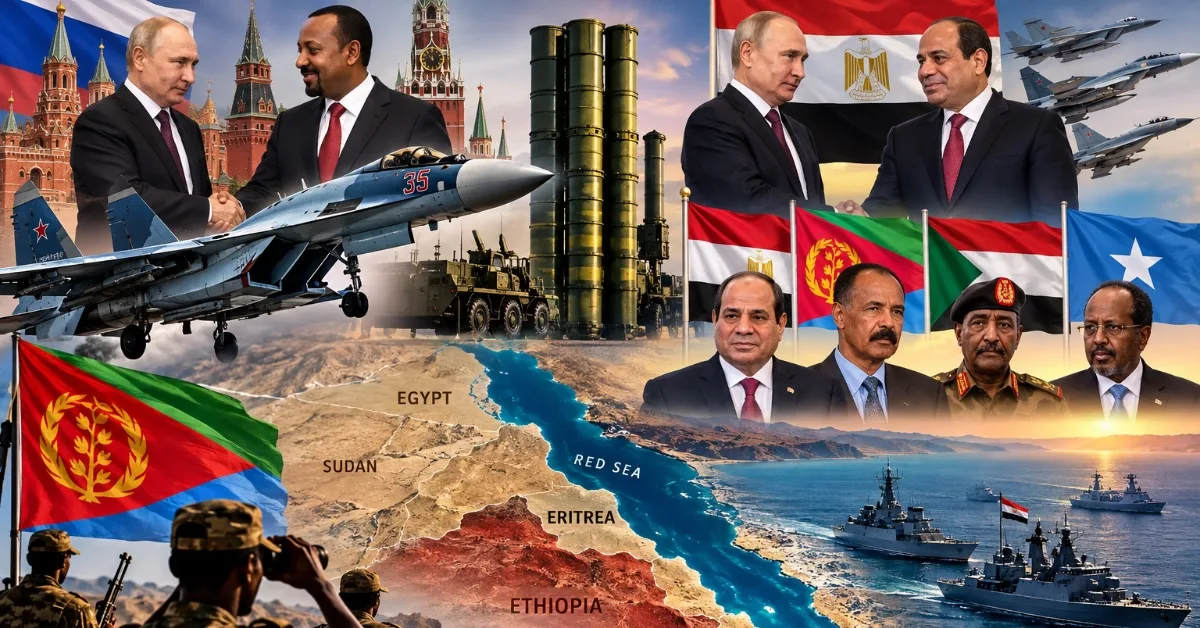
During the Russia–Africa Summit in Moscow, Ethiopian Prime Minister Abiy Ahmed announced that his government had received 12 advanced Russian Su-35 fighter jets, with four S-400 air-defense batteries expected to follow. The aircraft could strengthen Ethiopia’s capacity to defend strategic installations, including the GERD, against potential aerial threats, while also expanding its military capabilities in the Horn of Africa.
The Su-35 is among Russia’s most advanced operational fighter aircraft, capable of conducting air superiority and ground-attack missions. The S-400, meanwhile, is designed to detect and engage aerial threats at considerable distances. Together, these weapons could substantially strengthen Ethiopia’s military capabilities if they are properly integrated into its existing defense systems. Their effectiveness, however, will depend on maintenance, training, logistical support and the ability to sustain operations over time.
The acquisition also raises questions about Ethiopia’s military priorities at a time when the country continues to struggle with internal armed conflicts, displacement, economic pressures and humanitarian needs. Advanced combat aircraft are not necessarily restricted to external defense operations. They can also be employed in domestic conflicts, making the government’s future use of these weapons an important concern for civilian protection and regional security.
Russia also maintains longstanding military ties with Egypt, including previous sales of MiG-29 fighter aircraft. There are reports of a new Russian fighter-jet agreement with Cairo during the summit.
Moscow’s military relationships with both Ethiopia and Egypt illustrate the complexity of Russia’s growing involvement in African security affairs. Rather than aligning exclusively with one regional power, Russia appears interested in maintaining strategic partnerships across competing political and security interests. For Moscow, these relationships provide opportunities to expand its diplomatic influence, strengthen defense exports and maintain a presence in a region linking Africa, the Middle East and international maritime trade.
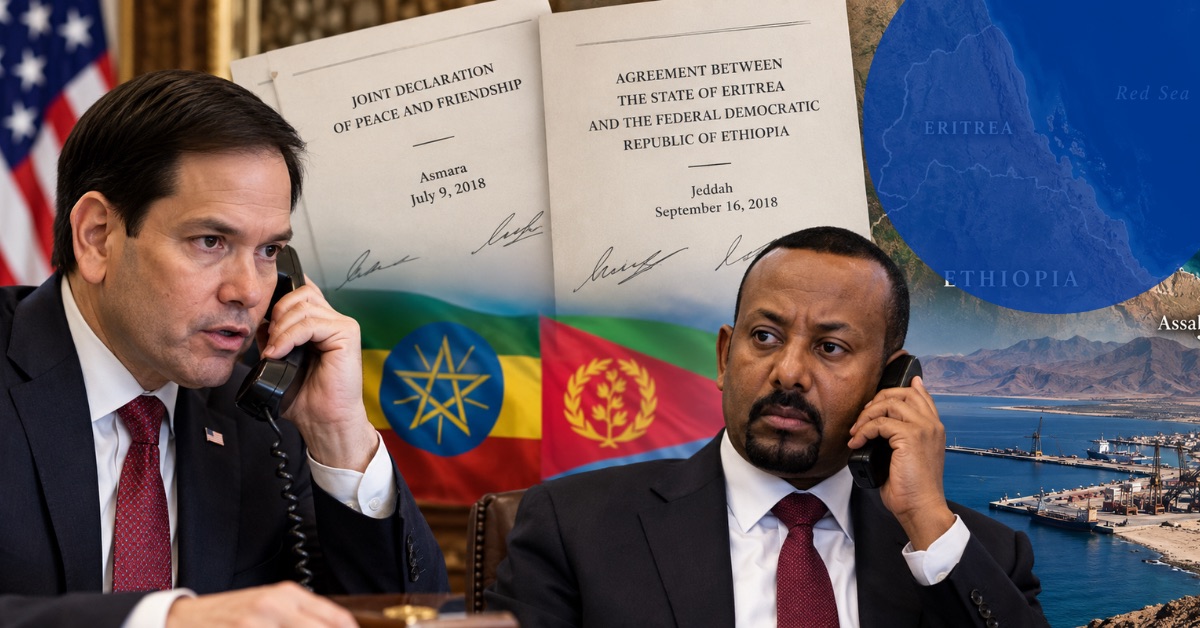
These developments come against the backdrop of two increasingly interconnected disputes: Egypt’s longstanding disagreement with Ethiopia over Nile waters and the GERD, and Ethiopia’s renewed pursuit of access to the Red Sea, particularly its strategic interest in Eritrea’s port of Assab.
Although the Nile and Red Sea disputes involve different legal and political questions, both have become central to the regional security calculations of Ethiopia and Egypt. Cairo considers the Nile essential to its national security and economic survival, while Addis Ababa regards the GERD as a symbol of national development and energy independence. Ethiopia’s maritime ambitions have introduced another dimension to these disagreements, particularly as Egyptian and Eritrean strategic interests increasingly overlap.
Ethiopia’s desire for reliable and affordable commercial access to the sea is understandable for a large landlocked economy. However, commercial maritime access and sovereign control over another country’s coastline are fundamentally different matters. Internationally recognized borders cannot be altered simply because one country considers another country’s territory strategically or economically valuable. Eritrea’s ports, including Assab and Massawa, remain under Eritrean sovereignty, and any future arrangement involving their use must be based on voluntary agreements and mutual respect.
Meanwhile, a potentially significant counterweight to Ethiopia’s maritime ambitions is emerging among Red Sea coastal states.
Egypt, Eritrea, Sudan and Somalia have reaffirmed their commitment to sovereignty, territorial integrity and regional security. Their October 4 El Alamein Declaration emphasized the responsibility of coastal states for Red Sea governance. Egypt has explicitly rejected military access for non-coastal countries while recognizing their right to pursue commercial access through negotiated agreements.
This distinction is important because Red Sea governance involves responsibilities that go beyond the use of commercial ports. Coastal states are responsible for protecting their territorial waters, maintaining maritime security, managing coastal resources and cooperating on threats affecting international navigation. Ethiopia’s commercial interests do not automatically confer the same rights and responsibilities enjoyed by states possessing sovereign coastlines along the Red Sea.
A coordinated regional security arrangement could substantially increase the diplomatic and military costs of any Ethiopian attempt to obtain Red Sea territory through coercion or force.
Such coordination could also encourage a more predictable regional security environment by establishing common positions on maritime safety, territorial integrity and the peaceful resolution of disputes. Diplomatic cooperation does not necessarily require the creation of a formal military alliance. Even regular consultations, intelligence exchanges, joint maritime-security planning and coordinated diplomatic responses could strengthen the ability of coastal states to address shared concerns.
Reports have also emerged of expanding Egyptian military cooperation with Eritrea. Regional reporting indicates that Egypt has pursued arrangements to develop Eritrean port facilities, including Assab, and accommodate visiting Egyptian naval vessels. There are also unconfirmed claims that Egypt is supplying Eritrea with sophisticated military equipment and that Egyptian warships are operating near Assab. These specific claims require independent verification.
The strategic importance of Eritrea to Egypt is closely connected to geography. Eritrea occupies a substantial stretch of the western Red Sea coast and possesses numerous islands, including the Dahlak Archipelago. Its position near the Bab el-Mandeb Strait makes it an important country in the security of maritime routes connecting the Suez Canal with the Gulf of Aden and the Indian Ocean.
For Egypt, the security of the Red Sea is directly linked to the Suez Canal, a vital source of national revenue and one of the world’s busiest shipping routes. Disruptions to maritime traffic in the southern Red Sea can have consequences far beyond the immediate conflict areas, affecting global commerce, energy transportation and shipping costs. This provides Cairo with a strong strategic interest in maintaining stable relations with Eritrea and other coastal countries.
For Eritrea, expanding cooperation with Egypt could strengthen maritime surveillance, military training, logistical capabilities and diplomatic coordination. However, such partnerships are most beneficial when they complement Eritrea’s own national defense capabilities and preserve its independent decision-making. Eritrea’s geographical position is a permanent strategic asset, and its value should be developed in ways that strengthen the country’s long-term sovereignty, economic independence and security.
Saudi Arabia represents another important factor in the emerging regional balance. Riyadh has longstanding security and diplomatic relations with Eritrea and other Red Sea countries. It also played a prominent role in the 2018 Eritrea–Ethiopia rapprochement and has promoted broader maritime security cooperation, including the eight-country Red Sea Council established in 2020.
Saudi Arabia’s interest in Red Sea stability is driven by its economic development, maritime trade, energy infrastructure and broader national security considerations. As the kingdom continues developing major commercial and tourism projects along its western coastline, the safety of Red Sea shipping lanes has become increasingly important. Cooperation with African coastal states is therefore a practical strategic necessity rather than simply a diplomatic preference.
Together, these relationships could create a powerful diplomatic deterrent against territorial aggression, although they do not yet constitute a verified collective-defense alliance directed against Ethiopia.
The emerging partnerships also suggest that Eritrea is not diplomatically isolated in matters concerning Red Sea security. Its relations with Egypt, Saudi Arabia and other regional countries provide opportunities to advance common interests without compromising its independent foreign policy. However, Eritrea’s strongest foundation remains its own national resilience, institutional capacity and ability to defend its territorial integrity.
But history offers a particularly important lesson about the limits of military superiority.
During Eritrea’s three-decade struggle for independence, the Soviet Union—Russia’s predecessor—was the principal supplier of sophisticated weapons to Ethiopia’s military government. Soviet tanks, fighter aircraft, artillery, and military advisers supported one of Africa’s most heavily equipped armies.
The Ethiopian military government received extensive Soviet assistance intended to strengthen its conventional military superiority over Eritrean liberation forces. The weapons included armored vehicles, combat aircraft, artillery systems and other modern equipment that placed considerable destructive power in the hands of Ethiopia’s armed forces.
Yet overwhelming military equipment failed to defeat the Eritrean People’s Liberation Front (EPLF).
In March 1988, during the historic Battle of Afabet, also known as Operation Nadew, EPLF fighters crushed Ethiopia’s heavily fortified Nadew Command, destroyed or captured substantial quantities of Soviet-supplied weaponry and captured Soviet military officers. The Soviet government subsequently acknowledged that three of its military advisers had been taken prisoner.
The battle demonstrated the limits of technological superiority when confronted by a determined, organized and strategically capable liberation movement. Despite possessing substantially greater conventional firepower, Ethiopia’s military was unable to overcome the EPLF’s battlefield planning, mobility, discipline and ability to exploit weaknesses in opposing forces.
The victory marked a decisive turning point in Eritrea’s liberation struggle, paving the way for the EPLF’s final military victory in May 1991 and Eritrea’s internationally recognized independence in 1993.
Today, nearly four decades after Operation Nadew, Russian fighter jets are once again strengthening Ethiopia’s military. But Eritrea’s history demonstrates that sophisticated foreign weaponry alone cannot guarantee military victory.
The historical comparison does not suggest that modern military technology is irrelevant or that the outcome of any future conflict is predetermined. Rather, it reinforces a broader principle: military strength depends on more than equipment. Effective leadership, national unity, logistical sustainability, strategic planning and the legitimacy of political objectives remain essential factors in determining whether military power achieves its intended results.
It also raises a question about the lessons Ethiopia’s leadership has drawn from the country’s own history. Ethiopia has repeatedly invested substantial resources in military capabilities, yet many of its most serious national challenges have been political rather than technological. Advanced weapons may strengthen the armed forces, but they cannot independently resolve domestic political divisions or replace the need for peaceful relations with neighboring countries.
As regional alliances evolve and tensions intensify, the central question remains whether Ethiopia will pursue its maritime ambitions through peaceful negotiation, or whether the Horn of Africa risks another devastating confrontation.
A new conflict between Ethiopia and Eritrea would have consequences extending far beyond their shared border. It could disrupt regional trade, deepen existing humanitarian difficulties, threaten investment and create additional instability across the Red Sea corridor. Countries already confronting internal conflicts and economic hardship would face further pressure, while civilians would once again bear the greatest costs.
The alternative remains diplomacy grounded in clearly established principles. Ethiopia can pursue commercial access to regional ports through negotiated transit arrangements, infrastructure partnerships and mutually beneficial economic agreements. Eritrea and other coastal states can pursue such cooperation when it serves their national interests, without surrendering sovereign authority over their territories.
For Eritrea and its Red Sea partners, the strategic message is increasingly clear: regional security must be built on respect for sovereignty, territorial integrity, and internationally recognized borders, not military coercion.
Ultimately, the security of the Red Sea depends not on which country possesses the most advanced weapons, but on whether regional governments respect the sovereignty of their neighbors and recognize that lasting stability cannot be achieved through territorial ambition.