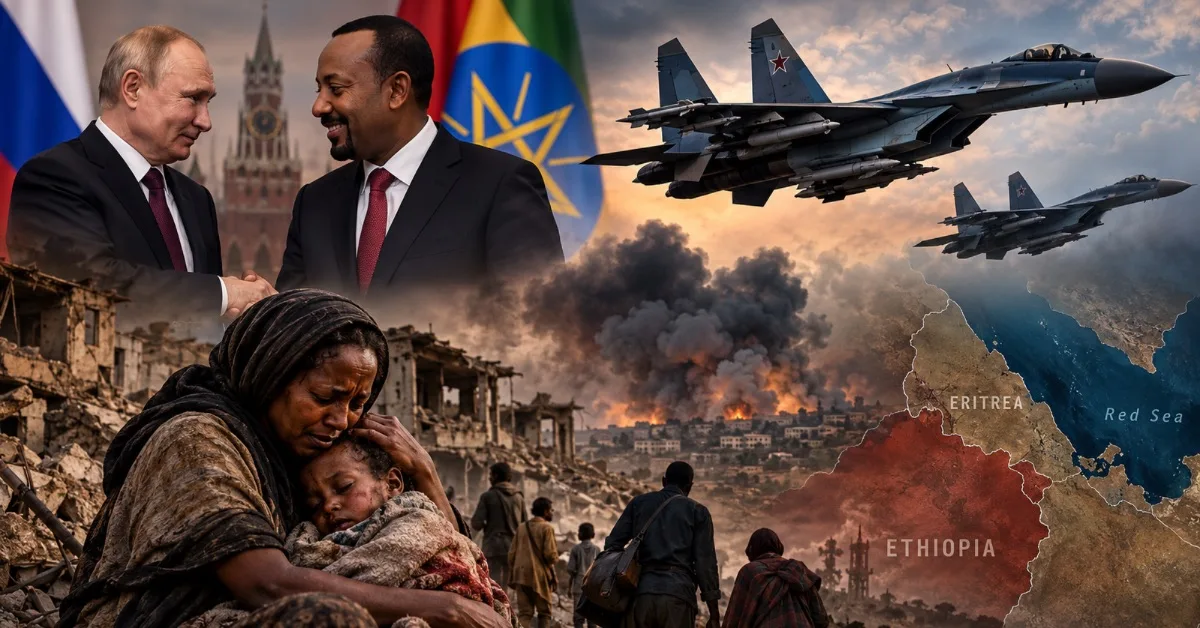
When Ethiopian Prime Minister Abiy Ahmed celebrated the acquisition of Russian Su-35 fighter jets in Moscow this week, he presented the development as a milestone in strengthening his country’s national security. The agreement, covering twelve advanced fighters and four S-400 air-defence batteries, was announced against the backdrop of renewed warfare in northern Ethiopia, continuing conflict in Amhara and growing tensions with Eritrea. Yet the discussion surrounding these weapons has largely concentrated on their potential implications for a future confrontation between Ethiopia and Eritrea. That is an important concern, but it overlooks another equally troubling possibility: the aircraft could eventually be used in Ethiopia’s internal conflicts, where government air operations have already caused substantial civilian casualties. For communities that have endured years of aerial attacks, military modernisation may not necessarily represent greater security. It may instead raise fears of further destruction.
This concern is grounded in documented experience rather than speculation alone. The United Nations Office of the High Commissioner for Human Rights reported that Ethiopian military drone strikes killed 248 civilians and injured another 55 in Amhara between August and December 2023. Human Rights Watch has documented additional attacks, including strikes that killed children and other civilians in 2024 and 2025. These findings demonstrate that civilian harm from Ethiopian government air operations is not an isolated allegation. They also expose serious questions about military targeting procedures, accountability and compliance with international humanitarian law. The newly acquired Su-35 fighters are different weapons from the drones used in those documented attacks, and there is no verified evidence that these particular aircraft have been deployed against Ethiopian civilians. Nevertheless, the historical record provides reasonable grounds to scrutinise how the government might use its expanded air capabilities.
The distinction between fighting armed opponents and protecting civilians is essential. Ethiopia’s government has a legitimate responsibility to maintain security and respond to armed threats, just as opposition forces are required to respect the laws of war. But that responsibility does not permit indiscriminate attacks, collective punishment or treating populations in contested territories as legitimate military targets. In Amhara, Tigray and other conflict-affected regions, communities have suffered from violence involving state forces and non-state armed groups. The government’s air operations deserve particular scrutiny because of the destructive power of the weapons involved and the state’s responsibility for their deployment. Advanced fighter jets can provide greater range, speed and precision, depending on their configuration and use. None of those technical capabilities, however, guarantees responsible targeting. The decisive issue is whether commanders distinguish combatants from civilians, observe the principles of necessity and proportionality, and investigate credible allegations of unlawful attacks.
For Russia, the implications extend well beyond a commercial defence agreement. Supplying advanced combat aircraft to a government with a documented history of civilian casualties associated with its air operations creates a responsibility to assess the risks of misuse. Moscow is entitled to maintain diplomatic and defence relationships with Ethiopia, but arms transfers cannot be evaluated solely through military cooperation or strategic influence. The relevant questions concern whether credible human rights assessments were undertaken, what safeguards exist against unlawful use and what consequences would follow if transferred equipment were implicated in serious violations. These questions are particularly pressing because Russia has simultaneously expressed an interest in facilitating dialogue between Ethiopia and Eritrea. A government seeking diplomatic credibility in the Horn of Africa must take seriously the human consequences of the military capabilities it helps introduce into an unstable region. Commercial interests and security partnerships do not eliminate the obligations of international humanitarian law.
Ethiopia’s military expansion also raises a question about national priorities. Years of warfare have damaged infrastructure, displaced communities and placed enormous strain on public finances. The renewed conflict in Tigray and continuing insecurity in Amhara demonstrate that the country’s political disputes remain unresolved. Acquiring sophisticated aircraft may strengthen the government’s capacity to conduct military operations, but it does not necessarily address the grievances underlying those conflicts. If expanded military capabilities are accompanied by insufficient political dialogue and inadequate civilian safeguards, the result could be further escalation rather than lasting stability. The cost would fall not only on combatants but also on ordinary Ethiopian families whose lives have already been disrupted by war. Genuine national security must ultimately be measured by the protection of citizens, not simply by the technological sophistication of the weapons available to the state.
Eritrea has its own reasons to examine these developments carefully. Ethiopia’s repeated assertions concerning sovereign access to the Red Sea have contributed to a serious deterioration in bilateral relations since October 2023. Against this political background, the acquisition of advanced Russian aircraft and air-defence systems has implications for the military balance between the two countries. Yet Eritrea’s legitimate security concerns should not overshadow the suffering of Ethiopian civilians. Indeed, the two issues are connected through the broader danger of resolving political disputes through military force. Eritrea must defend its internationally recognised territory while recognising that a stable Ethiopia, governed through peaceful political competition and respect for civilian life, would offer better prospects for regional security than another devastating war. Defending Eritrean sovereignty and expressing solidarity with Ethiopian civilians are not competing positions.
Moscow’s diplomatic balancing act therefore faces a test. It is strengthening Ethiopia’s military capabilities while offering to help manage tensions that could ultimately involve those same capabilities. Whether Russia can reconcile these interests remains uncertain. Ethiopia, meanwhile, has described the acquisition as a measure intended to deter aggression, and no evidence currently establishes that the Su-35s will be used against political opponents or civilian communities. The danger should nevertheless be evaluated against documented military practices rather than official assurances alone. Responsible diplomacy requires greater transparency regarding arms transfers, credible investigations into civilian casualties and meaningful pressure on all parties to observe humanitarian law.
Ultimately, the significance of the Russian aircraft agreement cannot be measured only through the number of fighter jets delivered or their technological specifications. Its importance lies in the political and military environment into which these weapons are being introduced. Ethiopia faces unresolved domestic conflicts, a painful record of civilian casualties and deteriorating relations with Eritrea. These circumstances demand restraint, accountability and political solutions rather than the assumption that more sophisticated weapons will produce lasting security. For Eritrea, the priority remains safeguarding national sovereignty without inviting another regional war. For Ethiopian civilians, the most urgent concern is whether their government will protect them from further violence. And for Russia, the central question is whether its expanding influence will contribute to durable peace or expose it to responsibility for foreseeable risks associated with the weapons it supplies. The true measure of security in the Horn of Africa should not be how effectively governments acquire weapons, but how reliably they protect the lives and sovereignty they claim to defend.