

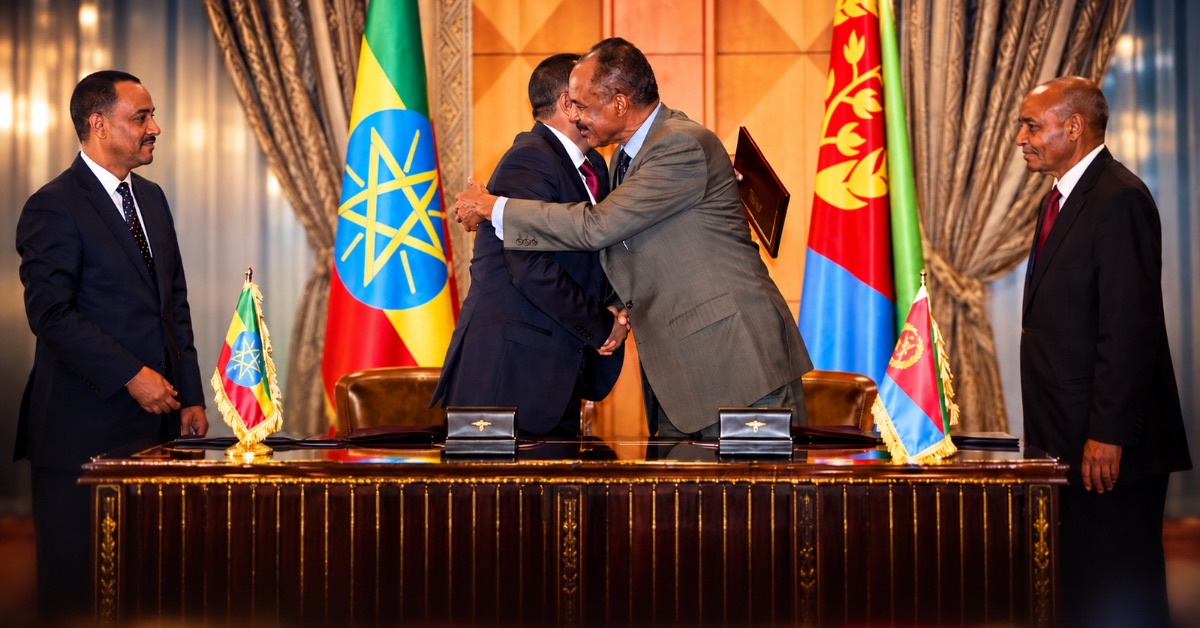
In July 2018, Ethiopian Prime Minister Abiy Ahmed arrived in Asmara promising a new chapter in relations between Eritrea and Ethiopia. The visit was historic. After two decades of hostility, the leaders of the two countries shook hands, embraced peace and signed an agreement that was supposed to put their troubled past behind them.
Two months later, they met again in Jeddah and reaffirmed their commitment to peace, sovereignty and respect for internationally recognized borders.
Eight years later, the optimism that accompanied those agreements has largely disappeared. Ethiopia is once again embroiled in war, relations with Eritrea have deteriorated, and Abiy Ahmed’s pursuit of sovereign access to the Red Sea has become a major source of regional tension.
For Eritreans, the contradiction is difficult to ignore. The same Ethiopian prime minister who recognized Eritrea’s territorial integrity in 2018 is now making maritime sovereignty a central issue in Ethiopia’s national political agenda.
What happened to the commitments made in Asmara and Jeddah?
The Promise Made in Asmara
The Joint Declaration of Peace and Friendship, signed on July 9, 2018, was supposed to mark the beginning of a fundamentally different relationship.
Its first provision declared:
“The state of war between Ethiopia and Eritrea has come to an end.”
The declaration went beyond ending hostilities. Its fourth provision committed both countries to implementing the decision concerning their common boundary.
That commitment was particularly important to Eritrea. The Eritrea-Ethiopia Boundary Commission had already issued its final and binding decision in April 2002, following the Algiers Agreement that ended the 1998–2000 border war.
The dispute was therefore not awaiting another political settlement. A binding international decision already existed.
By signing the Asmara Declaration, Abiy Ahmed accepted the framework for implementing that decision. Eritrea, in turn, welcomed reconciliation and supported the restoration of diplomatic relations, transportation links and economic cooperation.
The expectation was simple. Both countries would move forward as independent states, respecting each other’s sovereignty and established borders.
Eritrea was not offering territory in exchange for peace. It was offering cooperation based on mutual recognition.
Jeddah Left Little Room for Misinterpretation
On September 16, 2018, President Isaias Afwerki and Prime Minister Abiy Ahmed signed the Agreement on Peace, Friendship and Comprehensive Cooperation in Jeddah.
Its preamble recognized the importance of mutual respect for independence, sovereignty and territorial integrity.
Article Four reaffirmed the commitment to implement the Boundary Commission decision. Articles Two and Three provided for cooperation in security, defense, trade, investment and joint development projects.
These provisions offered a practical path forward.
Ethiopia could benefit from economic cooperation with Eritrea, including opportunities involving ports, transportation and trade. Eritrea could benefit from expanded regional commerce and investment. Neither country needed to surrender its independence or sovereign territory for those opportunities to materialize.
There was no provision transferring Eritrean land, coastline or maritime sovereignty to Ethiopia.
That is what makes Ethiopia’s current pursuit of sovereign access to the Red Sea so troubling.
Economic Need Does Not Create Territorial Rights
Since 2023, Abiy Ahmed has repeatedly argued that access to the Red Sea is essential to Ethiopia’s future. He has invoked the country’s population, economic needs, history and strategic interests.
Ethiopia’s dependence on foreign ports is a genuine economic concern. No reasonable argument denies that landlocked countries need reliable access to international trade.
But there is a clear difference between access to a port and sovereignty over the territory on which that port stands.
Ethiopia can negotiate commercial access. It can establish long-term transit agreements, invest in infrastructure and pursue mutually beneficial partnerships with coastal neighbors.
What it cannot do is turn its economic requirements into territorial rights over another independent country.
Eritrea’s independence is not conditional on Ethiopia’s development needs. Its coastline is not disputed property waiting to be reassigned. Its sovereignty cannot be reconsidered every time political priorities change in Addis Ababa.
Abiy Ahmed has maintained that Ethiopia prefers peaceful negotiations. That position should be acknowledged. But his government’s repeated emphasis on sovereign maritime access, against the background of deteriorating relations and renewed military tensions, has understandably raised alarm in Eritrea.
If the objective is commercial access, diplomacy offers many possibilities. If the objective is sovereign territory, Ethiopia must explain how that ambition can be reconciled with the agreements it signed in 2018.
A Dangerous Moment for Eritrea
The renewed fighting in northern Ethiopia has made this question more urgent.
During October 2026, Ethiopia accused Eritrea of conducting military operations inside Tigray. Eritrea disputed accusations of aggression and raised its own concerns about threats to its sovereignty.
Reports of cross-border military activity and drone strikes have heightened fears that Ethiopia’s internal conflict could develop into a wider confrontation.
The competing accounts of military operations require independent examination. But Eritrea has every reason to take the regional deterioration seriously.
The country’s security cannot depend on assurances that are contradicted by hostile rhetoric or military developments.
At the same time, Eritrea’s interests are not served by becoming unnecessarily entangled in Ethiopia’s internal wars. Its priority must remain protecting its borders, its people and its independence.
Article 2(4) of the United Nations Charter prohibits threats or the use of force against another state’s territorial integrity. Article 51 recognizes the right of self-defense when an armed attack occurs, subject to the applicable requirements of international law.
Eritrea has every right to maintain credible defenses and prepare for genuine threats. Exercising that right responsibly requires strategic discipline, a clear understanding of the facts and a determination to avoid unnecessary war.
Restraint is valuable, but restraint alone cannot guarantee security.
The Agreements Must Mean Something
The international community should not treat the present confrontation as though Eritrea’s borders remain open for negotiation.
The Boundary Commission delivered its decision. Ethiopia committed itself to implementation. Abiy Ahmed signed two agreements recognizing the principles upon which peaceful relations were supposed to rest.
Those commitments matter.
The African Union, United Nations and governments seeking to prevent another regional war should insist on respect for sovereignty and established boundaries. They should also examine allegations of aggression impartially and encourage both countries to avoid further escalation.
Ethiopia’s maritime needs can be addressed through negotiations. They cannot be used to justify coercion or territorial acquisition.
For Eritrea, defending sovereignty should go hand in hand with protecting the possibility of peace. The two are not contradictory. A lasting peace is possible only when neither country fears that its independence or territorial integrity will be challenged.
Peace Was Never a Territorial Concession
Eritrea paid an extraordinary price for its independence. That independence was achieved through decades of struggle, affirmed through a referendum and recognized internationally.
It is not a historical mistake to be corrected, nor is it an obstacle to Ethiopia’s future that must somehow be removed.
In 2018, Eritrea welcomed Abiy Ahmed’s peace initiative because reconciliation offered a better future for both peoples. That decision reflected a willingness to move beyond hostility, not an acceptance that Eritrea’s sovereignty could one day become negotiable.
The agreements signed in Asmara and Jeddah remain an important test of political credibility. They established the principles necessary for peaceful coexistence. Those principles cannot be honored selectively.
Eritrea must remain vigilant, united and prepared to defend its independence while avoiding a war that would bring further suffering to the region.
Abiy Ahmed came to Asmara promising peace. He went to Jeddah and reaffirmed respect for sovereignty. Eritrea has every right to expect those promises to be honored.
Eritrea extended its hand in friendship, not its coastline for bargaining.
Its restraint must never be mistaken for weakness.

