
Ethiopian Prime Minister Abiy Ahmed keeps returning to the Red Sea, presenting Ethiopia’s landlocked status as though it were a historical injustice committed against his country. His argument rests on the idea that Ethiopia lost something that rightfully belonged to it when Eritrea broke away in 1991. It is a convenient story, particularly at a time when Ethiopia is facing serious internal problems. But history, especially the kind preserved in official diplomatic archives, tells a rather different story.
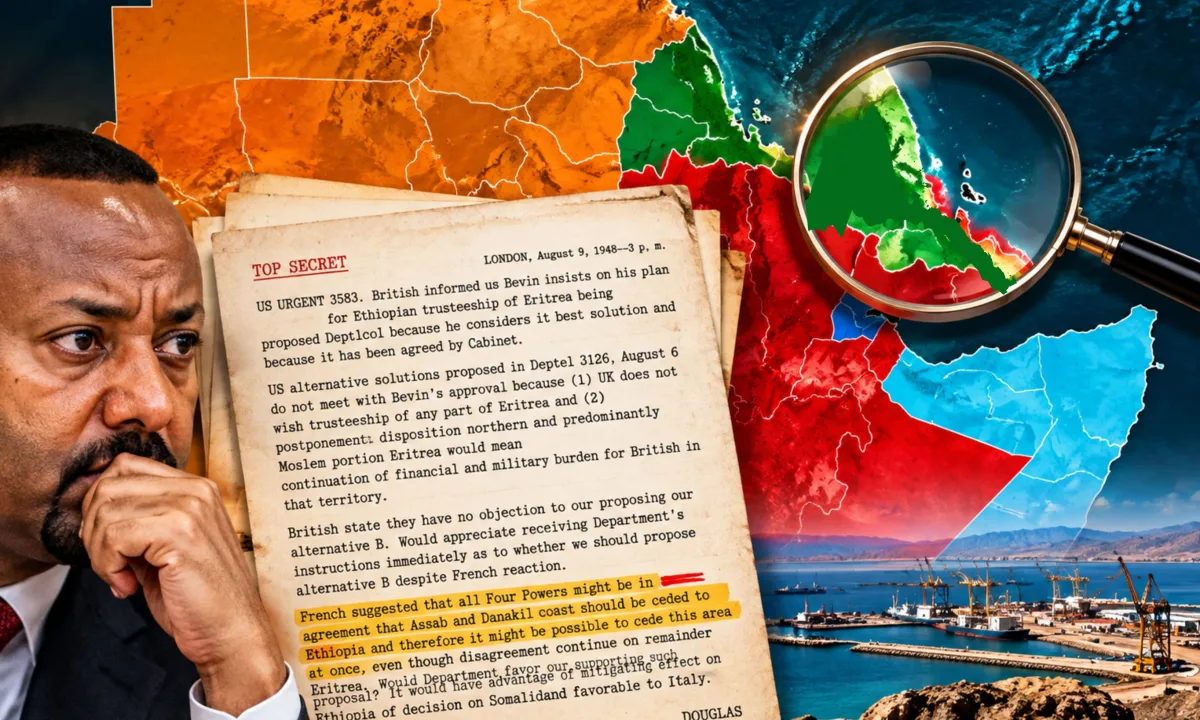
An American diplomatic telegram from August 9, 1948, raises a simple question that deserves an answer from those who insist Assab was historically Ethiopian territory. If Assab already belonged to Ethiopia, why were the United States, Britain, France and the Soviet Union discussing whether it should be given to Ethiopia?
The document is not an Eritrean political statement. It is not liberation-era propaganda. It is an official American diplomatic record, written decades before Eritrea’s independence.
What Washington Was Discussing in 1948
On August 9, 1948, Lewis Douglas, the American ambassador in London, sent a top-secret telegram to Washington concerning the future of Eritrea, then under British military administration following Italy’s defeat in World War II.
The telegram recorded a French suggestion that Assab and the Danakil coast should be ceded to Ethiopia. Douglas asked Washington whether the United States should support that proposal.
That single word, ceded, matters.
You cannot reasonably describe a proposal to transfer territory to another state as proof that the receiving state already owned it. The four powers were discussing Assab as part of the unresolved future of Eritrea, not as an Ethiopian possession that simply needed to be returned.
There was another revealing detail. The proposed transfer was linked to diplomatic bargaining over Somaliland. Eritrean territory was being discussed as something that could help satisfy Ethiopia in exchange for concessions elsewhere.
And where were Eritreans in these discussions? That is perhaps the most troubling part of this history. Foreign governments were debating the future of an entire country without giving its people the decisive voice.
The document does not establish every detail of Assab’s distant past. But it provides clear evidence that, in 1948, the international powers did not regard Assab as already belonging to Ethiopia.
Eritrea Was a Separate Territorial Entity
Assab did not suddenly appear on the map in 1991. Its documented modern history stretches back well before Ethiopia’s administration of the port.
In 1869, Italian representative Giuseppe Sapeto negotiated an agreement concerning Assab with local Afar rulers. Italy later established formal colonial possession in 1882. When Eritrea was proclaimed an Italian colony in 1890, Assab formed part of it.
This colonial history should not be confused with an endorsement of colonialism. Nor should it erase the history and rights of the Afar communities who lived along the coast. The important point is that modern Eritrea developed as a distinct territorial entity, with its own borders and political history.
After World War II, Eritrea came under British administration. In 1950, the United Nations adopted Resolution 390 A(V), establishing Eritrea as an autonomous unit federated with Ethiopia under the Ethiopian Crown.
Notice what the resolution actually did. It established a federation. It did not declare that Eritrea had always been an ordinary province of Ethiopia. Eritrea was recognized as having separate institutions and domestic autonomy, even though significant powers remained with the federal government.
In 1962, Emperor Haile Selassie’s government dismantled that arrangement and annexed Eritrea. By then, the struggle for Eritrean independence had already begun.
These facts are not obscure historical interpretations. They are recorded in international documents.
What Really Happened in 1991?
Abiy Ahmed’s account becomes particularly questionable when he presents 1991 as the year Ethiopia was deprived of its coastline.
What happened in 1991 was the defeat of Ethiopian military rule in Eritrea after thirty years of liberation struggle. Eritrea subsequently held an internationally observed referendum in 1993, when an overwhelming majority voted for independence.
Ethiopia became landlocked as a consequence of Eritrea becoming an independent sovereign state. That is a geographical and political fact. But it does not mean an independent Ethiopia had previously possessed Assab as its own sovereign territory before Eritrea’s incorporation.
There is something else that rarely receives enough attention in today’s arguments.
Ethiopia continued using Assab after Eritrea became independent.
For several years, Ethiopian imports and exports passed through Assab under commercial arrangements between the two governments. The International Monetary Fund documented those arrangements in 1997.
The major disruption came in 1998, following the outbreak of the border war, when Ethiopia redirected its maritime trade toward Djibouti.
So what exactly was lost in 1991? Ethiopian political and military control over Eritrea ended. But commercial access to Assab did not disappear overnight. Those are two entirely different things, and confusing them distorts the historical record.
What About the 2018 Peace Agreement?
There is another question Abiy Ahmed should answer.
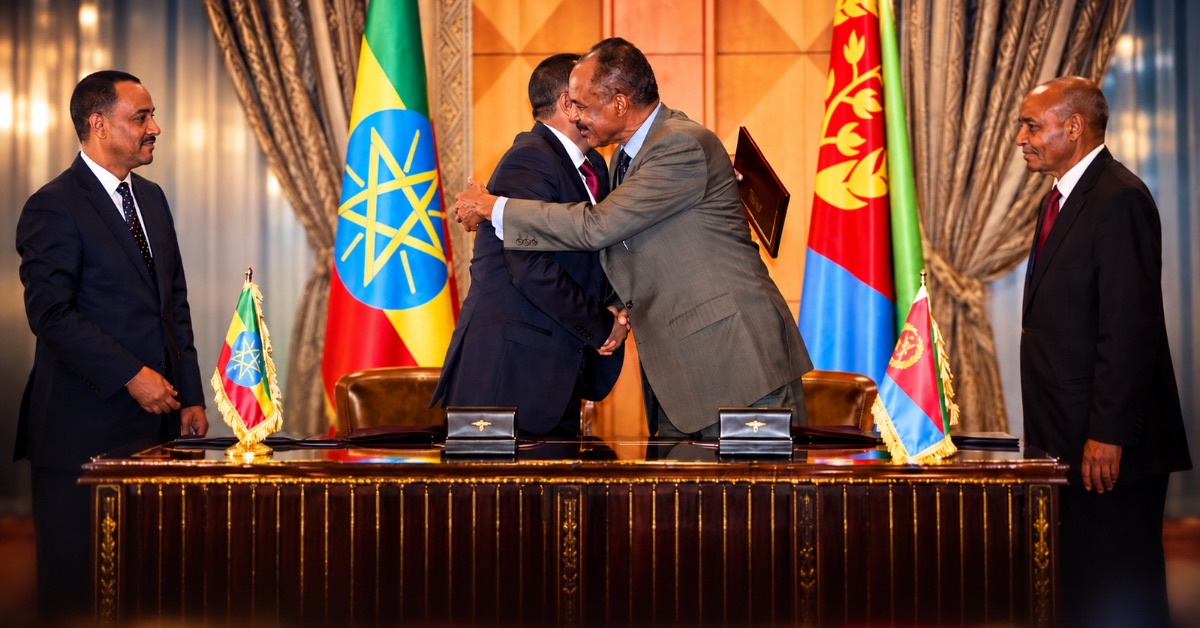
When he traveled to Asmara in July 2018 and signed the Joint Declaration of Peace and Friendship with President Isaias Afwerki, he agreed to a framework of peaceful coexistence, restored economic relations and implementation of the boundary decision between the two countries.
The agreement did not reserve Ethiopian ownership of Assab. It did not authorize Ethiopia to redraw Eritrea’s borders whenever maritime access became politically important.
Instead, it offered an opportunity to rebuild relations on the basis of mutual recognition and cooperation.
Ethiopia is a large country with genuine economic needs. No serious person should dismiss the importance of reliable access to international shipping routes. But those needs can be addressed through agreements with coastal states, as landlocked countries around the world routinely do.
There is a difference between asking a neighbor for access to a port and suggesting that the neighbor’s territory somehow belongs to you.
International law recognizes the transit needs of landlocked states. It does not turn those needs into automatic ownership of another country’s coastline.
History Cannot Be Rewritten
The significance of the 1948 American telegram is not that it resolves every historical argument surrounding Assab. Its value is that it reveals how the territory was viewed before Eritrea’s federation with Ethiopia, before annexation and long before the liberation war reached its conclusion.
Assab was part of the Eritrean territorial question. Its proposed transfer to Ethiopia was being discussed as a political decision, not acknowledged as the restoration of an existing Ethiopian possession.
Today, with tensions again rising between the two countries, that distinction matters more than ever. Historical grievances, real or imagined, should not become excuses for another devastating conflict.
Eritrea’s independence came at an enormous human cost. Its sovereignty is not something to be renegotiated because a neighboring government finds its geography inconvenient.
The question remains remarkably simple: If Assab was already Ethiopia’s, why did Ethiopia need the great powers to consider handing it over in 1948?
Ethiopia has a legitimate interest in reaching the sea. It can negotiate port access, build partnerships and pursue regional trade. None of that requires questioning Eritrea’s territorial integrity.
Abiy Ahmed may argue that Ethiopia lost direct sovereign access to the Red Sea when Eritrea became independent. That is true. But claiming that Eritrea took away territory that had always belonged to Ethiopia is another matter entirely.
Ethiopia did not lose Assab as a separate, pre-existing sovereign possession in 1991. Eritrea regained control of its own territory. And the 1948 American document makes that historical distinction difficult to ignore.