
The message from Washington and London is clear: respect the sovereignty of neighboring countries, honor existing agreements, and prevent another devastating war in the Horn of Africa. For Ethiopia’s Prosperity Party government, this should require no explanation. These are principles Prime Minister Abiy Ahmed personally accepted in 2018 when he signed historic peace agreements with Eritrea in Asmara and Jeddah.
Yet seven years later, the same agreements that helped earn Abiy international recognition and the Nobel Peace Prize are being invoked to prevent another confrontation between the two countries. That contradiction should concern everyone who believes the Horn of Africa deserves a future beyond recurring conflict.
On October 14, U.S. Secretary of State Marco Rubio spoke with Abiy Ahmed about heightened tensions with Eritrea. Washington emphasized de-escalation, respect for sovereignty and territorial integrity, and a return to dialogue under the 2018 peace framework. Britain reinforced those principles, warning against violations of neighboring countries’ borders and urging restraint.
These statements addressed all parties rather than assigning responsibility for disputed military incidents. But their message carries particular weight for Addis Ababa, where the pursuit of sovereign access to the Red Sea has increasingly become a defining political issue.
The fundamental question is simple: What value does a peace agreement have if the government that signed it no longer treats its commitments as binding?
The Promises Made in Asmara and Jeddah
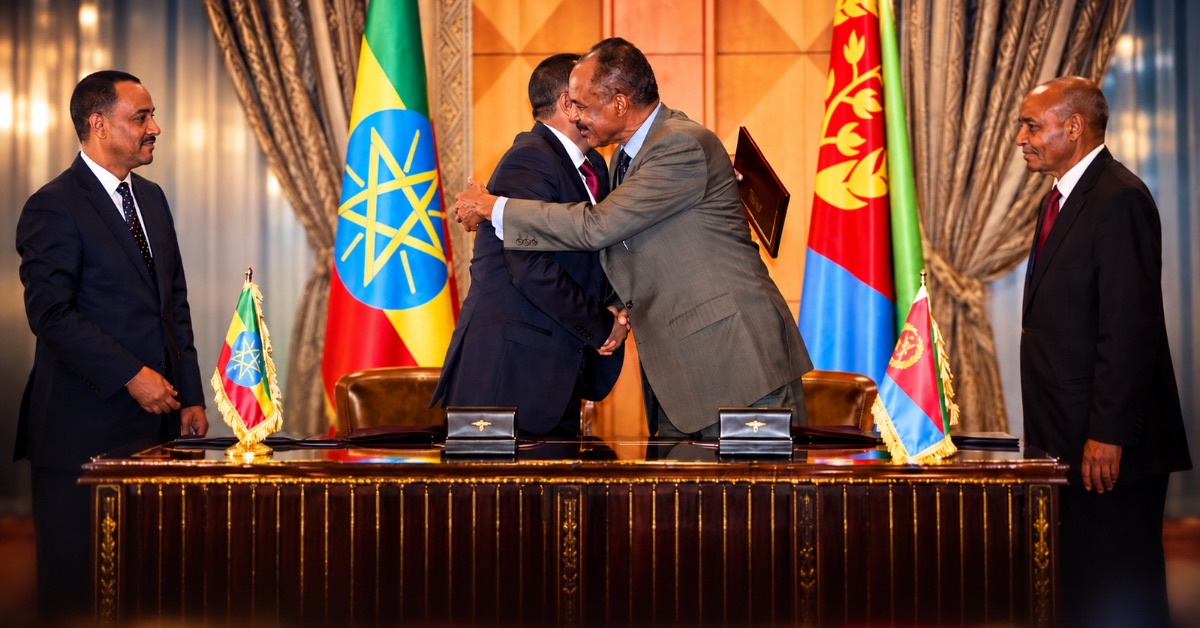
On July 9, 2018, President Isaias Afwerki and Prime Minister Abiy Ahmed signed the Joint Declaration of Peace and Friendship in Asmara. Its opening provision declared the end of the state of war between Eritrea and Ethiopia. The two governments committed themselves to a new relationship based on peace, cooperation and the restoration of political, economic, social and diplomatic ties.
Crucially, the declaration’s fourth provision committed both countries to implementing the decision on their common boundary. That decision had already been rendered by the Eritrea–Ethiopia Boundary Commission under the 2000 Algiers Agreement. It was not an invitation to reopen settled territorial questions.
On September 16, 2018, the two leaders reinforced these commitments through the Agreement on Peace, Friendship and Comprehensive Cooperation in Jeddah. The agreement explicitly recognized mutual respect for independence, sovereignty and territorial integrity. It reaffirmed the end of war, committed the parties to comprehensive economic and security cooperation, and again called for implementation of the boundary decision.
Article Three provided for joint investment projects, including special economic zones, while Article Seven established a high-level joint committee to oversee implementation.
These provisions matter today because they demonstrate that the two countries had already identified a peaceful framework for addressing their shared interests. Borders were to be respected. Economic opportunities were to be pursued through cooperation. Security concerns were to be managed through dialogue rather than confrontation.
The agreements were signed voluntarily, before regional and international witnesses. They cannot be reduced to ceremonial documents whose relevance depends on the political calculations of the moment.
Maritime Ambition Is Not a Claim to Sovereignty
Ethiopia’s renewed pursuit of access to the Red Sea has brought the question of territorial integrity back to the center of regional politics. Since October 2023, Abiy Ahmed has repeatedly described maritime access as an essential national interest, raising legitimate concerns in Eritrea over the implications of that rhetoric.
Ethiopia’s economic need for reliable port access is neither unusual nor unreasonable. Landlocked countries have legitimate interests in securing efficient routes to international markets. But the international legal order makes a clear distinction between commercial maritime access and sovereign ownership of another country’s coastline.
Ethiopia can pursue trade corridors, negotiated port arrangements and joint investment. Indeed, the 2018 agreements provided a foundation for precisely that kind of cooperation. What cannot be justified is the suggestion that economic necessity creates an entitlement to Eritrean territory.
Eritrea’s coastline is not a solution to Ethiopia’s political or economic problems. It is part of Eritrea’s sovereign territory, and its status is not open to unilateral revision.
The Prosperity Party government must recognize that regional cooperation is possible only when the independence and territorial integrity of neighboring states are respected. No durable economic partnership can emerge under the shadow of territorial threats.
Allegations Must Not Become a Path to War
The renewed fighting in northern Ethiopia has further complicated an already dangerous situation. Addis Ababa has accused Eritrea of military involvement and cross-border incursions, while Eritrea has rejected those allegations and warned of a possible Ethiopian attack.
These are serious accusations that demand credible, independent examination. Conflicting battlefield accounts and disputed reports cannot be treated as established facts merely because they are repeated by officials, commentators or media organizations.
Setit Media believes that the same standards of evidence and accountability must apply to all parties. Where violations occur, they should be documented and addressed through appropriate diplomatic and legal mechanisms. Where allegations remain unverified, they must not be used to create public acceptance of another war.
The sovereignty of Ethiopia deserves respect, just as Eritrea’s sovereignty does. Neither country’s security concerns grant it unrestricted authority to use force beyond its borders.
There is also a broader responsibility here. Ethiopia’s internal conflicts must not become an excuse for expanding confrontation with its neighbors. The country has already suffered enormously from successive wars, political divisions and humanitarian crises. A new interstate conflict would deepen that suffering and place the wider region at risk.
Eritrea’s Security Cannot Depend on Diplomatic Assurances Alone
The renewed emphasis on the 2018 agreements is welcome, but Eritrea cannot build its security solely on statements issued in foreign capitals. International support for sovereignty and territorial integrity is important, yet history demonstrates that diplomatic concern does not always prevent military aggression.
Eritrea has both the right and responsibility to maintain its defensive readiness. At the same time, national security is best served by avoiding unnecessary involvement in Ethiopia’s internal conflicts and maintaining a clear distinction between legitimate defense and military intervention.
A principled Eritrean position must therefore combine preparedness with diplomatic engagement. Eritrea should continue insisting on implementation of existing agreements, respect for its recognized borders and peaceful resolution of disputes. Its national interests do not require hostility toward the Ethiopian people, whose own aspirations for peace and stability deserve recognition.
The international community, meanwhile, must demonstrate that its renewed attention to the 2018 framework has practical meaning. Reaffirming signed agreements is necessary, but those commitments also require sustained diplomatic engagement and credible efforts to prevent escalation.
The Choice Is Addis Ababa’s
The Asmara and Jeddah agreements were built on a straightforward understanding: Eritrea and Ethiopia would recognize each other’s sovereignty, end their hostility and pursue common interests through cooperation.
Nothing in those agreements granted Ethiopia a claim over Eritrea’s Red Sea coastline. Nothing made respect for territorial integrity conditional on economic circumstances or changing political priorities.
Washington and London have now returned to these established principles. Their message should not be mistaken for a new diplomatic formula. It is a reminder of obligations that already exist.
Prime Minister Abiy Ahmed was celebrated internationally for bringing peace to Eritrea–Ethiopia relations. That achievement cannot remain merely a chapter in his political biography. Its credibility depends on whether the commitments he made continue to guide his government’s conduct.
Setit Media’s position is unequivocal: Eritrea’s sovereignty and territorial integrity must be respected, the 2018 agreements must be honored, and disputes must be resolved without threats or force.
Ethiopia’s future prosperity does not require confrontation with Eritrea. It requires stable relations, peaceful commerce and a genuine commitment to the agreements that made reconciliation possible.
The people of both countries have endured enough war. They deserve leaders who regard peace not as a diplomatic trophy, but as a responsibility.
The signatures remain on the agreements. The obligations remain in force. What is needed now is the political will to honor them.