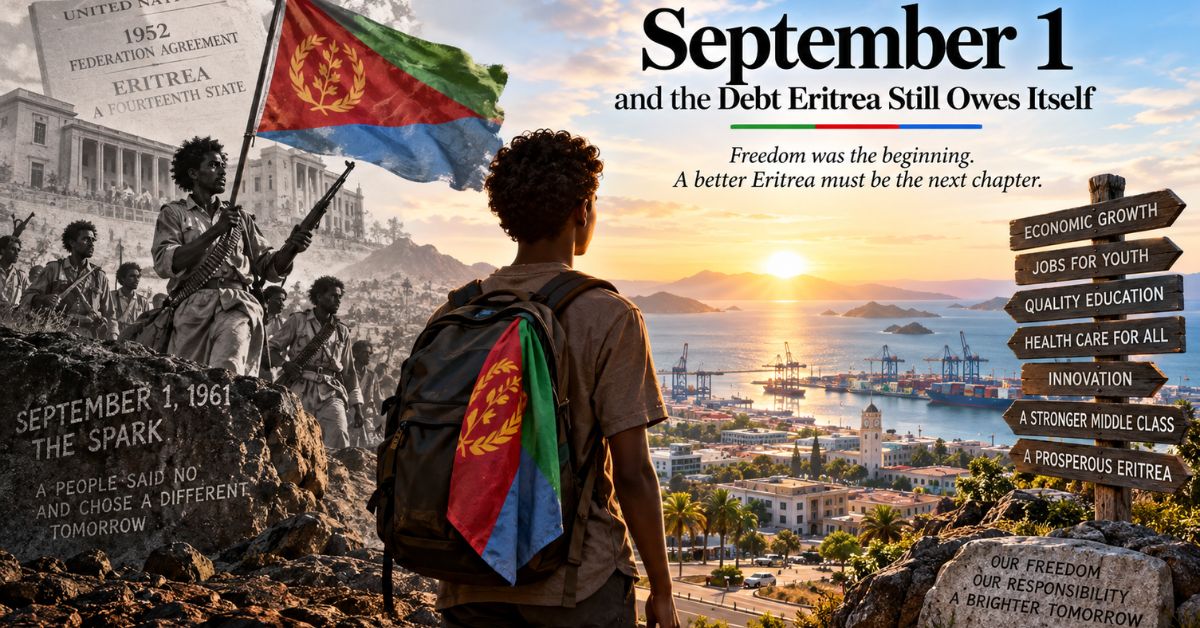
On September 1, 1961, a small group of men decided that the unilateral annexation imposed by Addis Ababa could no longer go unanswered. Nine years earlier, in 1952, the United Nations had sanctioned a federation between Eritrea and Ethiopia, granting Eritrea the status of a fourteenth autonomous state, complete with its own parliament, housed in a building in Asmara that today serves as the Ministry of Education. It was that same parliament that ratified the agreement. It took the emperor, Haile Selassie, only a few years to tear it up, reducing Eritrea to a mere province of the Ethiopian empire. That betrayal, formal before it was ever political, gave birth to the armed revolution.
Every year, on the first day of September, Eritrea marks that spark. It is a different date from May 24, the day independence was finally won in 1991, but it carries no less weight. If May is the finish line, September is the starting point, the moment a people chose to walk toward self-determination, knowing the price would be steep. Thirty years of war, one of the longest and least reported anticolonial conflicts of the twentieth century, produced one of the most successful liberation revolutions on the African continent. That is not a partisan claim. Few African independence movements managed to turn armed struggle into a functioning, internationally recognized state without the collapse that befell so many similar efforts elsewhere.
An Anniversary That Should Question, Not Just Commemorate
But precisely because that victory was real, September cannot be reduced to a ritual of memory. It has to become, as May 24 already partly does, an occasion for a hard accounting. How much progress has been made beyond the achievement of self-determination? How much room has opened up for civil liberties, for economic advancement, for technological progress, for the consolidation of democratic institutions?
No one arguing in good faith expects Eritrea to become the Switzerland of the Horn of Africa within a few decades. The country’s location, in one of the most volatile regions on the planet, wedged between the Red Sea, Sudan, and an Ethiopia that remains an unpredictable and overbearing neighbor, demands realism. But realism cannot become a permanent excuse. We cannot settle for remaining, in too many economic, political, and civic respects, among the last countries in Africa. Sixty-five years after that first of September, and more than three decades after independence, the question is no longer whether Eritrea deserves to exist as a free nation. It has already proven that. The question is what we intend to do, now, with that freedom.
We Do Not Need an Elite That Speaks Down to the People
My hope for this first of September concerns precisely the kind of leadership Eritrea will need in the decades ahead. We do not need a narrow ruling class convinced it must go on reshaping society from above, as though the task of politics, after all this time, were still to educate a people who have already proven, through blood and through decades of struggle, that they know exactly what they want. We do not need a model resembling the one embodied today by the military junta in Burkina Faso under Captain Ibrahim Traore, built on thunderous speeches against colonialism, against imperialism, on slogans that stir a crowd but build nothing lasting. Those rallying cries have a certain rhetorical appeal, but they do not produce a single hospital, a single business, a single stable job.
What Eritrea badly needs is people who are humble and competent, especially in economics and demographics. People who understand that a nation’s demographic and economic health carries the same strategic weight as national security. Devoting a large share of the public budget to defense may, in a difficult regional context, be a hard necessity. But it cannot become the only lens through which the future is viewed. A country that fails to invest just as seriously in its coming generations is like someone sawing through the branch he is sitting on: it secures today’s safety while jeopardizing tomorrow’s economic survival.
Keeping the Young, Not Just Educating Them
Nothing matters more, and nothing is more urgent, than the young. Career paths need to diversify, and conditions for students need to improve in real terms, so that after finishing their education they can choose to stay in their own country. A share of emigration, even a small one, is natural and happens in every nation on earth, for reasons ranging from personal ambition to simple curiosity about life elsewhere. But Eritrea’s problem is not that small percentage who leave by choice. It is the eighty or ninety percent who ought to be able to stay and who, too often today, cannot find the conditions to do so.
That silent majority needs real economic opportunity: building businesses, growing a middle class that remains far too thin, constructing infrastructure that genuinely supports growth, delivering a health care system worthy of the taxpayers who fund it, founding autonomous universities capable of producing basic and applied research, not merely diplomas.
A Geography Worth Turning Into an Advantage
There is also a dimension too often overlooked: Eritrea’s location on the Red Sea, its favorable climate, and its position at a crossroads between Africa, the Middle East, and Europe represent an enormous competitive advantage that remains largely untapped. The country could become a hub for the services sector, a natural home for international institutions and companies seeking a reliable African base, whether for the climate, for the services a stable country can offer, or simply for the strategic location itself. The potential for rapid growth is real, not theoretical.
September 1 as a National Emergency, Not Only a Memory
September 1 will always be the date the spark was struck, the day a people said no to an injustice formalized by an emperor who had already signed international agreements and broken them within a few years. That memory deserves respect, and it should be passed down with pride to new generations. But true loyalty to that struggle does not lie in commemoration alone. It lies in asking, with more urgency every year, whether we are honoring that sacrifice in the present as well as in memory.
My hope, then, is simple and demanding at once: that Eritrea’s leadership open itself to this vision, or that civil society, at home and abroad, make this national urgency impossible to ignore. Because independence won in blood cannot be the final milestone for a people who have already proven, once, that they can win against every prediction.