
The wars that have ravaged the Middle East in recent years are producing consequences that extend far beyond the battlefield. Gaza, Lebanon, the Gulf — and now the mounting confrontation between Israel and Iran. Together, they are reshaping a regional balance that had seemed fixed for decades. Against this backdrop, a development is taking shape that until recently would have appeared deeply unlikely: the strategic rapprochement between Saudi Arabia, Turkey, Pakistan, and Egypt.
These are four countries with vastly different histories, frequently diverging interests, and, in some cases, relationships marked by deep-seated rivalry. Yet history rarely moves in straight lines. When the international context shifts, even the most entrenched antagonisms can be set aside. The divisions that once fragmented the Sunni world now appear less consequential than the pressures bearing down from outside.
For a long time, the major regional tensions played out within the Islamic world itself — competition for religious and political leadership, ideological fault lines, and national rivalries all stood in the way of any unified front. Today, however, the center of gravity is shifting. A growing number of governments in the region have come to believe that the defining challenges are no longer primarily about relations between Islamic actors, but about how they position themselves within a rapidly changing international system.
Alongside economic and strategic interests, a symbolic and religious dimension is emerging that cannot be dismissed. For many Sunni-majority countries, the events of recent years have deepened the sense of an external pressure that cuts across traditional intra-Islamic divisions. In this sense, the possible convergence among Saudi Arabia, Turkey, Pakistan, and Egypt is not simply a matter of foreign-policy calculus. It also reflects something deeper: a renewed awareness of belonging to a shared civilizational space.
Israel no longer looks like the strategic partner that some Arab governments had envisioned during the Abraham Accords era. Meanwhile, the United States no longer appears willing or able to serve as the unconditional guarantor of regional order. This transformation is not merely the product of one administration’s choices. It is the outcome of a longer trend, one that began taking shape under Obama and continued, in different forms, through successive presidencies. The gradual reorientation of American strategic attention toward the Indo-Pacific has left a political vacuum in the Middle East that other actors are now moving to fill.
The End of the Abraham Accords Illusion
The Abraham Accords were presented as the foundation of a new regional architecture. The goal was to build a network of economic and infrastructural cooperation linking India, the Arabian Peninsula, Israel, and Europe — a project that promised prosperity, investment, and commercial integration.
Reality, however, has proven more complicated than the blueprints allowed. The conflicts of recent years have called into question many of the premises on which that vision was built. The devastation in Gaza, the deterioration of regional security, and the widening confrontation with Iran have laid bare just how fragile the idea of a Middle East stabilized through Israel’s integration into Arab economic networks always was.
For Riyadh, the problem has become particularly acute. Saudi Arabia is not merely an energy power. It is the custodian of Mecca and Medina, and it occupies a symbolically central position for over one and a half billion Muslims. Any excessive alignment with Israel — especially in the wake of recent developments — risks undermining its legitimacy across the Islamic world.
Other factors have also reshaped Saudi strategic calculations. The grand regional projects conceived in recent years tended to sideline actors who cannot realistically be excluded from any lasting Middle Eastern settlement. Iran, despite its fraught relations with Arab neighbors, remains a regional power with significant military capabilities and an extensive network of alliances. At the same time, China has consolidated its economic and diplomatic presence in the area, cultivating privileged relationships with both Tehran and Islamabad.
The upheaval of recent years has thus produced a conclusion now spreading across many regional capitals: any future order will have to be built by accounting for the interests of all major players, and it cannot rest on arrangements perceived as structures of subordination. It is in this context that the idea of closer cooperation among Saudi Arabia, Turkey, Pakistan, and Egypt is beginning to take shape — a kind of “Mohammed Accord” that, at least in the minds of its proponents, is meant to replace the logic of the Abraham Accords.
The Strategic Weight of the New Quadrilateral
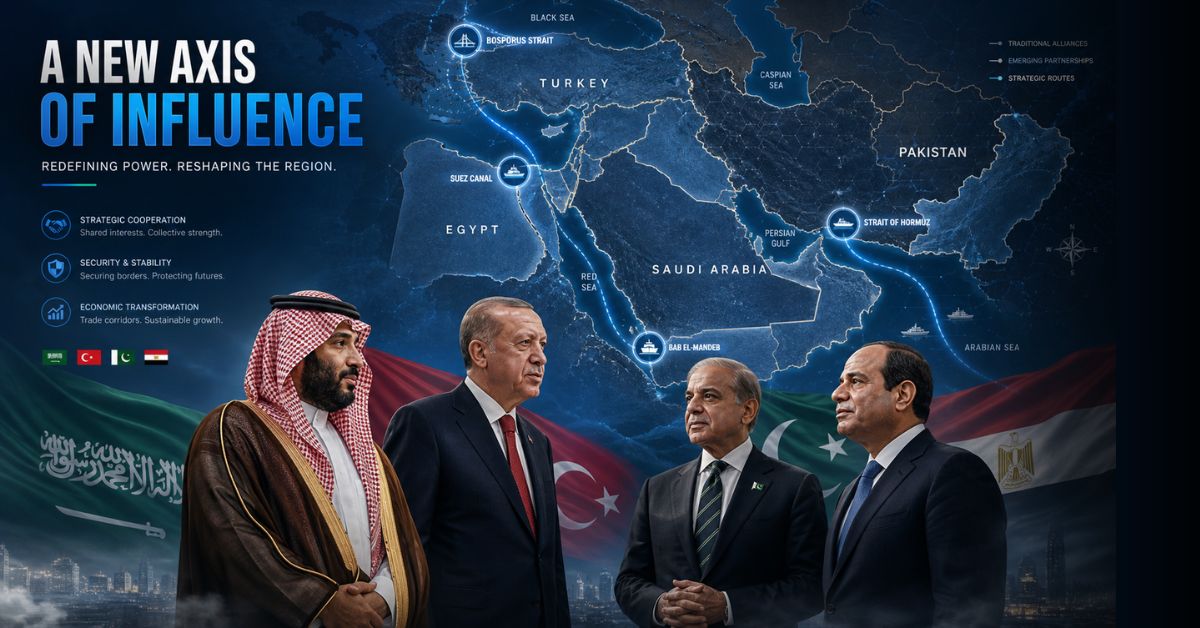
Viewed on a map, this possible convergence is immediately striking. Saudi Arabia, Turkey, Pakistan, and Egypt occupy a singular position at the crossroads of Asia, Africa, and Europe.
Together, they represent roughly half a billion people — a combined population larger than that of the European Union. They bring together economic, energy, and military capabilities that none of the four possesses fully on its own. Saudi Arabia commands vast financial resources and a central role in global energy markets. Pakistan is the group’s sole nuclear power and holds a pivotal position in South Asia. Turkey has a sophisticated industrial base, one of NATO’s largest armies, and a strategic reach extending from the Mediterranean to the Caucasus and Central Asia. Egypt, for its part, remains the Arab world’s principal demographic anchor and controls one of the world’s most critical trade arteries: the Suez Canal.
The group’s geopolitical relevance comes into further relief when one considers the major maritime routes. Through their direct or indirect influence, these four countries sit astride the passages connecting the Mediterranean, the Red Sea, the Persian Gulf, and the Indian Ocean. The Bosphorus, Suez, Bab el-Mandeb, and the Strait of Hormuz are the chokepoints through which a significant share of global trade and worldwide energy supplies must pass.
The diplomatic picture is equally noteworthy. Egypt is already a BRICS member. Saudi Arabia has begun moving closer to the group. Turkey maintains simultaneous relationships with NATO, Russia, and a broad range of Asian actors. Pakistan is deeply embedded in Chinese infrastructure projects while retaining historic ties with the Gulf monarchies.
This breadth of relationships offers a crucial advantage. Unlike the rigid alliances of the past, the new quadrilateral could function as a flexible platform capable of engaging simultaneously with Washington, Brussels, Moscow, Beijing, and New Delhi. In an increasingly multipolar international system, that kind of flexibility is a strategic asset of enormous value.
Multipolarity, Identity, and the New Diplomacy
It would, of course, be naive to assume that this emerging coalition is destined for automatic success. The divergences among the four countries remain substantial. Ideological differences, historical rivalries, and competing national interests could resurface at any moment. Turkish-Egyptian rapprochement is relatively recent. Relations between Turkey and Saudi Arabia have passed through periods of acute tension. Pakistan faces complex internal and regional balancing acts of its own.
The fundamental question, therefore, is not whether contradictions exist — they plainly do — but how much weight they carry relative to external pressures. This is where the logic of multipolarity becomes decisive. In a world where power is distributed across multiple centers, middle-ranking states discover that cooperation can amplify their influence in ways that acting alone cannot. Separately, Saudi Arabia, Turkey, Pakistan, and Egypt are significant actors. Together, they could become a regional pole capable of shaping global balances.
Paradoxically, the very strategies pursued by Israel, the United States, and, to some extent, Europe seem to have accelerated this process. The widespread perception of shortsighted crisis management has pushed regional actors toward new forms of coordination. Many Middle Eastern governments have concluded that the region’s security can no longer be contracted out to external powers, and that autonomous mechanisms of cooperation must be developed.
In this landscape, China appears particularly well-positioned. Beijing lacks the United States’ web of military alliances, but it offers investment, infrastructure, and economic partnerships without demanding full political alignment in return. If the Sunni quadrilateral were to consolidate, it is plausible that China would seek to integrate it into its global commercial and financial networks.
Yet perhaps the most important observation bears on a different question altogether. As the world witnesses a new arms buildup, it is becoming increasingly clear that military power alone is insufficient to build a stable order. The war in Ukraine, like the confrontation between the United States and Iran, reveals the limits of coercion in a complex international system. Arms remain necessary, but they deliver ever more uncertain returns.
For this reason, the truly decisive terrain may prove to be diplomacy — and it is precisely here that the West appears to be going through a period of unusual weakness. If the new Sunni quadrilateral succeeds in converting its strategic convergence into a coherent political project, the Middle East may be entering an entirely new phase. Not the emergence of a monolithic bloc. Not the reconstitution of an impossible Islamic unity. Something more nuanced: a new regional center of gravity, grounded equally in strategic interests and a shared sense of civilizational identity — one capable of negotiating with all the major powers without being wholly dependent on any of them. In a century marked by the return of geopolitics and great civilizational allegiances, this could prove to be one of the most significant transformations still unfolding.