

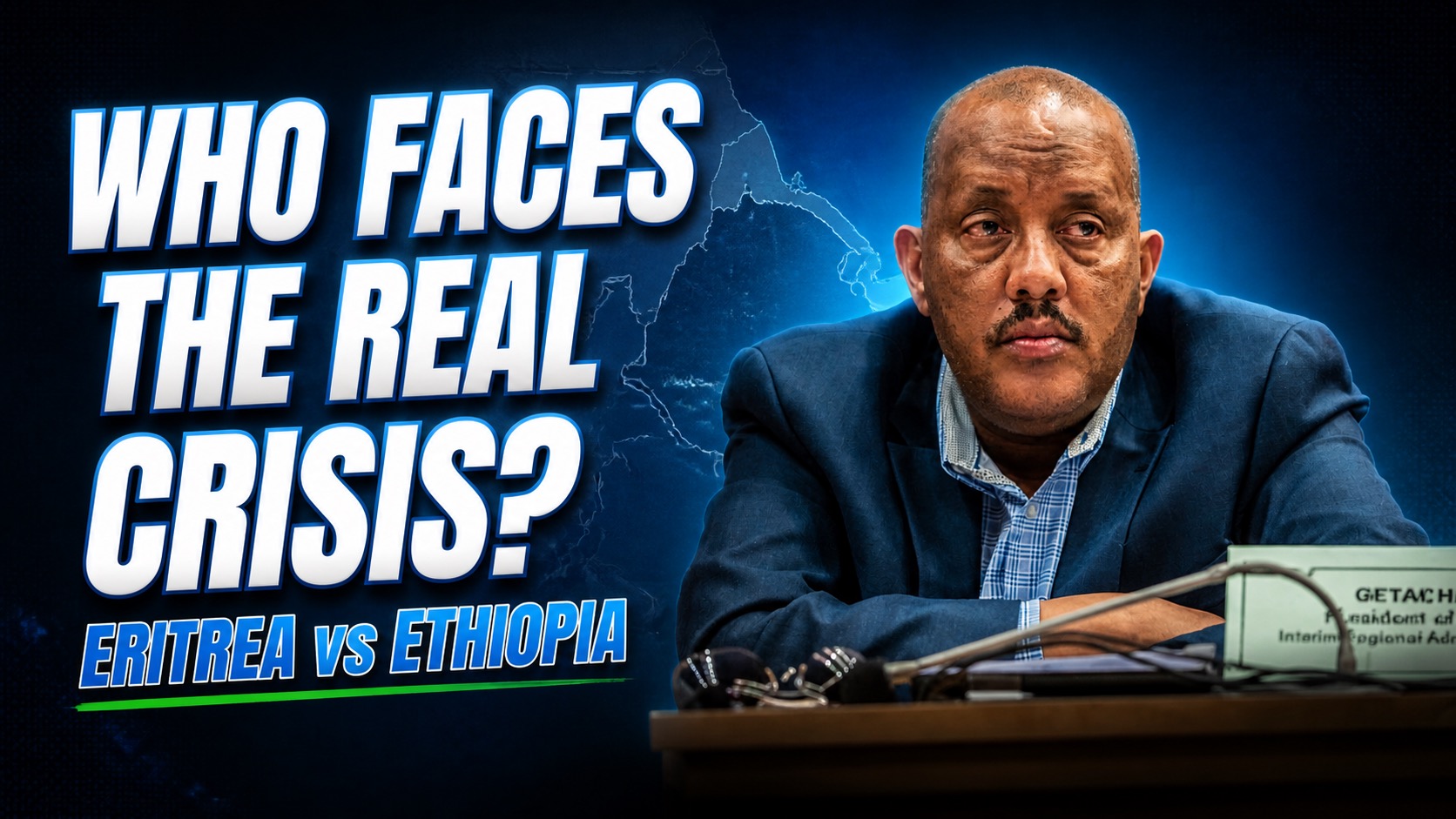
Over the years, Mr Getachew Reda has made numerous public remarks about Eritrea. Most have reflected political disagreement, repeated familiar arguments or simply failed to warrant a response. His latest interview with an Ethiopian television station, however, is of a different order. On this occasion, he went beyond criticising Eritrea’s policies or leadership and questioned the long-term viability of the Eritrean state itself. Such a claim deserves a considered response, not because it is convincing, but because it raises a more fundamental question that extends well beyond Eritrea: by what criteria should the viability of a state actually be judged?
When political leaders question the viability of another state, they assume a heavy burden of proof. Such assessments should be grounded in objective analysis rather than political bias, rhetorical narratives or selective observations. They should be measured against the characteristics that determine whether a state is capable of preserving its sovereignty, maintaining its territorial integrity, sustaining institutional continuity and fostering the national cohesion upon which its long-term stability ultimately depends.
This distinction is fundamental. Every state faces governance challenges. Demographic trends, economic pressures, institutional shortcomings and questions of political succession are issues with which governments across the world must contend. However serious they may become, such challenges remain matters of governance rather than existential threats. They are capable of being addressed through institutional reform, sound public policy and political adaptation. Structural crises are of a different order altogether. They threaten the cohesion, continuity and long-term viability of the state itself. Confusing governance challenges with existential threats inevitably leads to flawed conclusions.
It is against this analytical framework that Mr Getachew’s argument should be assessed. The central weakness in his argument lies not in the examples he cites but in the criteria he employs.
The central weakness in his argument lies not in the examples he cites but in the criteria he employs. He points to demographic pressures, the concentration of political authority in the presidency and the absence of a clearly defined succession mechanism as evidence that Eritrea’s future is somehow in doubt. Even if one were to accept these observations at face value, they remain questions of governance rather than indicators of state survival. They are challenges encountered by many countries and, however important they may be, are capable of being addressed through institutional reform and political evolution. They do not, in themselves, constitute existential threats.
History offers a different test of state viability. States rarely cease to exist because they face governance problems. Governments change, institutions evolve, constitutions are amended and leadership transitions occur. These are normal features of political life. States become vulnerable for very different reasons: when they lose effective control over their territory, when their institutions cease to function, when political fragmentation overwhelms national cohesion, or when competing identities erode the shared sense of nationhood upon which the state ultimately depends.
Applying these criteria to Eritrea and Ethiopia produces a markedly different picture from the one presented by Mr Getachew.
Eritrea is one of the world’s youngest sovereign states, having achieved independence only three decades ago after a long and costly war of liberation. For much of those three decades, however, it has lived not in the relative stability that often follows independence but under exceptional external pressure. Successive wars, repeated security threats, prolonged regional instability and years of international sanctions have shaped much of its post-independence experience. Yet despite these extraordinary circumstances, the Eritrean state preserved its sovereignty, maintained its territorial integrity, ensured institutional continuity and sustained a strong sense of national cohesion. That is not the record of a state whose viability is in doubt; it is the record of a state that has repeatedly demonstrated resilience under conditions that would have severely tested many longer-established countries.
Whatever one’s views of Eritrea’s domestic or foreign policies, the historical record is difficult to ignore. The country’s experience since independence illustrates an important principle: the true measure of state viability is not whether a nation faces adversity, but whether it possesses the resilience to withstand prolonged external pressure without losing the essential foundations of statehood. Judged against that standard, Eritrea’s first three decades of independence provide compelling evidence of resilience rather than fragility.
This should not be interpreted as suggesting that Eritrea is free from challenges. Like every nation, it must continue to strengthen its institutions, improve governance, diversify its economy and adapt to changing regional and international realities. Those are legitimate subjects for public debate. They are, however, matters of governance. They do not threaten the existence of the state itself.
The comparison with Ethiopia is instructive because it illustrates the distinction between governance challenges and structural pressures that test the long-term cohesion of a state. The question is not whether Ethiopia can overcome its present difficulties; every state possesses the capacity for reform and adaptation. Rather, the issue is whether the country’s current challenges are correctly understood. Unlike the governance issues identified by Mr Getachew in relation to Eritrea, many of Ethiopia’s present difficulties are structural in nature.
Unlike the governance issues identified by Mr Getachew in relation to Eritrea, many of Ethiopia’s current challenges are structural. They extend beyond the policies of any particular government and reach the very foundations of the modern Ethiopian state. Since its formation in the late nineteenth century, successive governments have grappled with the challenge of reconciling central state authority with the country’s extraordinary ethnic, linguistic and cultural diversity. Different political systems and constitutional arrangements have sought to address this challenge, yet the underlying tension has remained unresolved.
Today those structural pressures appear more pronounced than at any time in recent decades. Armed conflicts continue in different parts of the country. Political violence has become a recurring feature of national life. Relations between the federal government and several regional actors remain deeply strained. Ethnic polarisation has intensified, constitutional disputes persist, economic pressures have mounted and public confidence in national institutions has been repeatedly tested. These are not simply governance problems capable of being resolved through routine policy adjustments. They raise more fundamental questions about political cohesion, institutional resilience and the long-term stability of the Ethiopian state.
This brings us to what is, in my view, the central question in any discussion of long-term state viability: the relationship between diversity and national identity. It is here that the experiences of Eritrea and Ethiopia diverge most clearly.
Both countries are ethnically, linguistically and religiously diverse. Diversity, in itself, is neither a weakness nor a source of instability. The decisive question is whether that diversity is united by a shared national identity capable of transcending communal, ethnic and regional loyalties.
In Eritrea, decades of common struggle and shared sacrifice forged precisely such an identity. Eritreans belong to different ethnic communities, speak different languages and practise different religions, yet they overwhelmingly identify first and foremost as Eritreans. That shared national consciousness has become one of the principal foundations of the country’s resilience. It has enabled Eritrea to withstand repeated external pressures without allowing its internal diversity to undermine the cohesion of the state.
Ethiopia continues to wrestle with a different reality. This is not because Ethiopians lack patriotism or attachment to their country. Rather, the relationship between ethnic identity and national identity has remained contested for generations. Competing visions of the Ethiopian state continue to shape political life, while political competition has increasingly been organised around ethnic identities. As a result, disputes over the nature of the state itself continue to influence constitutional debates, relations between the centre and the regions, and the country’s broader political trajectory.
History suggests that states rarely collapse because they face demographic pressures, leadership transitions or institutional imperfections. Those are matters of governance that can be addressed through reform and political evolution. States become vulnerable when the bonds that unite their citizens begin to weaken, when competing identities overshadow a shared national purpose, and when political institutions lose the confidence necessary to hold the state together. Measured against these criteria, it is difficult to conclude that Eritrea faces the more fundamental existential challenge. If anything, the available evidence points in the opposite direction.
Before concluding, however, it is important to place Mr Getachew’s remarks in their broader political context. Doing so is not intended to question his right to express his views, nor does political context by itself determine whether an argument is valid. It does, however, help explain why certain narratives emerge and why they deserve careful scrutiny.
Neither the divisions within the TPLF leadership nor the tensions surrounding Eritrea originated with the Pretoria Agreement. Both predated it. The secret contacts and negotiations that preceded Pretoria merely brought those differences into sharper focus, revealing fundamentally different approaches not only towards the federal government but also towards Eritrea itself. Pretoria brought an end to active hostilities, but it did not resolve the political disagreements that had already become apparent during those negotiations.
Mr Getachew has himself acknowledged that, during the secret talks held in Djibouti and the Seychelles, representatives of the Ethiopian federal government proposed that he and his colleagues resolve their dispute with Addis Ababa and subsequently join forces in waging war against Eritrea. Whether or not that proposal was ultimately accepted is not, in my view, the essential point. What matters is that such an offer was reportedly made while the war was still ongoing and before the Pretoria Agreement had been concluded. That alone demonstrates that Eritrea already occupied a central place in the strategic calculations surrounding the negotiations.
The obvious question that follows is what could have persuaded two sides that had just fought one of the bloodiest wars in Ethiopia’s modern history to contemplate political cooperation so soon afterwards. There were undoubtedly several political considerations. Nevertheless, I find it difficult to identify any issue more significant than their converging positions towards Eritrea. In my view, that convergence became the principal strategic factor that made the subsequent political realignment possible. This interpretation is consistent not only with the chronology of events but also with the political positions adopted by those who subsequently aligned themselves with the federal government.
Seen in that light, Mr Getachew’s repeated remarks about Eritrea assume a broader political significance. They no longer appear simply as isolated observations but as part of a wider political narrative that has become increasingly visible since the pre-Pretoria negotiations. It is against that political background that, in my view, his recent comments are best understood.
The political context discussed above helps explain why Mr Getachew’s recent remarks should be viewed with caution. It is not, however, the foundation upon which this article’s conclusion rests. Even if one were to set that political context aside entirely, the analytical conclusion would remain unchanged because it derives from objective criteria rather than political narratives or personal disagreements. The viability of a state cannot be judged by rhetoric or selective observations. It must be assessed against its capacity to preserve sovereignty, territorial integrity, institutional continuity and national cohesion under sustained pressure.
Nor is the purpose of this article to argue that Eritrea is stronger than Ethiopia or that Ethiopia is incapable of overcoming its present difficulties. States evolve, adapt and reform, and history rarely follows a linear course. The purpose has simply been to distinguish between governance challenges, which every state encounters and which can be addressed through political and institutional reform, and structural crises that call into question the cohesion and long-term resilience of the state itself. It is that distinction, rather than political preference or competing historical narratives, that should guide any serious assessment of state viability.
Mr Getachew’s remarks provided the occasion for this discussion, but they are not its principal subject. The real issue is how the viability of states should be assessed. If the criteria are applied consistently, the distinction becomes clear. Governance challenges, however serious, are not synonymous with existential threats. They are part of the normal evolution of states and can be addressed through reform, institutional development and political adaptation. Structural crises are different. They test the very foundations upon which states endure.
Ultimately, the viability of a state is measured not by the absence of challenges but by its capacity to preserve its sovereignty, territorial integrity, institutional continuity and national cohesion in the face of sustained pressure. Judged by that standard, Eritrea’s first three decades of independence demonstrate remarkable resilience despite war, repeated security threats, regional instability and prolonged international sanctions. Ethiopia’s future, by contrast, will depend not simply on economic growth or military strength, but on its ability to build a shared national identity capable of transcending the political and ethnic divisions that continue to shape the modern Ethiopian state. That, rather than Eritrea’s viability, is the more fundamental question confronting the Horn of Africa today.

