
How a smaller world makes America look greater
I. A hypothesis few seem willing to entertain
Since the opening of hostilities with Iran — now entering its fourth week — commentators and analysts across the world have scrambled to explain the American decision to open a confrontation of this scale. No convincing answer has emerged. Interpretations have piled up without a common thread: some pointed to subservience to Israel, others to Trump’s improvisation, his private financial entanglements, or the long-term strategic rivalry with China. All plausible readings; none fully satisfying.
It may be worth considering a different hypothesis: that the rationale exists, but has been deliberately constructed to remain invisible. The apparent confusion, the contradictory statements, the ill-timed remarks may not be signs of improvisation at all, but elements of a deliberate strategy — keeping public opinion off-balance while the war machine does its work. Buying time. Or, in the older metaphor, boiling the frog.
II. A long war, perhaps planned from the start
By the twenty-first day of the conflict, American military operations display a continuity that leaves little room for short-term improvisation. Reports filtering through established channels suggest troop movements toward the theater of operations that would require weeks on logistics alone. Two readings are possible. The first: Washington found itself more bogged down than expected and is now struggling to adapt. The second: a long war was always the plan, and the opening weeks were designed to ease domestic and international opinion into accepting the conflict’s existence.
The two are not mutually exclusive, but the second receives far less attention than it deserves. It is also worth noting that the charge of irrationality is leveled almost exclusively at the United States, rarely at Israel, whose objectives are considerably clearer. But what Israel wants from this war and what Washington wants may be two very different things, with strategies that only partially overlap. This distinction matters: conflating them obscures both.
III. Trump is the face. The strategy runs deeper.
Here is where the two readings converge into something more troubling. If Washington’s aims cannot be fully explained by the immediate military objectives, it may be because those objectives are not, in fact, the primary target. The real aim of American strategy may not be Iran at all, but the international system as a whole. Not military conquest, but something more subtle: weakening the rest of the world enough to make America look stronger — even without America having actually become stronger. Relative power is what counts, not absolute strength. If the others fall back, you move forward regardless.
It would be a mistake, though, to pin this reading on Trump alone. Trump is the visible face of a much broader and more durable coalition of interests. Behind him stands the military-industrial complex, which thrives on prolonged conflict. There are the major technology platforms and figures like Peter Thiel, who have openly invested in an alternative vision of the global political order. There are investment funds with strategic exposure to energy and commodities that benefit directly from instability. These are structures that do not depend on electoral cycles and that plan on decade-long horizons.
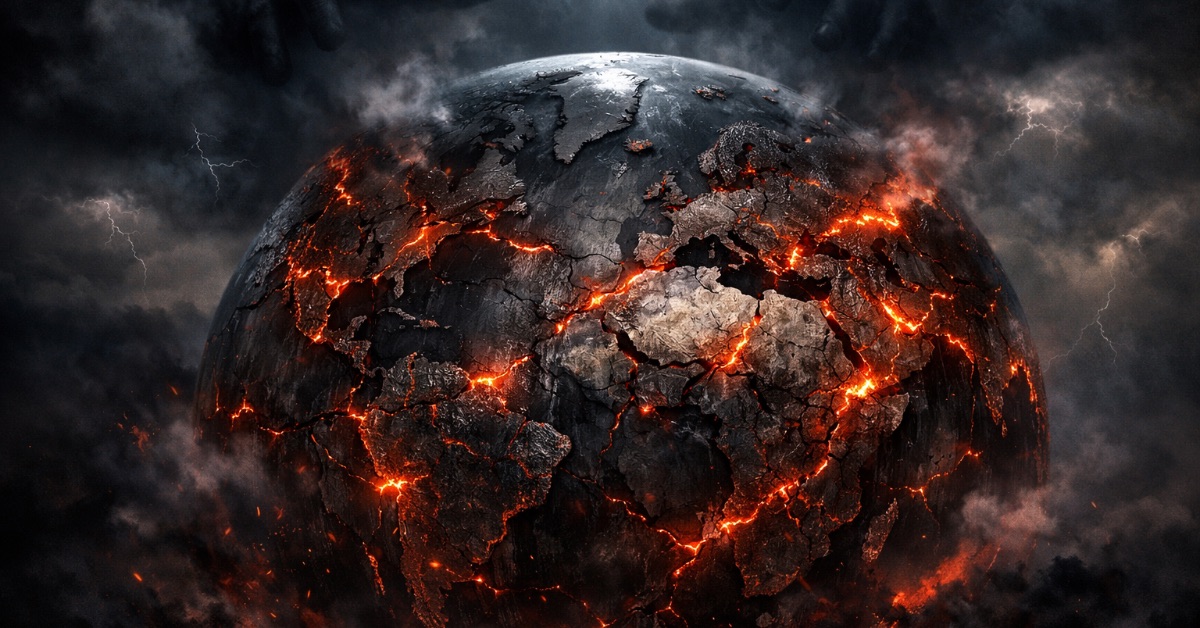
The logic behind all this is what Schumpeter called creative destruction: collapsing a system in order to create the conditions for building a new one. The concrete signals are already visible. China has suspended fertilizer exports, with potentially severe consequences for global food production. The damage to energy infrastructure in the Gulf will be measured in years, not months. Sovereign debts under strain, weakened currencies, fractured supply chains: not an explosion, but a slow, silent erosion — the kind that is hardest to stop precisely because it is hardest to see.
IV. The slow catastrophe, and who benefits from its invisibility
The outcome of this process, if the hypothesis holds, would not be a world defeated militarily. It would be a tired world — disoriented, too consumed by its own crises to mount any credible alternative to American hegemony. The deterioration would be incremental, with no single dramatic moment to point to as the break. That is precisely the mechanism of the boiling frog: there is never a clear moment to push back, because each individual step seems survivable on its own.
In that scenario, the United States would emerge with a significant relative advantage — not necessarily richer or stronger in absolute terms, but surrounded by a weaker, more dependent world, more willing to accept Washington’s terms. A hegemony no longer built on persuasion or multilateral institutions, but on hard power, undisguised and unapologetic.
There would be domestic costs: economic strain, likely electoral losses in the midterms, institutional friction. But this is where the picture grows genuinely disturbing. Several figures in the coalition around Trump have shown sustained interest in restructuring American institutional constraints themselves — not merely in winning within the system, but in rewriting the rules that govern it. The domestic and international projects may be two dimensions of the same ambition.
What we may be witnessing, then, is not the chaos of a miscalculated war. It is the first phase — deliberately opaque — of an attempt to redraw the global distribution of power. The confusion is not a bug. It is load-bearing. This is a hypothesis, not a verdict. But some hypotheses deserve to be taken seriously. Especially the ones we would rather not consider.