

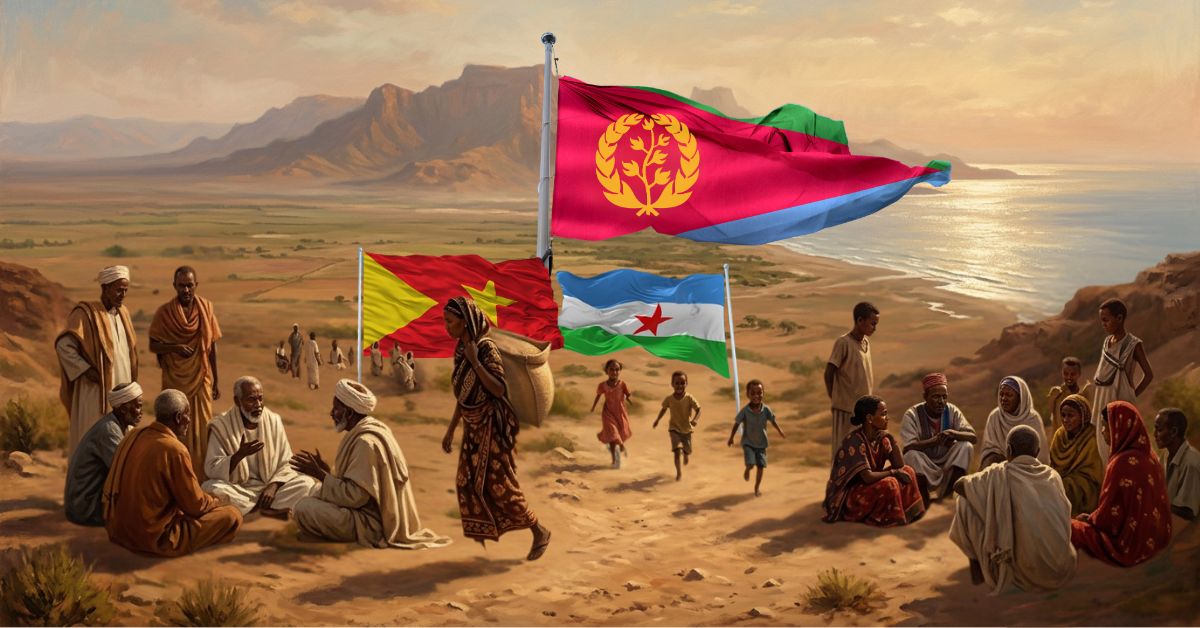
The Architecture of a Different Kind of Security
There is an old saying among soldiers: the map is not the territory. Generals who win wars understand that borders drawn in ink mean nothing if the people living along them have decided, in their hearts, that they have more to gain from your destruction than from your survival. Eritrea has known this truth longer than most. Squeezed between a vastly larger southern neighbor, a turbulent western flank, and a Red Sea that every ambitious power in the region wants a piece of, Eritrea cannot afford the luxury of believing that a dotted line on a map constitutes security.
What Eritrea is building instead imperfectly, sometimes contradictorily, but with discernible strategic intent is something classical military doctrine has not quite named yet. Call it societal strategic depth. The logic is older than the terminology: surround yourself not with walls, but with people who no longer see a reason to want you gone. This is the essence of what observers have begun calling the Ximdo — ጽምዶ — model: layered social engagement across borders, cultivated not as an act of goodwill but as a form of architecture. The architecture of a state that cannot afford to be surrounded by enemies and has decided to do something about it.
To understand why this matters, you have to understand the position Eritrea is actually in. Russia absorbs pressure through sheer geographic mass — Napoleon learned that lesson, and Hitler relearned it. China’s depth is demographic and industrial: a country of 1.4 billion people with a manufacturing base that can outlast almost any economic siege. Israel compensates for its small size through technological superiority and an alliance with the world’s most powerful military. Eritrea has none of these options in conventional form. What it has, and what it is beginning to use with growing deliberateness, is the ability to shape the human environment around its borders — to reduce hostility not by defeating it militarily, but by making it socially expensive, politically complicated, and emotionally difficult to sustain.
Tigray: Turning an Old Front Line Into a Social Firewall
The most dramatic illustration of this model in action is the Tigray dimension, and to appreciate it you need a short memory of history. For roughly three decades, the Tigray People’s Liberation Front ran Ethiopia from Addis Ababa. The TPLF’s hatred of Eritrea was not incidental — it was structural. Eritrea’s independence in 1991 had broken the TPLF’s access to the sea. Eritrea’s willingness to fight back in 1998 had humiliated a government that thought it controlled the region. The northern Ethiopian border was, for a generation, functionally an anti-Eritrean mobilization base. The TPLF kept it that way deliberately.
Then the Tigray war happened, and it broke everything including that arrangement. The federal government that Tigrayans had built and dominated turned its guns on them. Eritrean forces entered the war on Addis Ababa’s side, and atrocities followed on a scale that has been extensively documented. None of that was clean or simple. But in the wreckage, something unexpected opened up: space. Not political space in the formal sense, but social space the human possibility for Tigrayan communities to begin separating their experience of the Ethiopian state from their relationship with Eritrea. The enemy of my enemy is not automatically my friend, but the calculus had shifted.
What happened next is worth lingering on. In 2025, without formal approval from either government, community leaders and local activists organized a border reopening at Zalambessa. Families separated for five years embraced at a crossing that had been a militarized front line within living memory. By April 2026, over 700 Eritreans had crossed into Tigray’s Sheraro district to celebrate religious festivals with their neighbors, bringing grain for displaced families — and describing the visit, in their own words, as “a stage of brotherhood”. The Ethiopian federal government promptly called it meddling. That reaction tells you everything about what Addis Ababa understood was happening.
Think of it the way a historian might think about the Franco-German relationship after World War II. France and Germany spent a century bleeding each other. What finally broke the cycle was not a peace treaty — there had been peace treaties. What broke it was the deliberate weaving of human relationships: student exchanges, sister cities, joint institutions, economic interdependence. By the time a future French president considered going to war with Germany, the social cost would have been catastrophic. Too many French families knew Germans. Too many German families had cousins in Lyon. The political will to mobilize simply could not be manufactured against that backdrop of human familiarity.
Eritrea is not France, and Tigray is not Germany. The wounds are fresher, the distrust deeper, the political environment far more fragile. But the logic is the same. If future generations in Tigray grow up with social and economic ties to Eritrea — if they know Eritreans as neighbors rather than as caricatures in a government propaganda campaign — then mobilizing them against Asmara becomes harder. Not impossible, but harder. And in a region where wars are often decided by who can build a political coalition fastest, harder matters enormously.
The Afar Coast: Where Social Depth Meets Maritime Security
The Afar dimension of this model tends to get lost in analyses focused on Addis Ababa and Asmara. That is a mistake, because the Afar corridor is arguably the most geopolitically consequential piece of real estate in the entire Horn of Africa.
The Afar people inhabit the territory stretching from Eritrea’s Dankalia coast through northeastern Ethiopia to Djibouti directly adjacent to the approaches to Bab el-Mandeb, the chokepoint through which a significant share of global maritime trade passes. Whoever controls the human terrain of that corridor shapes one of the most strategic coastlines in the world. This is not an abstraction. It is why Gulf states have been competing aggressively for port agreements across the Red Sea littoral. It is why Ethiopia’s Abiy Ahmed has made “sovereign access to the sea” his defining foreign policy demand. And it is why Eritrea’s management of its Afar coastline is, in security terms, far more than a domestic administrative question.
What is observable along Eritrea’s Dankalia coast is the absence of what you would expect to find if the human terrain had been neglected. There are no recorded insurgent networks. No extremist sanctuaries. No documented history of external proxy infrastructure taking root along that stretch of shoreline. Afar communities in Eritrea participate in national institutions and local governance. The coast is stable. In a region where stability is the exception, that is a strategic asset — and it reflects sustained, deliberate attention to the communities living there.
The practical implication is direct. Any Ethiopian move toward Eritrea’s coast whether military, diplomatic, or through the instrumentalization of Afar grievances requires either community cooperation or community passivity. Eritrea’s engagement with Afar communities transforms the corridor from a vulnerability into something closer to social armor. You cannot march through a neighborhood whose residents have decided you are not welcome. History offers abundant examples: the British Empire found this in the Khyber Pass, the Soviets found it in Afghanistan, and the United States found it everywhere from the Mekong Delta to the Helmand Province. Physical geography matters less than human geography when the people on the ground have made their choice.
Sudan: Defending the Western Flank Through Relationship, Not Just Force
Eritrea’s western border has historically been its most porous strategic vulnerability. Sudan shares over 600 kilometers of frontier with Eritrea, and that border has at various times served as a corridor for refugees, arms, intelligence operatives, and hostile forces. The current Sudanese civil war which has drawn in the UAE, Egypt, Saudi Arabia, and various regional powers across complex and shifting alignments makes this flank more dangerous, not less.
Asmara’s response has been to embed itself directly in Sudanese politics and security. President Isaias Afwerki has been explicit: eastern Sudan is Eritrea’s “first line of defense”. When the civil war began deteriorating in ways that threatened the Sudanese Armed Forces, Eritrea moved toward direct alignment with the SAF — including a reported threat of military intervention should the fighting approach the border states. Port Sudan and Asmara deepened economic and diplomatic ties: joint committees, energy discussions, military coordination, and a personal visit from Sudanese Prime Minister Kamil Idris accompanied by senior generals.
This is worth reading carefully, because it is easy to misread as pure military alliance politics. It is more than that. The informal trust networks along the Eritrean-Sudanese border built through decades of cross-border trade, shared pastoral routes, and family connections between communities on both sides — are the real long-term asset. Formal alliances between governments collapse when governments change. But communities that have done business together for three generations, that share water and grazing land and wedding guests, tend to maintain a baseline of interdependence that outlasts any particular political arrangement.
Think of the way Ottoman and Byzantine merchants maintained trade networks even during periods of outright war between their states. The markets kept moving because the people running them had relationships that transcended the political moment. That kind of informal resilience is what cross-border community engagement builds — and it is considerably more durable than a signed memorandum of understanding. Tune in for Part Two.

