Overview
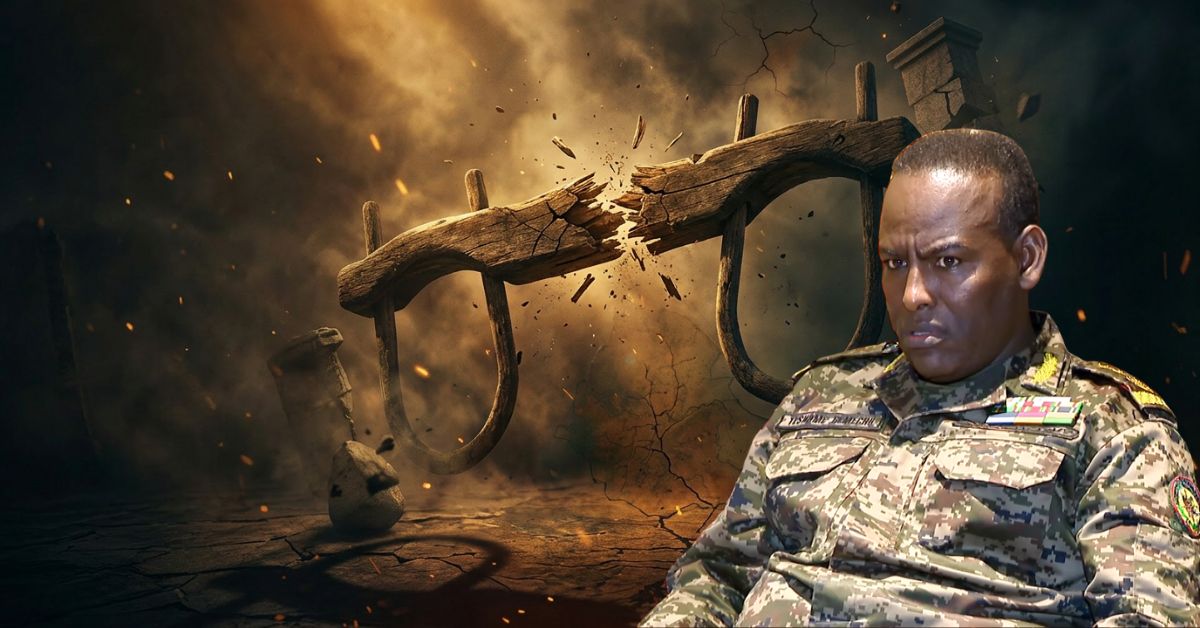
When Major General Teshome Gemechu sat before the Ethiopian state broadcaster to address the growing regional conversation around Ximdo, he handed analysts a rare gift: an unscripted window into the anxiety at the heart of Addis Ababa’s political and military establishment. His language was theatrical, his metaphors vivid, and his warnings fierce. But underneath the performance lies a deep and revealing contradiction. A state that has spent years trampling on the sovereignty of its neighbors was, in that studio, lecturing the world about the sanctity of its own. That contradiction is not incidental. It is the story.
What Ximdo Actually Is
Before the Ethiopian military’s narrative is dismantled, the foundation it is trying to distort must be established clearly. Ximdo ጽምዶ in Tigrinya means, at its most basic, coexistence and cooperation, like two animals harnessed side by side to plow a field, working in harmony rather than in conflict. Its first public expression was a direct, non-governmental, people-to-people peace initiative between Eritrean and Tigrayan communities at the border, initiated by Eritrean activist Awel Seid. Since then, it has expanded to include Ethiopian Afars, Eritrean Afars, and there are active attempts to bring Amharas and Tigrayans together under its framework.
This is the movement the Ethiopian general chose to describe as a “dream cooked up by those who have bowed to the yoke of Pharaoh.” That characterization, coming from a serving major general on state television, tells us a great deal. When a government finds a grassroots peace initiative threatening enough to require a formal military briefing on international diplomatic channels, that government is not speaking from a position of strength. It is speaking from one of fear.
The Pharaoh Yoke: Desperation in a Metaphor
The most revealing moment in the interview is the use of the phrase “yoke of Pharaoh.” In a deliberate political context, such language carries unmistakable weight. It is designed to invoke Egypt to plant in the listener’s mind an image of foreign domination, of ancient power reaching into the Horn of Africa to destabilize an ancient civilization. The timing is not accidental. It comes precisely as Ethiopia’s GERD dispute with Egypt has reached one of its most acute phases.
Ethiopia inaugurated the Grand Ethiopian Renaissance Dam in September 2025 to formal protest from Egypt, which described the action as a contravention of international law. Egypt, which depends on the Nile for roughly 90 percent of its freshwater needs, views the GERD as an existential threat. Cairo has responded not only diplomatically but strategically, signing defense agreements with Somalia, deepening port arrangements with Eritrea, and building a layered regional architecture that Addis Ababa perceives as encirclement. Egypt has agreed to develop the strategic Red Sea port of Assab in Eritrea and the port of Doraleh in Djibouti, partly as a pressure mechanism against Ethiopia’s sea ambitions.
This is the context in which the “Pharaoh yoke” language appears in Ethiopian state media. Addis Ababa is attempting to fold Egypt into the Ximdo story without presenting evidence that Egypt is operationally involved. It is a rhetorical move designed to activate nationalist sentiment, tap into the GERD dispute’s emotional register, and paint every actor that does not align with the Prosperity Party as a limb of a Pharaoh-led conspiracy. That is not intelligence analysis. That is propaganda management.
The Somaliland MoU: Sovereignty as a Tool, Not a Principle
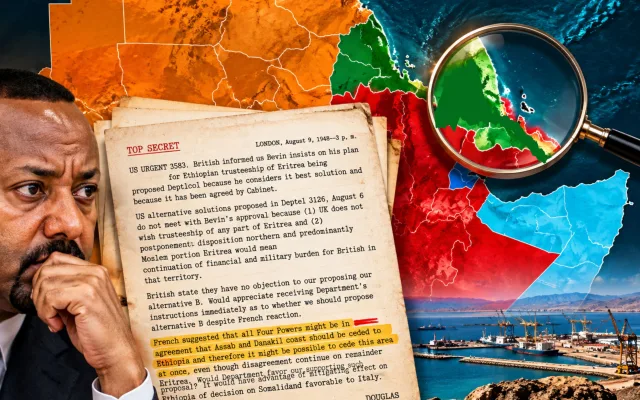
Nothing exposes the hollowness of Addis Ababa’s sovereignty rhetoric more decisively than the January 1, 2024, memorandum of understanding signed between Ethiopian Prime Minister Abiy Ahmed and Somaliland President Muse Bihi Abdi. Under that deal, Somaliland agreed to lease more than 19 kilometers of its Gulf of Aden coastline to Ethiopia’s navy for a period of 50 years. In return, Ethiopia offered a future promise of formal recognition of Somaliland as an independent state — a recognition that, if granted, would make Ethiopia the first United Nations member state to formally sever Somaliland from Somalia.
Somalia’s response was immediate and unequivocal. The federal government in Mogadishu declared the MoU “null and void,” described it as a “clear violation of Somalia’s sovereignty, unity, and territorial integrity,” and called on both the African Union and the United Nations to condemn what it characterized as Ethiopia’s “unwarranted aggression”. Somalia recalled its ambassador to Ethiopia in protest. The African Union’s own core principles regarding member state sovereignty and territorial integrity were directly cited.
The Somaliland MoU is not an isolated transaction. It is a window into how Addis Ababa approaches sovereignty when it is an obstacle to be bypassed rather than a principle to be honored. A government that constructs a 50-year naval lease deal with a territory whose sovereignty is constitutionally disputed by a UN member state, and which does so without the consent of that state, has already answered its own sovereignty lectures for the rest of the region.
The Sea Access Campaign: Entitlement Over Law
The Somaliland gambit did not emerge in isolation. It was the most dramatic expression of a sustained campaign by Prime Minister Abiy Ahmed to secure Ethiopia’s access to the Red Sea by any means available. In public parliamentary addresses, Abiy described sea access as an “existential” issue for Ethiopia. Ethiopia’s president, Taye Atske Selassie, went further, declaring that “Ethiopia’s renaissance will be attained when geography no longer curtails the destiny of its 120 million people”.
The nearest significant port to Ethiopia is Assab, across the border in Eritrea — approximately 40 miles away. Eritrea has responded with clarity. Information Minister Yemane Gebremeskel stated publicly that “Eritrea is bewildered by Ethiopia’s outdated and misguided pursuits for maritime access and a naval base, whether through diplomacy or military means”. Both sides have moved troops toward their shared border. Ethiopia sent a formal diplomatic letter to Eritrea accusing it of occupying Ethiopian territory, a charge Eritrea denied.
In October 2025, Abiy Ahmed called for international mediation over Red Sea access, describing Ethiopia’s claim as “irreversible,” while insisting he did not seek war. The language of “irreversible claims” directed at a sovereign neighbor’s territory is not peaceful diplomacy. It is territorial pressure wearing the costume of dialogue. When the same state then deploys its military general on national television to warn others about respecting Ethiopian sovereignty, the contradiction is not subtle. It is total.
The Pretoria Agreement: A Peace Abiy Hollowed Out
The Ethiopian government’s sovereignty argument also crumbles under scrutiny of its own domestic record. The Pretoria Agreement, signed in November 2022 to end a war that killed an estimated 600,000 civilians in Tigray alone, was supposed to be the framework for lasting peace. Three years later, the assessment is damning. A comprehensive analysis describes the outcome as “negative peace” — the guns fell temporarily silent, but the root causes were never addressed.
In May 2025, Ethiopia’s National Electoral Board delisted the TPLF as a recognized political party, effectively barring the primary political force of the Tigray region from participating in the June 2026 elections. The TPLF characterized this as a direct violation of the Pretoria Agreement and appealed to the African Union Commission. The AU’s own frameworks explicitly require mutual recognition of parties and empower its Peace and Security Council to uphold peace deals. Addis Ababa proceeded regardless.
By January 2026, Ethiopian federal forces were conducting drone strikes in central Tigray, killing civilians and destroying infrastructure. Ethiopian Airlines suspended flights to the region, triggering cash shortages and panic among the population. The Ethiopian Human Rights Commission confirmed renewed clashes between federal and Tigrayan forces, warning that civilians were at grave risk. These are not the actions of a state defending a peace agreement. They are the actions of a state that used a peace agreement as a pause before renewing pressure.
A Nobel Peace Prize Winner Who Went to War
The international community has already struggled publicly with the contradiction at the center of Abiy Ahmed’s leadership. The Norwegian Nobel Committee, which awarded Abiy the 2019 Nobel Peace Prize for his peace agreement with Eritrea, issued the highly unusual step of formally admonishing him in January 2022 over the Tigray war, stating that “Abiy Ahmed has a special responsibility to end the conflict and contribute to peace”. The New York Times reported in December 2021 that Abiy had been planning the Tigray military operation for months before it began, and that the Nobel Peace Prize had in fact emboldened Abi to plan the campaign against the TPLF.
This is the leader whose military general now invokes sovereignty as a shield. A man who received the world’s highest peace prize and used the recognition as cover to plan a war. A man who signed a peace deal with Eritrea and immediately used it to coordinate military action. A man who signed a peace agreement with Tigray and then systematically dismantled its provisions. The pattern is not accidental. It is structural.
Ethiopia in 2026: Convergence of Failures
By 2026, Ethiopia’s internal fractures are no longer confined to any single region or conflict. They are converging. The country faces simultaneous insurgencies in Amhara and Oromia, renewed federal-Tigrayan confrontation, economic deterioration, and dangerous confrontations with multiple neighboring states. Analysts describe a government that treats every demand for inclusion, representation, or dignity as an act of treason to be suppressed rather than a signal to be heard.
Sudan accuses that Ethiopian territory was used to strike Khartoum International Airport adds yet another front to this expanding crisis. Each new accusation, each new front, and each new external blame target follows the same logic: the problem is never internal governance; it is always a foreign “yoke” draped across Ethiopia’s shoulders by hostile neighbors and ancient enemies.
The Core Paradox
The Pharaoh yoke paradox, then, is this: the Ethiopian state invokes sovereignty as a sacred principle precisely in the moments when it most needs to distract from its own violations of that same principle. It signs a naval lease deal with a disputed territory against the objections of a sovereign UN member. It declares a neighbor’s ports as existentially Ethiopian. It hollow out a peace agreement it co-signed before resuming military operations. It delists a political party guaranteed recognition under a treaty. And then it convenes a general on state television to warn the world about the threat of a grassroots peace movement.
When a government cannot manage its own internal fractures, it manufactures external enemies. When its sovereignty argument collapses under the weight of its own contradictions, it reaches for civilizational symbols, historical insults, and the shadow of Pharaoh. Ximdo did not create Ethiopia’s crisis. It simply reflected it back at a government that has spent years refusing to look in the mirror.
The general’s metaphor was vivid. An old ox and a sly fox, he said, cannot be yoked together to plow a field. He was right about the impossibility. He simply had the wrong team in the harness.