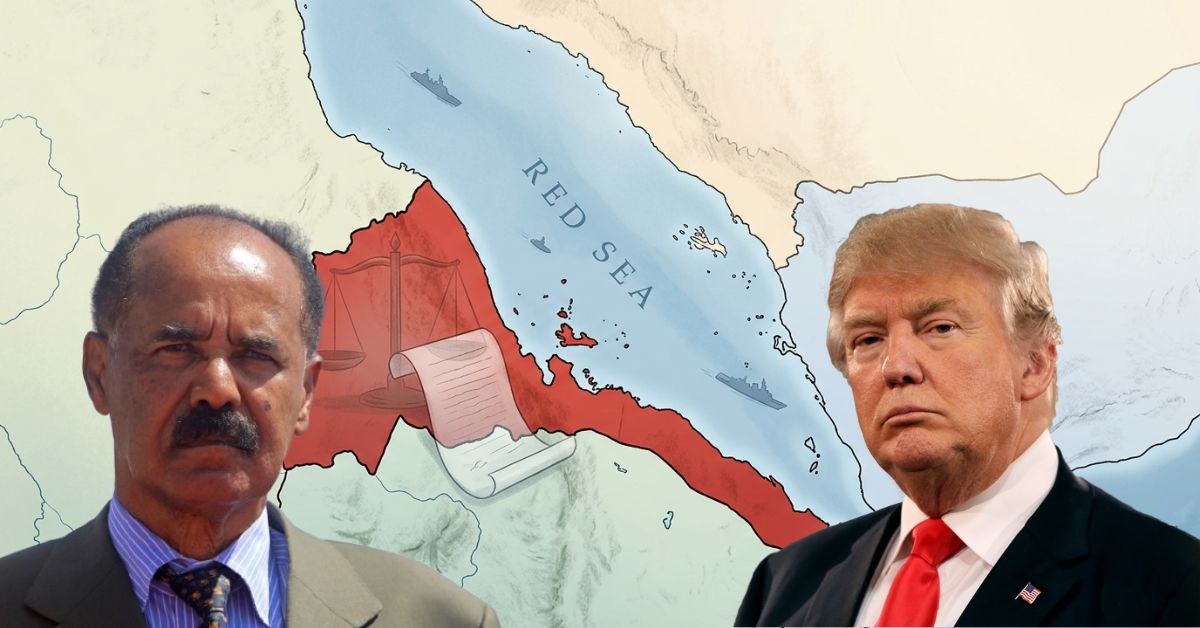
The latest signs of possible U.S.-Eritrea engagement should be read neither with excitement nor with suspicion alone. They should be read with clarity. According to a Wall Street Journal report published on April 22, the Trump administration is reviewing a plan that could ease some sanctions on Eritrea and reopen more serious diplomatic contact after years of distance.
This matters because it confirms something Eritreans have always known, even when others tried to deny it: Eritrea’s strategic relevance does not disappear because major powers choose to ignore it. The report says Washington’s interest is tied to the Red Sea, the Bab al-Mandeb chokepoint, and wider instability linked to Iran and the Houthis, all of which have increased the value of Eritrea’s long Red Sea coastline in American calculations. In other words, Eritrea has returned to the center of geopolitical thinking not because the outside world has suddenly become fair, but because geography and crisis have forced a reassessment.
There is an important lesson in that. Nations that stand firm through difficult periods can outlast the fashions of international politics, but endurance by itself is not enough. A country may survive on resilience, but it cannot build its full future on resilience alone.
Since independence in 1993, Eritrea has defended its sovereignty with unusual discipline and stubbornness, often under real pressure from stronger states and hostile diplomatic narratives. Relations with Washington deteriorated over time, and U.S. sanctions and restrictions tied to the conflicts in northern Ethiopia and broader human rights concerns remained part of that reality in recent years. Even now, reporting indicates that any U.S. move is still under review rather than finalized, which means Eritrea should approach this moment with patience and realism rather than illusion.
Still, the shift is real enough to deserve serious reflection. If Washington is reconsidering Eritrea because the Red Sea has become too important to neglect, then Eritrea must also reconsider how best to convert strategic location into durable national strength. Geography can give a country leverage, but only institutions, legitimacy, and productive citizens can turn leverage into lasting power.
This is where the discussion must become honest. Eritrea has every right to reject foreign bullying. It has every right to insist that engagement be based on mutual respect rather than diktat. But an Eritrea-first position should not confuse national dignity with political immobility. Strategic flexibility is not surrender. It is the ability to adapt without losing oneself.
That means the changing geopolitical climate should be treated not only as an external opportunity, but as an internal warning. If the world is shifting, Eritrea must not remain frozen. It should move with confidence to strengthen the state from within, beginning with long-delayed constitutional implementation and the building of credible national institutions. A constitution is not a gift to outsiders, and it is not a public relations tool. It is a covenant between state and citizen, and a framework that gives sovereignty institutional form.
The same is true for broader civic and political renewal. A strong Eritrea needs more than military vigilance. It needs functioning law, predictable institutions, and a public sphere where citizens can contribute to national life without fear. It needs a national compact that treats the people not only as defenders of the state, but as rightful participants in shaping it.
This is especially urgent because the region is becoming more dangerous, not less. Tensions related to Ethiopia’s recurring push for sea access have already fueled fears of a fresh confrontation, and recent analysis has highlighted the risk that rhetoric around Red Sea access could trigger another regional crisis. In such an environment, Eritrea needs both deterrence and diplomacy, both resolve and flexibility. Neither one alone is sufficient.
The Wall Street Journal report also notes that Egypt has been facilitating parts of the current dialogue and that contacts have involved senior American, Eritrean, and Egyptian figures. That detail matters because it shows the issue is no longer merely bilateral. Eritrea now sits inside a wider contest involving Red Sea security, Arab-African diplomacy, regional rivalries, and the strategic anxieties of global powers. A small country in such an environment cannot afford political stagnation at home while maneuvering in a rapidly changing region abroad.
There is also a deeper national question beneath the diplomacy. What kind of state does Eritrea want to be in this new phase? One that is noticed only when others need its coastline, or one that commands respect because it has combined sovereignty with institutional maturity, discipline with openness, and resilience with reform?
That is the real challenge of this moment. The outside world may be changing its tone toward Eritrea for reasons of strategy, not justice. Eritrea, however, should not respond only tactically. It should respond historically. It should recognize that strategic relevance creates a window, and windows do not remain open forever.
An Eritrea-first approach today should therefore rest on two principles at once. The first is that national independence remains nonnegotiable. The second is that internal reform is no longer optional. Implementing the constitution, broadening lawful civic space, strengthening institutions, and giving the younger generation a fuller stake in the future are not concessions to Washington or to any other capital. They are acts of national self-respect.
If this geopolitical shift teaches anything, it is that Eritrea still matters. But the next lesson is even more important: to matter is not enough. The country must also prepare itself to use that relevance wisely, strengthen itself internally, and enter the next era with confidence rooted not only in sacrifice, but in renewal.