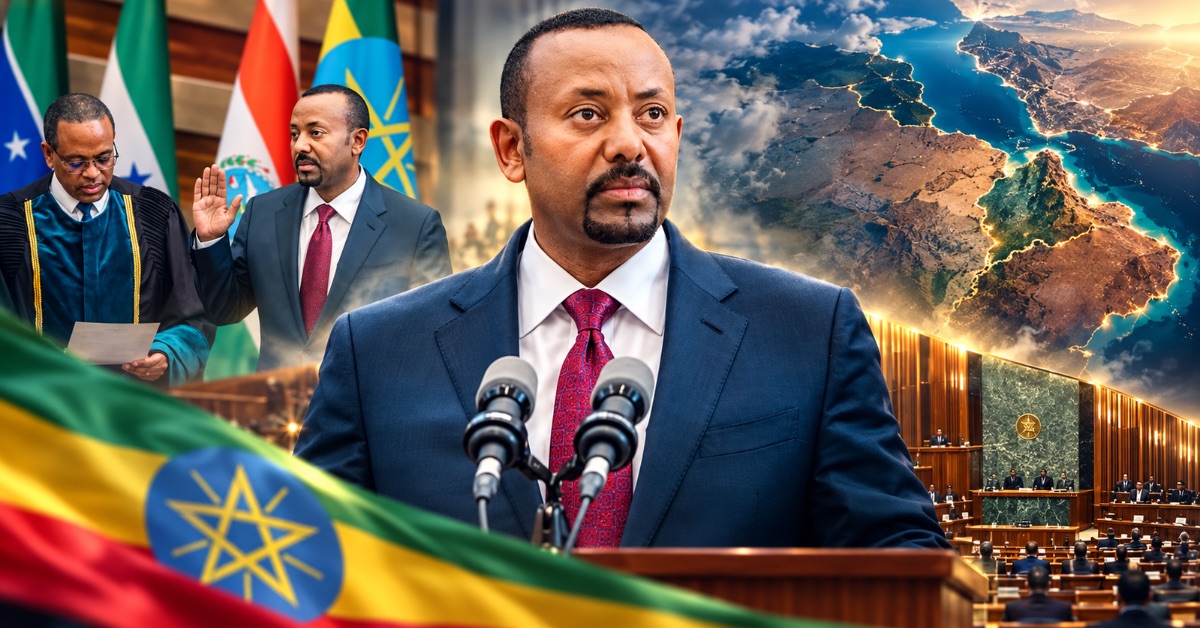

The article titled “Ethiopia-Eritrea Relations: Historical Drivers of Conflict and Pathways to Peace,” published by Ethiopia’s Institute of Foreign Affairs on May 22, 2026, presents itself as a serious roadmap for peace between Eritrea and Ethiopia. But once one goes beyond the diplomatic language and carefully examines its assumptions, the article reveals a deeper political agenda. It is not truly about peace between equals. It is about redefining Eritrea’s sovereignty as conditional, portraying Eritrea as an “abnormal” state, and intellectually preparing the ground for future Ethiopian strategic ambitions in the Red Sea region. The language of reconciliation is being used as political cover for a much larger geopolitical project.
The first major problem with the article is that it refuses to approach Eritrea as a fully legitimate sovereign state. Throughout the essay, Eritrea is described as militarized, isolated, irrational, insecure, and incapable of normal state behavior. This is not neutral academic analysis. This is political framing. In international relations theory, particularly realism, states are not judged based on whether outsiders approve of their internal systems. Sovereignty is based on territorial integrity, survival, and international recognition. Eritrea achieved all three through sacrifice, war, and legal international process. Once an article begins by treating Eritrea’s sovereignty as something that must be “normalized” or reshaped according to external expectations, then the discussion is no longer about peace. It becomes about political conditioning.
The article also deliberately strips Eritrea’s security posture from its historical context. Eritrea did not emerge from peaceful negotiations or colonial compromise. Eritrea emerged from a thirty-year liberation struggle against annexation, forced federation, military occupation, and repeated attempts to erase Eritrean national identity. No serious political analysis can discuss Eritrean militarization without discussing the history that produced it. States that emerge from existential wars naturally develop strong security cultures. Israel, Vietnam, and Algeria all developed similar patterns after long wars of survival. Yet the article presents Eritrea’s behavior as if it appeared in a vacuum. This is intellectually dishonest because it removes causality from history.
One of the clearest signs of the article’s hidden agenda appears in the section discussing the 1993 referendum and Eritrean independence. The author argues that many Ethiopians view Eritrean independence as flawed because Ethiopia lost direct access to the sea. This statement is extremely revealing. The real issue underneath this entire essay is not democracy, governance, or peacebuilding. It is the Red Sea. The article quietly reframes Ethiopia’s strategic frustration into a historical grievance in order to reopen debates that international law settled decades ago. Eritrea’s independence was internationally recognized, legally formalized, and accepted by Ethiopia itself. Access to the sea does not give any country the right to question another country’s sovereignty.
From the perspective of offensive realism, the logic behind the article becomes easier to understand. Regional powers seek strategic depth, economic access, and geopolitical influence. Ethiopia’s growing political discourse about ports and maritime access reflects this reality. Therefore, this article should not be read simply as an academic exercise. It should be understood as part of a broader strategic narrative attempting to morally legitimize future pressure regarding Eritrea’s coastline and geopolitical position. The repeated references to Assab, economic integration, and “shared destiny” are not accidental. They are part of a gradual effort to normalize the idea that Eritrea’s strategic assets should eventually serve Ethiopian geopolitical interests.
Another major weakness of the article is its attempt to portray Eritrea as the central source of instability in the Horn of Africa while minimizing Ethiopia’s own internal crises. Ethiopia today faces deep political fractures involving ethnic federalism, armed conflict, regional militias, constitutional disputes, and unresolved tensions across multiple regions. Yet the article externalizes instability onto Eritrea as if Eritrea is the primary obstacle to peace in the region. This is a classic political tactic. When states experience internal instability, external threats are often exaggerated in order to redirect public attention. Eritrea becomes the convenient strategic scapegoat for problems that are fundamentally internal to Ethiopia itself.
The article’s discussion of Eritrean support for armed groups also lacks balance and strategic honesty. Proxy politics has existed throughout the Horn of Africa for decades. Nearly every major regional actor has supported non-state armed groups at different moments for security or strategic purposes. Ethiopia itself has historically intervened across neighboring states and supported armed movements when it suited its interests. Yet the article presents Eritrean actions as uniquely destabilizing while portraying Ethiopian actions as defensive and justified. This selective morality weakens the credibility of the entire essay because it applies one standard to Eritrea and another standard to Ethiopia.
The section discussing the TPLF exposes even deeper contradictions. The article claims Eritrea and the TPLF are now strategically aligned against Ethiopia. This argument ignores decades of hostility, war, and political confrontation between Eritrea and the TPLF. In reality, the regional situation is far more complex than the simplified narrative presented in the article. The author selectively reconstructs political realities in order to create a larger threat perception around Eritrea. In security studies, this is called threat inflation — exaggerating or simplifying threats in order to justify future strategic positioning.
The article’s repeated use of the word “normalization” is also deeply political. On the surface, normalization sounds harmless and constructive. But in practice, the article argues that Eritrea must transform its internal political system before regional peace can exist. This reflects a very dangerous principle in international politics. It suggests that powerful states or regional actors have the right to decide which political systems are acceptable and which are not. Dependency theory and post-colonial international relations scholarship warn precisely against this mentality. Smaller states are often pressured to reorganize themselves according to the preferences of stronger powers under the language of reform, stability, and integration.
Another weak point is the comparison between Ethiopia-Eritrea relations and post-World War II cooperation between France and Germany. The comparison sounds intellectually attractive, but it collapses under scrutiny. France and Germany first accepted each other’s sovereignty fully and unconditionally before economic integration became possible. In contrast, this article repeatedly questions the legitimacy of Eritrea’s independence process while simultaneously proposing integration and shared destiny. That contradiction destroys the analogy completely. Genuine partnership can only exist between equals. Integration without equality becomes absorption by other means.
The final paragraphs of the article reveal its strategic intention most clearly. Eritrea is presented as a future failed state that could collapse into terrorism, trafficking, instability, and mass migration unless a “managed transition” takes place. This is classic crisis framing. In international relations, states and institutions often exaggerate catastrophic future scenarios in order to create justification for external involvement in another country’s affairs. The message is subtle but clear: Eritrea cannot be trusted to manage its own future without outside guidance. Once again, this is not the language of sovereign equality. It is the language of geopolitical paternalism.
In the end, the article fails because it does not approach peace from the principle of mutual respect between sovereign states. Real peace cannot be built on narratives that portray one side as historically legitimate and rational while portraying the other as abnormal, insecure, and in need of restructuring. Eritrea is not required to justify its sovereignty to anyone. Eritrea paid for its independence with blood, sacrifice, and decades of struggle. Any serious framework for peace must begin by accepting this reality without hidden conditions or strategic revisionism. Otherwise, “peace” simply becomes another political weapon used to weaken smaller states under the cover of diplomacy and regional cooperation.