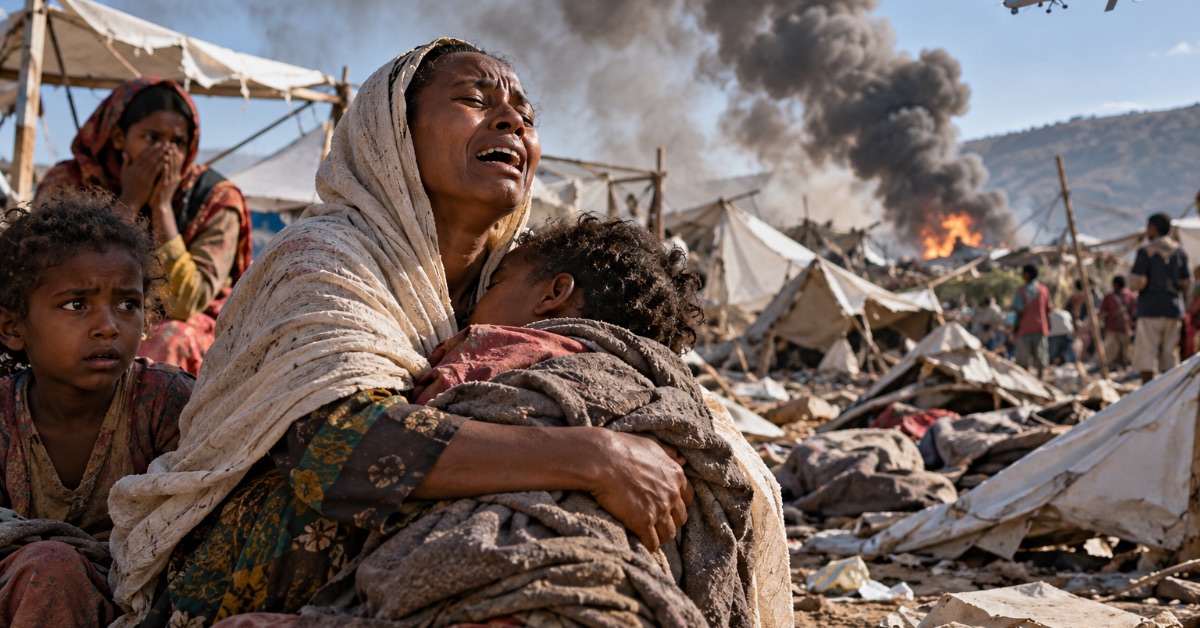
SHERARO, Ethiopia — A drone strike on a camp for internally displaced people in Sheraro, northwestern Tigray, killed at least eight people, including a child, and seriously wounded six others, according to a humanitarian worker and a witness who spoke to AFP.
The strike hit early Sunday in a camp where tens of thousands of people displaced by Ethiopia’s 2020–2022 civil war have been living. One witness told AFP that a mother, four of her children and a grandchild were among those killed. Three others also died.
That detail gives the attack a particularly stark humanitarian dimension. The people killed were not civilians newly caught on an active front. They were among those who had already survived one devastating war, lost their homes and sought refuge in a displacement camp. For families in Sheraro, the renewed conflict has not brought them back to war; in many ways, they never fully escaped its consequences.
Responsibility for the strike remains unclear. Local Tigrayan accounts have blamed the Ethiopian federal government, but AFP’s reporting did not independently establish who launched the drone. Access to affected areas remains restricted and communications have been disrupted, making independent verification difficult.
The attack comes as federal and allied forces consolidate control of Mekelle after the TPLF withdrew from the regional capital. Reuters reported that pro-government forces retook the city following a rapid counteroffensive, marking a major battlefield reversal for the TPLF.
But Sheraro is a reminder that control of Mekelle does not mean civilians elsewhere in Tigray are safe.
Across the region, displaced communities are already facing severe shortages of food, medicine, shelter and health care. Recent reporting from Tigray has documented critical malnutrition and worsening humanitarian gaps among displaced populations.The strike therefore hit a population already living with extreme vulnerability, where even surviving an attack can leave wounded civilians facing limited access to surgery, medicine and emergency care.
The incident also follows another drone strike in northwestern Tigray that hit a humanitarian aid truck carrying more than 41 metric tons of food assistance.Together, the incidents are raising new concerns about the protection of civilians and humanitarian operations as drones become a more visible feature of the renewed conflict.
The humanitarian significance extends beyond casualty numbers. Camps such as Sheraro are supposed to function as places of refuge for people who have already been uprooted by war. When violence reaches those spaces, civilians lose not only physical safety but also the assumption that there is somewhere left to flee.
The renewed fighting began on September 23 and has raised fears of a return to the devastation of the previous war. Federal forces have since pushed back the TPLF-led offensive and retaken Mekelle, but fighting and insecurity continue elsewhere.
For families in Sheraro, the military question of who controls Mekelle may feel distant compared with a more immediate one: where can civilians go when even displacement camps are no longer safe?
That is increasingly the humanitarian story of this war. The battle lines may move quickly, capitals may change hands, and political alliances may shift, but civilians who survived the last conflict remain exposed to the next one before they have had time to rebuild their lives.The Sheraro strike should therefore be investigated independently and transparently. Establishing responsibility matters, but so does protecting civilians before the next strike occurs. Every party to the conflict has obligations under international humanitarian law to distinguish between military objectives and civilians and to take precautions to minimize civilian harm.
For Tigray’s displaced population, another war does not begin with declarations from political leaders. It begins when food routes close, hospitals run short of medicine, communications disappear and the place they believed was safe is struck from the sky.