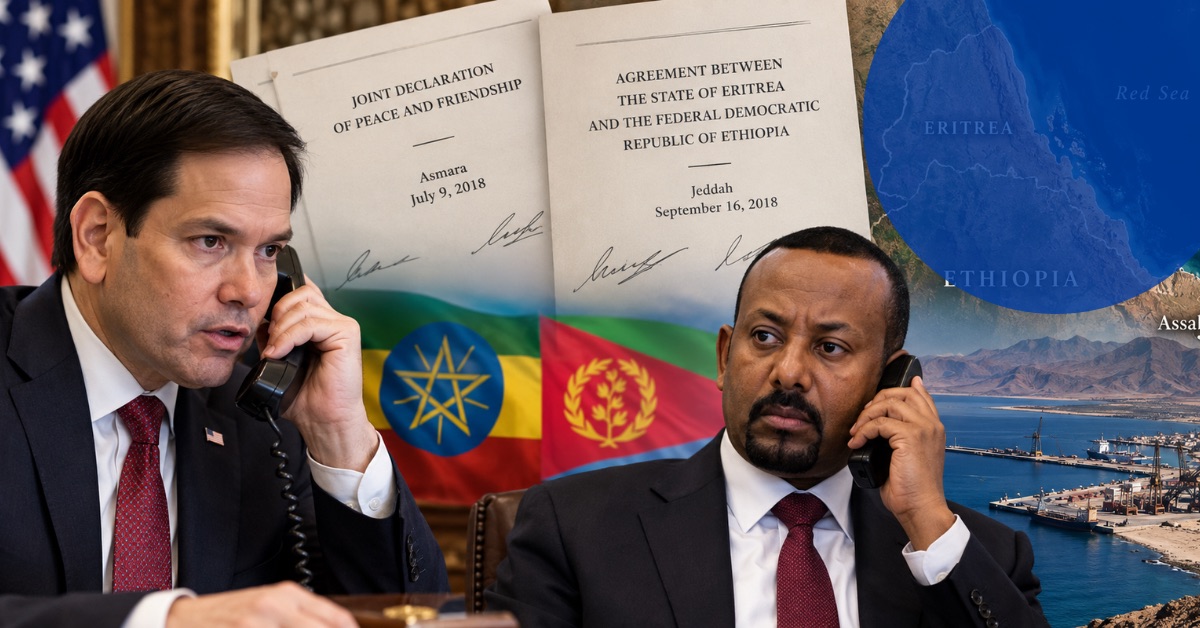


Ethiopia’s renewed demand for sovereign access to the Red Sea has brought back an old argument that history itself has already examined. Ethiopian leaders continue to speak about access to the sea as though their country was unfairly deprived of something that rightfully belonged to it. They present the issue as a matter of history, national interest and economic survival. But there is one important question they have not properly answered: where is the historical document or legal agreement that gives Ethiopia ownership of Assab?
When we go through the historical records, a different picture begins to emerge. The agreements signed in the nineteenth century, the treaties between Ethiopia and Italy, and the confidential diplomatic discussions held by American and Italian officials in 1949 all point towards the same conclusion. Ethiopia’s desire to control Assab is not the same as having a historical or legal right to possess it. In fact, some of the strongest evidence against the present claim can be found in the very treaties signed by Ethiopian emperors.
1869: Who actually sold Assab to Italy?
Let us begin with November 15, 1869. On that date, Giuseppe Sapeto, representing Italian commercial interests, entered into an agreement with Hassan bin Ahmad and Ibrahim bin Ahmad, two local Afar rulers identified as the sultans of Assab. Under the agreement, territory around Assab was purchased for 6,000 Maria Theresa thalers. Other transactions followed, and in 1882 the Italian government took over the holdings of the Rubattino shipping company.
What is important here is not only the transaction, but also the people involved. The Ethiopian emperor was not a party to this agreement. Ethiopia did not sign the document, and Assab was not transferred to Italy by an Ethiopian ruler under its terms.
Of course, the political history of the Afar coast did not begin in 1869. Different rulers and communities exercised influence in the wider region. But influence is one thing, while documented sovereignty and an international agreement are another. Anyone arguing that Italy acquired Assab directly from Ethiopia must provide the document supporting that claim. The 1869 agreement does not.
1889–1908: Ethiopia recognised the boundaries through its own treaties
The next important chapter concerns the treaties signed between Ethiopia and Italy. In May 1889, Emperor Menelik II signed the Treaty of Wuchale, which dealt with relations between the two countries and their territorial arrangements. The treaty later became controversial because of differences between its Italian and Amharic versions, particularly over Ethiopia’s foreign relations.
Following Ethiopia’s victory at Adwa in 1896, the two countries signed the Treaty of Addis Ababa. It cancelled the Treaty of Wuchale and confirmed Ethiopia’s independence. However, it did not establish Ethiopian sovereignty over Assab. Instead, the agreement addressed the boundary separating Ethiopia from Italian Eritrea.
Further boundary agreements followed in 1900, 1902 and 1908. These were not simply colonial documents prepared without Ethiopia’s involvement. They were agreements concluded with Ethiopian authorities. The 1908 convention is particularly important because it dealt with the eastern boundary towards the Red Sea.
This raises a serious question. If Assab was recognised as Ethiopian sovereign territory, why did the agreements signed by Ethiopia itself not establish that ownership? Why was the coastal territory treated separately in the boundary arrangements?
These questions cannot be answered by repeating that Ethiopia needs the Red Sea. A country’s economic needs cannot replace the written agreements it entered into.
1949: The American document that says more than political speeches
Perhaps the most interesting evidence comes from a secret American diplomatic memorandum dated March 25, 1949. The document, preserved in the United States Department of State archives, records a discussion between Italian Ambassador Alberto Tarchiani and American Assistant Secretary of State Dean Rusk about the future of the former Italian colonies.
During the meeting, Tarchiani explained that Italy was willing to cede Assab and part of southern Eritrea to Ethiopia so that Ethiopia could have an outlet to the sea. He also argued that most of Eritrea had never been under Ethiopian rule.
The Italian ambassador was speaking for his government and its political interests, so his statements should not be mistaken for an independent historical judgment. Nevertheless, the language used in this official discussion is important.
The word cede means to transfer territory or sovereign rights. Italy was discussing the possibility of transferring Assab to Ethiopia. It was not describing an existing legal obligation to return Ethiopian territory. The distinction is not a small one.
American officials themselves were considering proposals that would place much of Eritrea under Ethiopian authority. Their position reflected the political and strategic interests of that period. Yet these proposals were about what should happen to Eritrean territory in the future, not proof that Ethiopia already possessed an established sovereign title to Assab.
For Eritreans, this history also brings another troubling question. How could foreign governments negotiate the future of an entire country, including its ports and communities, without allowing its people to determine their own destiny? Eritrea was being discussed as territory to be distributed according to the interests of powerful states.
1952–1993: Ethiopia’s administration did not give it permanent ownership
We must also be fair with the historical facts. Eritrea was federated with Ethiopia in 1952 under a United Nations arrangement, and Ethiopia later incorporated Eritrea in 1962. For several decades, Ethiopia exercised authority over Eritrean territory, including its ports. Nobody needs to deny this part of history.
But temporary or previous political control does not automatically establish a permanent right of ownership. After a long struggle for independence, the Eritrean people voted overwhelmingly for independence in April 1993. Ethiopia recognised that decision, and Eritrea became an internationally recognised sovereign state.
The two countries later agreed to resolve their boundary dispute through the Algiers Agreement of December 2000. In April 2002, the Eritrea–Ethiopia Boundary Commission delivered its decision using the colonial treaties and international law. The Commission did not award Assab to Ethiopia or recognise any Ethiopian sovereign corridor to the Red Sea.
This is where the legal question becomes even clearer. Ethiopia recognised Eritrean independence and participated in a binding international boundary process. It cannot simply disregard those developments because its economic circumstances have changed.
Access to the sea is not ownership of the sea
No reasonable person should deny Ethiopia’s need for dependable maritime access. Ethiopia is a large country with important commercial interests, and access to international shipping is essential for its economy. International law recognises the importance of transit rights for landlocked countries.
But we must distinguish between access and sovereignty. Ethiopia can negotiate to use Assab, develop commercial arrangements, or cooperate with Eritrea on transport and trade. Such cooperation is possible when both countries respect each other’s independence.
What Ethiopia cannot establish merely through economic arguments is a sovereign right to take ownership of Eritrean territory. Article 125 of the United Nations Convention on the Law of the Sea concerns access and freedom of transit. It does not give landlocked countries the right to acquire neighbouring ports against the will of the coastal state.
The historical record cannot be ignored
When we put these documents together, the argument becomes clear. In 1869, the documented acquisition of Assab involved local Afar rulers and an Italian representative, not the Ethiopian emperor. Ethiopia subsequently signed treaties with Italy defining the frontier. In 1949, American and Italian officials discussed the possibility of ceding Assab to Ethiopia. Eritrea later achieved independence through a referendum recognised by Ethiopia, and the international boundary process reaffirmed the treaty-based frontier.
There is no established legal title in these documents giving today’s Ethiopia sovereignty over Assab.
This does not mean that every period of history was simple or that Ethiopia never governed Eritrea. It means that historical influence, previous administration and economic necessity cannot be used to disregard Eritrea’s present sovereignty.
The issue is not whether Ethiopia needs Assab. The issue is whether Assab belongs to Ethiopia. These are two different questions, and the historical documents do not support Ethiopia’s claim to ownership.
Eritrea does not have to surrender its territory to prove that it supports regional peace and cooperation. Good relations between neighbours begin with mutual respect, not territorial demands. If Ethiopia wants access to Assab, there is a peaceful and lawful way to discuss it. But it must approach Eritrea as a sovereign neighbour, not as a country whose coastline can be claimed through political pressure.
The history is there in writing. The treaties have been signed. Eritrea’s independence has been recognised. What remains is for these realities to be respected.