

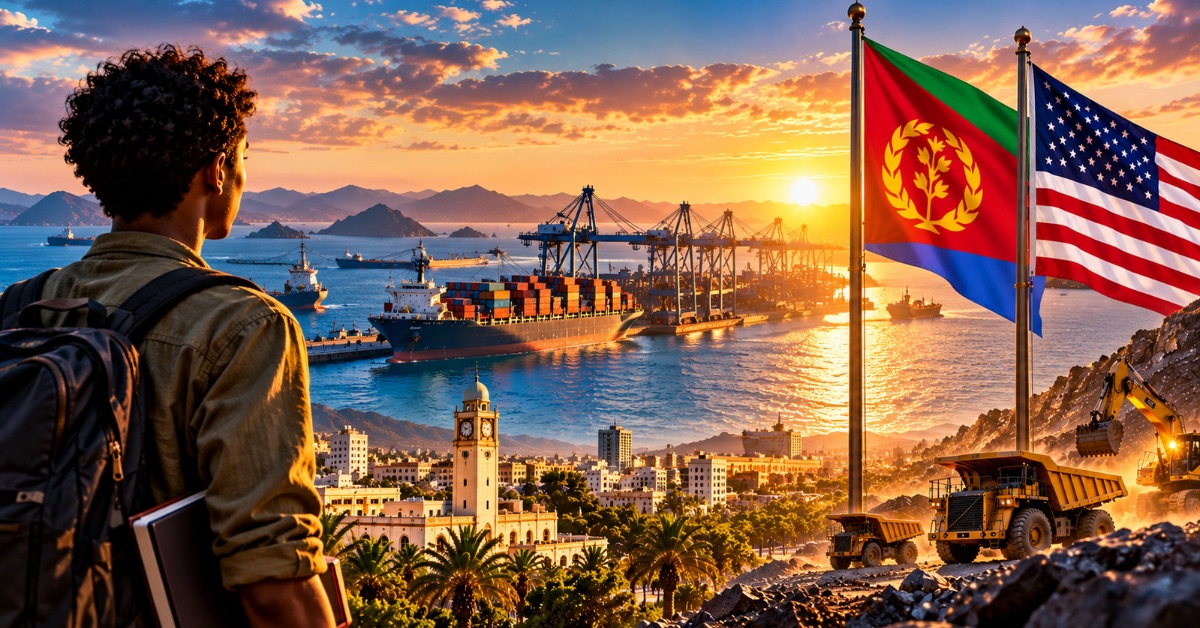
A Reuters report published on October 5 presents Eritrea as a country cautiously seeking to “come in from the cold.” The reporting is valuable precisely because Reuters gained unusual access inside the country, interviewed officials and ordinary citizens, and documented frustrations around national service, professional opportunity and political freedom. Those concerns should not be dismissed. Eritrea’s future depends on whether its young people can build dignified and productive lives at home. Yet the broader frame of a shunned country now trying to re-enter the world misses an equally important part of the story: the outside world is also reassessing Eritrea because the strategic environment around the Red Sea has changed.
Reuters itself supplies much of the evidence. The war involving Iran, insecurity around major shipping routes and continued threats near Yemen have increased the importance of Eritrea’s roughly 1,000-kilometer Red Sea coastline. At the same time, Washington has allowed the national emergency underpinning its Ethiopia-related sanctions program to expire, leading the U.S. Treasury to remove persons and entities designated under Executive Order 14046 from the sanctions list. Reuters reports that U.S. officials described the policy shift as serving American regional interests. That matters because it shows that the change is not simply Eritrea seeking acceptance. External powers are recalculating their own interests as well.
The economic side of that story becomes clearer through Seamus Cornelius, executive chairman of Danakali Limited. Cornelius spent years involved in the Colluli potash project, developed through a joint venture with the Eritrean National Mining Corporation. His recent public comments directly challenge the assumption that dealing with Eritrean institutions was itself the central commercial problem. Cornelius said the Eritrean people, companies and government departments his company dealt with were good to work with, while arguing that the difficulties they encountered were caused by U.N. or U.S. sanctions. He added that Danakali plans to return and continue doing business in Eritrea.
His testimony should not be treated as the final word on Eritrea’s investment climate. One executive cannot erase legitimate questions about regulation, access to foreign currency, the scale of the private sector or the broader policy environment. But his experience matters because it comes from someone who spent years trying to execute a large-scale project inside Eritrea. More importantly, Danakali has made a similar argument in a formal market disclosure. In a September 23 announcement, the company said removal of the U.S. measures could reduce sanctions-related compliance complexity and perceived reputational risk for financiers, contractors, insurers and joint-venture partners. It also said sanctions screening had created practical difficulties involving banks, payment channels and counterparties. Danakali is currently pursuing an exploration licence for the roughly 1,500-square-kilometer Ela Gedel gold and base-metals project in Gash-Barka.
That evidence complicates the phrase “coming in from the cold.” Eritrea certainly made choices that contributed to its political and economic seclusion, and Reuters is justified in examining them. But isolation was not produced by Asmara alone. U.N. sanctions imposed beginning in 2009 were not lifted until 2018, when the Security Council unanimously terminated them and noted that its monitoring group had not found conclusive evidence that Eritrea supported Al-Shabaab. Later U.S. sanctions associated with the Tigray conflict created another layer of financial and reputational risk. The cumulative effect was to make international companies, banks and insurers more cautious about Eritrea even where transactions were not universally prohibited.
None of this absolves Eritrea of responsibility for its own development. In fact, the present opening makes domestic reform more urgent. Reuters’ strongest reporting concerns young Eritreans who describe frustration with national service, limited professional choice and low wages. Those concerns matter. A country can successfully defend its sovereignty yet still weaken itself if educated young people conclude that their best opportunities exist elsewhere. Eritrea should therefore view reform not as a concession demanded by foreign governments, but as part of strengthening the country itself. If an Eritrean studies engineering, medicine, agriculture, information technology or mining, the national economy should increasingly be capable of turning that education into a productive career at home.
National service sits at the center of this dilemma. Eritrea’s security concerns did not emerge from imagination. Its modern history includes the 30-year independence war, the 1998-2000 border war with Ethiopia and years during which the final and binding boundary decision remained unimplemented on the ground. Today, relations with Ethiopia have again deteriorated, while questions surrounding Red Sea access have returned to the center of regional politics. Reuters itself reports that Eritrean officials see Ethiopia as their principal security concern, while Addis Ababa maintains that it seeks peaceful maritime arrangements.
In such an environment, demands that Eritrea simply dismantle its security posture as though it exists in a stable neighborhood overlook regional realities. But permanent mobilization carries costs of its own. The more difficult and useful question is how Eritrea can move gradually from a system designed around wartime survival toward one that preserves credible national defense while giving young people greater control over their education, careers and economic future. Security and reform do not have to be opposing ideas. Properly managed, each can strengthen the other.
Renewed foreign interest therefore represents both opportunity and test. Eritrea possesses significant mineral resources, ports and an important strategic coastline, but geography by itself does not create development. Foreign investment matters only if it produces skills, infrastructure, employment and productive capacity inside Eritrea. Mining should help train Eritrean engineers and technicians. Port development should support logistics, manufacturing and regional commerce. Educational reform should increasingly connect young Eritreans with sectors the country intends to develop. Engagement with outside powers should expand Eritrea’s options rather than create dependency on any one partner.
Cornelius’ testimony is valuable because it illustrates what may now be changing. Danakali once sold its interest in Colluli, yet the company is again seeking opportunities in Eritrea and publicly arguing that sanctions created serious obstacles to commercial engagement. Its formal disclosure says the removal of U.S. measures could make financing, banking and international partnerships easier. That does not prove that every obstacle facing investors originated abroad. It does show that the familiar explanation of Eritrea’s isolation as entirely self-inflicted is incomplete.
Eritrea, then, is not simply asking the world to welcome it back. The world is rediscovering that Eritrea occupies a strategic position it cannot easily ignore. The more important question is what Eritrea does with that renewed attention. If it can combine sovereignty with gradual reform, security with opportunity, and international investment with national self-reliance, geopolitical relevance can be converted into something far more valuable: a stronger economy and a country in which more young Eritreans see their future at home.
That would not be Eritrea coming in from the cold.
It would be Eritrea using a changing world to strengthen the promise of its own independence.

