

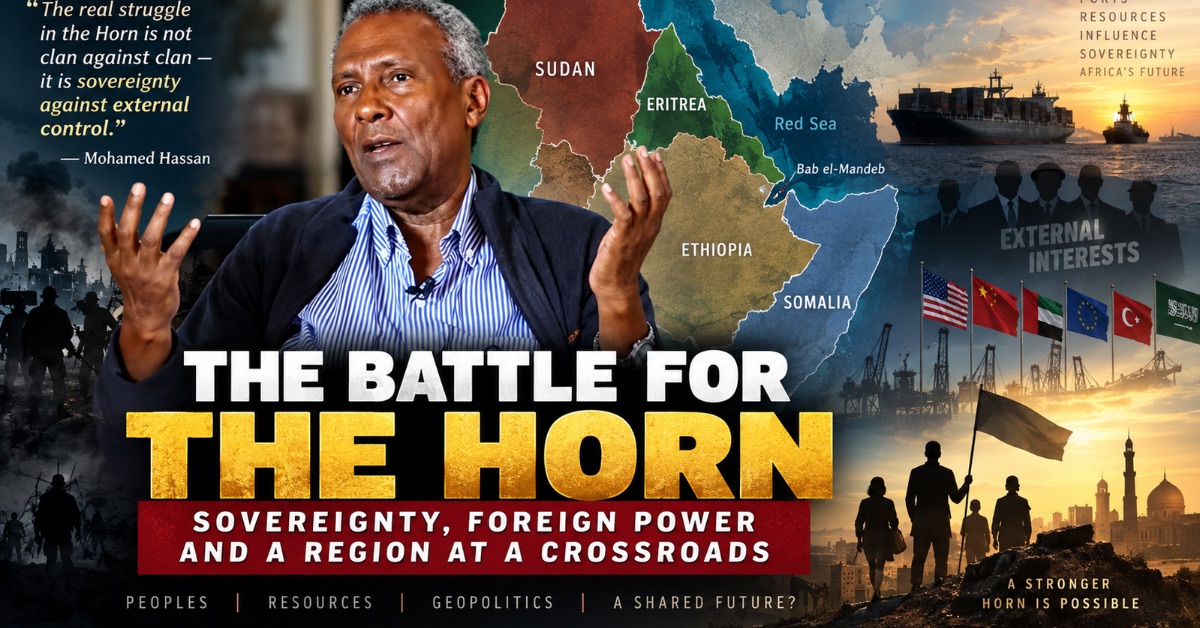
I recently watched a lengthy interview watched a lengthy interview with veteran diplomat and political activist Mohamed Hassan discussing the Horn of Africa, Sudan, Ethiopia, Somalia, Eritrea and the expanding role of foreign powers in our region.
I did not agree with every formulation. Some of his allegations deserve considerably more evidence before they can be treated as established fact. But when the interview ended, one question remained with me:
How much of what is happening in the Horn of Africa are we actually seeing?
We spend enormous amounts of time discussing the visible conflicts.
Ethiopians argue about ethnicity and political power. Sudanese are trapped in a catastrophic war. Somalis continue wrestling with fragmentation and insecurity. Eritrea remains suspicious of international systems that it believes have repeatedly been used against its sovereignty.
Yet behind these visible crises lies another struggle—one involving ports, minerals, military relationships, financial dependency, maritime routes and geopolitical influence.
Hassan’s central argument is that we cannot understand the Horn merely by studying Africans fighting Africans.
On that broader point, he deserves to be heard.
When Internal Problems Become External Opportunities
There is an uncomfortable habit in African political discussion.
One camp blames virtually everything on imperialism. Another dismisses foreign interference altogether and explains our problems entirely through corruption, ethnicity, dictatorship, tribalism or incompetence.
Neither explanation is sufficient.
Foreign powers did not invent every contradiction in the Horn of Africa.
We have produced many of our own failures.
Our governments make mistakes. Our political movements sometimes choose confrontation over compromise. Our elites manipulate ethnicity, religion and nationalism. We have failed repeatedly to construct regional mechanisms capable of resolving African disputes before outsiders become indispensable to their management.
We should own that.
But acknowledging our failures does not require pretending that powerful foreign states are disinterested spectators.
They are not.
The Horn of Africa sits beside one of the most important maritime corridors on earth. The Red Sea connects the Indian Ocean to the Mediterranean through Bab el-Mandeb and the Suez Canal.
Ports along these waters are strategic assets.
Sudan possesses gold and agricultural potential. Somalia possesses an enormous coastline and potential offshore resources. Ethiopia represents a huge market while remaining geographically landlocked. Eritrea occupies more than a thousand kilometers of strategically important Red Sea coastline.
Anyone who believes major powers look at this geography purely through humanitarian considerations misunderstands international politics.
Countries pursue interests.
The United States does it. China does it. Russia does it. Türkiye does it. Saudi Arabia does it. The United Arab Emirates does it.
African states must learn to do the same.
Hassan’s Ethiopia Argument
One of the most provocative moments in the interview comes when Hassan describes Ethiopia as effectively becoming a colony of the United Arab Emirates.
That is an extraordinary claim.
I would not state it as fact without substantially more evidence.
But dismissing the entire argument because of the language would also be a mistake.
The more important question is how much influence foreign capital, security relationships and diplomatic patronage can acquire over a strategically vulnerable state.
Ethiopia today faces serious economic pressures while simultaneously searching for investment, security partnerships and dependable access to the sea.
There is nothing inherently wrong with any of those objectives.
Ethiopia has legitimate economic interests.
The problem begins when legitimate national interests are mixed with historical entitlement toward neighboring sovereign states.
Eritrea’s coastline is not the solution to Ethiopia’s internal economic problems. Access to maritime commerce can be negotiated. Sovereignty cannot.
This distinction matters enormously.
The Horn needs trade corridors, railways, electricity connections, ports and economic integration. Eritrea itself would benefit from a peaceful and economically productive neighborhood.
But regional integration must be voluntary.
No country should have to surrender sovereignty so another can solve its geography.
Then There Is Sudan
Sudan makes Hassan’s broader warning much harder to ignore.
Its war is fundamentally Sudanese, involving Sudanese armed actors and a long history of unresolved problems within the Sudanese state. But it has also become deeply internationalized.
Foreign weapons, money, diplomatic relationships and regional interests have become part of the conflict.
Sudan has accused the UAE of supporting the Rapid Support Forces. The UAE rejects those allegations. The dispute has reached international forums.
Whatever conclusions ultimately emerge regarding individual allegations, the larger phenomenon is already visible: Sudan’s internal struggle exists within a much wider geopolitical competition.
And Sudan should frighten every serious African policymaker. When national institutions collapse far enough, outside powers do not necessarily need to invade.
Domestic factions begin searching for foreign patrons themselves. That is one of the most dangerous stages in the destruction of sovereignty.
Once competing political or military forces depend upon different external sponsors, compromise becomes more difficult because the conflict develops interests beyond the battlefield. Sudan’s tragedy should therefore be studied throughout the Horn. Not simply as a Sudanese tragedy.
As a warning.
Then M. Hassan Turned to Eritrea This was naturally the portion of the interview that interested me most.
Hassan describes Eritrea as a country punished and isolated partly because it refused to participate obediently in an international system of dependency.
There is something important in that argument.
Eritrea has made sovereignty almost sacred since independence. To understand why, one must understand Eritrean history.
Our independence was not handed to us through a diplomatic conference. Eritreans fought for it for thirty years, often while international calculations worked against Eritrean aspirations. That experience created a political culture deeply suspicious of dependency.
So when outsiders sometimes ask why Eritrea does not simply behave like other aid-dependent African states, they misunderstand the country. Eritrea’s resistance to dependency is not merely economic policy. It is historical memory.
The country has resisted allowing foreign NGOs unlimited influence over national development. It has been cautious toward international financial institutions. It has emphasized domestic capacity, national service and self-reliance.
But those of us who believe in Eritrean sovereignty must also be capable of asking difficult questions about our own country.
Self-reliance cannot become an excuse for stagnation. Sovereignty cannot only mean surviving pressure. Eventually it must produce prosperity.
A genuinely self-reliant Eritrea must create opportunities that persuade young Eritreans that their future can be built inside Eritrea. It must develop agriculture, ports, manufacturing, technology, education and human capital. It must strengthen institutions.
And reform, when necessary, should emerge organically from Eritrean society—not because Washington, Brussels or anybody else dictates it, but because a confident nation continuously improves itself.
That distinction matters. Defending Eritrea from external interference does not require pretending Eritrea has nothing to improve.
Somalia and the Convenient Explanation of Clanism
M. Hassan’s discussion of Somalia was equally interesting. For decades we have heard Somalia explained through one word: clan. Of course clan politics matter. But Hassan asks us to look beyond that explanation toward resources, oil interests, foreign intervention and the political economy that grew around Somalia’s collapse.
His strongest claims require careful investigation.
Still, the question itself is legitimate.
Who benefits from weak African states?
Who signs resource agreements when governments are desperate?
Who controls ports?
Who finances political actors?
Who trains security forces?
Who receives exploration rights?
Who mediates disputes?
Follow those relationships and sometimes a very different map of African politics appears. The lesson should not be that foreigners created every Somali problem. The more useful lesson is that domestic fragmentation creates opportunities for external manipulation.
Where Hassan Is Most Convincing
The strongest part of Hassan’s argument, for me, was ultimately not about the UAE, Ethiopia, Somalia or even Eritrea. It was his emphasis on political consciousness. Africans must understand the interests surrounding them.
That does not require becoming anti-Western, anti-Arab, anti-Chinese or anti-anyone. It requires becoming pro-African sovereignty.
Eritrea should cooperate with countries that respect Eritrean sovereignty. Ethiopia should do the same. Sudan and Somalia should.
And eventually the countries of the Horn must develop enough political confidence to speak directly to one another instead of communicating through foreign capitals.
Imagine the alternative.
Eritrean ports serving peaceful regional commerce. Ethiopian markets connected to Red Sea trade through negotiated agreements. Sudan stabilized and rebuilding. Somalia controlling and benefiting from its enormous coastline.
Regional infrastructure connecting populations rather than armies crossing borders. None of this requires erasing national borders. It requires respecting them.
The Real Struggle Is Sovereignty
When Mohamed Hassan’s interview ended, I was left thinking less about imperialism as a slogan and more about sovereignty as a responsibility.
Foreign powers will continue pursuing their interests in the Horn. We cannot stop them from having interests.
Nor should we expect them to place ours ahead of theirs. The responsibility belongs to us.
Eritrea must become strong enough economically and institutionally that independence is not merely something we commemorate every May, but something reflected in the opportunities available to every Eritrean. Ethiopia must reconcile its economic ambitions with the sovereignty of its neighbors. Sudan must eventually rebuild a national political order independent of competing armed factions and their external relationships.
Somalia must continue rebuilding a state capable of negotiating with the outside world from national strength.
And the peoples of the Horn must learn something our history has repeatedly tried to teach us:
A divided region invites intervention. A dependent state negotiates from weakness. And sovereignty that is not supported by economic, institutional and national strength will always remain vulnerable. Mohamed Hassan may not have provided every answer.
But his interview raised a question Africans cannot afford to ignore. When the world’s powers look toward the Horn of Africa and the Red Sea, they know exactly what they want.
Do we?

