

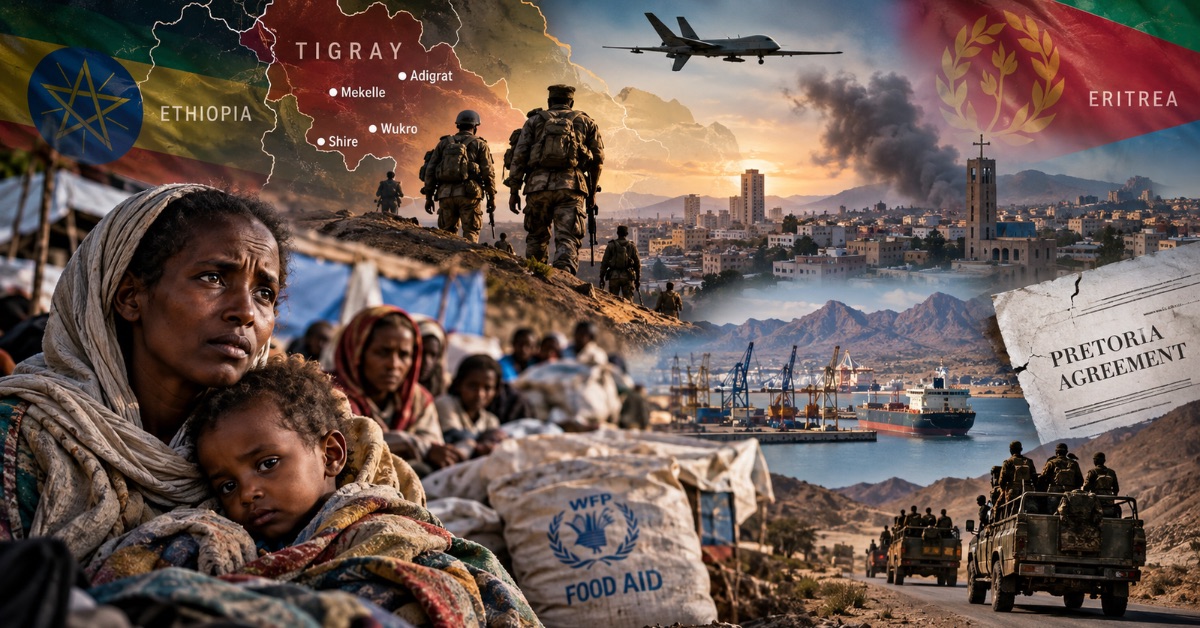
As Ethiopian forces reportedly regain control of major towns in Tigray, allegations of Eritrean military involvement are raising fears of a wider conflict. But before accusations become accepted facts, serious questions about the evidence must be answered.
The war in northern Ethiopia has taken another dangerous turn. In the space of a week, Ethiopian federal forces and their allies have reportedly regained control of Mekelle, the Tigray People’s Liberation Front (TPLF) has withdrawn from several important positions, and reports of drone strikes and military movements have spread across the region. Relations between Ethiopia and Eritrea have deteriorated sharply, while accusations that Eritrean troops are operating inside Tigray have become a prominent part of the international coverage.
But beyond the competing military claims, another tragedy is unfolding. Millions of people in Tigray are struggling to survive, and the renewed fighting is making an already desperate humanitarian situation worse. According to figures cited by The New Humanitarian on October 8, approximately 3.9 million people require emergency food assistance, while an estimated 3.2 million people in need are not receiving it. These figures are drawn from regional humanitarian assessments and should be understood as reported estimates, but they reveal the scale of the crisis confronting ordinary families.
For Eritrea, the developments across its southern border are deeply concerning. The country has every reason to follow the fighting closely, particularly given Ethiopia’s repeated statements about access to the Red Sea. But there is a difference between recognizing a genuine security threat and accepting every allegation circulating during a war. That distinction is becoming increasingly important.
The Fall of Mekelle Does Not Mean the War Is Over
The most important reported military development was the return of Mekelle to Ethiopian federal control. TPLF forces withdrew from the regional capital, and subsequent accounts described further federal advances toward Agula, Wukro and other parts of Tigray. Reports also indicated that TPLF forces had left Shire, another strategically important town.
These are significant developments, assuming the reported changes in control are sustained. But anyone familiar with the history of the Tigray conflict should be cautious about declaring victory too early. The TPLF has previously demonstrated an ability to withdraw from urban areas, reorganize and continue fighting. Whether its latest retreat is part of a deliberate strategy or the consequence of serious military losses remains unclear.
For Prime Minister Abiy Ahmed, taking control of major towns may offer an immediate military and political advantage. Keeping those towns secure, restoring public services and establishing an administration that residents regard as legitimate will be a much harder challenge. Reports of looting, disrupted services and insecurity in Mekelle suggest that military control has not automatically brought stability.
There is also the question of the Pretoria agreement. Signed in November 2022, it was supposed to bring an end to the previous war and establish a path toward political normalization. The return to major fighting raises questions not only about its implementation but also about whether the parties remain committed to resolving their differences through that framework. Without a political settlement, the latest military gains may simply mark another stage in a conflict that has already devastated the region.
While the Armies Fight, Millions Face Hunger
The humanitarian situation deserves far more attention than it is receiving. Tigray was already struggling with drought, damaged agricultural production, displacement and the consequences of the previous war. Renewed fighting has added another layer of hardship to communities that have had little opportunity to recover.
The latest humanitarian reporting describes severe food shortages and widespread disruption to relief operations. Aid organizations have reportedly lost vehicles, medical equipment and essential supplies during looting in Mekelle. One local organization that had been supporting displaced families and thousands of vulnerable children has reportedly been forced to suspend much of its work.
The exact circumstances of these incidents, including responsibility for the looting, still require investigation. But the human consequences are difficult to ignore. Families who were already dependent on assistance now face additional uncertainty over whether food and medicine will reach them.
It is easy to discuss military advances on a map. It is much harder to explain what those advances mean for a mother trying to feed her children, a patient whose hospital has lost its equipment or a displaced family wondering whether it is safe to return home.
Whoever controls Mekelle and the surrounding areas has a responsibility to protect civilians, maintain public order and allow humanitarian organizations to operate safely. The same obligation applies to all armed groups. The people of Tigray should not have to endure another humanitarian disaster while political and military leaders compete for control.
The Allegations Against Eritrea: Where Is the Independent Evidence?
Perhaps the most politically sensitive development of the week has been the reporting that Eritrean soldiers entered northern Tigray through the Zelambesa area and were seen around Adigrat.
Reuters, AFP and other international outlets have published accounts attributed to local residents who reportedly identified Eritrean soldiers and military vehicles. Conflict monitors have also reported alleged cross-border movements and drone attacks on vehicles believed to be associated with Eritrean forces.
These are serious allegations. If independently confirmed, they would have major implications for relations between Ethiopia and Eritrea. But that is precisely why the evidence must be examined carefully.
Some reported witnesses identified the soldiers through uniforms or the appearance of military vehicles. Others provided information obtained from relatives. Such accounts may offer important leads, but they do not necessarily establish who commanded the soldiers, what their mission was or whether they were operating in cooperation with the TPLF.
There is also a difference between claiming that Eritrean troops were seen in Tigray and claiming that Eritrea is participating in Ethiopia’s internal war. Those are separate propositions, each requiring its own evidence.
Eritrea has denied involvement. Ethiopian officials have accused Asmara of supporting forces fighting the federal government. Both positions are part of the political dispute, but neither an accusation nor a denial should be treated as the final word.
The public needs independent corroboration, not simply competing statements from governments already at odds with one another.
The Adigrat Question Journalists Need to Answer
One issue deserves particular attention: how were the reported eyewitness accounts from Adigrat obtained during the communications disruptions affecting Tigray?
The region has experienced interruptions to telephone and internet services during the fighting. Ethiopian authorities have exercised control over telecommunications infrastructure, but the precise timing and extent of service interruptions in Adigrat have not been independently established for every relevant period.
This creates a straightforward question. If the city’s mobile networks and internet connections were unavailable when the alleged sightings occurred, how did journalists communicate with people inside Adigrat?
Were the witnesses interviewed by telephone? Did they have access to satellite communications? Were they contacted after leaving the city? Did journalists speak to them directly, or was information passed through relatives and intermediaries?
These questions matter because the difference between a firsthand account and information received from another person can be significant. Reuters, for example, reported an account from someone outside Adigrat who had received information from family members. That may be useful testimony, but it should be clearly distinguished from a direct observation.
A communications blackout does not automatically make reporting impossible. Networks may function intermittently, and journalists have other ways to contact sources. Nor does the inability to disclose a witness’s identity mean the account is unreliable. Protecting sources in a conflict zone is essential.
Nevertheless, when reports concern possible foreign military intervention, news organizations should explain as much as they safely can about how their information was obtained and corroborated.
The question is not whether journalists should be believed or disbelieved because of who they work for. It is whether the evidence presented supports the conclusions being drawn.
The Problem With Recycled Images and Videos
The photographs and videos circulating alongside the Eritrean army allegations also require careful examination.
The previous Tigray war, between 2020 and 2022, produced extensive footage of military convoys, soldiers, damaged vehicles and battlefield operations. Some of that material has resurfaced during the current conflict, often accompanied by captions suggesting that it shows new developments.
Fact-checkers have already documented examples of old material being presented as recent, including footage from a November 2020 speech by Abiy Ahmed and misleadingly edited military broadcasts.
That should make everyone cautious about accepting images shared online as evidence of current Eritrean military movements.
But it is equally important not to go further than the evidence allows. The fact that some videos are old does not prove that every image circulating about Adigrat was recorded in 2022. Each image must be examined individually, with attention to its original publication date, identifiable landmarks and the circumstances in which it was recorded.
If footage from the previous war is being used to support current allegations, it should be exposed with clear evidence of its earlier origin. If the date cannot be established, the material should remain classified as unverified.
Neither governments nor journalists should use questionable images to strengthen a narrative that has not been independently established.
Ethiopia’s Red Sea Ambitions Remain a Serious Concern
The dispute over alleged Eritrean military involvement cannot be separated from the wider deterioration in relations between Asmara and Addis Ababa.
Prime Minister Abiy Ahmed has repeatedly presented access to the Red Sea as a strategic priority for Ethiopia. There is nothing unreasonable about a landlocked country seeking dependable commercial access to ports. Ethiopia’s economy depends on international trade, and negotiated maritime arrangements could benefit the entire region.
The problem arises when commercial access becomes entangled with questions of territorial sovereignty.
Eritrea’s coastline is internationally recognized Eritrean territory. Neither historical arguments nor economic necessity can justify changing another country’s borders without its consent. Assab and Massawa are not bargaining chips in Ethiopia’s domestic political debates.
This is why Eritrea cannot afford to ignore the language coming from Addis Ababa, particularly when diplomatic relations have deteriorated and military operations are taking place near its border.
At the same time, concern about Ethiopia’s intentions should not be confused with proof that an invasion is imminent. Statements, troop deployments and military preparations must be assessed carefully, with a clear distinction between possible threats and confirmed operational decisions.
The recent summit involving Eritrea, Egypt, Sudan and Somalia also reflects the growing importance of regional diplomacy. Its emphasis on sovereignty and territorial integrity is relevant to the present tensions. But diplomatic cooperation among these countries should not automatically be interpreted as evidence of a military alliance against Ethiopia.
Eritrea’s Interest Is Peace, Backed by Preparedness
Eritrea has no reason to become involved in another Ethiopian civil war. Whether the TPLF survives, whether the federal government consolidates its gains or whether a new political arrangement emerges in Tigray are ultimately questions for Ethiopians to resolve.
But remaining outside the conflict does not mean remaining indifferent to developments that could threaten Eritrea’s security.
Eritrea has the right to maintain defensive readiness, monitor military movements near its border and prepare for possible threats to its sovereignty. Such preparations should remain defensive, proportionate and consistent with international law.
The distinction matters. A country can take its security seriously without seeking confrontation. It can reject territorial threats without becoming involved in its neighbor’s internal political struggle.
For Ethiopia, another war with Eritrea would add an entirely new dimension to an already complicated internal crisis. For Eritrea, being drawn into Ethiopia’s conflict would carry serious human, economic and security costs. Neither population stands to benefit from another interstate confrontation.
The Questions That Still Matter
After a week of fighting, some developments appear clearer than others. Federal forces have reportedly gained important territory. The TPLF has suffered setbacks but has not demonstrated that it is incapable of continuing the war. The humanitarian situation is deteriorating, and the Pretoria peace framework faces a profound challenge.
The allegations involving Eritrean troops remain consequential but disputed. They require more than political accusations, eyewitness descriptions or photographs of uncertain origin.
How were the witnesses in Adigrat contacted? What independent evidence confirms the identity of the reported soldiers? Can military movements be established through authenticated footage or satellite imagery? And do the available facts demonstrate Eritrean participation in the conflict, or are broader conclusions being drawn from evidence that remains incomplete?
These are not questions designed to dismiss international reporting. They are questions that responsible reporting should welcome.
Eritrea’s sovereignty must be respected, and Ethiopia’s internal war must not become an excuse for threatening its neighbor. At the same time, Eritrea’s interests are best served by insisting on credible evidence, maintaining defensive preparedness and avoiding unnecessary escalation.
The people of Tigray need food, medicine, security and a political settlement. Ethiopia needs a way out of its internal conflict. Eritrea needs peace along its border and respect for its territorial integrity.
The Horn of Africa has already paid an enormous price for wars fueled by mistrust, political ambition and competing narratives. It cannot afford another one built on allegations that have not been adequately tested.
Editorial note: This article draws on reported developments and humanitarian assessments. Allegations of Eritrean military involvement, specific drone targets and the origins of circulating Adigrat imagery remain subject to independent verification.

