
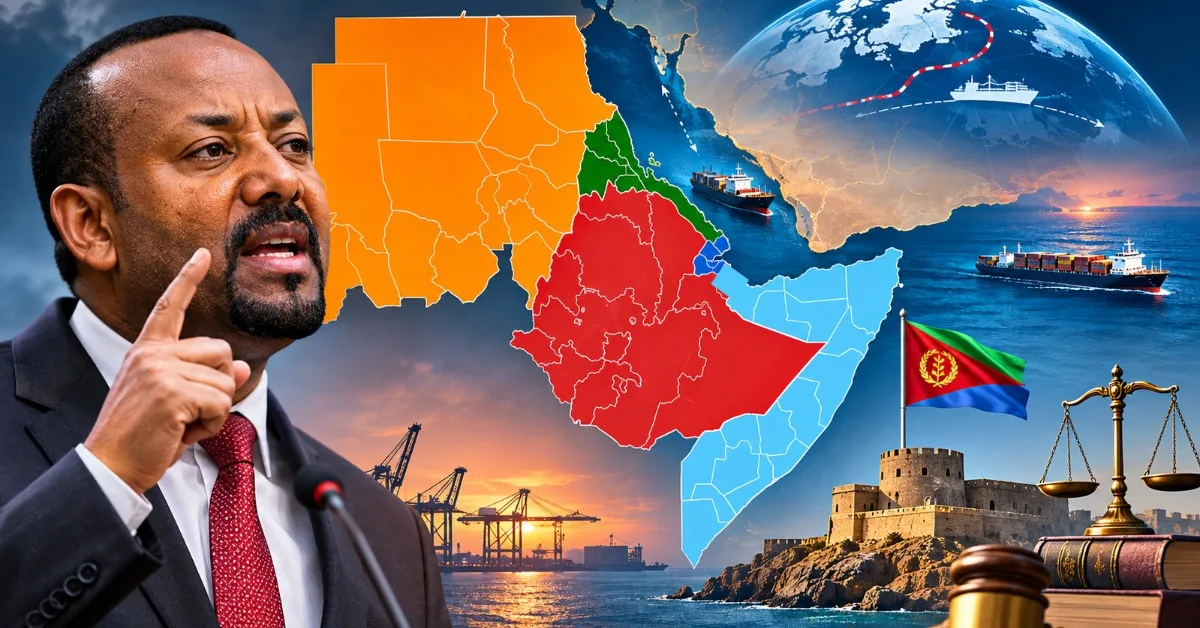
There is something revealing about Abiy Ahmed’s latest remarks on Eritrea and the Red Sea. For all his assurances of peaceful coexistence and mutual development, the Ethiopian prime minister continues to speak about maritime access in terms that go well beyond economic necessity. His references to historical territorial transfers, Ethiopia’s demographic weight and what he calls a strategic awakening raise a fundamental question about the nature of his government’s ambitions.
Ethiopia’s need for reliable maritime access is neither new nor controversial. What is controversial is the growing tendency to present Ethiopia’s geographical circumstances as a historical injustice that its coastal neighbors are expected to correct.
The Shatterbelt Argument
Abiy predicts that within five, ten or fifteen years, the Red Sea will cease to be what he calls a Shatter Zone. He attributes this anticipated transformation to melting Arctic ice and Russian icebreaker technology, which could open shorter shipping routes between Asia and Europe.
“It will not continue as it has for the past 400 years,” he declares.
There is some merit in discussing how emerging Arctic shipping routes might reshape international trade. But Abiy’s conclusion confuses commercial geography with geopolitical reality. A Shatterbelt, as explained by political geographer Saul Bernard Cohen, is a strategically important region where internal conflicts, regional rivalries and external power competition intersect.
The opening of an alternative shipping route will not end the war in Sudan, resolve Yemen’s political crisis, stabilize Somalia or settle interstate disputes in the Horn of Africa. Neither will it erase the strategic interests of the countries bordering the Red Sea. Arctic navigation also faces considerable environmental, technological, commercial and infrastructural limitations.
The more interesting question is why Abiy has made the Red Sea such a prominent national strategic objective while simultaneously predicting its declining international importance. Ethiopia’s commercial interest in maritime access could certainly survive such a decline, but that does not explain his repeated references to territorial settlements.
What Exactly Has Ethiopia Awakened To?
Abiy argues that Ethiopia’s political elites made a historical mistake in their understanding of the Red Sea.
“We are now experiencing a strategic awakening. We have awakened to the fact that this was wrong,” he says.
He goes further, distinguishing Ethiopia’s permanent strategic interests from temporary operational approaches. In other words, the methods may change, but the objective remains.
Eritreans have every reason to ask what exactly this awakening entails. Is Abiy correcting Ethiopia’s failure to diversify its commercial access to the sea, or does he regard the territorial reality that emerged from Eritrea’s independence as a mistake?
His historical references make this question particularly relevant. Abiy cites Jordan’s agreement with Saudi Arabia, Iraq’s access to the Persian Gulf and Poland’s acquisition of coastal territories from Germany. These are not ordinary port-use agreements. They involve territorial arrangements and, in some instances, the redrawing of international borders.
Even his historical account requires correction. Jordan already had a coastline before its voluntary territorial exchange with Saudi Arabia in 1965. Poland regained access to the Baltic Sea following the First World War, contrary to Abiy’s suggestion that it had no maritime access until the Second World War.
If Ethiopia simply wants affordable access to ports, there are numerous commercial arrangements around the world from which it could draw inspiration. Why, then, does Abiy find territorial transfers more compelling?
When Geography Becomes a Political Argument
Perhaps the most peculiar part of Abiy’s speech is his comparison between Ethiopia’s maritime ambitions and the natural flow of the Blue Nile. He argues that attempting to prevent the river from entering Sudan would be futile because it would sweep away those who tried to obstruct it.
“The Red Sea issue is similar,” he concludes.
But a river does not formulate foreign policy. It does not negotiate treaties, recognize international borders or decide whether to respect the sovereignty of neighboring countries. Governments do. Ethiopia’s maritime ambitions are political objectives, not natural laws. Presenting them as geographically inevitable obscures the responsibility of those who formulate and pursue them.
Abiy also invokes Ethiopia’s population size, asking his audience to imagine ten million Ethiopians moving into Eritrea, another ten million into Somalia and another ten million into South Sudan.
“They would automatically become the majority,” he says.
He presents this hypothetical scenario as a warning about the regional consequences of Ethiopia’s destabilization. Nevertheless, introducing the demographic vulnerability of neighboring countries into a discussion about maritime access is deeply troubling. Smaller nations should not be expected to make territorial concessions out of fear of instability in a larger neighboring country.
Ethiopia’s population is an asset to Ethiopia. It is not a source of additional sovereign rights.
Peace Cannot Be Conditional on Territorial Concessions
Abiy insists that Ethiopia has no intention of invading Eritrea. He speaks of negotiation, mutual development and cooperation. These assurances deserve acknowledgment, but they cannot be examined in isolation from the rest of his speech.
“Whether you like it or not, a country called Ethiopia exists beside you. It is growing. It is expanding,” he tells the countries surrounding the Red Sea.
He also warns that regional peace is unrealistic if Ethiopia remains closed off on land and in the air. Meanwhile, he accuses Eritrea of arming Ethiopia’s enemies, an allegation that requires independently verifiable evidence.
There is a considerable difference between inviting a neighbor to cooperate and warning that peace may become impossible unless that neighbor accommodates one’s demands. The credibility of any peaceful negotiation depends on both parties having the freedom to reject proposals without facing threats or coercion.
International law is sufficiently clear on this matter. Article 125 of the United Nations Convention on the Law of the Sea recognizes the maritime transit rights of landlocked countries while safeguarding the sovereignty and legitimate interests of transit states. Access to the sea does not mean ownership of the sea or the territory through which that access is secured.
Eritrea Is Not a Problem Ethiopia Needs to Solve
Eritreans need not wish Ethiopia harm to defend their country. A peaceful, prosperous and stable Ethiopia is in Eritrea’s interest. But Ethiopia’s domestic challenges, however considerable, cannot become Eritrea’s territorial responsibility.
Equally, Eritrea’s response must extend beyond rejecting external pressure. Building strong national institutions, advancing justice, strengthening the economy and restoring confidence among Eritreans are essential components of national security. Defending sovereignty and addressing domestic shortcomings are not competing responsibilities. They reinforce one another.
If Abiy genuinely wants the Red Sea to cease being a Shatterbelt, Ethiopia can contribute by resolving its internal conflicts, respecting established international borders and pursuing commercial cooperation without territorial pressure. Reopening settled questions of sovereignty risks adding another layer of instability to an already troubled region.
Eritrea’s independence is not a historical mistake awaiting Ethiopia’s strategic awakening. It is the legitimate achievement of a people whose sovereignty carries the same weight under international law as that of any other nation.
The Red Sea does not need a new master. It needs neighbors who have finally learned to live alongside one another without questioning each other’s right to exist within their own borders.