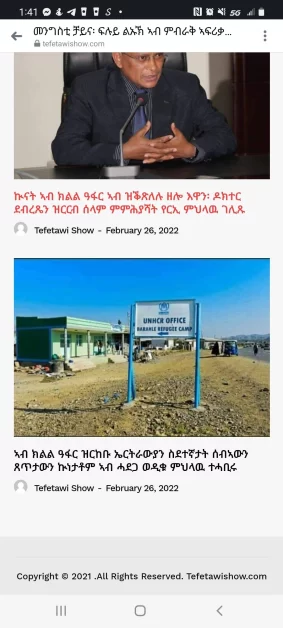
A website TEFETAWI SHOW without authorization copied entire contents of several Tigrinya news stories from Setit Media, Saturday, February 26. TEFETAWI TALKSHOW site placed Setit news articles on its site not only failed to cite source or link the content to Setit, but also removed bylines of setit media journalists from the stories and placed Tefetawi show.
Setit material in the past had been subjected to plagiarism but this incident was unprecedented immediately triggering a system notification alert.
Exceeding beyond the level of plagiarism, an over 10 setit media Tigrinya news articles were harvested by TEFETAWI TALKSHOW website. Setit media material are now moved from the website after we informed contact person to remove them.
Such act is considered online theft – unlawful copying or reproduction action and is prosecuted under the law violation of the Digital Millennium Copyright Act (DMCA).
Setit media is run by volunteer journalists and web content specialists. The website is among the few credible sites producing news, articles, and YouTube programs with contents focusing on Eritrea, regional and international issues.
They say the death of an elderly man is like a burning library. How would one measure the loss or cope grief when such figure wasn’t just aged but he was Patriarch for the Eritrea Orthodox Tewahedo Church, Abune Antonios? A leader deposed, and under house arrest for over 15 years.
What is the calamity of such loss of a leader of religious group that makes up 40% of the Eritrean population? And do we mourn or celebrate his life knowing such God serving figure-this burning library was left to burn slowly before demise? It is all mixed feelings. conflicting feelings driven by anger, guilt and despair. At its core, this burning emotion is endless superfluous mistreatment of Eritreans – regardless of religion affiliation, ethnicity or rank.
If there is anything well retained in the memories of Eritreans, it is their historic struggle for independence, offensive wars from the south and the unaccounted and silenced many perishing – jailed Eritreans who question or criticize the administration of president Isayas Afwerki, yet the nation to hear their fate.
With similar circumstances, some nations read their prisoners verdict, others issue pardon -and Eritreans dare ask. Many are languishing in prisons inside Eritrea for decades with no due process.
With no official statement from Issaya’s administration and no news report by Eritrean government run media, reports on the death of Patriarch, Abune Antonios, the third Patriarch of the Eritrea Orthodox Church surfaced in social media on Wednesday.
Anger and guilt of failure, knowing this is another passing of Eritreans jailed and held incommunicado. And just like the rest their body put to rest in graves with no questions asked or explanation offered. In 2018 Eritreans grieve for the passing of Haji Musa Mohamed Nur, honorary president of the Al diaa Islamic school who died in detention in Asmara. Both religion leaders stood for the autonomy of religion and resists government intrusion.
The never ratified constitution of Eritrea of 1997, article 19 (Freedom of conscience, religion, expression…..) address the rights that were denied to those religion leaders. Gazette of Eritrean Laws, Proclamation 73/1995, also outline separation of religion and government.
In May 2021, the government of Eritrea announced Eritrean Orthodox Tewahdo Church had elected Reverend Abune Qerlos as the patriarch, claiming it was conducted in accordance with the norms and regulations of the Holy Synod and the Church.
For many it came as a shock. It was unheard of for the Orthodox Tewahdo Church to elect a new Patriarch, when it’s sitting Patriarch, Abune Antonios, the third Patriarch was still alive. The government in power will go to such length, announce the election of church leader, when the leader in power, President Issayas Afwerki shies away from election and leadership responsibilities – an issue that had landed many Eritreans in prison. The Orthodox Tewahdo Church, pressured by the government of Eritrea to replacing the late Abune Antonios while still alive and on house arrest was a total sham to say the least.
With life expectancy for male Eritreans at 64-65, Eritrean Patriarch Abune Antonios, the third died at the age of 94. His death at such age indeed calls for us to celebrate his life. Alas we will always be reminded as a nation, Eritrean Patriarch Abune Antonios spend the last 15 years of his life not serving his God and church but in house arrest.
“The church, that we had inherited from our fathers is autonomous and we abide by its rules. I was in jail for the past 12 years and I still remain in jail for following those rules.” Those are direct quote of Abune Antonios during public appearance in 2018. “I shall not abandon but die upholding the rules of the church and I pray to God to bestow strength upon me.”
Abune Antonios has passed remembered by Eritreans and the world as principled leader who stood up to power to protect the orthodox Tewahdo church and its congregation.
In Tigrinya they say Nemewot aytebkeyo, nehelfet bekeyo (ንምውት ኣይትብከዩ ንሕልፈት ብኽዩ) – close translation, don’t cry for the death, cry for the ineffective. Imagine what could have been accomplished if government of Eritrea is run by a leader, just like Abune Antonios, a leader who serves and put the nation and its people first, rather than one dictates, intimidates and set the nation on down spiral. Those are the times one is remined indeed, ንምዉት ኣይትብከዩ ንሕልፈት ብኽዩ።
Refugees must not be held hostages in the conflict. Those are words we often hear from UN and UN agents for refugees and human rights. But yet Eritrean refugees in Tigray are treated as hostages, assaulted, raped and dying not only from boom shells but from hunger and shortage of medical treatment.
“10 refugees died when I was still in the camp.” said Tecklit one of the refugees who spoke to Setit Media journalist Abdu Ismail. Tecklit made it safe last week from Adi Harush to Dabat camp in the Amhara region. “A mother took her life, cause she didn’t have food to feed her kids, the next day another died while in labor due to lack of medical attention. In our camps there are stories also of children death attributed to trauma and hunger.”
The situation of Eritrean refugees is getting worse as they are running out of belongings that they can sell to buy food. We will sell one cloth and buy a half kilo onion or tomato and now refuges in camp are running out of cloths, and I don’t know what they will do, recalls one witness who made it to Dabat camp last week. Villagers from close area would stop on their way to town and buy clothes from the refugees.
UNHCR spokesperson Boris Cheshirkov, had also echoed similar situation in the camps, in a virtual press briefing held at the end of January after UNCHR staff were able to reach camps of Mai Aini and Adi Harush in Tigray. Those two camps are home to over 25,000 Eritrean refugees. And despite the ongoing call for a safe passage and relocation to a safer region or third party, refugees find themselves entangled, vulnerable and prone to political exploitation. Neither the Ethiopia Federal government nor the Tigray regional government had taken measures to ensure safety, conducive human condition or facilitate their relocation.
Moreover, with ongoing conflict between Ethiopia’s regions of Tigray and Afar, many more Eritrean refugees are at risk. Despite talks on peace and reconciliation, all parties, including the Ethiopia government are engaged in blackmailing and pointing fingers, while innocent, unprotected civilians including refugees are left to deal with catastrophes owing to constant conflicts that keep ignited in regions of Ethiopia. One could argue Ethiopia PM Abiy “Leave no stone unturned” for lasting peace remarks during the 35th African Union Summit is merely rhetoric, giving the ongoing conflict in Afar region waged by TPLF. A shift in paradigm may be, but Ethiopia is still in civil war and safety, security and lasting peace seems a far cry. And for Eritrean refugees in Afar region and Tigray the situation is much worse.
UN staff members who visited Adi Harush and Mai Aini at the end of January reported deteriorating conditions of both camps and Eritrean refugees starving and barely getting enough to eat, lack of medicine and access to clean water. Refugee who spoke to Setit media point out it is much worse.
On top of shortage of food, water and medical supplies, Eritrean refugees in Tigray are constantly at fear for their lives. Armed forces target refugees for pity theft. “There is no security. In broad daylight armed young men had robbed refugees, they will empty whatever they find in our pockets, take our mobile phone, jewelry and anything they think valuable.” Says Tecklit. At nights, the men will be on watch to protect the camp, but often met with armed predators. Unarmed, hungry and some even ill Eritrean refugees will take shifts at night to protect the most vulnerable, women and children and chase the robbers despite gun shots being fired at them. “We lost three men during those firing at night.” said Tecklit.
Every day Eritrean refugees in Tigray grapple with hunger, illness, and terror and there is no sign of end to the debacle. And for many refugees who were able to escape the dire situation at the refugee camps in Tigray they feel they were abandoned by the international communities.
At times it is hard to distinguish between the aid staff and individuals from the regional government who visit the camps says Tecklit. Aid staff in UN vehicles will pay refuges a visit , conduct interview, promising solution and report the situation to the international communities. Seldom do we hear back from the UN staff and living condition of refugees deteriorates further, and much worse, Tecklit recalls staff from Tigray administration will visit the camp and ask them to hold demonstrations along Tigrians but not independently. “We keep informing them that we are refugees, and we don’t want to get involved in politics. We did told we would rather organize our own demonstration for refugees only. And I left the camp while this confrontation was going on.” he added.
Finding themselves at a crossfire, beyond the fear of violence, Eritrean refugees in Tigray have to deal with trauma involving rape of Eritrean women refugees said Tecklit . “Armed men would take our sisters from the camp and drop them late hours at night. Some of the women will scream helplessly gripped with fear. Sometimes women are left unconscious in dark alley.”
Constant fear, with no food, clean water and no more cloths left to sell for food, Tecklit and three others, made it to Dabat camp in Amhara region. It took them 4-5 days, walking at nights to avoid being caught by TDF.
If caught running away in search of a safe place, prison and harsh conditions awaits Eritrean refugees. As some are savagely beaten with sticks and transported to detention area, they also face verbal abuse. “ You shouldn’t have brough them here. You should have killed them on the spot” Tecklit recalls the words of armed prison guards when 11 Eritrean refugees were caught and brough to the prison during his visit – his friend was caught earlier trying to make it to safety.
This might be a story of those who survived the escape from refugee camps in Tigray and made it to safer refugee camp in Ethiopia. But their dangerous journey also uncovers the untold story of the many Eritrean refugees who vanished and are missing trying to reach a safe place. “We saw many identification cards scattered everywhere in the path.” Said Tecklit.
According to UN reports from last year, there are at least 20,000 refugees missing from camps in Tigray region. Despite news of peace talks, the civil war is still on. TDF has launched offensive attack in Afar region. People are dying, innocent civilians affected and caught in this prolonged crossfire, Eritrean refugees’ plight is getting worse with no hope in sight, their horrors continue.
Sources have reported that two Eritrean refugees have been physically assaulted and have sustained critical injuries in Adi Harush, Tigray. The attack occurred on July 16th while the refugees were in search of grain mill machine. According to the report, they were attacked by armed individuals. The refugees are now admitted in the local hospital and are in critical condition. The report also added these victims are not getting sufficient treatment and care due to the shortage of medical care supplies that has been impacted by the war.
The sources also reported that the refugees in Adi harush and Mai-Aini camps are being forced to give up their currency and cellphones. The intense conflict in the area has led to the closure of the local bank and the expense of living has increased significantly.
The UN has stated that Eritrean refugees have been victim of retaliation , imprisonment and neglect in the Tigray region. Eritrean refugee has been killed by the Tigrayan militia in recent eventd as a result. Additionally ,Radio Erena reported that the refugees are forced to carry and transport armory’s that were ceased in the war.
Currently, two refugee camps have been completely destroyed and are not suitable for living conditions. The whereabouts of most of the resident refugees remains unknown up to this present time. “
Spokesperson of Ethiopian Foreign Affairs Comments about Eritreans not being happy for [tooltip text=”breaking away” gravity=”nw”]1991 Independence of Eritrea[/tooltip] from Ethiopia has caused anger among many Eritreans. This came after Ambassador Dina mufti’s comments on Tuesday March 30th. The Ambassador, when asked about exiting of Eritrean Soldiers from Tigrai Region “Eritreans never felt happy about the day that they seceded from Ethiopia and they do not respect that day” he said. “This is what Eritreans in Diaspora often talk about” the spokesperson Added.
These remarks have angered many Eritrean and they are calling out the spokesperson. Some also have demanded an apology from the diplomat. Many, including prominent Eritrean Artist Dahab Fatinga took their anger to Social media and has attracted a wide attention from many.
These comments came amid worsening humanitarian crisis in the northern region of Ethiopia, where soldiers of Ethiopia and Eritrean may have committed gross violation of human rights according to the allegation by rights group.
Friday, March 26 was a sad day for me and many Eritrean journalists. We lost a hero, a fighter, a fighter for the freedom of the press. A man who founded a newspaper to fight for justice, a man who was never afraid to express his views, a man who was a voice for the voiceless: the people who live in remote areas, the youth in the national service. A man who always prioritized the interest of his people before him, even though he knew it would cost him everything, but he did not care. A man who was always willing to speak his mind and tackle corrupt leaders.
I’ll bet you knew him. An eloquent writer, a bold and ambitious man — Milkias Mihreteab. He passed away at 52. His life was cut short because of an illness that had been torturing him for years.
He co-founded Kestedebena newspaper on November 24, 1998 with his friends Medhanie Haile, Yosief Alazar and Habteab Yemane.
Kestedebena means rainbow, and they named the paper this in order to include all facets of Eritrean life, like different colours of the rainbow. Milkias ran the newspaper as editor-in-chief and Medhanie Haile was his deputy. Because of their firm commitment, the circulation of the newspaper grew from its first issue of 5000 copies to 20,000, from biweekly to twice a week when it ended its publication involuntarily in September 2001 along with the whole independent press of the country.
The secret of Kestedebena’s success was Milkias’s bold approach to issues that were very important for the public. He wrote about the crippled transport system of Asmara, the inflated charge of taxi drivers, and the refusal of the regime to tackle the basic needs of the people.
In his editorials, there was no crucial issue that he left unexplored. What stood out for me, though, was the editorial he wrote that criticized the foreign policy of the Eritrean government. The title read “Either be a mountain or lean to a mountain.”
Seeing the shrewd approach of the Ethipian prime minister Meles Zenawi with the international community, Milkias wanted Eritrea to change its diplomatic tactics in order to be heard globally. He called on the Eritrean government to master the language of diplomacy in how it interacted with foreign superpowers like the USA — either to be a mountain or lean to it to save the people and the country.
I always enjoyed reading his unfiltered approach on issues that sometimes I didn’t have the courage to speak up about myself. When I realized the self-reliance, mantra drummed by the regime, I knew it was false. Milkias spotted that too and poured his ideas onto paper.
A mutual friend, Medhanie Haile, introduced me to Milkias first in 1997, while Medhanie was working as a sports reporter for my newspaper Setit, the newspaper I co-founded and edited. Instantly we hit it off.
Milkias was sociable, funny and intelligent. He liked to joke around but also to talk about serious issues. Whenever he met me on campus or outside, he always had good things to say about my newspaper or the articles I had written.
A year after our introduction, he launched Kestedebena with his friends. He used to say that they started Kestedebena because they had been inspired by Setit newspaper. To become the voice of the people rather than working for the ministry of Justice. He studied law but never wanted to work with his field.
The love he had for his country and his people was visible. You could hear it when he talked and read it when he wrote. There was nothing that would make him happier than seeing progress in the country — whether it was in the economy, education, health or construction. Unfortunately, that progress had been put on hold, and he could no longer talk about progress but only about relapse.
The other excellent quality Milkias had was his ability to admit his mistakes when he made one, and he was never too shy to admit to them. There was one incident that rocked our relationship for a week. One of the contributing cartoonists submitted a cartoon that criticized Kestedebena newspaper for serving the interests of the American government. The cartoonist didn’t mention the name of Kestedebena, but it was easy for readers to know especially if they followed the coverage of the paper that week. I didn’t select the cartoon, and it never crossed my mind to publish it, but to my disappointment it was published. It was a total mistake. I took full responsibility. Three days later, as a retaliation, Milkias wrote over 1000 words to attack me and my colleagues and published this column in his newspaper. To avoid the escalation of the case, we chose not to respond, but I stated that we would handle the issue legally. We never intended to sue him or his newspaper for defamation.
Two days after he published the inflammatory article, he saw me entering Bar Lidya, the bar and coffee shop in which I used to often hang out when I had an appointment near the University of Asmara. He followed me. Before I saw him, I heard his voice, “Masterey, I am so sorry.” I turned around, and it was him. As a matter of respect, he often called his friends “masterey” (my boss).
“I am so sorry. I crossed the line. I was supposed to focus on the cartoonist, not on you or your paper,” he said, regretfully.
“No, actually, I am sorry too,” I said. “I was not supposed to publish such a cartoon, but it slipped out.”
“So, you will not sue us?”
“Only if you pay for this coffee.” We both laughed.
That’s the beauty of his character. He was always straightforward and very honest. We both moved on, holding no grudges.
He was one of the few lucky journalists like me who escaped the grip of the regime at the end of 2001. Since then, he lived in Washington, DC, and pursued his struggles by blogging at Asmarino, Awate and other websites until his health hindered him.
Whenever I went to Washington DC, I used to meet him to catch up and remember our colleagues who have been in jail since 2001. The last time I met him in person was in 2012. We spent the evening together remembering the old times, our fellow journalists, the contributions they made to their country, the ambition they had, and what could have been accomplished if the crackdown hadn’t happened.
One by one we remembered all our former colleagues, particularly those reported dead: Medhanie Haile, deputy editor of Kestedebena; Matewos Habteab, editor-in-chief of Meklih; and Fessehaye Yohannes, a talented playwright and journalist.
“Do you think this news could be true?” I asked. I never forgot what he said then.
“I don’t want to believe it, but it could be true,” he said. “If we get sick often here despite breathing fresh air, how could we expect them to be alive if they have been kept in a shipping container for years?”
He was right. Year after year, we have only received worsening news. Yusuf Mohamed Ali, editor-in-chief of Tsigienay; Dawit Habtemichael, deputy editor of Mekalih; and Said Abdelkadir, editor-in-chief of Admas have all died. And we know nothing about the wellbeing of Seyoum Tsehaye, Amanuel Asrat, Dawit Isaak, Temesgen Gebreyesus and many others who were arrested in September 2001.
What frustrated him most, though, was that he was not able to do as much as he would have wished to advocate for his colleagues’ release. He never reconciled with himself and he used to take it personally as if all of this were his fault. He didn’t have the peace of mind like many of us.
Now, the hero is gone. But his legacy to journalism, his contribution to his country, and his love for his people will live forever. Rest in peace, my friend!


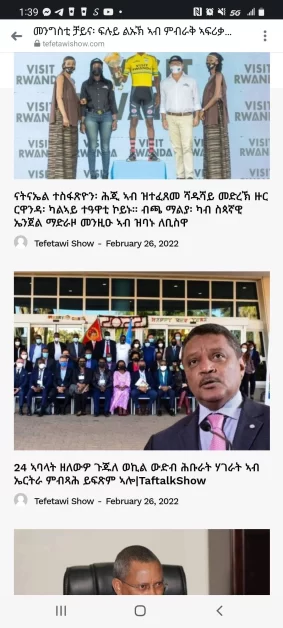 A website TEFETAWI SHOW without authorization copied entire contents of several Tigrinya news stories from Setit Media, Saturday, February 26. TEFETAWI TALKSHOW site placed Setit news articles on its site not only failed to cite source or link the content to Setit, but also removed bylines of setit media journalists from the stories and placed Tefetawi show.
 Such act is considered online theft – unlawful copying or reproduction action and is prosecuted under the law violation of the Digital Millennium Copyright Act (DMCA).

 UNHCR spokesperson Boris Cheshirkov, had also echoed similar situation in the camps, in a virtual press briefing held at the end of January after UNCHR staff were able to reach camps of Mai Aini and Adi Harush in Tigray. Those two camps are home to over 25,000 Eritrean refugees. And despite the ongoing call for a safe passage and relocation to a safer region or third party, refugees find themselves entangled, vulnerable and prone to political exploitation. Neither the Ethiopia Federal government nor the Tigray regional government had taken measures to ensure safety, conducive human condition or facilitate their relocation.
 ብመሰረት ካብ ዓለማዊ ውድብ ሕርሻ( FAO) ዝተረኽበ ሓበሬታ፡ ኤርትራ ትርከበን ሃገራት ቀርኒ ኣፍሪቃ ኣብ ትሕቲ ጽኑዕ ሓደጋ ወራር ኣንበጣ ከምዘለዋ ተፈሊጡ። ኣብዘን ዝሓለፋ ሒደት መዓልታት ኣብ ሰሜናዊ ምዕራብ ሶማል፡ ደቡባዊ ጅቡቲ፡ ምብራቕ ኢትዮጵያን ሰሜናዊ ምብራቅ ኢትዮጵያን ከምኡ ድማ ኣብ ምብራቅ ክልል ኣምሓራን ዕስለ ኣንበጣ ብብዝሒ ይረአ ምህላው እቲ ትካል ኣብ ጸብጻቡ ኣፍሊጡ ኣሎ።

 Kestedebena means rainbow, and they named the paper this in order to include all facets of Eritrean life, like different colours of the rainbow. Milkias ran the newspaper as editor-in-chief and Medhanie Haile was his deputy. Because of their firm commitment, the circulation of the newspaper grew from its first issue of 5000 copies to 20,000, from biweekly to twice a week when it ended its publication involuntarily in September 2001 along with the whole independent press of the country.
 The other excellent quality Milkias had was his ability to admit his mistakes when he made one, and he was never too shy to admit to them. There was one incident that rocked our relationship for a week. One of the contributing cartoonists submitted a cartoon that criticized Kestedebena newspaper for serving the interests of the American government. The cartoonist didn’t mention the name of Kestedebena, but it was easy for readers to know especially if they followed the coverage of the paper that week. I didn’t select the cartoon, and it never crossed my mind to publish it, but to my disappointment it was published. It was a total mistake. I took full responsibility. Three days later, as a retaliation, Milkias wrote over 1000 words to attack me and my colleagues and published this column in his newspaper. To avoid the escalation of the case, we chose not to respond, but I stated that we would handle the issue legally. We never intended to sue him or his newspaper for defamation.