Dear Eritrean diaspora refugee youth. You went through untold hardships, misery and life and death situations to arrive in Europe, Canada, and the United States. If you are ready to use it the western world provides an ample opportunity for self-improvement and change. Go to school, work hard to earn a living, and support your families at home and of course define your future. No government can be toppled by throwing stone at your fellow Eritrean compatriots. Please be aware that as resident of the western world, every person including those ardent Eritrean government supporters have the right to support whoever they want to support as long as they do not cross the law of the country where they reside.
Remember “Your right to swing your arms ends just where the other man’s nose begins”. When you try to cross that boundary, the law catches on. Those who are pushing you from behind do not cross the law themselves. Their job is to use you as a human instrument to achieve their economic and political objectives. Whatever level of hatred you may have against the Eritrean government it cannot be resolved by violence against fellow Eritreans. Violence will only burn you and your future.
Historical Background
The future of Eritrea and Its youth has been challenged many times. On 15, November 1962 when the Ethiopian Emperor Haile Selassie disbanded the Federation and annexed Eritrea, the youth flocked to the war front and joined the struggle to liberate Eritrea from Ethiopian occupiers. The Eritrean youth paid dear price to liberate their country in 1991. Although the struggle for independence achieved its objective, the 30 years bloody war and arduous journey brought Eritrea 50 years back. The human and economic cost was staggering for a small country like Eritrea to bear.
When Eritrea officially became an independent country on May 24, 1993, it seemed the future was bright and even those who fled the country, due to the Ethiopian occupation, were returning home. Yet the hope was short lived. Eritreans were once again forced to defend their country against the Tigray Liberation Front (TPLF) led invasion against Eritrea in May 1998. This war was different because it was instigated by the TPLF that was considered as the offspring of the Eritrean Liberation Front (EPLF). Again, the TPLF invasion against Eritrea consumed tens of thousands of Eritrean youths and dismantled about one third of Eritrean population from their villages.
After the war ended, the government of Eritrea and the then TPLF led Ethiopian Government agreed to adjudicate the boundary dispute in the court law. The Eritrea and Ethiopia Border Commission (EEBC) gave its ruling on April 13, 2002, and everyone was waiting for the demarcation of the border to start. Unfortunately, once again TPLF rejected the decision and dashed the prospect of peace in the Horn of Africa. Later TPLF continued its saber rattling, including conducting attacks deep inside Eritrean territory and targeting Eritrean Mining Operations with newly acquired missiles. Accordingly, the Eritrean youth were forced to stay in the trenches for close to 20 years.
TPLF and Western Intelligence agencies used such difficult situation as an opportunity to drain Eritrea’s youth from their country. TPLF’s Radio and Television stations continued telling the Eritrean youth if they came to Tigray, they would be resettled to the western world outrightly. Even Eritrean cattle herders as young as 11 years old left their cattle at the field and crossed to Tigray to be resettled to Europe, the US and Canada. Deceived by TPLF’s propaganda machine thousands of Eritrean youths ended up in TPLF managed refugee camps in northern Ethiopia and became the cash cows of TPLF extortion machinery. To show its success in dismantling Eritrean youth from their country TPLF suddenly made Tigray refugee camps a pilgrimage to western high profile officials and a means to ask for more financing.
The worst part of the sinister scheme against the unsuspecting Eritrean refugees was TPLF stole their identity and used it to resettle Tigrayans to western countries. Such despicable practice of the TPLF highlights the mafia character and cruelty of the clique. Not being aware of their identity was stolen and a Tigrayan had already been resettled in their name, many Eritreans wasted their youth life in refugee camps in Tigray. However, as the waiting time became endless they lost hope and again trekked to Sudan to be robed, raped, and killed by cruel human traffickers. Among those who arrived in Libya many lost their lives in the dangerous sea journey to Europe. Those who were lucky ended up in Europe and some in the US and Canada. When close to 350 refugees from many African countries, including Eritrea, lost their lives in the ship wreckage in Lampedusa TPLF called the African union to organize a candle lighting Vigil for them and the ceremony was held in the African Union compound in Addis Ababa. Yes, the Wolf acting out in a Sheep clothing. In the mind of the TPLF clique anything that masks realty or gives the clique a political cover is worthy of pursuing.
When Prime Minister Abiy Ahmed came to power in Ethiopia in 2018, again there was hope that peace would prevail, and the remaining Eritrean refugees would return to their country. However again the TPLF initiated a power struggle with Prime Minister Abiy Ahmed and refused to allow the demilitarization of the Ethio-Eritrea border. In fact instead of encouraging Eritrean refugees in Tigray refugee camps to return to their country, the TPLF leader openly invited Eritrean youth to come to Tigray. When TPLF attacked the Ethiopian Northern command that was stationed on the Tigray region on November 4th, 2020, the Eritrean refugees became the primary target of the Tigray militia and paramilitary groups. Many were robed, raped, killed, and forced to act as carriers to the TPLF army. TPLF kept the remaining refugees as hostages and most of them perished of hunger and lack of medicine.
The sad story of Eritrean refugees did not end in Tigray. During its 27 years reign in power in Ethiopia the TPLF was using Eritrean refugees as an instrument to overthrow the Eritrean government. Accordingly, the TPLF had already recruited the refugees and created an opposition group for each of the nine ethnic groups in Eritrea. Again, the purpose was to divide Eritreans and make them fight each other like what we are currently witnessing in today’s Ethiopia. To advance such sinister agenda, supported by the then TPLF led Ethiopian Embassies, the tentacles of TPLF created ethnic based Eritrean opposition groups spread to the Eritrean diaspora. The project to divide the Eritrean diaspora was fully funded by the TPLF. Media personalities were created, and the so-called Eritrean opposition media spewed their ethnic poison on the Eritrean youth. The TPLF funded so called Eritrean opposition media told the unsuspecting Eritrean youth that their enemy was “Eritreanism” and were pushed to target those who called themselves Eritreans. The TPLF propaganda machine worked hard to convince its messengers that there was no Eritrean identity. Eritreans were told their identify was their “ethnicity”. The objective of the propaganda was to divide the Eritrean diaspora youth based on their ethnicity and align them with the ethnic armed opposition groups created in Tigray. Such action fits to the often made claim that TPLF is not only a danger to Ethiopia but also to the horn of Africa.
When TPLF attacked the Ethiopian Federal Army based in Tigray on the night of November 4, 2020, the so called Eritrean opposition Media Personalities formerly created and funded by the TPLF joined the “Tigray Wins” slogan and openly stood against the Ethiopian and Eritrean governments. As a continuation to their sinister agenda, they organized the Eritrean diaspora youth into gang groups whose aim was to attack any Eritrean who was believed to participate in Eritrean government sponsored events. Those gangsters were made of Tigrayan’s who were born and raised in Eritrea and Eritreans who were recruited by the TPLF sponsored groups. Many of the TPLF funded so called Eritrean opposition media started to patronize expensive European hotels and pledged to raise money for the gangsters who terrorized Eritrean communities in Europe. Accordingly, many elderly men, women and children who went to the community festival in Giessen, Germany were brutally attacked.
The hijacked Eritrean refugee youth did not understand the consequence of their actions. In the western world attacking women, elders and children who were minding their own business is a criminal activity. Accordingly, many innocent Eritrean youth who failed to understand the consequences of their actions became victims. The recent bad news that is coming from Europe is the ultimate consequence of the TPLF sponsored ignorant and greedy so called Eritrean opposition media personalities. Many were thrown to prison, fired from their work and their records blemished forever. In the western world once you are classified as a violent criminal your life is messed up. Those young Eritreans who arrived in Europe and hopped to live a decent life were hijacked by the cruel TPLF trained and funded Eritrean media personalities and activists for their destructive agenda.
The truth is the so called TPLF trained Eritrean Media personalities and activists are smart enough not to cross the law themselves. None of them were seen in the areas in Europe where the violence occurred. On the back of the Eritrean youth, they were increasing their YouTube viewers and off course enriching their pockets. Many of the so called opposition media personalities and activists are based in the US but none of them were seen to organize gangs of Eritrean youth in the United States. The reason is they perfectly know what that means and the severe consequence against them.
Conclusion,
It has been a while since TPLF’s interference in the business of the diaspora Eritrean community has been crossing many red lines. Now it is time for every diaspora Eritrean to fight back and bring those who are misled by the enemy propaganda to their right place. Eritrean diaspora refugee youth in Europe has become the target of irresponsible and greedy youtubers who have no concern to the wellbeing of the youth except the money they generate from TPLF and YouTube. Those modern day human traffickers who claim to be Eritreans, sooner or later, will be made accountable for their actions. Until then, to register their opposition to these YouTube sites that preach violence, Eritreans need to visit them and press the dislike button.
Eritrean diaspora refugee youth need guidance and support on how to assimilate to the society they are resettled at. That includes an awareness of the rules and regulations of the countries where the Eritrean youth refuges reside. To curve the effect of loneliness and mental trauma Eritrean communities in Europe should step up their effort in organizing social programs that will intermingle Eritreans from every social walk life. Eritrean professionals in Europe and other parts of the world need to study the problem thoroughly and play their part to remedy it. Eritrean technology professionals should identify those greedy modern day licensed human traffickers and report them to YouTube and relevant authorities in these countries. Such initiatives will not be welcomed by the modern day licensed human traffickers. Yet there is no choice other than to fight back using every possible means.
As We Eritreans, we harbor a glimmer of hope that the Eritrean regime will undertake a metamorphosis. The issue with TPLF has been proffered as a pretext for the government to abstain from enacting the 1997 constitution, conducting elections, and demobilizing the army. Many of our soldiers have been conscripted in the army for over two decades, with the government’s rationale being the border dispute with Ethiopia.
The TPLF, the political organization that held sway over Ethiopian politics for almost three decades, had a containment policy that insulated the Eritrean government, regionally and internationally. The impact of this containment policy resulted in dire economic and poor human rights conditions in Eritrea, causing many of our youth to emigrate in pursuit of a better life and freedom. It also incited the Eritrean government to clamp down on political dissidents, arrest journalists, and tighten its grip on the country.
However, after TPLF lost its dominance in 2018, the newly appointed Ethiopian Prime Minister reached a rapprochement with Eritrea. And that was seen as a new down for the people of Eritrea and Ethiopia. But the progress of 2018 rapprochement was deterred after the civil war broke out in Ethiopia in 2020. And Eritrean Government aided the Ethiopian government against TPLF in the war that broke out in November 2020. Significant number of Eritreans, believe that TPLF had been an obstacle for the full implementation of peace agreement between Eritrea and Ethiopia even after 2018. Now that TPLF is capitulated, Eritreans anticipate; observing if the Eritrean government undertakes political transformations.
Some of our main curiosities, particularly for those of us outside the country, are to see if the government releases political prisoners, journalists, and religious leaders. Some of these individuals were detained in connection with the war with Ethiopia that took place between 1998 and 2000. We also aspire to see if Eritrea becomes more conducive for political parties, freedom speech, religious freedom and etc. and if the government is willing to engage in political discussion with Eritreans inside and outside the country for democratic transition in Eritrea.
As a community, we also question whether the opposition should be willing to accede to the government or vice versa. Some of us also ponder the role of scholars and activists in bringing about change. As a nation, we must prioritize unity among our members and making peace with the government in order to achieve our goals. Additionally, we must consider how these changes will benefit the common citizens.
We Eritreans can also learn from the Ethiopian experience. After a brutal civil war for two years, the Ethiopian government and TPLF were able to reach a peace agreement. This serves as a testament to the potential for unity and compromise in the face of political conflict.
The fall of the TPLF in 2018 and surrender in 2022 has unveiled new possibilities for political transformation in Eritrea. We Eritreans, and the international community, are attentively observing to see if the government will take steps towards implementing democratic reforms and releasing political prisoners. It is crucial for us, as a nation, to prioritize unity and compromise in order to achieve our goals and bring about change that will benefit all Eritreans and avoid divisions that cause extremism.
“Thank you to the brave men and women members of the Eritrean Defense Forces (EDF) who have made the ultimate sacrifice to hold our flag high”. We will Never Let Our Guard Down.
For over 60 years Eritrea has been fighting for its survival. From 1961-1991 it passed through a very arduous and complicated struggle for independence. After enjoying a few peaceful years, following the liberation and subsequent independence of Eritrea in 1991, the Eritrean enemies, under the pretext of Badme, initiated a war of aggression that aimed at occupying Eritrea and its people. One undeniable truth that persisted during the past two challenging periods, was the unity of Eritreans and their determination, persistence, and loyalty to their country. Eritreans inside and outside of the country stood together hand in hand and fought hard against the aggressors. However, when the recent TPLF’s violent armed insurrection and attempt to overthrow the Ethiopian Government and then subsequently invade Eritrea crashed miserably, some formerly TPLF- trained hidden voices started to emerge. Previously such voices were operating under the guise of “Eritrean Justice Seekers”. However, these groups exposed themselves because they took the TPLF’s insurrection as a golden opportunity to overthrow the Eritrean government and assume power in Asmara. They were lined up for a power grab. These groups were Agazians, Tigray-Tigrigna, Greater-Tigray, Islamists, Tribalists, and of course Eritrean Ahmed Chalabis. Under the banner of “Tigray-Wins”, these treasonous groups initiated and implemented a multi-front distractive propaganda campaign against the Eritrean government, the Eritrean army, and even the country. Some of the campaign messages were focused on dividing and confusing diaspora Eritreans, weakening the well-known Eritrean patriotism, and of course, getting paid by their sponsors. The members of these groups are Eritrean- born and raised Tigrayans, Eritreans whose parents served the former occupying Ethiopian regime in Eritrea, and some who were expelled from the Eritrean government for disciplinary reasons. Some of the dreadful actions of these subversive groups can be summarized as follows:
African Borders were Demarcated by Colonialists.
African borders were demarcated by European Colonialists. Accordingly, the African Union has long decided colonial borders to be acceptable borders between African countries. These borders were not demarcated along ethnic lines. For example, if we take Ethiopia: the Somali, the Afar, the Oromo, and other ethnic groups live in Somalia, Eritrea, Kenya, etc. respectively. Then why is the presence of Tigrinya- speaking communities in Eritrea and Ethiopia considered a unique demographic reality? The truth is it is not the presence of the two Tigrigna- speaking people in the two countries that is unique. It is the sinister motive behind it. The mission is to destroy the Eritrean unity that has long been an obstacle to the invaders that dreamed and failed to occupy Eritrea. The British tried to antagonize the Eritrean Moslem with their Eritrean Christian brothers and sisters. By sponsoring the Eritrean Orthodox church Haile Selassie used the same method to make the annexation of Eritrea a reality. The Dergue military junta used highland and lowland politics to weaken the Eritrean struggle for independence. Now we see TPLF doing the same. TPLF’s propagandists are telling the Eritrean Tigrigna speakers to forget their Moslem brothers and sisters and align themselves with Tigray. For the Eritrean people and especially for those freedom fighters who spent their precious youth years working hard to eradicate such sub-patriotic thinking, TPLF’s divisionary propaganda must be the biggest joke of 2023. The unity of Eritreans was reshaped and hardened during the liberation struggle, and it will persist for generations to come. For those who continue to challenge it the writer likes to remind them that they are making us remember the conspiracies and tactics of the old foreign invaders who persistently tried to occupy Eritrea and failed miserably. As to the relationship between Tigray and Eritrea it will continue forever but as neighbors only.
Desecrating the Eritrean Flag.
An ignorant amateur singer who claims to be an Eritrean was once asked why he desecrated and burned the Eritrean flag. He responded that civilized western citizens burn their flags to protest their government policies. What this amateur half-baked Eritrean wannabe politician didn’t know was citizens do not burn their flag. Only those who are foreigners who oppose the activities of other foreign governments’ policies burn flags. For instance, whatever the reason is Americans do not burn their flags. They have high regard for their flag. When they find their flag in the wrong place, they fold it respectfully and put it where it belongs. Conversely, to express their opposition to foreign government policies towards their country the Iranians are often seen burning an American flag. So do the Afghans and the Palestinians. In no way does any group that claims to oppose its government burn or desecrates his/her flag. The reason is that the flag belongs to the people, not the government.
Undermining the Eritrean Martyrs.
During the 1998 TPLF’s aggression against Eritrea, TPLF’s rag-tag army destroyed Eritrean Martyrs’ cemetery in Shambuko, and trashed the human remains. TPLF’s action against the cemetery was a clear indication that its objective was not only to invade Eritrea but also to erase its history and deeply held values. To understand this, you do not have to go further than Wolkaite. In the 1980s when TPLF started operating in Wolkaite, its initial action was to eliminate rich families in Wolkate. After it finished arresting and killing the symbols of Wolkite, later it started marrying their wives and daughters. By doing that TPLF worked hard to change the demography of Wolkite. The objective of undermining Eritrean martyrs is to destroy Eritrean values and open the door to Eritrean enemies to realize their long-held dream to compromise the symbols of Eritrean national identity and territorial integrity. So, anyone who undermines Eritrean martyrs is simply operating under the payroll of the TPLF. There could not be any other explanation for such irresponsible action because no citizen of a country disrespects his/her martyrs. The bottom line is in a country like Eritrea where each family has at least one martyr, any so-called treasonous political group that undermines Eritrean martyrs cannot come to power through the will of the Eritrean people.
Not Separating Government from Country.
Government is a political institution that administers a country for a certain period. After its time is up another government replaces it. As history tells us some governments stay in power longer than others. But neither of them stays in power forever. Unlike the government, a country lasts forever. That is why almost all opposition groups in the world oppose the government, not their country. Accordingly, it is about time to bring the famous Mark Twain quote here, “Loyalty to Country Always, Loyalty to Government When it Deserves it”. The message of the quote is no one in his/her right mind works against his/her country. If that is the case, anyone who is engaged in those treasonous activities needs to know that he/she is committing a high crime. If you oppose the policies of the government direct your criticism and anger toward those policies and the government, not against the country. To those Eritreans who love their country dearly, the author of this article likes to remind you that even after all the devastating war that we have recently witnessed, Tigray remains home to so-called local political parties and toxic diaspora groups that openly advocate for the establishment of Greater Tigray at the cost of the state of Eritrea and Ethiopian Afar and Amhara Administrative regions. Therefore, let’s not our guard down.
Blackmailing the Eritrean Army.
A national army is a collection of sons and daughters of the population of that nation. In Eritrea, an army has a special meaning. It is a group of volunteers who raised their arms to defend the country no matter what. Lack of enough food, meager salary, or unlimited service period does not discourage the Eritrean army from performing its job effectively. Because for the Eritrean Army despite the difficulties its commitment to its people and country comes first. Anyone who claims to be a citizen of a country and blackmails the Eritrean Army is not an Eritrean. It does not matter whether the Eritrean Army enters Tigray or fights within its boundaries, the mission is not to invade another country but to make Eritrea and Eritreans safe and secure. Some people think that the TPLF’s Missile attack on Eritrea started on November 2020. They are wrong. It started long before that. When the TPLF invaders crossed into Eritrea during the 1998-2000 war of aggression, they did not limit themselves to occupying the area they falsely claimed to belong to them. For those who have already forgotten it, in addition to the widespread rape, killing and wanton looting of private property, here is a sample list of Eritrean public institutions that were purposely destroyed by the TPLF Army.
1. Hirgigo power plant.
2. Senafe Hospital
3. Senafe telecommunications building.
4. The Belew kelew historical monument.
5. Barentu hospital.
6. Berentu Gashsettit hotel.
7. Alighider Cotton Ginning Plant
8. Shambuko Maryters cemetery.
The above-listed sample civil Eritrean institutions were not destroyed during an exchange of gunfire. They were purposely demolished by powerful dynamite after TPLF entered these areas and stayed for only 14 days. Did the Eritrean Army destroy the Tekeze power plant? No. Did the Eritrean Army destroy the Axum monument? No. Did the Eritrean Army destroy the Axum hospital? No. The point is the Eritrean Army is a very disciplined force that perfectly knows the enemies of Eritrea are TPLF leaders, not the Tigray people and its institutions. TPLF tried to use the unfortunate incident that happened to Monalisa Abraha for propaganda purposes against the Eritrean army. Later, in her own words, Monalisa testified that the Eritrean army saved her life. Similarly, an older gentleman whom the Eritrean army found thrown on the side of the road from Shire to Maitsemri testified on Tigray TV that the Eritrean army put him in their truck, gave him food, and dropped him in a hospital. These are some of the good Samaritan acts of the Eritrean army that escaped the TPLF sinister demonization campaign. So, the Eritrean army is a decent human being and not an animal as defeated TPLF’s propagandists put it and Eritrean treasonous groups claim it to be. As we continue burying TPLF and its evil acts the truth about the Eritrean army will continue to emerge and will be spoken by none other than the Tigrayans themselves.
Working For Foreign Special Interest Actors.
Anyone who wants to understand the origin of western policy toward Africa has only to hear the recent European Foreign Policy Chief, Joseph Borrell’s speech that characterized Europe as a Garden that needs to be protected from the rest of the world which he thought was a jungle. Moreover, recently former US special envoy to the Horn of Africa, Jeffery Feltman’s article titled “Ethiopia’s Hard Road to Peace” that lays the ground to label Eritrea as a spoiler of the peace process between the Ethiopian Federal Government and the TPLF would be an additional reference. The article indicates how the US wants to shape the future of Horn of Africa Politics. Feltman knows very well that when the TPLF attacked the Ethiopian Northern Command Eritrea saved Ethiopia from disintegration. Also, without Eritrea, the current TPLF’s current overture towards peace would have not been achieved. Ignoring such truth, Feltman falsely argues that Eritrea wants Ethiopia to remain weak. If Eritrea wanted Ethiopia to remain weak, why would it work hard to save it from disintegration? The truth is Feltman is laying the ground for the upcoming US overt and covert activities that intend to create a rift between Ethiopia and Eritrea. TPLF is a conduit for that. As his army was going to the abyss, a defeated TPLF’s crying general shamelessly argued that without the TPLF US interests in the horn of Africa would not be protected because Eritrea will dominate it. He begged the US to support the TPLF. The crying defeated TPLF General openly admitted that TPLF is a US proxy against Eritrea. Previously the same crying disgruntled TPLF general also said during his study in the US he uncovered a legal clause that would enable Ethiopia to claim Eritrea’s Assab. He told the world that a legal clause that was hidden from a high-powered legal team that was representing Ethiopia in the Ethio-Eritrea border legal proceeding was discovered by an amateur student who was writing a master’s paper. If this is the truth, then why are Eritrean Chalabis working for foreign special interest actors? Well, they do not have any hope at all. For anyone who is falling into a deep gorge, it is logical for him to try to catch anything that he thinks would save him from death. Other than that, anyone who claims to be a citizen of Eritrea would not write a letter urging the AU mediators to mention Eritrea as a “foreign force” in the agreement. This is only something that recently came to the open. What else are they conspiring inside the hidden office corridors of the western world?
Trying to be More Tigrayan than the Tigrayans.
Some people may think that few YouTubers with Eritrean heritage willfully advocate against the suffering of the Tigray people. However, if you dig deeper, you will find it is not true. YouTube pays YouTubers based on the number of viewers’ click times and the number of subscribers. So, if you are sub-patriotic and you want to earn money from YouTube, you must choose a popular issue that increases your viewership. Because the Tigrayan diasporas were highly distraught by the war, they were the ones who spent most of their time scouting the internet for favorable news. So, if you have true or fabricated favorable news for Tigrayans, you win the market and ultimately increase your earnings. Such business opportunities even attracted YouTubers from Pakistan and India. But such hidden motive goes further than the money that comes from YouTube. It is well known that TPLF gives money to individuals and institutions that vilify the Eritrean government. For instance, some years ago a TPLF agent who operates under the nickname of “Pilot” was exposed depositing money to the accounts of some Eritreans who were harshly criticizing the Eritrean government. Disgruntled diaspora Eritrean musicians also incite violence at pro-government diaspora events simply to destroy the competition in the diaspora music event market. Overall, leaving those who have a deep-rooted hatred for the Eritrean government aside, most of the subversive activity in the diaspora is shaped by an economic interest than a genuine concern for the welfare of the Tigray people. That is why you always hear Tigrayan YouTubers warning the so-called Eritrean subversive YouTubers not to interfere in Tigray’s affairs. Now that, sooner or later, TPLF is handing over its weapons to the Ethiopian National Defense Forces, you will start to see a realignment in the Eritrean subversive YouTube actors.
Subversive Acts of Failed Eritrean So-Called Diaspora Academicians.
Nowadays it is common to see Eritrean academicians who moved to foreign countries in search of greener pastures ending up being a daily staple in the so-called Eritrean opposition group YouTube channels. As a foreign academician, to be successful in the western world you need to work harder than the citizen academicians. In the western academic position ranking, there are three challenging steps an academician needs to pass through to secure a permanent job. For instance, in the American academic rank system, after someone earns a Ph.D. he or she can be hired as a lecturer or as an assistant professor. To make it clearer, only those who have a good research background and language skills are hired as assistant professors. If not, even if you have a Ph.D., you could end up languishing as a lecturer or worse as a research fellow, a visiting professor, an adjunct professor, or a refugee agency interpreter. Also, only those who are initially hired as assistant professors can progress to associate and then full professor ranks. Now you need to investigate the background of those propagandists whom you wrongly call professors. To cover their failure in their academic career it is common to see failed Eritrean academicians boasting their inexistent political analytical skills and simply poisoning the younger diaspora population with false logic. Accordingly, it is not uncommon to see a failed Eritrean economist, veterinarian, and even a failed Eritrean marine biologist leading treasonous meetings and constantly appearing in subversionary YouTube programs. You rarely see successful Eritrean academicians wasting their time and energy in such useless meetings or YouTube programs. Because time is precious for them. Instead of using whatever opportunity the western world bestows to foreigners those incapable and failed so-called Eritrean academicians are serving as western errand boys and Eritrean Ahmed Chalabis. For those who did not know Ahmed Chalabi of Iraq, he was the one who fed the CIA false information about Iraq. Later after he was expelled from the Iraqi parliament and mistreated by the American Army, he died in Iraq.
Conclusion.
In the current very dangerous and complicated world, it is not uncommon to see governments succumbing to outside pressure and taking their county and people to the abyss. If you were to ask the citizens of Sudan, Yemen, Somalia, and Libya about their current predicament they would tell you they regretted being involved in overthrowing their previous governments. I am not saying change is not necessary. I am arguing that a change that did not follow an orderly transfer of power ends up in the hands of foreign handlers and leads to the suffering of the people and ultimately the disintegration of the country. To save your country from evil foreign acts, honor your martyrs and your flag, support your army no matter what, be loyal to your country and work hard to improve your country’s governance through constructive criticism. To sum up the correct approach to bringing change in your country is to follow Mark Twain’s notable quote “Loyalty to Country Always, Loyalty to Government When it Deserves it”.
Victory to the Masses and Eternal Glory to Our Martyrs.
Navigating polarization, foreign influence, and a lack of clarity to bring about change
The Eritrean opposition has long been waiting for change to happen in their country, but has failed to take action themselves. Instead, they have become polarized on issues that should not divide them, and have even been accused of acting as foreign agents at times. One of the main focus of the opposition has been their hatred towards President Isayas Afwerki, but many agree that merely hating him will not bring about change.
In the past two years, since the civil war began in Ethiopia’s Northern Tigray region, the Eritrean opposition has been hoping that the Tigray People’s Liberation Front (TPLF) would topple the People’s Front for Democracy and Justice (PFDJ) for them. As a result, they have been disseminating propaganda that supports the TPLF’s agenda, which could cause damage to Eritrea in the long run.
Some opposition groups seem to copy the TPLF’s programs, and have started to advocate for the implementation of ethnic federalism in Eritrea for a long time. This has caused mistrust among the opposition and the Eritrean people, as many scholars and politicians believe it is unrealistic to just copy the Ethiopian federalism that was implemented by the TPLF. Furthermore, there are suspicions that the TPLF has infiltrated the opposition and created satellite organizations within the opposition camp, such as Bruh Mexai, Agazian, Yiakl, and more recently Felsi.
In the past two years, many opposition members have sided with the TPLF due to the Eritrean government’s support of the Ethiopian federal government against the TPLF. However, now that the Eritrean Army has begun to withdraw from Tigray, the opposition seems to have become muted. Their hatred towards Isayas Afwerki is still alive, but there is no clear path forward for bringing about democratic change in Eritrea.
It is unfortunate that some members of the Eritrean opposition expect that Abi Ahmed and Isayas Afwerki will disagree, and then Ethiopia will invade Eritrea. Some also hope that the TPLF will rejoin the federal government and help to invade Eritrea. Overall, there is a lack of clarity in the Eritrean opposition, and it is important for them to come together and focus on a clear path forward for bringing about democratic change in their country.
One question that arises is what should the Eritrean opposition focus on next? How can they come together and form a united front against the current regime? How can they create a clear path forward for bringing about democratic change in Eritrea without causing more harm than good? These are important questions that the Eritrean opposition must seriously consider and work towards finding answers, if they hope to bring about a positive change in their country.
One potential solution could be for the opposition to focus on building a strong, united front that can effectively challenge the current regime. This would involve putting aside their differences and working towards a common goal, rather than allowing themselves to be divided by issues that should not polarize them. Additionally, the opposition could focus on building a clear and realistic plan for bringing about democratic change in Eritrea, rather than simply relying on the actions of other countries or groups.
Another important step for the opposition would be to gain the support and trust of the Eritrean people. This could involve working to address the concerns and needs of the population, rather than solely focusing on their hatred towards the current regime. Additionally, the opposition could work to dispel any suspicions that they may be acting as foreign agents, and make it clear that their goal is to bring about positive change for the people of Eritrea.
In conclusion, the Eritrean opposition groups face many challenges in their efforts to bring about democratic change in their country. However, by working towards a united front, building a clear and realistic plan, and gaining the support and trust of the Eritrean people, they can work to overcome these challenges and bring about positive change in their country. The Eritrean opposition must also be realistic about the fact that copy pasting models from other countries may not work for Eritrea. They must come up with a plan that is tailored to the Eritrean context and needs of the people. They must also be aware of the fact that their actions may have serious consequences and must think twice before supporting any external actors or groups that may not have Eritrea’s best interests at heart.
Another important consideration for the Eritrean opposition is to focus on building a diverse coalition of groups and individuals that represent the different regions, ethnicities and religious groups within Eritrea. This will help to ensure that the concerns and needs of all Eritreans are taken into account and that the opposition is not seen as dominated by any one group.
The Eritrean opposition must also be willing to engage in dialogue with the government and other stakeholders to find a peaceful and sustainable solution for the country. This can include working towards a national reconciliation process that addresses past human rights abuses, and promotes justice and healing for the Eritrean people.
Additionally, the Eritrean opposition must also focus on building a robust media presence that can provide reliable and accurate information to the Eritrean people, as well as the international community. This can include establishing an independent media platform that can counter the government’s propaganda and provide a voice for the opposition. The opposition must also work on building a strong online presence and using social media as a tool for communication and mobilization.
Lastly, the opposition must be ready to work with the government and other stakeholders if and when change comes. They must be ready to participate in any transitional process that might occur, and to be part of the solution, not the problem.
Lastly , bringing about democratic change in Eritrea will not be easy, but it is not impossible. The Eritrean opposition must focus on developing a clear and realistic plan, building a united front, creating a diverse coalition, engaging in dialogue, and being ready for change when it comes. They must put the needs and well-being of the Eritrean people at the forefront of their efforts, and be aware that their actions may have serious consequences. The Eritrean opposition must be realistic about their goals, and not put their hopes on external actors but take their fate into their own hands.
In summary, the Eritrean opposition faces many challenges, but with a clear and realistic plan, a united front, a diverse coalition and a willingness to engage in dialogue, they can work towards bringing about democratic change in Eritrea. The opposition must also put the needs and well-being of the Eritrean people at the forefront of their efforts and be aware that their actions may have serious consequences. The opposition must be realistic about their goals and not put their hopes on external actors, but rather take their fate into their own hands.
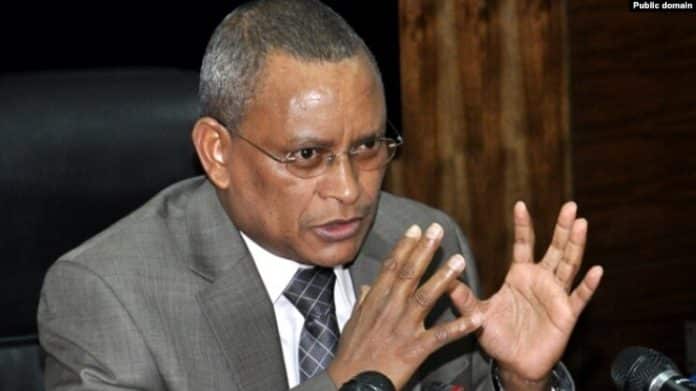
Tigrai regional government president Dr. Debretion Gebremichael confirmed the withdrawal of Eritrean Army from the region in an address to the Tigraian regional government council members. He also added that the Ethiopian government is taking steps to remove non-ENDF forces from Tigrai.
Many mainstream media outlets reported the exit of Eritrean troops at the end of last week, with images and videos showing Eritrean troops on military trucks driving towards the Eritrean border and waving the Eritrean flag. There has been no official statement from either the Eritrean government or the Ethiopian government regarding the withdrawal.
US Secretary of State Antony Blinken welcomed the report of the withdrawal.
The Eritrean Army has withdrawn from the Ethiopian Tigray Region, hoping to bring an end to a brutal two-year conflict that began in November 2020. Videos and pictures show a military convoy moving through Bouvard in an undisclosed location, with people standing by the road welcoming the Eritrean Defense Forces members and cheering on the soldiers as they wave the Eritrean flag. The Eritrean government had previously denied involvement in the war in Tigray, but the international community and Tigrayan authorities had condemned Eritrea for its alleged involvement.
This conflict between Eritrea and Ethiopia has deep roots. The two countries have a long history of tension, which came to a head in 1998 with the outbreak of a border war that lasted until 2000 and resulted in the deaths of tens of thousands of people.
The war ended with the Algiers Agreement, which established a ceasefire and created a commission to demarcate the border. However, the border dispute remained unresolved and the two countries have had an uneasy relationship until 2018.
In November 2020,after the civil war ignited in Ethiopia, TPLF launched rockets at the Eritrean capital of Asmara, which led to the Eritrean Army entering Tigray, escalating the conflict.
After a two-year brutal civil war, TPLF and the Ethiopian government reached a cessation of hostilities in November 2022 in South Africa, followed by an agreement in Kenya. The agreement included TPLF demobilizing its combatants and disarming them, concurrent with the withdrawal of non-ENDF forces from Tigray, including the Eritrean Army and Amhara militants. According to sources from Ethiopia, TPLF has begun the disarmament process, and now the EDF is leaving the region.
The reports of EDF withdrawal from Tigray on January 20 have sparked mixed reactions among social media users of both Eritreans and TPLF supporters.
Deplatforming has become a hotly debated topic in recent years, as social media and other online platforms have taken action against controversial figures and groups. But what exactly is deplatforming, and why is it so controversial?
One of the main arguments for deplatforming is the protection of users from hate speech and violence. Hate speech is any form of speech, conduct, writing, or expression that may incite violence or prejudicial action against or by a particular individual or group, or because it disparages or intimidates a particular individual or group. In the context of online platforms, this can include anything from racist or sexist slurs to calls for violence against specific groups of people.
Deplatforming can be seen as a way to combat this kind of speech by removing the individuals or groups responsible for it from the platform. This not only helps to create a safer and more welcoming environment for all users, but it also sends a message that such behavior is not tolerated.
Another argument for deplatforming is accountability. By removing individuals or groups from a platform, it sends a clear message that their actions have consequences and that they are not above the rules. This can be particularly important in cases where an individual or group has a large following and the potential to do harm to a wide audience.
However, there are also strong arguments against deplatforming. One of the main concerns is that it can constitute censorship and suppress free speech. While platforms have the right to set their own rules and enforce them as they see fit, there is a risk that deplatforming can be used to silence dissenting voices and stifle debate.
There is also the concern about overreach and inconsistency in enforcement. It is not uncommon for different platforms to take different actions against the same individual or group, and there is a risk that some may be unfairly targeted while others are allowed to continue their harmful behavior.
Finally, there is the worry that deplatforming can become a tool for silencing dissenting voices and stifling debate. While it is important to create a safe and welcoming online environment, it is also important to allow for a diverse range of viewpoints and to encourage healthy and respectful discourse.
In light of these concerns, some have argued for alternative approaches to dealing with controversial figures and groups. One option is moderation, where content is monitored and flagged for inappropriate or offensive material. This can be combined with the use of content warnings, which alert users to potentially controversial or offensive material.
Another option is to reduce the visibility of controversial content, rather than removing it completely. This can be done through measures such as demoting or downranking controversial content in search results or news feeds, or by limiting the reach of individuals or groups that engage in harmful behavior.
Finally, educating users on how to report and flag inappropriate content can help to create a more welcoming and safe online environment without resorting to deplatforming. By empowering users to take action against harmful content, platforms can create a more positive and supportive community.
In conclusion, deplatforming is a complex and multifaceted issue that raises important questions about the role of platforms in modern society and the balance between promoting safety and protecting free speech. While it is important to create a safe and welcoming online environment, it is also important to allow for a diverse range of viewpoints and to encourage healthy and respectful discourse.
Key takeaways and Challenges – Disarmament of TPLF Forces and Implementing Transitional Measures.
The Federal government of Ethiopian and TPLF forces signed a peace agreement Wednesday November 2nd in Pretoria, South Africa ending 10-day long peace talks mediated by the African Union and presence of US, led by US Special Envoy for the HoA, Mike Hammer. Representative for Ethiopia government, Ambassador Redwan Hussein and TPLF forces representative Getachew Reda singed the peace agreement – a move expected to bring an end to two-year long civil war in Ethiopia resulting in hundreds of thousands death, millions displaced and facing famine and in need of urgent aid.
Although in his press briefing Mr. Obesegun Obasanjo indicated both parties agreeing saying “The two parties in the Ethiopian conflict have formally agreed to cession of hostility and systematic and orderly , smooth and coordinated disarmament “, he went further to say this is not the end of peace process but the beginning – a hint of uncertainty , given the magnitude and the complexity of the conflict and parties involved.
Key takeaways from South Africa peace talk agreement reached between Federal government of Ethiopia and TPLF representatives from Tigray as stated by former Nigerian president Olesegun Obasanjo, is the waring parties reaching an agreement for the TPLF combatants’ disarmament, demobilization, and reintegration – emphasizing the upper hand of a one Ethiopian national force (EDF) and Ethiopia constitution.
Now the focus is on the implementation of joint statement which entails several points, including upholding the peace agreement, permanent end of conflict, upholding the constitution of the federal government, disarmament of TPLF, expediting humanitarian aid and implementing transitional measures in restoring order, accountability, and reconciliation.
Despite inundated news by western media, TPLF leaders, and constant condemnation of western leaders of the presence of Eritrea and its role in the Ethiopia civil war, there is no mention of Eritrea in the 2-page agreement signed by both parties.
Family of journalist and professor Aaron Berhane – co-founder of the first private newspaper in independent Eritrea, will host signing of his memoir “The Burden of Exile” at 12:30pm on November 6th at Hirut Café in Toronto Canada. Aaron’s daughter Ms. Frewini Berhane in charge of the book signing event and family members will be present at this special event, that is open for the public. The editor of the book , and PEN Canada’s executive director Brendan Caires will also be attending the book signing.
Aaron Berhane was the co-founder and editor-in-chief of the first private newspaper in Eritrea published after the Press Proclamation No.90/1996 – Gazette of Eritrean Laws. Aaron passed in May 2021 before his memoir made it to the publisher. Aaron was dedicated husband, father, journalist, professor and activist.
“The Burden of Exile” narrates Aaron’s life journey as young reporter, father, and the dangerous journey to escape Eritrean government’s nationwide hunt and incarceration of dozens private newspaper journalists in September 2001.
Speaking to Setit media on the high anticipation of readers and what to expect from her father’s memoir, Frewini said “The readers should expect to gain a deeper understanding and insight into the extreme challenges and obstacles journalists face in Eritrea for speaking or broadcasting the truth.” She further added “The challenge doesn’t stop there however, even after escaping the dictator regime, the government tries to find a way to create more obstacles that directly interferes their freedom of speech. ”
‘The Burden of Exile’ published by Dundurn Press is now available online at the Dundurn Press website. Excerpts from the publisher reads -“Berhane’s story is one of bravery amid complicated international geopolitics, of spies, guns, and betrayal, and — ultimately — of triumph and the piecing together of family in a cold new country.” Dundurn Press.
Echoing her late father’s tenacity and staying the course in purse and realization of free press and justice, Frewini expressed her expectation saying “People both in exile and at home to understand the true meaning of resilience and to fight for the cause you believe is right tirelessly. Never give up.”
The book signing will take place at the following address Hirut Café, 2050 Danforth Ave, Toronto ON M4C 1J6 Canada. ብዳሓንምጹ!
Access to the sea is currently a topic of discussion among Eritreans and Ethiopians in the mass media primarily due to continuous assertions of access to the Red Sea by Ethiopian individuals and groups, including Tigrayans.
Ethiopian assertions of access to the sea can be placed into two categories: (1) ownership of the Red Sea, the Eritrean port of Asseb in particular; and (2) the right of access to the sea and freedom of transit. The issue of ownership targets the independence, sovereignty and territorial integrity of Eritrea, issues that were litigated, and settled when Eritrea emerged as an independent and sovereign state within internationally recognized borders in the early 1990s. Thus, it is only briefly discussed here.
The right of access to the sea and freedom of transit, however, is an on-going and debatable issue and is, therefore, the focus of this essay. What does “the right of access” mean? What is the legal basis for it? And how should it be applied in general and specifically to Ethiopia and Eritrea? This essay addresses these and related questions.
Two terms that are used throughout this essay are defined as follows: “Land-locked State” means a state which has no seacoast, and “Transit State” means a state situated between a land-locked State and the sea, through whose territory traffic in transit passes.[1]
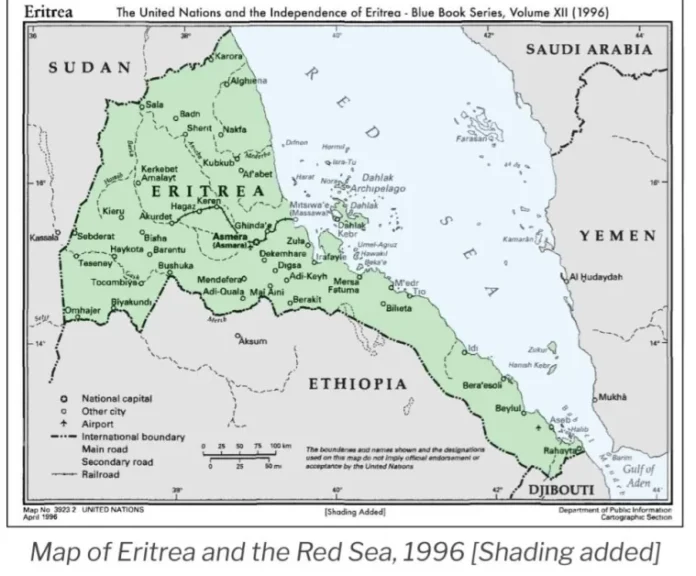
Map of Eritrea and the Red Sea, 1996 [Shading added]
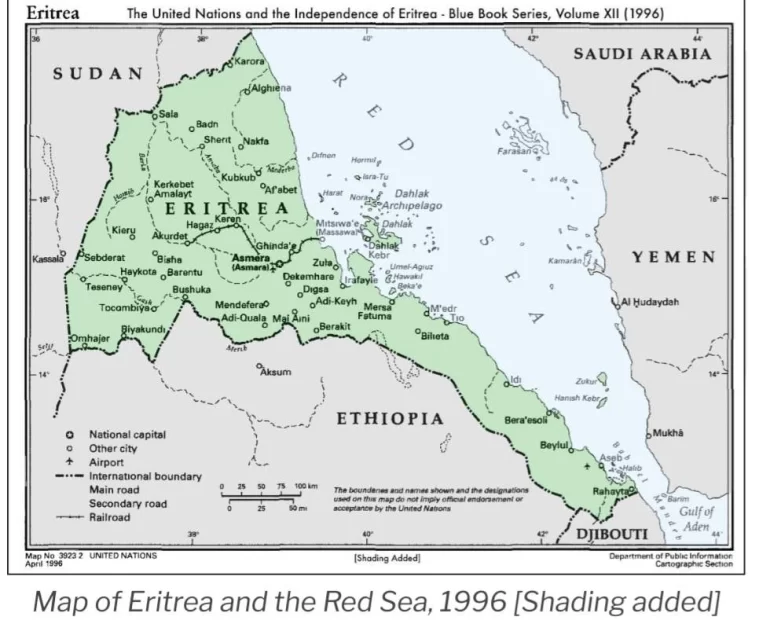
Map of Eritrea and the Red Sea, 1996 [Shading added][2]
Claims of Ownership of Eritrea’s Red Sea Coast and/or Port of Asseb Are Dismissible
Ownership of the Red Sea coast, and especially that of the port of Asseb, appears to be a never-dying issue for some Ethiopian scholars and government officials. Even after Eritrea’s formal independence in 1993, with international recognition as sovereign State, assertions of ownership continue to be raised.
1.1. Persistent Claims of Ownership by Ethiopian Scholars
In this regard, two recent publications in particular need mentioning. One is a thesis by Abebe T. Kahsay titled, “Ethiopia’s Sovereign Right Access to the Sea under International Law,”[3] and another, a book in the Amharic language by Yacob Hailemariam bluntly titled, Asseb yeman nat? (Whose is Asseb?)[4] And his answer, predictably, is Ethiopia.
The contents of the two publications are similar, and they feed on each other. Both writers detail the disadvantages and challenges of being a land-locked State and the desirability of having access to the sea; they both detail historical and cultural connectivity going back to the Axumite Era; they both dismiss the colonial treaties of 1900, 1902 and 1908, that defined Eritrea’s territory, as “defunct, and obsolete treaties.” This assertion may have a political appeal, but legally, it runs counter to the principle of African uti possidetis,[5] which sanctions colonially inherited boundaries. Both authors fault the Ethiopian Peoples’ Revolutionary Democratic Front (EPRDF)[6] for supporting Eritrea’s independence, describing the support as “handing over Asseb, Ethiopia’s natural outlet to the sea,” to the Eritreans, notwithstanding the fact that Eritreans won the war of independence. Moreover, both writers consider the Algiers’ Agreement[7] as a missed opportunity for EPRDF to reassert Ethiopia’s right to the sea. Further, they, especially Yacob, passionately call for exerting continued efforts to repossess Asseb and its environs.
1.2. Assertion of Ownership from Unexpected Quarters
Claims of ownership of the Red Sea coast and Eritrean ports made by Tigrayans may seem unexpected, but not surprising. Recently, Dedebit Media, one of the Tigrayan mass-media outlets, declared, “Tigray is the owner of a sea! It has a historical and legal right of ownership of sea.”[8] The presenter’s basis for the claimed ownership is, as would be expected, historical and cultural links, going back to the Axumite Era. What is interesting is his pronouncement of ownership of the sea and the legal right of access to the sea in the same breath. If one claims ownership of sea, the right of access to the sea is moot, as the latter, as will be elaborated in Section 2, is applicable to a situation of a land-locked State and a transit State.
A group calling itself the Global Society of Tigray Scholars and Professionals (GSTS), and claiming to represent over 3,500 Tigrayan scholars and professionals, stated as one of seven “non-negotiable vital interests of Tigray, stating, “[R]elated to the territorial integrity of Tigray is access to international borders, and the right of access to and from the sea and freedom of transit as provided in article 125 of the Law of the Sea.”[9] Putting aside whether the Group sees Tigray as an already independent sovereign entity, or is anticipatory, what is relevant here is that the Group’s reference to article 125, again, as will be shown in Section 2, is distorted, or more correctly, incomplete.[10]
1.3. Claim of Ownership is an Affront to Eritrea’s Sovereignty and Territorial Integrity
The claim of ownership of the Red Sea coast, and/or of the port of Asseb, by certain elements within Ethiopia, be they Tigrayans or others, is an affront to Eritrea’s sovereignty and territorial integrity. Eritrea has been an internationally recognized sovereign State for the last thirty years. Its internationally recognized territory was defined by the colonial treaties of 1900, 1902 and 1908 which includes the Red Sea coast and its ports. It is the same definition that the U.N. took up for disposal, as one of three former Italian colonies, following Italy’s defeat in World War II; the same definition for which a costly war and political struggles were conducted for self-determination for over five decades; the same definition on which the internationally observed referendum of 1993 was conducted resulting in formal independence supported by a vote of 99.8%; the same definition to which recognition was extended by the international community (including Ethiopia itself) as an independent, sovereign State; and the same definition the Eritrea Ethiopia Border Commission (EEBC) considered for adjudicating the border conflict in 2001.
The claims of ownership, such as the ones mentioned above, are consistent with the “Greater Ethiopia” narrative advanced in opposition to Eritrea’s struggle for self-determination and independence. That narrative asserted that Eritrea, before Italian colonization, was an integral part of Ethiopia, going back to the Axumite Era, and the federation and eventual union with Ethiopia in 1962 comprised the restoration of a lost territory. This contrasts with the Eritrean narrative, which is: As a former Italian colony for nearly 60 years, Eritrea should have been entitled to self-determination and national independence, as was the typical outcome for colonized peoples. Instead, the Western powers imposed an ill-conceived, faulty federation with neighboring Ethiopia, contrary to the wishes of the majority of the people of Eritrea. Left with no other option, the Eritreans waged an armed struggle for self-determination that resulted in winning independence and establishing a national sovereignty in 1993. This narrative is consistent with the African uti possidetis. There is a rich body of literature on the Eritrean narrative.[11]
The Eritrean narrative was borne out by the emergence of Eritrea as an independent sovereign State, following an internationally observed referendum that was held in 1993. Thus, the issues of Eritrea’s self-determination, and sovereignty have already been litigated and settled. There is a saying in Tigrinya that aptly describes this situation: Weyo tQalisnas tewadiQna’qua (loosely translated, “We have already wrestled, and landed on the ground.)”[12]
Any assertion of ownership of the Red Sea coast, or ownership of Asseb, typified by the ones mentioned above, is an affront to the sovereignty and territorial integrity of Eritrea, and therefore dismissible. The issue of the right of access to the sea, however, has legitimacy, and is taken up in the following section.
Right of Access to the Sea and Freedom of Transition
Globally, there are forty-four land-locked states, sixteen of them, including Ethiopia, are in Africa.[13] Right of access to the sea and freedom of transition is a legitimate issue for land-locked countries. The question is: What does it mean and how should it be implemented?
First, a brief history of the concept and how it developed into an internationally recognized principle and right.
2.1. Brief History of the Right of Access to the Sea
The history of the issue of access to the sea is marked by land-locked states desiring and pushing for unrestricted right of free access countered by transit states pushing back, claiming the supremacy of territorial sovereignty. Historically, several conventions were held to reconcile the two competing principles. Following are some of the significant ones.[14]
In 1804 The Convention of Vienna adopted the principle of the freedom of navigation on the Rhine, an important international river in Europe. That convention laid the foundation for another one that followed, the Vienna Congress of 1814 that established the freedom of navigation without discrimination in international rivers and their tributaries.[15]
The Barcelona Convention of April 20, 1921, established the principle of freedom of transit by requiring “all contracting states to facilitate freedom of transit by rail or international navigable waterway.” However, it added, “provided the security and vital interests of the transit country are not adversely affected.”[16]
The New York Convention of 1965 (came into force in 1967) adopted a resolution “advocating the necessity of recognizing the right of free transit to the sea” for land-locked states. However, it added that such a right is “permitted under mutually acceptable means.”[17] The New York Convention is significant on two counts: one, it was the first international agreement that dealt exclusively with the specific issue of transit trade; and two, and more importantly, it recognized the access issue as “right,” as opposed to “need,” described in previous conventions. But, like its predecessor conventions, its provisions attempted to establish a balance between the principles of freedom of transport and that of sovereignty.
A series of conventions and discussions held by the UN and its specialized agencies in the 1970s and early 1980s, led to the emergence of the U.N. Convention on the Law of the Sea (often called “The Law of the Sea” for short), now considered as the international law governing the right of a land-locked state’s access to the sea and free transition.
2.2. The United Nations Law of the Sea
The United Nations Convention on the Law of the Sea, an international agreement adopted in 1981 (came into force in 1994), establishes a legal framework for maritime activities. Part X of the convention, covering Articles 124-132, deals with rights of access of land-locked states. Article 125 is the one that addresses specifically the right of access to and from the sea and freedom of transit. It is helpful to look at its text verbatim:[18]
Article 125 (1).Land-locked states shall have the right of access to and from the sea for the purpose of exercising the rights provided in this Convention including those relating to the freedom of the high seas and the common heritage of mankind. To this end, land-locked States shall enjoy freedom of transit through the territory of transit States by all means of transport.
Article 125 (2). The terms and modalities for exercising the freedom of transit shall be agreed between the land-locked States and transit States concerned through bilateral, subregional or regional agreements.
Article 125 (3). Transit States, in the exercise of their full sovereignty over their territory, shall have the right to take all measures necessary to ensure that the rights and facilities provided for in this Part for the land-locked States shall in no way infringe their legitimate interests.
It is not uncommon for land-locked states to invoke just 125 (1), ignoring 125 (2) and 125 (3), to assert their right of access to the sea. (That is what the Tigrayan’s GTSP statement did.) However, invoking Paragraph 1 alone is incomplete. Paragraph 2 of the Article makes it clear that the land-locked state’s right is contingent on an agreement between the land-locked and transit states. Further, Paragraph 3 of the Article reiterates that the transit state exercise its full sovereignty over its territory in the execution of the land-locked state’s rights. Thus, a land-locked state’s right of access to the sea and freedom of transit, as articulated in Article 125, is not absolute. In other words, when viewed in its totality, Article 125 of the U.N. Law of the Sea balances the right of the land-locked state with the sovereignty and territorial integrity of the transit state.
2.3. Land-Locked State Ethiopia and Transit State Eritrea
In view of the above-described UN Law of the Sea provisions, Ethiopia as one of the sixteen African countries that do not have access to the sea, can invoke its right of access to the Red Sea through the transit State of Eritrea. But, as pointed out above, that right can only be exercised through an agreement between the two States.
There is, in fact, a precedent. On August 2, 1929, Italy (then colonizer of transit Eritrea) and land-locked Ethiopia concluded an agreement addressing Ethiopia’s access to the sea. Italy granted to Ethiopia a free zone in the Port of Asseb and allowed it to construct warehouses in the zone. Further, the agreement dealt with the construction of a road linking Asseb to the City of Dessie in Ethiopia.[19] Following are examples of other agreements signed between land-locked and transit states.
A Protocol was signed between land-locked Rwanda and Kenya on February 26, 1992, allowing Rwanda to construct warehousing facilities at Kenya’s port of Mombasa. On a more general level, the states of Burundi, Kenya, Rwanda, South Sudan, Tanzania, and Uganda belong to the East African Community (EAC), a regional economic integration bloc. The Community facilitates access to the sea for the land-locked States of Burundi, Rwanda, South Sudan, and Uganda through the territories of the transit States of Kenya and Tanzania.[20]
A Treaty of Commerce exists between Nepal and India, signed on July 31, 1950. The State of India recognizes the State of Nepal’s “full and unrestricted right of transit of all goods and manufactures through the territory of India. Further, goods and merchandize originating from Nepal, in transition through India, are exempt from excise and import duties.”[21]
Mali and Senegal signed an agreement on June 8, 1963, which created a free zone for land-locked Mali at the two ports of the transit State of Senegal, Dakar and Kaolack.[22]
The International Court of Justice case between Bolivia and Chile provides a good lesson on what can happen when a bilateral agreement between a land-locked state and a transit state does not work, or when the land-locked state becomes overzealous.
Bolivia and Chile had signed a Treaty of Peace and Friendship on October 20, 1904, that granted Bolivia a complete right of transit of trade on Chile’s territory and authorized Bolivia to establish customs offices in Chile’s ports.[23] Bolivia was not satisfied with the agreement, and petitioned the International Court of Justice (ICJ) on April 24, 2013, asking the Court to obligate Chile to negotiate to reach an agreement that grants Bolivia “a fully sovereign access to the Pacific Ocean.” On October 1, 2018, the Court concluded that Chile has no obligation to negotiate Bolivia’s sovereign access to the Pacific Ocean. But the Court added that its finding does not “preclude the parties from continuing their dialogue and exchanges, in a spirit of good neighbourliness, to address the issues relating to the landlocked situation of Bolivia, the situation to which both had recognized to be a matter of mutual interest.”[24]
Recently, the BBC News, Tigrinya, posed the question: “Red Sea: Can Ethiopia force Eritrea to grant her access to the sea?” By interviewing four experts on maritime laws, it arrived at an answer in the negative.[25]
Summary and Conclusion
To summarize, any claim of ownership of the Red Sea coast portion of Eritrea or ownership of the Port of Asseb is a direct affront to the sovereignty and territorial integrity of Eritrea. Claims for Eritrea (or any territorial pieces thereof), based on historical background or cultural similarities, were already litigated, and settled when Eritrea emerged as an independent sovereign state in 1993 with internationally recognized boundaries. What remains to be amicably resolved is Ethiopia’s right of access to the sea, which, according to international law, should be implemented through a bilateral agreement between the land-lock State of Ethiopia and the transit State of Eritrea. Thus, two main suggestions are in order:
First, Ethiopians should accept the independence and sovereignty of Eritrea. Eritrea, for the last 30 years, has been an internationally recognized sovereign state, covering a territory that includes the coasts of the Red Sea and its ports of Massawa and Asseb. Neither voluminous reciting of historical and cultural connections nor emotional appeals can change that fact. Eritrea, defined as such, is here to stay. Any dealings between the two countries must start with that reality as the premise.[26]
Second, Eritrea and Ethiopia should negotiate for a bilateral agreement that provides Ethiopia an access to the sea and freedom of transit of its goods in a way that does not infringe on Eritrea’s sovereignty and territorial integrity. The precedent of the 1929 agreement between colonial Italy and Ethiopia was already mentioned. A much better and mutually benefitting agreement between the two states can be reached if approached in good faith. Eritrea is not the only transit State for Ethiopia’s trade and commerce. Djibouti, Somalia, and even Sudan and Kenya, also are transit States for land-locked Ethiopia. Thus, the establishment of a regional economic bloc should be explored covering at least Eritrea, Ethiopia, Djibouti, and Somalia, which can facilitate Ethiopia’s access to sea and transit of goods, similar to how the East African Community (EAC) facilitates for the land-locked States of Burundi, Rwanda, South Sudan and Uganda.
As a final note and reminder: There is no denying of the historical and cultural connections between the peoples of Eritrea and Ethiopia, the legacy of the Axumite Era and subsequent periods. But that is history, a history the people of the region should be proud of and should teach to current and future generations. Much has happened since then, the most significant of which was the nearly sixty years of Italian colonial rule over Eritreans. Also, there is no denying of the special cultural and emotional ties between the two peoples. But this aspect should be channeled towards friendship and cooperation between the peoples of the two countries for mutual benefits, respecting each other’s sovereignty and territorial integrity, rather than towards making territorial claims.
Gebre H. Tesfagiorgis earned his Ph.D. and J.D. from the University of Wisconsin-Madison. He held senior administrative positions at the University of Wisconsin, and the University of Nebraska. He was Director of Institutional Research when he retired from Iowa State University at the end of 2016. He now resides in Madison, Wisconsin, USA. He was a member of the Constitutional Commission of Eritrea. His scholarship interest is in Eritrea and the Horn region of Africa. He has written, and edited, several publications on Eritrea. He was the Executive Editor of the Eritrean Studies Review, journal of the Eritrean Studies Association.
[1] Definitions given in The UN Law of the Sea, Article 124 (1).
[5] The African uti possidetis is a reference to the principle adopted in 1964 (when the Eritrean war of independence was on-going), by the then Organization of African Unity (OAU) which declared sovereignty and inviolability of colonially inherited boundaries regardless of pre-colonial territorial configurations. The principle has acquired a status of international law.
[6] The Ethiopian People’s Revolutionary Democratic Front (EPRDF) was the coalition party dominated by the Tigray People’s Liberation Front (TPLF) that ascended to power when Eritrea became formally independent in1993.
[7] The Algiers Agreement was the peace agreement signed by Eritrea and Ethiopia in 2000, following the border war of 1998-2000, on the basis of which the Eritrea-Ethiopia Border Commission (EEBC) ruled on the border dispute between the two countries.
[8] In Tigrinya: ትግራይወናኒትባሕሪእያ! ባሕሪናይምውናንታሪኻውንሕጋውንመሰልኣለዋ! Dedebit Media, disseminated through YouTube on 01/02/2022.
[10]A reminder to Tigrayans: The assertions that Tigray has ownership of the Red Sea coast, hopefully, is the position of some fringes in the Tigray cause. However, to the extent that Dedebit claims to advocate for the cause, and in the case of GSTS, to the extent the group claims to represent 3,500 scholars and professionals, it is prudent to remind both that Eritreans, regardless of their position in the country’s current political spectrum, are unanimous about and very protective of their country’s sovereignty and territorial integrity.
[11] To cite a few: Travaskis, GKN, Eritrea: A colony in Transition (1960); Bereket Habte Selassie, Conflict and Intervention in the Horn of Africa (1980); Gebre H. Tesfagiorgis, “Self-Determination: Its Evolution and Practice by the UN and Its Application to the Case of Eritrea” in Wisconsin International Law Journal, Vol. 6, No. 1, (pp 75-127) Fall 1987; Tekie Fessehatzion, “Eritrea from Federation to Annexation,” a working paper (1990); Ogbazghi Yohannes, Eritrea:A Pawn in World Politics (1991); Jordan Gebremedhin, Peasants and Nationalism in Eritrea (1993); Gebre-Ab Habtu, Ethiopia and Eritrea (1993); Ruth Iyob, The Eritrean Struggle for Independence: Resistance and Nationalism, 1941-93 (1995).Tekeste Negash, Eritrea and Ethiopia: The Federal Experience (1997); Alemseged Tesfai, a trilogy of books in Tigrinya titled: Aynfalale (2002), Federation Ertra ms Etiopia kab Matienso ksab Tedla1951-1955 (2005), and Ertra kab federation nab GobeTansewran 1956-1962 (2016); Andebrhan Welde Giorgis, Eritrea at a Crossroads (2014).
[13] The land-locked countries in Africa are Botswana, Burundi, Burkina Faso, Central African Republic, Chad, Ethiopia, Eswatini (Lesotho), Malawi, Mali, Niger, Rwanda, South Sudan, Swaziland, Uganda, Zambia, and Zimbabwe. See Thought Co., part of Dotdash Publishing family, June 22, 2019.
[14] For a detailed discussion on the history and development of the principle of the right of access to the sea, See Uprety, Kishor, “Landlocked States and Access to the Sea: An Evolutionary Study of a Contested Right,” in Penn State International Law Review, Vol. 12, No. 3, Article 2 (1994).
[15]See Statute on Freedom of Transit, adopted by the Convention of Vienna, April 20, 1921, 7 L.N.T.S. 11
[16]See The Statute of Barcelona on Freedom of Transit, April 20, 1921, reported in the League of Nations, Treaty Series, Vol. VII, at 37.
[17]See Convention on Transit Trade of Landlocked States, held in New York, July 8, 1965, 597 U.N.T.S. 42.
[19]See Report of the Secretariat of the Economic Commission for Africa, Transition Problems of Eastern African Landlocked States, at 14, UN Doc. E/CN 14/INR/44 (1963).
[20] Nkusi, Fred, “Being Landlocked Country,” Opinion in The New Times, Rwanda’s daily, January 14, 2019.
[21] Articles 1 and 2 of the Treaty of Commerce between India and Nepal of 31 July 1950.
[26] The experiences of Sweden and Norway can be instructive (Their relationship has parallels with that of Ethiopia and Eritrea, except no issue of access to sea is involved). Norway was forcibly linked to Sweden to form an uneasy Union in 1815. When Norway declared its independence following a referendum, based on the principle of self-determination, and gained international recognition in 1905, there was consternation on the part of the Swedes. But the latter eventually accepted the status of Norway and the two states now co-exist cooperating and respecting each other’s sovereignty and territorial integrity.