Copyright and authorship: a protection that exists, but not for everyone
There is a scene that plays out with near-ritual regularity in Facebook groups, TikTok comment sections, and Eritrean diaspora communities online: someone posts that an Ethiopian singer has just released a track — or an entire album — that sounds strangely familiar. Familiar because it was already written, composed, recorded, and sung by someone else. Familiar because it is Eritrean. Outrage spreads, comments multiply, the thread fills with appeals to conscience and basic decency. Then the post slides down the feed, and the cycle begins again.
These are not isolated incidents. Dozens, perhaps hundreds, of Eritrean songs have been lifted — in part or in full — by Ethiopian artists, sometimes with minimal melodic adjustments, sometimes without even that. The problem is not only moral, though the moral dimension is real and should not be dismissed. The problem is that outrage, however justified, is not a legal instrument. And without legal instruments, cultural theft continues undisturbed.
In advanced legal systems, musical copyright operates on two distinct planes. The first is moral rights: these guarantee authorship and are by nature perpetual and inalienable — no one can legitimately claim to have written someone else’s work. The second is economic rights, which give the author the power to authorize or prohibit the use of their work and to receive compensation each time it is performed, broadcast, reproduced, or distributed. Both planes find their international foundation in the Berne Convention, a treaty signed by virtually every country in the world — including Eritrea and Ethiopia — which guarantees, in principle, automatic cross-border protection. A song recorded in Asmara is, on paper, as protected in London, Berlin, and Nairobi as it is at home.
On paper. Because between that principle and its concrete application there lies an abyss — and into that abyss fall, every day, the work of artists who lack the tools to enforce what the law nominally grants them.
How protection works where it actually works
In countries with a structured music industry, copyright protection does not rest on written law alone. It rests on a technical, institutional, and financial infrastructure that transforms that law into daily practice. The system turns on three fundamental pillars.
The first is collective management organizations: bodies such as SACEM in France, GEMA in Germany, SIAE in Italy, or ASCAP and BMI in the United States collect and distribute revenue on behalf of artists whenever their music is broadcast on radio, licensed for film, played in a public venue, or streamed on a digital platform. These organizations monitor the market continuously and act legally on behalf of registered artists, without requiring each of them to pursue every infringement on their own.
The second pillar is technological, and it is the one that today provides the most immediate and far-reaching protection. YouTube’s Content ID is an audio fingerprinting system: every song registered in its database generates a unique digital signature, and every video uploaded to the platform is automatically matched against that signature. When a match is detected, the rights holder is notified and can choose to block the content globally, monetize it directly — redirecting advertising revenue away from whoever used the work without permission — or simply monitor its spread. The numbers involved are difficult to absorb: in 2024 alone, the system issued 2.2 billion automated claims, with automated detection accounting for more than 99 percent of them. Total payouts to rights holders crossed twelve billion dollars.
The third pillar is judicial. In advanced legal systems, a victim of musical theft can pursue litigation and obtain not only the removal of the unauthorized content but financial damages as well. High-profile cases — the dispute between the estate of Marvin Gaye and Robin Thicke over ‘Blurred Lines,’ the protracted litigation surrounding Led Zeppelin’s ‘Stairway to Heaven’ — show that music plagiarism jurisprudence is contested and technically demanding, but it exists, it has weight, and it is enforced. The precondition, here too, is prior registration of the work: without formal documentation of authorship and date of creation, even the strongest legal claim becomes difficult to sustain in court.
Eritrea and the structural void: when the foundations are missing
The problem for Eritrea is not a shortage of talent, nor an absence of deep and original musical tradition. The problem is structural, rooted in a context where the infrastructure required to make any protection system function simply does not exist — or exists in wholly inadequate form.
Eritrea is among the countries with the lowest internet penetration in the world: fewer than ten percent of the population has regular access to the network. Beyond connectivity, the deficits compound. There is no national platform for digital music distribution, no collective rights management society, no copyright registry that is digitally accessible, affordable, and internationally recognized. There is no banking system sufficiently integrated with international platforms to allow an artist to actually receive the proceeds generated by their music abroad. Each of these absences alone would be an obstacle; together, they form a wall.
The practical consequences are direct. An Eritrean singer who releases music through informal YouTube channels, WhatsApp groups, or recordings circulating within the diaspora has deposited no digital fingerprint in any international database. In the eyes of automated detection systems, that artist does not exist as a rights holder. Anyone — including an Ethiopian singer assembling material for an album — can appropriate that work without triggering any automatic defense, without a notification reaching anyone, without a cent being redirected.
The Eritrean diaspora — spread across Europe, North America, and the Middle East — has tried in part to fill this void informally. Artists open YouTube channels, maintain social media pages, collect donations through PayPal or Western Union. These are improvised solutions, dependent on third-party goodwill, entirely without institutional coordination or legal force. Relying on the generosity of intermediaries or the momentum of social media outrage is not a cultural policy. It is what cultural policy looks like when it does not exist.
What is needed: a concrete agenda for moving beyond indignation
Eritrean music is a cultural heritage of extraordinary depth and originality, and that heritage continues to be plundered — not because no law exists to protect it, but because the material conditions required to enforce that law are absent. Changing this demands a concrete agenda, operating on several levels at once.
The first level is institutional. Eritrea needs a national copyright management organization for music — a body that registers artists’ works, represents them before international platforms and foreign collecting societies, and acts when infringements occur. This is not an impossible undertaking: countries with far more constrained resources have built comparable structures. The model is established, it is replicable, and its absence in Eritrea is a political choice before it is a technical limitation.
The second level is technological and financial. For any protection system to function in practice, artists must be able to distribute their music through digital aggregators onto international platforms — Spotify, Apple Music, YouTube — registering their fingerprints in global databases in the process. This requires reliable internet access, functional digital payment tools, and a banking system capable of receiving revenue from abroad. None of this is peripheral: digital and financial infrastructure is the necessary condition for any right, however clearly written into law, to become something an artist can actually use.
The third level concerns the diaspora. Eritrean communities abroad possess expertise, networks, and resources that could be mobilized far more systematically than they are. Cultural associations, intellectual property lawyers, music industry professionals based in European and North American cities could form a collective reference point for artists facing infringement — assisting them with platform takedown requests, work registration, and, where the situation warrants, legal action.
The next time an Eritrean song appears under someone else’s name — and there will be a next time — the adequate response is not collective outrage in comment sections, however understandable that impulse may be. The adequate response is for that song to already be on file in an international database, for its fingerprint to already exist, for a national body to already have standing to act, and for the artist to already be owed something enforceable. Moral indignation is a beginning. It has never, on its own, been enough.
Bibliography
World Intellectual Property Organization. “Berne Convention for the Protection of Literary and Artistic Works.” WIPO, 1886 (as amended 1979). https://www.wipo.int/treaties/en/ip/berne/
Goldstein, Paul, and P. Bernt Hugenholtz. International Copyright: Principles, Law, and Practice. 4th ed. Oxford: Oxford University Press, 2019.
Kretschmer, Martin, and Friedemann Kawohl. “The History and Philosophy of Copyright.” In Music and Copyright, edited by Simon Frith and Lee Marshall, 21–53. Edinburgh: Edinburgh University Press, 2004.
YouTube. “How Content ID Works.” Google Support. Accessed June 2026. https://support.google.com/youtube/answer/2797370
International Federation of the Phonographic Industry (IFPI). Global Music Report 2024. London: IFPI, 2024. https://www.ifpi.org/resources/
Fitzgerald, Brian, and Benedict Atkinson, eds. Copyright Future Copyright Freedom: Marking the 40 Year Anniversary of the Whitford Committee Report. Sydney: Sydney University Press, 2011.
International Telecommunication Union (ITU). Measuring Digital Development: Facts and Figures 2023. Geneva: ITU, 2023. https://www.itu.int/en/ITU-D/Statistics/
World Bank. “Individuals Using the Internet (% of Population) — Eritrea.” World Development Indicators, 2023. https://data.worldbank.org/indicator/IT.NET.USER.ZS?locations=ER
Confederation of Societies of Authors and Composers (CISAC). Global Collections Report 2023. Paris: CISAC, 2023. https://www.cisac.org/Newsroom/news-releases/cisac-global-collections-report-2023
When Major General Teshome Gemechu sat before the Ethiopian state broadcaster to address the growing regional conversation around Ximdo, he handed analysts a rare gift: an unscripted window into the anxiety at the heart of Addis Ababa’s political and military establishment. His language was theatrical, his metaphors vivid, and his warnings fierce. But underneath the performance lies a deep and revealing contradiction. A state that has spent years trampling on the sovereignty of its neighbors was, in that studio, lecturing the world about the sanctity of its own. That contradiction is not incidental. It is the story.
What Ximdo Actually Is
Before the Ethiopian military’s narrative is dismantled, the foundation it is trying to distort must be established clearly. Ximdo ጽምዶ in Tigrinya means, at its most basic, coexistence and cooperation, like two animals harnessed side by side to plow a field, working in harmony rather than in conflict. Its first public expression was a direct, non-governmental, people-to-people peace initiative between Eritrean and Tigrayan communities at the border, initiated by Eritrean activist Awel Seid. Since then, it has expanded to include Ethiopian Afars, Eritrean Afars, and there are active attempts to bring Amharas and Tigrayans together under its framework.
This is the movement the Ethiopian general chose to describe as a “dream cooked up by those who have bowed to the yoke of Pharaoh.” That characterization, coming from a serving major general on state television, tells us a great deal. When a government finds a grassroots peace initiative threatening enough to require a formal military briefing on international diplomatic channels, that government is not speaking from a position of strength. It is speaking from one of fear.
The Pharaoh Yoke: Desperation in a Metaphor
The most revealing moment in the interview is the use of the phrase “yoke of Pharaoh.” In a deliberate political context, such language carries unmistakable weight. It is designed to invoke Egypt to plant in the listener’s mind an image of foreign domination, of ancient power reaching into the Horn of Africa to destabilize an ancient civilization. The timing is not accidental. It comes precisely as Ethiopia’s GERD dispute with Egypt has reached one of its most acute phases.
Ethiopia inaugurated the Grand Ethiopian Renaissance Dam in September 2025 to formal protest from Egypt, which described the action as a contravention of international law. Egypt, which depends on the Nile for roughly 90 percent of its freshwater needs, views the GERD as an existential threat. Cairo has responded not only diplomatically but strategically, signing defense agreements with Somalia, deepening port arrangements with Eritrea, and building a layered regional architecture that Addis Ababa perceives as encirclement. Egypt has agreed to develop the strategic Red Sea port of Assab in Eritrea and the port of Doraleh in Djibouti, partly as a pressure mechanism against Ethiopia’s sea ambitions.
This is the context in which the “Pharaoh yoke” language appears in Ethiopian state media. Addis Ababa is attempting to fold Egypt into the Ximdo story without presenting evidence that Egypt is operationally involved. It is a rhetorical move designed to activate nationalist sentiment, tap into the GERD dispute’s emotional register, and paint every actor that does not align with the Prosperity Party as a limb of a Pharaoh-led conspiracy. That is not intelligence analysis. That is propaganda management.
The Somaliland MoU: Sovereignty as a Tool, Not a Principle
Nothing exposes the hollowness of Addis Ababa’s sovereignty rhetoric more decisively than the January 1, 2024, memorandum of understanding signed between Ethiopian Prime Minister Abiy Ahmed and Somaliland President Muse Bihi Abdi. Under that deal, Somaliland agreed to lease more than 19 kilometers of its Gulf of Aden coastline to Ethiopia’s navy for a period of 50 years. In return, Ethiopia offered a future promise of formal recognition of Somaliland as an independent state — a recognition that, if granted, would make Ethiopia the first United Nations member state to formally sever Somaliland from Somalia.
Somalia’s response was immediate and unequivocal. The federal government in Mogadishu declared the MoU “null and void,” described it as a “clear violation of Somalia’s sovereignty, unity, and territorial integrity,” and called on both the African Union and the United Nations to condemn what it characterized as Ethiopia’s “unwarranted aggression”. Somalia recalled its ambassador to Ethiopia in protest. The African Union’s own core principles regarding member state sovereignty and territorial integrity were directly cited.
The Somaliland MoU is not an isolated transaction. It is a window into how Addis Ababa approaches sovereignty when it is an obstacle to be bypassed rather than a principle to be honored. A government that constructs a 50-year naval lease deal with a territory whose sovereignty is constitutionally disputed by a UN member state, and which does so without the consent of that state, has already answered its own sovereignty lectures for the rest of the region.
The Sea Access Campaign: Entitlement Over Law
The Somaliland gambit did not emerge in isolation. It was the most dramatic expression of a sustained campaign by Prime Minister Abiy Ahmed to secure Ethiopia’s access to the Red Sea by any means available. In public parliamentary addresses, Abiy described sea access as an “existential” issue for Ethiopia. Ethiopia’s president, Taye Atske Selassie, went further, declaring that “Ethiopia’s renaissance will be attained when geography no longer curtails the destiny of its 120 million people”.
The nearest significant port to Ethiopia is Assab, across the border in Eritrea — approximately 40 miles away. Eritrea has responded with clarity. Information Minister Yemane Gebremeskel stated publicly that “Eritrea is bewildered by Ethiopia’s outdated and misguided pursuits for maritime access and a naval base, whether through diplomacy or military means”. Both sides have moved troops toward their shared border. Ethiopia sent a formal diplomatic letter to Eritrea accusing it of occupying Ethiopian territory, a charge Eritrea denied.
In October 2025, Abiy Ahmed called for international mediation over Red Sea access, describing Ethiopia’s claim as “irreversible,” while insisting he did not seek war. The language of “irreversible claims” directed at a sovereign neighbor’s territory is not peaceful diplomacy. It is territorial pressure wearing the costume of dialogue. When the same state then deploys its military general on national television to warn others about respecting Ethiopian sovereignty, the contradiction is not subtle. It is total.
The Pretoria Agreement: A Peace Abiy Hollowed Out
The Ethiopian government’s sovereignty argument also crumbles under scrutiny of its own domestic record. The Pretoria Agreement, signed in November 2022 to end a war that killed an estimated 600,000 civilians in Tigray alone, was supposed to be the framework for lasting peace. Three years later, the assessment is damning. A comprehensive analysis describes the outcome as “negative peace” — the guns fell temporarily silent, but the root causes were never addressed.
In May 2025, Ethiopia’s National Electoral Board delisted the TPLF as a recognized political party, effectively barring the primary political force of the Tigray region from participating in the June 2026 elections. The TPLF characterized this as a direct violation of the Pretoria Agreement and appealed to the African Union Commission. The AU’s own frameworks explicitly require mutual recognition of parties and empower its Peace and Security Council to uphold peace deals. Addis Ababa proceeded regardless.
By January 2026, Ethiopian federal forces were conducting drone strikes in central Tigray, killing civilians and destroying infrastructure. Ethiopian Airlines suspended flights to the region, triggering cash shortages and panic among the population. The Ethiopian Human Rights Commission confirmed renewed clashes between federal and Tigrayan forces, warning that civilians were at grave risk. These are not the actions of a state defending a peace agreement. They are the actions of a state that used a peace agreement as a pause before renewing pressure.
A Nobel Peace Prize Winner Who Went to War
The international community has already struggled publicly with the contradiction at the center of Abiy Ahmed’s leadership. The Norwegian Nobel Committee, which awarded Abiy the 2019 Nobel Peace Prize for his peace agreement with Eritrea, issued the highly unusual step of formally admonishing him in January 2022 over the Tigray war, stating that “Abiy Ahmed has a special responsibility to end the conflict and contribute to peace”. The New York Times reported in December 2021 that Abiy had been planning the Tigray military operation for months before it began, and that the Nobel Peace Prize had in fact emboldened Abi to plan the campaign against the TPLF.
This is the leader whose military general now invokes sovereignty as a shield. A man who received the world’s highest peace prize and used the recognition as cover to plan a war. A man who signed a peace deal with Eritrea and immediately used it to coordinate military action. A man who signed a peace agreement with Tigray and then systematically dismantled its provisions. The pattern is not accidental. It is structural.
Ethiopia in 2026: Convergence of Failures
By 2026, Ethiopia’s internal fractures are no longer confined to any single region or conflict. They are converging. The country faces simultaneous insurgencies in Amhara and Oromia, renewed federal-Tigrayan confrontation, economic deterioration, and dangerous confrontations with multiple neighboring states. Analysts describe a government that treats every demand for inclusion, representation, or dignity as an act of treason to be suppressed rather than a signal to be heard.
Sudan accuses that Ethiopian territory was used to strike Khartoum International Airport adds yet another front to this expanding crisis. Each new accusation, each new front, and each new external blame target follows the same logic: the problem is never internal governance; it is always a foreign “yoke” draped across Ethiopia’s shoulders by hostile neighbors and ancient enemies.
The Core Paradox
The Pharaoh yoke paradox, then, is this: the Ethiopian state invokes sovereignty as a sacred principle precisely in the moments when it most needs to distract from its own violations of that same principle. It signs a naval lease deal with a disputed territory against the objections of a sovereign UN member. It declares a neighbor’s ports as existentially Ethiopian. It hollow out a peace agreement it co-signed before resuming military operations. It delists a political party guaranteed recognition under a treaty. And then it convenes a general on state television to warn the world about the threat of a grassroots peace movement.
When a government cannot manage its own internal fractures, it manufactures external enemies. When its sovereignty argument collapses under the weight of its own contradictions, it reaches for civilizational symbols, historical insults, and the shadow of Pharaoh. Ximdo did not create Ethiopia’s crisis. It simply reflected it back at a government that has spent years refusing to look in the mirror.
The general’s metaphor was vivid. An old ox and a sly fox, he said, cannot be yoked together to plow a field. He was right about the impossibility. He simply had the wrong team in the harness.
The article titled “Ethiopia-Eritrea Relations: Historical Drivers of Conflict and Pathways to Peace,” published by Ethiopia’s Institute of Foreign Affairs on May 22, 2026, presents itself as a serious roadmap for peace between Eritrea and Ethiopia. But once one goes beyond the diplomatic language and carefully examines its assumptions, the article reveals a deeper political agenda. It is not truly about peace between equals. It is about redefining Eritrea’s sovereignty as conditional, portraying Eritrea as an “abnormal” state, and intellectually preparing the ground for future Ethiopian strategic ambitions in the Red Sea region. The language of reconciliation is being used as political cover for a much larger geopolitical project.
The first major problem with the article is that it refuses to approach Eritrea as a fully legitimate sovereign state. Throughout the essay, Eritrea is described as militarized, isolated, irrational, insecure, and incapable of normal state behavior. This is not neutral academic analysis. This is political framing. In international relations theory, particularly realism, states are not judged based on whether outsiders approve of their internal systems. Sovereignty is based on territorial integrity, survival, and international recognition. Eritrea achieved all three through sacrifice, war, and legal international process. Once an article begins by treating Eritrea’s sovereignty as something that must be “normalized” or reshaped according to external expectations, then the discussion is no longer about peace. It becomes about political conditioning.
The article also deliberately strips Eritrea’s security posture from its historical context. Eritrea did not emerge from peaceful negotiations or colonial compromise. Eritrea emerged from a thirty-year liberation struggle against annexation, forced federation, military occupation, and repeated attempts to erase Eritrean national identity. No serious political analysis can discuss Eritrean militarization without discussing the history that produced it. States that emerge from existential wars naturally develop strong security cultures. Israel, Vietnam, and Algeria all developed similar patterns after long wars of survival. Yet the article presents Eritrea’s behavior as if it appeared in a vacuum. This is intellectually dishonest because it removes causality from history.
One of the clearest signs of the article’s hidden agenda appears in the section discussing the 1993 referendum and Eritrean independence. The author argues that many Ethiopians view Eritrean independence as flawed because Ethiopia lost direct access to the sea. This statement is extremely revealing. The real issue underneath this entire essay is not democracy, governance, or peacebuilding. It is the Red Sea. The article quietly reframes Ethiopia’s strategic frustration into a historical grievance in order to reopen debates that international law settled decades ago. Eritrea’s independence was internationally recognized, legally formalized, and accepted by Ethiopia itself. Access to the sea does not give any country the right to question another country’s sovereignty.
From the perspective of offensive realism, the logic behind the article becomes easier to understand. Regional powers seek strategic depth, economic access, and geopolitical influence. Ethiopia’s growing political discourse about ports and maritime access reflects this reality. Therefore, this article should not be read simply as an academic exercise. It should be understood as part of a broader strategic narrative attempting to morally legitimize future pressure regarding Eritrea’s coastline and geopolitical position. The repeated references to Assab, economic integration, and “shared destiny” are not accidental. They are part of a gradual effort to normalize the idea that Eritrea’s strategic assets should eventually serve Ethiopian geopolitical interests.
Another major weakness of the article is its attempt to portray Eritrea as the central source of instability in the Horn of Africa while minimizing Ethiopia’s own internal crises. Ethiopia today faces deep political fractures involving ethnic federalism, armed conflict, regional militias, constitutional disputes, and unresolved tensions across multiple regions. Yet the article externalizes instability onto Eritrea as if Eritrea is the primary obstacle to peace in the region. This is a classic political tactic. When states experience internal instability, external threats are often exaggerated in order to redirect public attention. Eritrea becomes the convenient strategic scapegoat for problems that are fundamentally internal to Ethiopia itself.
The article’s discussion of Eritrean support for armed groups also lacks balance and strategic honesty. Proxy politics has existed throughout the Horn of Africa for decades. Nearly every major regional actor has supported non-state armed groups at different moments for security or strategic purposes. Ethiopia itself has historically intervened across neighboring states and supported armed movements when it suited its interests. Yet the article presents Eritrean actions as uniquely destabilizing while portraying Ethiopian actions as defensive and justified. This selective morality weakens the credibility of the entire essay because it applies one standard to Eritrea and another standard to Ethiopia.
The section discussing the TPLF exposes even deeper contradictions. The article claims Eritrea and the TPLF are now strategically aligned against Ethiopia. This argument ignores decades of hostility, war, and political confrontation between Eritrea and the TPLF. In reality, the regional situation is far more complex than the simplified narrative presented in the article. The author selectively reconstructs political realities in order to create a larger threat perception around Eritrea. In security studies, this is called threat inflation — exaggerating or simplifying threats in order to justify future strategic positioning.
The article’s repeated use of the word “normalization” is also deeply political. On the surface, normalization sounds harmless and constructive. But in practice, the article argues that Eritrea must transform its internal political system before regional peace can exist. This reflects a very dangerous principle in international politics. It suggests that powerful states or regional actors have the right to decide which political systems are acceptable and which are not. Dependency theory and post-colonial international relations scholarship warn precisely against this mentality. Smaller states are often pressured to reorganize themselves according to the preferences of stronger powers under the language of reform, stability, and integration.
Another weak point is the comparison between Ethiopia-Eritrea relations and post-World War II cooperation between France and Germany. The comparison sounds intellectually attractive, but it collapses under scrutiny. France and Germany first accepted each other’s sovereignty fully and unconditionally before economic integration became possible. In contrast, this article repeatedly questions the legitimacy of Eritrea’s independence process while simultaneously proposing integration and shared destiny. That contradiction destroys the analogy completely. Genuine partnership can only exist between equals. Integration without equality becomes absorption by other means.
The final paragraphs of the article reveal its strategic intention most clearly. Eritrea is presented as a future failed state that could collapse into terrorism, trafficking, instability, and mass migration unless a “managed transition” takes place. This is classic crisis framing. In international relations, states and institutions often exaggerate catastrophic future scenarios in order to create justification for external involvement in another country’s affairs. The message is subtle but clear: Eritrea cannot be trusted to manage its own future without outside guidance. Once again, this is not the language of sovereign equality. It is the language of geopolitical paternalism.
In the end, the article fails because it does not approach peace from the principle of mutual respect between sovereign states. Real peace cannot be built on narratives that portray one side as historically legitimate and rational while portraying the other as abnormal, insecure, and in need of restructuring. Eritrea is not required to justify its sovereignty to anyone. Eritrea paid for its independence with blood, sacrifice, and decades of struggle. Any serious framework for peace must begin by accepting this reality without hidden conditions or strategic revisionism. Otherwise, “peace” simply becomes another political weapon used to weaken smaller states under the cover of diplomacy and regional cooperation.
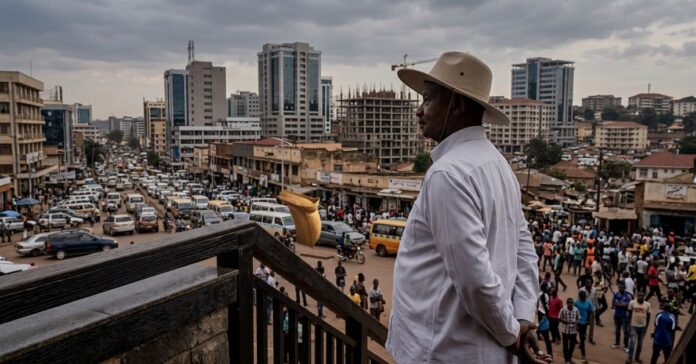
For personal reasons, I have spent the past several weeks in Kampala, Uganda’s capital — a vibrant, contradictory city where snarled traffic, new building sites, and the energy of an extraordinarily young population coexist alongside the ragged edges of a modernization still incomplete. By coincidence, my stay overlapped with one of the defining political moments in recent African history: the seventh inauguration of Yoweri Museveni, who was reelected president in January 2026 with 71.6 percent of the vote and an official turnout of 52.5 percent. At 81, having governed since 1986, Museveni belongs to that rare category of leaders whose biography has become indistinguishable from the history of the country itself.
For anyone arriving in Uganda today, it is difficult to dismiss what has been achieved over these four decades. When Museveni came to power, the country was emerging from generations of dictatorship and civil war. Under Idi Amin and Milton Obote, Uganda had been a country of repression, violence, and economic ruin. The relative stability of recent decades — the expansion of the economy, Kampala’s growing regional weight, the state’s ability to preserve a degree of internal cohesion — represents a genuine achievement, and one that explains why a significant portion of the population still regards Museveni as the guarantor of order and continuity.
And yet, moving through the city in the days surrounding the inauguration, what struck me was not so much enthusiasm as a kind of normalization. Kampala did not feel animated by popular fervor; it felt orderly, almost administrative. Some supporters of the National Resistance Movement, the ruling party, wore its customary yellow, while daily life went on as though it were any other day. The impression was not of a new beginning, but of a predetermined story quietly reaffirming itself.
The question that kept presenting itself was simple enough: how long can a political system built on the continuity of a single man sustain itself before stability loses its original meaning and becomes, instead, the indefinite suspension of democratic renewal?
The Ceremony of Permanence
The inauguration ceremony, held in Kampala, had the unmistakable tone of a celebration of sheer political endurance. Wearing a traditional straw hat and a white shirt, Museveni enumerated his government’s achievements and credited the military with having secured the country’s safety. In his address, he paid tribute to Julius Nyerere, the historic president of Tanzania, underscoring the symbolic and political continuity between his personal trajectory and the liberation movements of East Africa.
Numerous African heads of state were in attendance, including the presidents of the Democratic Republic of Congo and Burundi, and the leaders of Somalia, South Sudan, and Mozambique, as well as Tanzania’s president. Their presence gave the event a regional dimension, signaling that Museveni continues to be regarded as a central figure in the political and security landscape of East Africa and the Great Lakes region. The United States was represented by a senior State Department official — a sign of the pragmatic relationship Washington maintains with a partner deemed strategically convenient.
The ceremony’s language was that of continuity. There was no talk of succession, no talk of transition; the themes were consolidation, the fight against corruption, and further economic development. Museveni promised to reduce residual poverty and to steer Uganda toward middle-income status, with particular emphasis on improving public services, especially in healthcare.
In formal terms, this was a routine presidential inauguration. In substantive terms, the ritual carried the meaning of a renewed personal consecration. After four decades in power, each reelection inevitably resembles less a transfer of power and more a dynastic reaffirmation — even if it takes place within the formal scaffolding of constitutional procedure.
The Opposition and the Limits of Democracy
Museveni’s main challenger was Bobi Wine, the former musician and leader of the National Unity Platform, who received 24 percent of the vote. As in previous elections, Wine alleged pressure, intimidation, and irregularities at polling stations, contesting the credibility of the entire process. The opposition also chose to boycott the inauguration ceremony, refusing to lend it any symbolic legitimacy.
The more revealing fact is not simply the electoral result but the distance between how power is organized and the expectations of an overwhelmingly young population. The majority of Ugandans were born after Museveni was already president. For entire generations, the peaceful transfer of power has remained a theoretical concept rather than anything they have ever witnessed.
Yusuf Serunkuma, a professor at Makerere University, described this latest inauguration as a permanent fresh start — a particularly apt phrase for capturing the feeling of a system that perpetually promises transformation while reproducing the same configuration of power. The country continues to wrestle with widespread poverty, inequality, and persistent social problems, even as political renewal remains indefinitely deferred.
Democracy is not measured by the mere existence of elections, but by the real possibility that power can change hands. When a leader wins for the seventh consecutive time, the question is not only a legal one; it is political and cultural. Elections risk becoming not a vehicle for change but a mechanism for ratifying a balance of power that was never really in question.
Stability Is Not Enough
It would be shallow to ignore what Museveni has meant for Uganda. In a country that has known disorder and violence, stability is no small thing. But stability is a means, not an end. Its function should be to create conditions for stronger institutions, broader participation, and eventually the peaceful transfer of power.
When stability instead becomes the all-purpose justification for one man’s indefinite hold on power, it risks becoming the opposite of democracy. Order cannot be the alibi for stagnation, nor can the memory of past achievements stand in indefinitely for the work of building what comes next.
The question of succession, too, remains unresolved. In recent years, the name most frequently mentioned was that of Muhoozi Kainerugaba, Chief of Defense Forces and the president’s son, who has since stated that he does not intend to run in the 2031 elections, pointing instead to his uncle, Salim Saleh, as a possible candidate. This uncertainty is itself a reminder of how thoroughly the political system revolves around the president’s family and inner circle.
From where I stood in Kampala, Museveni’s seventh term presents itself as a paradox of contemporary politics. It is at once the symbol of an undeniable stability and the sign of a democracy that struggles to imagine itself beyond its founding leader. After four decades of his rule, Uganda’s real test is not simply to preserve the order it has built, but to prove that stability can outlast the man who made it.
The Deeper Strategic Logic – and Its Limits, Challenging Ipsedixitism on the Ground
Ethiopia’s structural advantages over Eritrea are not in question: larger population, bigger economy, greater diplomatic weight, more mobilization capacity. But alongside those material advantages sits an intellectual architecture that Ethiopian elites have built to justify their regional ambitions — and that architecture deserves to be named precisely. It is, in the strict philosophical sense of the term, ipsedixitism.
Ipsedixitism from the Latin ipse dixit, “he himself said it” describes the fallacy of asserting something as true simply on the authority of the speaker, without evidence, argument, or justification. Jeremy Bentham coined the term specifically to expose the political habit of declaring issues closed by the weight of who is asserting them rather than by the quality of what is being argued. The claim stands not because it has been demonstrated, but because he said so, and he is powerful enough that no one has yet made him defend it.
Abiy Ahmed’s Red Sea “sovereign access” doctrine is ipsedixitism in perhaps its most politically charged modern form. The claim that Ethiopia has a natural, civilizational, historical right to Eritrea’s coastline and that Eritrea’s internationally recognized sovereignty over that coast is itself a kind of injustice requiring correction carries no foundation in international law, no basis in the post-independence order, and no legitimacy under the Algiers Agreement. It is simply declared, repeatedly and forcefully, with the expectation that force of repetition substitutes for force of argument. The more it is said, the more it sounds like a truth rather than an aspiration dressed up as destiny.
The rhetorical strategy works domestically because it traffics in emotion rather than evidence. It tells a nationalist audience a story they want to believe: that Ethiopia was once whole, that its access to the sea was taken, and that restoring it is not aggression but restoration. Nobody is asked to examine the legal record. Nobody is invited to interrogate whether the border was internationally arbitrated. The assertion does the work that argument would otherwise need to do.
But asserted loudly is not the same as established factually. And this is precisely where the Ximdo model operates as a strategic counter — not by winning a rhetoric contest, but by building a counter-reality on the ground that makes the ipsedixitism increasingly hollow. When Tigrayan communities cross the Zalambessa border to reunite with Eritrean families, they are not debating international law. They are producing lived evidence that the narrative of Eritrea as an obstacle to regional destiny does not match the actual human terrain. When 700 Eritreans carry grain to displaced families in Sheraro, they are performing a different story entirely — one that no government press release can easily overwrite. When Afar communities along the Dankalia coast remain stable and integrated, absent of the insurgent infrastructure that Ethiopian proxy strategy would require, the operational premise of the sovereign access campaign is quietly undermined at the base.
The TPLF’s April 2026 reassertion of Tigrayan governance authority citing Ethiopian federal violations of the Pretoria Agreement deepened this fracture. The people most geographically positioned to serve as the mobilization base for any northern campaign against Eritrea are increasingly focused on defending themselves from the federal government, not on joining it in an adventure against Asmara. That is not a condition Eritrea engineered. But it is a condition the Ximdo model is built to sustain and deepen. Eritrea does not need to defeat Ethiopian ipsedixitism in an argument. It needs only to ensure that, on the ground, in the communities where mobilization is actually built or blocked, the dogma is met with the friction of lived human experience.
Narrative Security: Why Relationships Are a Form of Defense
One dimension of this model that rarely receives the strategic attention it deserves is the information warfare layer. Eritrea’s historical vulnerability to international pressure has been, in significant part, a narrative vulnerability. When a state is socially isolated, it becomes an empty canvas onto which its adversaries can paint whatever story serves them best. Accusations spread without friction. Propaganda moves faster than counter-narrative. External actors shape global perceptions while the targeted state argues, largely unheard, from behind its own walls.
The solution is not better propaganda. Better propaganda is an arms race that a small state will lose against a larger one with more resources, more international relationships, and more platforms. The solution is human familiarity the kind that makes demonization structurally harder because too many people have direct, personal experience that contradicts the caricature. During the Cold War, American cultural exchange programs were not charity. They were strategic. The logic was simple: a Soviet intellectual who had spent a year at an American university and made American friends would find it harder to believe that Americans were the soulless agents of capitalist imperialism his government described. Human experience complicates propaganda. It introduces the noise of reality into an otherwise controlled signal. The Ximdo model operates on the same principle — not through organized exchange programs, but through trade, religious ceremony, shared grazing land, family visits, and cross-border markets. These are not soft gestures. They are, in information warfare terms, structural defenses.
The Asymmetric Logic: Punching Above Your Weight
The deeper strategic sophistication of this model lies in its asymmetry. Eritrea is not trying to match Ethiopia. It cannot, and attempting to do so directly would be the kind of strategic miscalculation that has destroyed small states throughout history. Carthage tried to match Rome militarily. The result was Carthago delenda est. The Aztec Empire tried to absorb the Spanish through its traditional tributary logic. The result was Tenochtitlan in rubble.
What small states that survive and sometimes thrive tend to do instead is complicate the math for larger adversaries. Switzerland did not survive centuries of surrounding great powers by fighting them. It survived by being expensive to absorb militarily, economically, and politically. Finland survived Soviet pressure during the Cold War not by matching Soviet military power but by making itself useful, non-threatening, and deeply embedded in networks of economic and political interdependence that made invasion more costly than accommodation. Singapore transformed from a resource-poor city-state into a node that every regional power found more valuable intact than destabilized. Eritrea’s Ximdo model follows this logic. It cannot outnumber Ethiopia. It cannot outspend the Gulf powers competing for Red Sea influence. What it can do is make the surrounding environment complicated — socially, politically, narratively. This is what strategic thinkers mean when they talk about a smaller state punching above its weight. It is not about strength. It is about making the cost of aggression high enough that the aggressor must think twice.
The Risks That Cannot Be Glossed Over
Honesty requires confronting the vulnerabilities in this model directly, without softening. The trust deficit is not cosmetic. Historical trauma between Eritrean and Tigrayan communities runs through living memory — and not only through the 1998-2000 war. During the Tigray conflict, Eritrean forces were documented participating in serious atrocities against Tigrayan civilians. The communities now crossing at Zalambessa carry those memories. Reconciliation built on social engagement is fragile in the way that scar tissue is fragile — it holds until it is struck in exactly the right place. One traumatic event, one political miscalculation, one atrocity attributed to Asmara in a moment of crisis, can collapse years of careful relationship-building overnight.
Ethiopia can also flip the script. Addis Ababa has already labeled Eritrean cross-border activity as “meddling in Ethiopia’s internal affairs”. That framing is not entirely without resonance. To an Ethiopian nationalist audience with historical reasons to distrust Asmara’s intentions, the image of Eritrea cultivating social relationships across the Tigrinya-speaking north looks less like community-building and more like a long-term influence operation. That perception can itself become a mobilization tool which means the Ximdo model carries the paradoxical risk of accelerating the very hostility it is designed to reduce, if it is managed clumsily.
And then there is the deepest contradiction in the model’s architecture: a government that restricts civic space at home is asking neighboring communities to trust its civic intentions abroad. That gap is not invisible. Eritreans living under indefinite national service, operating without independent media, and lacking formal political participation represent a structural credibility problem for any narrative of Eritrea as a stabilizing civic partner. A virtual buffer zone built on trust requires the architect to be trustworthy. That demands consistency, restraint, and long-term credibility — qualities that are easier to describe than to demonstrate across decades of difficult regional politics.
The Long Game
If this model succeeds over the coming decades, the transformation it produces would be genuinely remarkable. Eritrea would shift from what it has largely been a heavily isolated fortress state, perpetually on guard, perpetually pressured into something closer to a stabilizing node: a small state at the center of a network of layered relationships, economic ties, and cross-border communities whose stability interests have become aligned with Asmara’s own.
That is not a utopian vision. It is a strategic calculation. The logic, stripped to its essentials, is this: the strongest border is often not the most militarized one. It is the one where neighboring societies no longer see benefit in your destabilization. Walls can be breached. Armies can be outflanked. But a surrounding human environment that has decided, through its own experience and its own interests, that your survival is in its interest that is a form of security that cannot be taken by force.
Whether Eritrea can build and sustain this over time depends on variables beyond any single decision made in Asmara — on Ethiopia’s internal trajectory, on whether the Gulf’s competitive maneuvering allows any breathing room, on whether the Sudanese civil war produces a manageable outcome along Eritrea’s western flank, and above all on whether Eritrea itself can demonstrate the patience and consistency the model demands. None of that is guaranteed. Regional politics in the Horn rarely reward long-term patience. External powers with leverage to lose from regional stability have strong incentives to disrupt whatever reconciliation efforts emerge.
But the concept being tested here the idea that a small nation can build its security through people rather than only through weapons, through social geography rather than only through physical geography is one of the more original strategic frameworks to emerge from the Horn of Africa in the post-independence era. A nation hemmed by history and geography, building its safety not from walls but from human relationships. That is worth watching carefully. And it is worth understanding precisely.
There is an old saying among soldiers: the map is not the territory. Generals who win wars understand that borders drawn in ink mean nothing if the people living along them have decided, in their hearts, that they have more to gain from your destruction than from your survival. Eritrea has known this truth longer than most. Squeezed between a vastly larger southern neighbor, a turbulent western flank, and a Red Sea that every ambitious power in the region wants a piece of, Eritrea cannot afford the luxury of believing that a dotted line on a map constitutes security.
What Eritrea is building instead imperfectly, sometimes contradictorily, but with discernible strategic intent is something classical military doctrine has not quite named yet. Call it societal strategic depth. The logic is older than the terminology: surround yourself not with walls, but with people who no longer see a reason to want you gone. This is the essence of what observers have begun calling the Ximdo — ጽምዶ — model: layered social engagement across borders, cultivated not as an act of goodwill but as a form of architecture. The architecture of a state that cannot afford to be surrounded by enemies and has decided to do something about it.
To understand why this matters, you have to understand the position Eritrea is actually in. Russia absorbs pressure through sheer geographic mass — Napoleon learned that lesson, and Hitler relearned it. China’s depth is demographic and industrial: a country of 1.4 billion people with a manufacturing base that can outlast almost any economic siege. Israel compensates for its small size through technological superiority and an alliance with the world’s most powerful military. Eritrea has none of these options in conventional form. What it has, and what it is beginning to use with growing deliberateness, is the ability to shape the human environment around its borders — to reduce hostility not by defeating it militarily, but by making it socially expensive, politically complicated, and emotionally difficult to sustain.
Tigray: Turning an Old Front Line Into a Social Firewall
The most dramatic illustration of this model in action is the Tigray dimension, and to appreciate it you need a short memory of history. For roughly three decades, the Tigray People’s Liberation Front ran Ethiopia from Addis Ababa. The TPLF’s hatred of Eritrea was not incidental — it was structural. Eritrea’s independence in 1991 had broken the TPLF’s access to the sea. Eritrea’s willingness to fight back in 1998 had humiliated a government that thought it controlled the region. The northern Ethiopian border was, for a generation, functionally an anti-Eritrean mobilization base. The TPLF kept it that way deliberately.
Then the Tigray war happened, and it broke everything including that arrangement. The federal government that Tigrayans had built and dominated turned its guns on them. Eritrean forces entered the war on Addis Ababa’s side, and atrocities followed on a scale that has been extensively documented. None of that was clean or simple. But in the wreckage, something unexpected opened up: space. Not political space in the formal sense, but social space the human possibility for Tigrayan communities to begin separating their experience of the Ethiopian state from their relationship with Eritrea. The enemy of my enemy is not automatically my friend, but the calculus had shifted.
What happened next is worth lingering on. In 2025, without formal approval from either government, community leaders and local activists organized a border reopening at Zalambessa. Families separated for five years embraced at a crossing that had been a militarized front line within living memory. By April 2026, over 700 Eritreans had crossed into Tigray’s Sheraro district to celebrate religious festivals with their neighbors, bringing grain for displaced families — and describing the visit, in their own words, as “a stage of brotherhood”. The Ethiopian federal government promptly called it meddling. That reaction tells you everything about what Addis Ababa understood was happening.
Think of it the way a historian might think about the Franco-German relationship after World War II. France and Germany spent a century bleeding each other. What finally broke the cycle was not a peace treaty — there had been peace treaties. What broke it was the deliberate weaving of human relationships: student exchanges, sister cities, joint institutions, economic interdependence. By the time a future French president considered going to war with Germany, the social cost would have been catastrophic. Too many French families knew Germans. Too many German families had cousins in Lyon. The political will to mobilize simply could not be manufactured against that backdrop of human familiarity.
Eritrea is not France, and Tigray is not Germany. The wounds are fresher, the distrust deeper, the political environment far more fragile. But the logic is the same. If future generations in Tigray grow up with social and economic ties to Eritrea — if they know Eritreans as neighbors rather than as caricatures in a government propaganda campaign — then mobilizing them against Asmara becomes harder. Not impossible, but harder. And in a region where wars are often decided by who can build a political coalition fastest, harder matters enormously.
The Afar Coast: Where Social Depth Meets Maritime Security
The Afar dimension of this model tends to get lost in analyses focused on Addis Ababa and Asmara. That is a mistake, because the Afar corridor is arguably the most geopolitically consequential piece of real estate in the entire Horn of Africa.
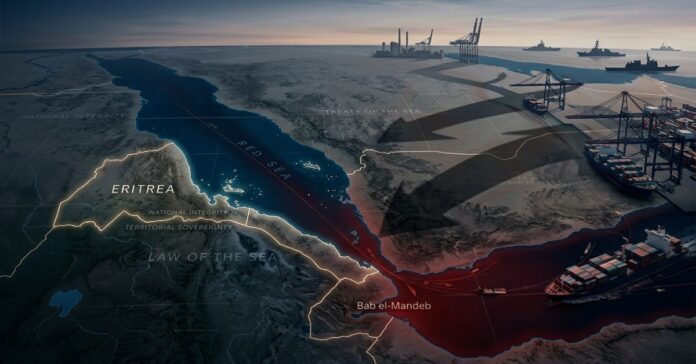
The Afar people inhabit the territory stretching from Eritrea’s Dankalia coast through northeastern Ethiopia to Djibouti directly adjacent to the approaches to Bab el-Mandeb, the chokepoint through which a significant share of global maritime trade passes. Whoever controls the human terrain of that corridor shapes one of the most strategic coastlines in the world. This is not an abstraction. It is why Gulf states have been competing aggressively for port agreements across the Red Sea littoral. It is why Ethiopia’s Abiy Ahmed has made “sovereign access to the sea” his defining foreign policy demand. And it is why Eritrea’s management of its Afar coastline is, in security terms, far more than a domestic administrative question.
What is observable along Eritrea’s Dankalia coast is the absence of what you would expect to find if the human terrain had been neglected. There are no recorded insurgent networks. No extremist sanctuaries. No documented history of external proxy infrastructure taking root along that stretch of shoreline. Afar communities in Eritrea participate in national institutions and local governance. The coast is stable. In a region where stability is the exception, that is a strategic asset — and it reflects sustained, deliberate attention to the communities living there.
The practical implication is direct. Any Ethiopian move toward Eritrea’s coast whether military, diplomatic, or through the instrumentalization of Afar grievances requires either community cooperation or community passivity. Eritrea’s engagement with Afar communities transforms the corridor from a vulnerability into something closer to social armor. You cannot march through a neighborhood whose residents have decided you are not welcome. History offers abundant examples: the British Empire found this in the Khyber Pass, the Soviets found it in Afghanistan, and the United States found it everywhere from the Mekong Delta to the Helmand Province. Physical geography matters less than human geography when the people on the ground have made their choice.
Sudan: Defending the Western Flank Through Relationship, Not Just Force
Eritrea’s western border has historically been its most porous strategic vulnerability. Sudan shares over 600 kilometers of frontier with Eritrea, and that border has at various times served as a corridor for refugees, arms, intelligence operatives, and hostile forces. The current Sudanese civil war which has drawn in the UAE, Egypt, Saudi Arabia, and various regional powers across complex and shifting alignments makes this flank more dangerous, not less.
Asmara’s response has been to embed itself directly in Sudanese politics and security. President Isaias Afwerki has been explicit: eastern Sudan is Eritrea’s “first line of defense”. When the civil war began deteriorating in ways that threatened the Sudanese Armed Forces, Eritrea moved toward direct alignment with the SAF — including a reported threat of military intervention should the fighting approach the border states. Port Sudan and Asmara deepened economic and diplomatic ties: joint committees, energy discussions, military coordination, and a personal visit from Sudanese Prime Minister Kamil Idris accompanied by senior generals.
This is worth reading carefully, because it is easy to misread as pure military alliance politics. It is more than that. The informal trust networks along the Eritrean-Sudanese border built through decades of cross-border trade, shared pastoral routes, and family connections between communities on both sides — are the real long-term asset. Formal alliances between governments collapse when governments change. But communities that have done business together for three generations, that share water and grazing land and wedding guests, tend to maintain a baseline of interdependence that outlasts any particular political arrangement.
Think of the way Ottoman and Byzantine merchants maintained trade networks even during periods of outright war between their states. The markets kept moving because the people running them had relationships that transcended the political moment. That kind of informal resilience is what cross-border community engagement builds — and it is considerably more durable than a signed memorandum of understanding. Tune in for Part Two.
There are moments in the life of a region when words are not mere words. They become signals. They reveal intentions. They test whether history will be respected or manipulated. The latest rhetoric from Ethiopia’s political elite on the question of the Red Sea is one of those moments. It is presented as historical correction, national necessity, and strategic logic. But beneath the polished language lies an old and dangerous habit: refusing to accept Eritrea as a sovereign equal and searching, once again, for escape from Ethiopia’s internal failures through external ambition.
It must be said clearly from the beginning: Eritrea’s independence was not an accident of history, nor was Ethiopia’s loss of direct access to the sea the result of some mysterious foreign plot alone. Eritrea became independent because its people fought for thirty years against annexation, occupation, and denial. Eritreans paid for sovereignty with blood, sacrifice, discipline, and endurance. That truth cannot be erased by political slogans, nor can it be rewritten by those who now speak as if Eritrea’s statehood is an inconvenience rather than a settled historical and legal reality.
As the elders teach us, a man who refuses to learn from yesterday will injure himself again tomorrow. For too long, sections of Ethiopia’s elite have treated the Red Sea not as a matter for lawful cooperation, but as a wounded imperial memory. For years, they spoke as if time itself would undo Eritrea’s freedom. Today, the same thinking returns dressed in modern language. Yet what is old remains old. A claim repeated many times does not become truth. A fantasy spoken loudly does not become strategy.
The question of sea access, as presented by Ethiopian officials and media voices, is now being elevated into a national cause tied to Ethiopia’s future. We understand why they do this. Ethiopia is a large country facing immense pressure, economic strain, unresolved conflict, and political fragmentation. But size does not create rights over another people’s coast. Population does not cancel sovereignty. Frustration does not produce entitlement. If Ethiopia needs access for trade, that is a matter for peaceful negotiation, mutual benefit, and respect between states. It is not a basis for historical revisionism.
Prime Minister Abiy Ahmed and others around him have argued that Ethiopia cannot guarantee development or peace without secure access to the sea. But this argument collapses the moment it is examined honestly. Ethiopia’s deepest crisis today is not the absence of ownership over a coastline. Its crisis is internal. Its people are burdened by war, displacement, poverty, debt, and mistrust. Its regions remain unsettled. Its political compact remains fragile. No port will solve that. No maritime slogan will heal what bad governance, violence, and instability have torn apart. A nation is not rescued by romantic geography. It is rescued by leadership, justice, and discipline.
A country of more than one hundred million people should not be encouraged to believe that its future depends on revisiting borders that have already been settled in war, diplomacy, and international law. That road does not lead to peace. It leads to false hope at home and fear abroad. It is especially reckless in a region as sensitive as the Red Sea and the Horn of Africa, where one irresponsible narrative can unsettle millions. If Ethiopia truly seeks regional stability, it should begin by lowering the temperature, not raising expectations around a project that has no legal foundation.
The truth is simple. Eritrea is not obstructing history. Eritrea is history. Eritrea’s sovereignty was not gifted by anyone. It was won. The Eritrean people did not vote in 1993 so that future Ethiopian politicians could reopen the question whenever domestic politics became difficult. They voted to end that question forever. Eritrea is not a temporary arrangement. It is not a bargaining chip. It is not a province waiting to be remembered by another name. It is a sovereign state, born through struggle and affirmed by law.
Those who say Ethiopia is only asking for what was once “naturally” its own should be careful. That language is dangerous not only for Eritrea, but for Africa as a whole. If every state begins to search the distant past for emotional title deeds, then no border on this continent will remain safe. The modern African order, with all its imperfections, rests on the principle that existing boundaries are to be respected. Without that principle, the continent would drown in endless claims and counterclaims. Ethiopia, of all countries, should not help normalize such thinking.
From the Eritrean perspective, this matter is not emotional confusion. It is a question of sovereignty, memory, and national dignity. Eritrea has no interest in threatening anyone’s independence, no interest in violating another people’s borders, and no need to seek legitimacy through loud declarations. Eritrea’s position is restrained because it is grounded. We do not ask for what belongs to others. We insist only on what is ours. Our independence is ours. Our coastline is ours. Our territorial integrity is ours. That is not extremism. That is the minimum definition of statehood.
From an economic point of view, Ethiopia’s landlocked condition is indeed a challenge. No serious person denies that. But difficulty does not justify delusion. Many countries trade successfully through negotiated port access, transport corridors, and regional agreements. Eritrea itself never opposed cooperation in principle. The issue has never been whether Ethiopia can access ports through law and partnership. The issue has been whether Ethiopia’s elite can accept access without domination, commerce without entitlement, and cooperation without dreams of ownership. That is the real political test.
When one listens carefully to the current Ethiopian discourse, another troubling theme appears. Some voices suggest that small states cannot secure major trade routes, and that larger powers must therefore play a controlling role. This too must be rejected. Sovereignty is not measured by population size. A small nation does not lose its rights because a bigger neighbor claims strategic need. Eritrea’s control over its coast is not a temporary technicality. It is a sovereign fact. Regional security is strengthened when states respect each other’s rights, not when one state imagines itself the natural manager of all around it.
As another old saying reminds us, not every road that looks wide leads home. Ethiopia’s political class should reflect deeply before marching their public down this road. The language of return, destiny, and natural access may stir emotions, but emotions do not carry containers, lower inflation, stop armed conflict, or build functioning institutions. The people of Ethiopia need serious leaders focused on the nation before them, not restless elites searching for redemption in waters beyond their borders.
The history of Eritrea’s struggle should have taught the region one enduring lesson: a people who know the cost of freedom do not negotiate their existence under pressure. Eritrea endured empire, annexation, war, sacrifice, and isolation. It did not endure all of this so that, decades later, commentators in Addis Ababa could casually speak of “correcting history” at Eritrea’s expense. History was already corrected — by the Eritrean people themselves.
This is why the current moment requires firmness, not noise. Eritrea should remain calm, lawful, and clear. We should not be drawn into theatrical exchanges. We should not answer inflated rhetoric with inflated rhetoric. We should answer it with principle. Eritrea’s sovereignty is final. Eritrea’s borders are not up for renegotiation through public pressure. Any future relationship with Ethiopia must be built on equality, mutual respect, and legal clarity. Nothing else will endure.
The coming generation in Eritrea must inherit a country that is secure in its rights, confident in its memory, and unshaken by revisionist storms from abroad. And the coming generation in Ethiopia deserves something better than geopolitical fantasy. It deserves peace within its borders, functioning institutions, economic seriousness, and leaders mature enough to build rather than provoke.
What is planted today in rhetoric can grow tomorrow into tension or wisdom. That choice still exists. Ethiopia’s political elite can continue sowing grievance, illusion, and dangerous expectation. Or they can turn inward, do the hard work of nation-building, and build a stable future within internationally recognized borders. That is the only serious path. That is the only peaceful path. And that is the path history, law, and regional stability demand.
Eritrea will remain where it stands — sovereign, watchful, disciplined, and free.
This article first appeared in Arabic on Siyassa.org.eg and is republished here in English with the author’s permission. Setit Media presents this translation as part of our mission to uphold truth, credible journalism, and serious public understanding.
Introduction
What is unfolding in the Horn of Africa is no longer a limited disagreement over commercial transit facilities, nor a diplomatic tension that can be managed by reassuring statements or technical formulas. It is a regional crisis with deep legal and geopolitical implications. More importantly, it is a test of whether the rules that protect sovereignty and territorial integrity still carry real meaning in the Red Sea and the wider Horn of Africa.
The present crisis is not the result of an emergency circumstance, nor the product of a passing misunderstanding. It is a direct reflection of Ethiopia’s declared ambition to obtain what its leadership describes as “sovereign access to the sea”. This ambition has been presented in several changing forms: sometimes as a legal right, sometimes as a historical entitlement, and at other times as an existential or economic necessity that cannot be postponed. Yet the diversity of the language does not change the essence of the matter. The real problem lies in the move from legitimate contractual access, which international law recognises for landlocked states, to a sovereign claim that reopens questions of borders and territorial jurisdiction in an extremely sensitive region.
Most importantly, none of these descriptions, regardless of their political formulation, creates under contemporary international law any right to acquire sovereignty over the territory of another state. There is no legal rule that grants a landlocked state the right to impose its sovereignty over the coast of a sovereign state. Nor does any modern principle permit the acquisition of territory outside the framework of treaties, mutual recognition, and free consent. The United Nations Charter enshrines the sovereign equality of states and prohibits the threat or use of force against the territorial integrity or political independence of any state. The difference between a “right of access” and a “sovereign right” is therefore not a linguistic detail. It is the dividing line between legitimate cooperation and the redefinition of the foundations of the international system itself.
In a region such as the Red Sea, where global trade routes intersect with the competition of regional and international powers, this shift becomes a matter of collective security, not merely a limited economic issue.
First: The Ethiopian Vision as Presented by Decision-Makers
For criticism to be coherent and fair, the Ethiopian vision must first be presented as it appears in official and semi-official discourse. This vision rests on three main pillars: national security, the economy, and the problem of near-total dependence on the ports of others. From a national security perspective, Addis Ababa argues that a country of Ethiopia’s demographic and geographic size cannot remain confined within land borders, and cannot link the security of its foreign trade to the decision of one or two coastal states. From an economic perspective, it argues that high transport costs, fees, and insurance charges weaken the competitiveness of exports and imports, and make development hostage to logistical bottlenecks beyond the direct control of the state.
As for dependence on the ports of others, the Ethiopian argument points to the fact that most of Ethiopia’s foreign trade passes through Djibouti, and that this reliance creates strategic vulnerability in the event of political, security, or commercial crises. This point should not be denied in principle. Landlocked states do indeed face structural challenges in accessing global markets. International law has addressed this problem by recognising the right of access to the sea and freedom of transit, not by granting sovereign rights over the territory of coastal states.
The weakness in the Ethiopian discourse begins when it moves from diagnosing a real problem to proposing a remedy that is unlawful. Economic need, however serious, does not become a basis for acquiring sovereignty over the coast of another state. National security, however important, does not give a state the right to redefine the borders of its neighbours or to pressure them under the heading of “existential necessity”. Here precisely lies the essence of the matter: the distinction between commercial access and a sovereign right. The former can be regulated through fair and mutually beneficial agreements; the latter collides directly with the principles of sovereignty and territorial integrity.
Second: The Formation of the Modern Ethiopian State and the Limits of Legitimacy
To understand the depth of the controversy, it is necessary to return to the historical context in which the modern Ethiopian state, in its internationally recognised form, took shape. Ethiopia as we know it today did not emerge as a continuous extension of an ancient imperial entity with fixed borders. Its modern political boundaries were formed in the late nineteenth century during the reign of Emperor Menelik II, who expanded the Kingdom of Shewa northwards and southwards in the context of the redrawing of the maps of the Horn of Africa amid European colonial competition.
On 1 January 1890, Eritrea was officially declared an Italian colony. The modern Eritrean entity therefore took shape in international legal terms before the completion of the expansion of the modern Ethiopian state within its contemporary borders. This chronology is not a secondary detail. It is a decisive element in understanding the nature of political entities in the region. If Eritrea took shape as a defined and recognised entity before the consolidation of modern Ethiopia’s borders, the claim that it was an original part of that state contradicts both historical and legal facts.
Modern Ethiopia, as internationally recognised before the federal union with Eritrea, was a landlocked state with no direct coastline on the Red Sea. It did not lose a maritime outlet that had formed part of its stable legal entity, nor were coasts that fell within its internationally recognised borders taken away from it. Therefore, portraying the “loss of the sea” as a historical grievance rests on a confusion between recognised legal arrangements and temporary situations that arose under exceptional circumstances.
Ethiopia’s temporary access to the sea came as a result of United Nations General Assembly Resolution 390(V) of 1950, which approved a federal union between Eritrea and Ethiopia. This arrangement came into effect in September 1952, before being unilaterally terminated in 1962 through the annexation of Eritrea and the abolition of its federal status.
From the standpoint of international law, annexation, however long it lasts, does not create a legitimate historical right. It raises questions of legality and accountability. For this reason, Eritrea’s independence, achieved after de facto liberation in 1991 and confirmed through a United Nations-supervised referendum in 1993, was not secession from a mother state. It was the termination of a situation created by unilateral annexation and the exercise of the right of self-determination.[1] Invoking history to justify contemporary sovereign claims overlooks a basic truth: legitimacy in the international system is built on treaties and mutual recognition, not on civilisational narratives or selective readings of the past.
Third: The Legal Framework – Right of Access, Not Sovereign Right
The United Nations Charter, the Constitutive Act of the African Union, and the United Nations Convention on the Law of the Sea all draw clear boundaries between what is lawful and what is unlawful. The principle of sovereign equality and the prohibition of the threat or use of force are not merely abstract moral language. They are foundational rules designed to protect international stability and prevent political ambition from turning into the coercive alteration of borders.
The United Nations Convention on the Law of the Sea of 1982, which entered into force in 1994, grants landlocked states the right of access to the sea and freedom of transit through fair and equitable contractual arrangements. It does not grant them any sovereign right over the territory or ports of other states. Similarly, the African framework entrenches the principle of respect for the borders existing at independence, a principle that has been central to preventing border conflicts on the continent.[2]
Accordingly, turning the “right of access” into a “sovereign right” is not legal development. It is a move into direct collision with the founding principles of the modern international order, foremost among them the inadmissibility of acquiring territory by force or political pressure. This is where the test lies: will these principles remain real red lines, or will they become texts open to reinterpretation under the pressure of political discourse and geopolitical interests?
Fourth: Landlocked States in Africa – A Real Problem and a Cooperative Solution
Ethiopia is not unique in facing the problem of landlocked geography. Africa has sixteen landlocked or developing landlocked states, including Ethiopia, Uganda, Rwanda, Burundi, Mali, Niger, Chad, Zambia, Zimbabwe, Botswana, Lesotho, Eswatini, South Sudan and others.[3] Most of these states have addressed their challenges through transit agreements, trade corridors, customs cooperation, road and rail links, and joint infrastructure projects, not through sovereign claims over the coasts of their neighbours.
This is the essential idea that needs to be developed rather than merely rejecting sovereign claims. The practical path is not to close the door to Ethiopia’s legitimate economic needs, but to place them within forms of cooperation that do not affect sovereignty. Several alternatives are possible: long-term port-use agreements, free logistics zones, commercial corridors with regional or international guarantees, transparent transit fees, joint road and rail links, and customs and security cooperation that protects the rights of the coastal state and the needs of the landlocked state at the same time.
In this sense, legal rejection of the sovereign claim should not appear as rejection of cooperation. It should appear as a defence of the very rule that makes cooperation possible. Coastal states can offer practical solutions, but they cannot, and should not be asked to, relinquish their sovereignty or accept ambiguous arrangements that could later be transformed into a political or military fait accompli.
Fifth: Structural Drivers and the Link Between the Internal and the External
Ethiopia’s maritime ambition cannot be read in isolation from its internal context. Ethiopia faces deep challenges in managing its ethnic diversity, prolonged internal conflicts, and growing economic and security pressures. In such environments, a sovereignty-related external issue may become a tool of political mobilisation, redirecting internal debate towards a unifying external cause. Maritime claims may then be presented as a “solution” to structural domestic crises rather than as a normal path of cooperation with neighbouring states.
This link between the internal and the external is not a passing political accusation. It is a recognised entry point in analysing the behaviour of states facing crises of legitimacy or internal pressure. When internal consensus weakens, border or symbolic issues may acquire heightened mobilising power. The Ethiopian maritime discourse cannot therefore be separated from the need to produce a national issue that cuts across internal divisions, even if this comes at the expense of calming relations with neighbours or respecting the sensitivities of the Red Sea.
Sixth: Regional and International Actors – From Generalisation to a Network of Interests
At the same time, the Red Sea has become an open arena of competition between regional middle powers and major international actors seeking to strengthen their military and logistical presence. But a general reference to “regional and international powers” is not enough to understand the nature of the current crisis. Although the Red Sea has become a space in which the interests of many actors intersect, the present crisis, linked to Ethiopia’s pursuit of what is called “sovereign access to the sea”, appears more closely connected to dynamics of influence led by some regional powers, foremost among them the United Arab Emirates, with an indirect presence of Israeli interests in the security of the Red Sea and Bab el-Mandeb.
The UAE, by virtue of its investments in ports and logistics and its growing presence in the Horn of Africa, is an actor that cannot be ignored in any serious reading of maritime transformations in the region. Its name has previously been linked, through DP World, to the arrangements concerning Berbera Port, including the 2018 agreement that referred to a possible Ethiopian stake in the project.[4] Israel, because of its strategic position and security concerns related to navigation in the Red Sea, remains interested in any arrangements that may affect the balance along the opposite African coast.
This dimension has become more important as the Israeli-Iranian conflict has widened and as Red Sea security has become linked to the role of forces allied with Iran in Yemen, especially around Bab el-Mandeb. This passage is no longer merely an international trade route; it has become part of a wider security equation connected to the Gulf, Israel, the Suez Canal, and global energy and trade movements. The Houthi attacks on shipping in the Red Sea since late 2023 have shown how a non-state actor, supported by or aligned with a regional power, can affect global trade routes and the calculations of major powers.
Therefore, any rearrangement of influence on the African coast of the Red Sea may acquire a meaning that goes beyond Ethiopia itself and enters calculations of deterrence, monitoring, alliances, and regional competition. Understanding the crisis requires looking at how Ethiopian ambition intersects with the interests of these actors, rather than explaining it simply as the economic need of a landlocked state. The maritime file here is not about commercial transit alone. It is part of a wider network of calculations linked to ports, maritime security, alliances, and the redistribution of influence in the Red Sea.
Seventh: The Red Sea – The Figures of Power and the Reality of Sensitivity
The Red Sea is not merely a regional passage. It is one of the world’s most important economic arteries and a geopolitical crossroads at which energy security, trade movement, and supply chains are shaped. The Red Sea-Bab el-Mandeb-Suez Canal axis links Europe to Asia and the Gulf to the Mediterranean, and represents a strategic node in global supply chains. United Nations and international estimates indicate that the Suez Canal handled around 12 to 15 per cent of global trade in 2023, while a large part of container traffic between Asia and Europe either passes through, or is affected by, the Red Sea.
Energy data also show that oil flows through Bab el-Mandeb fell sharply after the Red Sea disruptions, from an average of around 8.7 million barrels per day in 2023 to around 4 million barrels per day during part of 2024. This illustrates the sensitivity of the passage to security risks.[5] Any sustained disruption in this corridor is immediately reflected in insurance and transport costs, then in the prices of goods, energy, and consumption, especially in importing and developing economies.
Beyond that, the Red Sea has become a space where military investments, strategic ports, and security alliances intersect. Naval bases, logistical arrangements, and long-term partnership agreements all mean that any attempt to redefine “sovereignty” in this space goes beyond the region and touches international economic security.
Eighth: What Is Required in Practice?
First, the legal principle must be established with clarity: the rights of landlocked states are contractual, not sovereign. Under no circumstances should the need for maritime access be transformed into a claim that affects the territorial integrity of coastal states or diminishes their sovereignty. This does not mean denying Ethiopia’s economic needs or underestimating the difficulty of its position as a landlocked state. It means placing those needs within a clear legal framework that prevents them from being turned into sovereign pressure or a pretext for reopening border questions. International law does not close the door to access to the sea, but it strictly distinguishes between access organised by agreement and claims to sovereign rights over the territory of others.
Second, practical alternatives for cooperation must be developed instead of relying on general political responses. The rejection of sovereign claims becomes stronger and more convincing when accompanied by realistic avenues that meet legitimate economic needs without undermining sovereignty. These alternatives may include long-term port-use agreements, secured transit corridors, free zones inside the ports of coastal states, joint investments in roads and railways, arbitration mechanisms for commercial disputes, customs and security coordination, and transparent and reviewable service fees. Regional cooperation frameworks can also be established to guarantee the regular movement of trade, prevent the politicisation of ports, and provide the landlocked state with a degree of logistical stability without turning commercial facilities into sovereign rights or permanent security presence.
Third, any future arrangements should be based on mutual benefit, not coercion. Coastal states are not required to give up their sovereignty, but they can benefit economically from their geographic position by developing ports, logistics, storage, transport, insurance, and maritime maintenance services. In return, Ethiopia can obtain stable and diversified commercial access that reduces transport costs and excessive dependence on a single corridor. In this sense, geography can be transformed from a source of tension into an arena of integration, provided cooperation is based on mutual recognition, respect for borders, and legal clarity.
Fourth, the most affected coastal states should strengthen their diplomatic and security coordination within the framework of international law. Deterrence here does not necessarily mean military confrontation. It means preventing the creation of a new fait accompli that threatens stability and undermines confidence in the rules-based system. This includes coordinating collective positions, rejecting unilateral sovereign claims, strengthening joint maritime cooperation to protect international navigation, and establishing regular regional consultation mechanisms to assess strategic risks. Coordination should also include information exchange, monitoring movements that may affect the security of sea lanes, and developing a unified diplomatic discourse that clearly distinguishes between legitimate cooperation and claims that affect sovereignty.
Fifth, the African Union, the United Nations, and regional bodies, including IGAD, the Arab League, and the Red Sea coastal states, should affirm their practical commitment to the principles of territorial integrity and the inadmissibility of changing borders by force or political pressure. It is not enough to issue general statements about stability. The message must be clear: transit rights and economic cooperation are negotiable; sovereignty and territorial integrity are not. Tolerance of such behaviour does not threaten one state alone. It threatens the very idea of international law as the reference point that regulates relations between states.
Sixth, the Red Sea should, as far as possible, be insulated from bloc politics and proxy conflicts. The more ports and maritime routes become instruments in struggles for influence between regional and international powers, the more economic cooperation declines and the greater the risks of miscalculation and escalation become. What is required is not only to address Ethiopian ambition in itself, but to place it within a broader vision for Red Sea security, based on respect for the sovereignty of coastal states, freedom of navigation, preventing the militarisation of ports and islands, and ensuring that the need of landlocked states for maritime access does not become a gateway for redistributing influence or creating ambiguous security arrangements.
Conclusion: What Is Really Being Tested?
The issue today is not merely maritime access, nor a simple dispute over a port or a trade corridor. It is a test of the credibility of the international system itself in an extremely sensitive region. If sovereignty can be redefined on the basis of shifting political discourse, or if economic necessities can be presented as sovereign rights, then regional stability becomes inherently fragile and borders become subject to bargaining under the pressure of force or geopolitical inducement. In such a situation, it is not only one state that is harmed. The rule on which modern international relations are built is harmed: borders are not altered by coercion, and the needs of states, however legitimate, are not solved at the expense of the sovereignty of other states.
At the same time, protecting sovereignty does not mean closing the door to cooperation, nor denying the real challenges facing landlocked states in accessing markets and ports. The real challenge is to formulate a balanced equation that allows landlocked states fair and stable access to the sea, allows coastal states to preserve their sovereignty and security, and at the same time prevents regional and international powers from turning legitimate economic needs into instruments for re-engineering influence in the Red Sea. This cannot be achieved through slogans or escalation, but through clear agreements, secure corridors, transparent commercial arrangements, and legal guarantees that protect transit rights without opening the door to ambiguous sovereign claims.
The practical solution, therefore, does not lie in imposing facts on the ground, nor in invoking history to justify contemporary claims. It lies in returning to the rules whose necessity has been proven in Africa and the world: respect for borders, non-use of force or threat of force, mutual recognition, and cooperation based on shared interests. The clearer the rules, the more possible cooperation becomes. When these rules disappear, ports and maritime corridors turn from opportunities for economic integration into arenas of competition and conflict.
The Red Sea has never been merely a body of water. It has always been a space of trade, civilisational interaction, and strategic competition. Its stability today requires legal clarity, responsible balance, and recognition that protecting international rules is not a theoretical luxury, but a condition for collective security. The question facing the region, and indeed the world, is not simply who has access to the sea. It is what kind of international order we are prepared to defend: one based on sovereignty, cooperation, and law, or one that allows economic need and geopolitical ambition to become justifications for reopening borders and conflicts.
Brief References and Notes
[1] On the legal and historical formation of Eritrea: Eritrea was declared an Italian colony on 1 January 1890; United Nations General Assembly Resolution 390(V) of 2 December 1950 established the federal arrangement between Eritrea and Ethiopia; and Eritrea’s April 1993 referendum was conducted under United Nations supervision.
[2] United Nations Charter, especially Article 2(1) on sovereign equality and Article 2(4) on the prohibition of the threat or use of force; United Nations Convention on the Law of the Sea, 1982, Part X, Articles 124-132, especially Article 125 on the right of landlocked states to access to and from the sea and freedom of transit; see also the Constitutive Act of the African Union, Article 4(b), and OAU Resolution AHG/Res.16(I), Cairo 1964, on respect for borders inherited at independence.
[3] UN-OHRLLS and UNCTAD lists and reports on landlocked developing countries, indicating 32 landlocked developing countries globally, including 16 in Africa.
[4] On the UAE role and Berbera Port arrangements, see DP World and Reuters reports on the 2018 agreement referring to a possible Ethiopian stake in the Berbera Port project alongside DP World and the Somaliland Port Authority.
[5] On the sensitivity of the Red Sea and Bab el-Mandeb: UNCTAD, 26 January 2024, on disruptions to global trade in the Red Sea and Suez Canal; U.S. Energy Information Administration, 11 October 2024, on the decline in oil tanker transits through the Red Sea; and UN Security Council and Reuters reports on Houthi attacks on shipping since late 2023.
Sanctions are routinely presented as a clean alternative to military force. In reality, they are a blunt instrument with a poor track record — particularly when deployed unilaterally. This article examines the legal distinction between multilateral and unilateral sanctions, reviews the empirical evidence on their effectiveness, and applies both lenses to the case of Eritrea. The central argument is that sanctions, especially of the unilateral variety, tend to consolidate the regimes they target while transferring the burden onto civilian populations.
1. A Tool That Promises More Than It Delivers
In the vocabulary of international politics, sanctions are often presented as a ‘clean’ alternative to force — a way to apply pressure without resorting to war. The logic appears straightforward: if you strike a country in its economic or financial interests, its leadership will be compelled to reconsider its choices. But this framing significantly oversimplifies a mechanism that, in practice, is far more uncertain.
Sanctions do not act on abstract entities. They operate on concrete political systems — systems with entrenched elites, security apparatus, informal networks, and adaptive capacities that are routinely underestimated. It is precisely this capacity for adaptation that explains why, in the majority of cases, the instrument fails to produce the expected results.
As a substantial body of scholarship has noted, sanctions rarely function as a direct lever for change. More often, they generate indirect effects that are difficult to control, and sometimes the opposite of what was intended. The promise of an effective, non-violent intervention runs up against a reality defined by ambiguous and frequently disappointing outcomes.
2. The Only Legitimate Sanctions
Before any assessment can be made, a point of principle must be established. The only sanctions that can claim legitimacy under international law are those adopted by the United Nations Security Council. This is not a procedural technicality — it is a substantive distinction.
Multilateral sanctions arise from a collective process and exist within a recognized legal framework, with the declared objective of responding to threats to international peace and security. Unilateral sanctions are an altogether different matter. They are decisions taken by individual states — typically major powers — that extend their political will beyond their own borders. They carry no international mandate, and for precisely that reason, they must be considered illegitimate under international law.
In the case of Eritrea, the distinction is concrete and current. The United Nations sanctions, introduced in 2009 and strengthened in 2011, were lifted in 2018. What remains today is a collection of unilateral measures, primarily American, targeting specific individuals and entities — often through instruments such as asset freezing and financial restrictions. To continue speaking generically of ‘sanctions’ without distinguishing between these two levels is not merely imprecise. It actively contributes to a misleading narrative.
3. Do They Work? The Evidence Says Rarely
When the analysis moves from the normative to the empirical, the picture becomes even starker. Systematic studies — among them those of Gary Clyde Hufbauer, Jeffrey Schott, and Kimberly Ann Elliott, alongside the critical analyses of Robert Pape and Daniel Drezner — consistently show that sanctions have a limited success rate, particularly when the objectives are ambitious. Where positive results do occur, they tend to involve narrow, discrete goals rather than structural transformations.
The explanation is relatively straightforward. Sanctions generate economic costs, but they do not automatically translate into political change. Ruling elites have strong incentives to hold firm, and the means to do so: control of resources, suppression of dissent, and the construction of alternative networks. Moreover, as several studies have shown, sanctions can actually strengthen a regime’s internal cohesion — providing a justification for tightened control and a ready-made narrative of resistance against an external enemy.
In the meantime, the most immediate consequences fall on the population: inflation, scarcity of goods, reduced access to essential services and markets. This gap between stated objectives and actual outcomes is one of the central reasons why many scholars regard sanctions as a blunt instrument — particularly when deployed extensively and unilaterally.
4. Eritrea: Convenient Explanations and a More Complex Reality
In discussions about Eritrea, sanctions have become a recurring explanation for a range of domestic problems: economic stagnation, the absence of reform, institutional weakness. It is an explanation that has some basis in reality, but it becomes problematic when it is used as the sole or primary lens.
Following the lifting of UN sanctions in 2018, the formal context shifted significantly. Yet this shift did not translate into any comparably evident transformation at home. This data point suggests that internal factors play a determining role. Unilateral sanctions may limit access to certain resources or financial circuits, but they alone cannot account for the absence of structural reform or independent institutions.
When sanctions become the only explanatory framework, they risk functioning as an alibi — redirecting attention away from domestic dynamics (political, economic, institutional) and toward external factors. A more rigorous reading requires holding both dimensions together, without reducing complexity to a single cause.
5. Who Actually Pays the Price
The most critical issue concerns the concrete effects of sanctions, particularly unilateral ones. Designed to target governments and their leaderships, they end up falling directly on the population. Financial and trade restrictions translate into rising prices, shrinking economic opportunity, and diminished access to essential goods and services. In less open environments, these effects are magnified.
External pressure does not necessarily weaken power — it often reinforces it. Resources concentrate in the hands of the state or entrenched elites; the margins for economic autonomy narrow; dependence deepens. This is the central paradox of sanctions: a tool conceived to change a government’s behavior can end up consolidating it, while transferring the costs onto society at large.
Conclusion
An honest conclusion must start here. Sanctions are not a simple solution to complex problems. They may have a limited role to play, in specific contexts and with well-defined objectives. But unilateral sanctions in particular remain a tool without international legitimacy — frequently ineffective, and potentially counterproductive.
In the Eritrean case, acknowledging this does not mean denying the weight of external pressures. It means refusing to let those pressures become a total explanation. Because when analysis comes to rely on a single cause, the risk is not merely oversimplification. The risk is a failure to understand at all.
Key References
Hufbauer, G.C., Schott, J.J., Elliott, K.A. & Oegg, B. (2007). Economic Sanctions Reconsidered (3rd ed.). Peterson Institute for International Economics.
Pape, R.A. (1997). Why Economic Sanctions Do Not Work. International Security, 22(2), 90-136.
Drezner, D.W. (1999). The Sanctions Paradox: Economic Statecraft and International Relations. Cambridge University Press.
UN Security Council Resolution 1907 (2009) and Resolution 2023 (2011) on Eritrea. Lifted by Resolution 2444 (2018).
There is a truth that global history has repeatedly confirmed, yet powerful nations and international institutions continue to obscure: dependency is not a safety net it is a trap. When a country surrenders its sovereignty over security, economy, food production, or strategic geography to external actors, it does not gain protection. It gains exposure. It trades one form of vulnerability for another except this time, the vulnerability is structural, deeply embedded, and politically exploitable.
For three decades, Eritrea has been lectured about its refusal to integrate into the Western-led aid and security architecture. It has been called reclusive, isolated, and self-defeating. Critics in think tanks and Western capitals have framed Eritrea’s self-reliance policy as obstinacy. But in April 2026, the Wall Street Journal published what amounts to a geopolitical confession a report revealing that the Trump administration is actively exploring lifting sanctions on Eritrea and resetting diplomatic relations, driven by Eritrea’s strategic Red Sea coastline and Washington’s urgent need to counter Iranian threats to global maritime corridors.
The country that was told it needed the West more than the West needed it has, without firing a shot, become the country that every major power now courts. That is not an accident. That is the dividend of self-sufficiency.
The WSJ Report: A Strategic Confession
On April 22, 2026, the Wall Street Journal broke news that sent diplomatic signals across the Horn of Africa and beyond. The Trump administration, the report said, is exploring ways to reset ties with a “reclusive and autocratic state controlling prime geopolitical real estate along the Red Sea as Iran threatens to choke off a second vital maritime corridor against the backdrop of war with the U.S.”
The report confirmed that Massad Boulos, President Trump’s senior envoy for Africa, had met privately with President Isaias Afwerki in Cairo late last year a significant move after years of diplomatic silence. Boulos told foreign counterparts that the U.S. aims to begin lifting some sanctions on Eritrea. The State Department confirmed it “looks forward to strengthening U.S. ties with the people and government of Eritrea.”
What drove this about-face? The answer lies in geography and strategic leverage that no amount of isolation, sanction, or international pressure could erase. Eritrea’s more than 700 miles of Red Sea coastline controlling approaches to the Bab el-Mandeb Strait, one of the world’s most critical maritime chokepoints has made it indispensable at exactly the moment global powers need it most. Twelve percent of world commerce passes through the Red Sea waters Eritrea overlooks. With Iran threatening to strangle maritime traffic through the Strait of Hormuz and Houthi forces disrupting Red Sea shipping, Eritrea’s sovereign control of that coastline is no longer a regional footnote. It is a global strategic asset.
Critically, China’s Special Envoy to the Horn of Africa, Hu Changchun, had already made two visits to Asmara within four months in December 2025 and April 2026 signaling Beijing’s own active engagement with Eritrea’s strategic position. This is not the diplomatic landscape of a nation that failed by choosing self-reliance. This is the landscape of a nation that succeeded — on its own terms.
The Gulf: When Security Dependency Becomes a Bullseye
To understand why Eritrea’s path was wise, look at the Gulf states nations that built entire security architectures on dependency with the United States, and are now living through the catastrophic consequences.
Saudi Arabia, the UAE, Kuwait, Qatar, and Bahrain are all classified as U.S. “major non-NATO allies” or formal defense partners. They host major American military bases. Arms deals with Gulf states exceeded $130 billion between 2015 and 2023. The foundational premise was explicit: American military power, forward-deployed to the Gulf, would deter Iran and protect host states from attack. The Gulf monarchies accepted this premise wholeheartedly and paid for it with their strategic autonomy.
When the U.S.-Israeli military campaign against Iran launched in February 2026, the premise collapsed with stunning speed. Iran, knowing exactly which countries hosted American forces, struck not the United States itself — but the Gulf states that had welcomed American bases. The logic was precise and punishing: if you host the patron’s military, you absorb the patron’s wars.
Qatar hosts Al Udeid Air Base one of the most important U.S. military installations in the world. Iran had already fired missiles at Al Udeid in June 2025. After the February 2026 escalation, Iran launched multiple waves of strikes against Qatar, targeting Hamad International Airport, natural gas facilities, and military installations. Iranian missiles struck Qatar’s massive natural gas facility, forcing Doha to expel Iranian military attachés within 24 hours. Qatar found itself absorbing punishment for decisions made in Washington and Tel Aviv, with no meaningful say in whether the war that brought those strikes should have been launched at all. Qatar could not remove the American bases. It could not stay neutral. It could not join the offensive. Dependency had narrowed its options to zero.
The United Arab Emirates hosts Al Dhafra Air Base near Abu Dhabi and Jebel Ali port capable of accommodating U.S. aircraft carriers. Dubai and Abu Dhabi had cultivated global reputations as safe commercial and investment havens. When the Iran war began, the UAE became Iran’s most intensely targeted Gulf state: 298 ballistic missiles, 15 cruise missiles, and 1,606 drones. Debris from intercepted missiles damaged the Burj Al Arab hotel. Fires erupted near Dubai International Airport. Jebel Ali port was struck. At least six people were killed in Abu Dhabi and Dubai casualties of a war the UAE officially opposed. The UAE had publicly stated in January 2026 that it would not allow attacks on Iran to be launched from its territory. It could not remove the American bases that made it a target. The bases designed to protect the UAE had, instead, painted targets on it.
Saudi Arabia reportedly warned Washington against the attack before it was launched, and stated that neither the U.S. nor Israel would be permitted to use Saudi territory for offensive operations. Riyadh had spent years carefully managing its relationship with Tehran — reopening embassies, pursuing economic dialogue. That diplomatic architecture was obliterated overnight when Washington made its decision without Riyadh’s meaningful consent. Iran launched over 500 ballistic missiles and 2,000 unmanned aerial vehicles at Gulf targets. Saudi oil infrastructure at Ras Tanura was struck. Despite purchasing the world’s most advanced American air defense systems, the kingdom found its energy facilities under sustained attack. Senator Lindsey Graham publicly gave Saudi Arabia an ultimatum: “Join the war or consequences will follow.” That is the reality of security dependency laid bare — a patron that can demand your participation in a war you did not choose, threaten you if you decline, and simultaneously be incapable of fully protecting you from retaliation.
Bahrain hosts the U.S. Fifth Fleet headquarters at the Jufair naval base the most significant U.S. naval installation in the Middle East, and the ultimate symbol of Gulf-American security dependency. When Iranian strikes began, the Fifth Fleet base itself was targeted. The very symbol of American protection in the Gulf was struck by the enemy it was meant to deter.
The verdict from analysts was unambiguous. The Soufan Center concluded that U.S. military presence in the Gulf “has neither acted as a deterrent nor been able to protect from Iranian missile and drone incursions.” Responsible Statecraft noted that “far from insulating Persian Gulf states, the U.S. military presence has contributed to their vulnerability.” Carnegie Endowment analysts observed that Gulf states are now in the middle of an active war scrambling to develop “homegrown manufacturing” of air defense systems to reduce their dependence on the United States. In other words, after decades of dependency and at enormous cost, the Gulf states are being forced to consider the very model Eritrea chose from the beginning.
Africa’s Debt Trap: Dependency as Financial Colonialism
The security dependency trap has a financial twin: aid and debt dependency the preferred instrument of Western powers for maintaining influence over African nations after formal colonialism ended.
The International Monetary Fund and World Bank have, since the 1950s, structured African development through what analysts now call a Faustian bargain. A country facing economic difficulty accesses IMF credit — but only by agreeing to conditions: currency liberalization, privatization of state assets, reduction of public spending on health and education, and structural reforms designed to make economies accessible to foreign capital rather than capable of domestic production. In Zambia, IMF-supported reforms resulted in the privatization of vital assets and a public debt surge that ended in default. In Zimbabwe, World Bank and IMF reforms produced deindustrialization and job losses that set the stage for economic collapse. In Mozambique, IMF-promoted liberalization triggered a debt crisis that forced years of austerity on ordinary citizens.
Today, 48 African countries collectively owe USD 42.2 billion to the IMF approximately one-third of its total outstanding credit globally. Donor countries routinely use “promises of aid or threats of stopping aid to pressure recipients into adopting the political or economic policies preferred by the donor.” The result is not development. It is a sophisticated, institutionalized form of dependency that preserves external control over the most fundamental national decisions.
Eritrea rejected this architecture entirely. The government has consistently argued that development cannot be achieved through aid but can be attained through trade and investment aligned with national priorities. That choice widely derided in Western capitals preserved Eritrea’s policy independence at a time when the rest of the continent was mortgaging its sovereignty for credit lines.
Afghanistan: What Happens When the Patron Leaves
If the Gulf example shows the danger of military dependency during conflict, Afghanistan shows its catastrophic consequence when the patron simply decides to leave.
For twenty years, the United States invested massively in Afghanistan its military, its institutions, its civilian infrastructure, its women’s education programs. Afghanistan’s security, civil society, and economic survival were deeply interwoven with American presence. When the withdrawal was completed, the entire architecture collapsed almost instantly. The Afghan state, built entirely on dependency, had no internal foundation to stand on.
By 2026, the United States has committed no humanitarian funding at all to Afghanistan, effectively abandoning the civilian consequences of its own twenty-year intervention. Women and girls who depended on Western support for education and employment are bearing the heaviest burden of that withdrawal. No country that depends on a foreign power for its survival can be truly sovereign. Afghanistan had twenty years, billions of dollars, and the world’s most powerful military behind it — and never built the capacity to stand independently, because the aid model was never designed to make Afghanistan self-sufficient. It was designed to make Afghanistan manageable.
Pakistan, Ukraine, and South Korea: Three More Warnings
Pakistan demonstrates how dependency inverts power in unexpected ways. During the Afghanistan war, the United States depended on Pakistan for 40 to 60 percent of all military supplies to coalition forces — shipments traveling through Karachi and across 1,200 miles of Pakistani territory. When U.S. forces killed Pakistani troops, Pakistan shut down the supply routes. The patron became the dependent. U.S. foreign policy was constrained by Pakistan’s tolerance. This is how dependency works in every direction — vulnerability follows regardless of which side of the equation you occupy.
Ukraine has built its entire battlefield strategy around continuous Western weapons supply: Patriot air defense systems, HIMARS rockets, artillery shells, and precision munitions. That supply chain is now under direct stress. U.S. officials have warned allies that ongoing operations against Iran could delay weapons shipments to Ukraine, as the Pentagon prioritizes munitions for the Middle East. The National Defense University documented that the war in Ukraine revealed “the inadequacy of the U.S. defense industrial base to keep pace with high-intensity conflict.” Ukraine’s battlefield survival depends on decisions made in Washington, Brussels, and London not Kyiv. That is the ultimate cost of military dependency: you do not control your own fate even in the defense of your own territory.
South Korea learned the high-technology version of the same lesson. In 2019, Japan imposed export restrictions on three critical semiconductor materials that Samsung and SK Hynix had become wholly dependent upon: high-purity hydrogen fluoride, photoresist, and fluorinated polyimides. South Korea’s entire semiconductor industry — the backbone of its economy — was held hostage by a single supplier. The crisis forced a billion-dollar emergency localization program. Within three years, South Korea had broken its 100 percent dependence on Japanese photoresist and reduced its reliance on Japanese hydrogen fluoride by 30 percent. The lesson South Korea paid dearly to learn is one Eritrea already knew from day one: strategic dependency is strategic vulnerability.
Eritrea’s Self-Sufficiency: The Philosophy Behind the “Isolation”
Against this global backdrop, Eritrea’s development philosophy so routinely dismissed in Western media as obstinacy — reveals itself as a coherent and historically grounded strategic doctrine.
Eritrea emerged from a thirty-year liberation struggle with a foundational understanding forged through lived experience: dependence was not a safety net but a vulnerability. During those decades of armed struggle, the EPLF built supply lines, trained doctors, engineered weapons, and sustained an entire liberation economy without foreign patrons — because it had no choice. That experience of self-organization under conditions of extreme scarcity became the blueprint for post-independence governance.
Since 1993, Eritrea has built 785 dams throughout the country to reduce dependence on rain-fed agriculture and increase food security. It has invested in vocational training and education to build a domestic skilled workforce rather than relying on foreign expertise. In the mining sector, Eritrea has insisted on arrangements requiring local benefit and skills transfer from foreign partners rather than simply exporting raw resources. At the 2026 ECOSOC Forum on Financing for Development, Eritrea engaged with IMF reform discussions not as a supplicant seeking credit, but as an advocate for a global financial system that “respects sovereignty and supports country-led development.”
Eritrea maintains diverse partnerships — with Italy, China, the United Kingdom, Japan, and the United Nations — but on terms that protect its development sovereignty. Self-reliance is not isolation. It is, as Eritrea’s model demonstrates, “not about rejecting the world, but about engaging it on its own terms, ensuring partnerships are mutually beneficial.” A self-reliant nation can engage globally without being captured. A dependent nation cannot refuse engagement even when that engagement is destructive.
The Diplomatic Flood: When the World Comes to You
The ultimate validation of Eritrea’s strategic model is visible in the dramatic convergence of global diplomatic attention on Asmara in 2025 and 2026. China’s Special Envoy visited Asmara twice within four months. The European Union maintained its delegation in Asmara and hosted formal diplomatic events with over 150 attendees from the government and diplomatic corps. Canada, Japan, Norway, Turkey, and the United Kingdom jointly reaffirmed Eritrea’s sovereignty and territorial integrity. Egypt dispatched a high-level economic delegation covering investment, trade, electricity, agriculture, and central banking. Eritrea’s Foreign Minister Osman Saleh, at the 80th UN General Assembly, held bilateral meetings with the foreign ministers of Egypt, Algeria, and Iran, as well as the Vatican’s Archbishop. And now, Washington itself is signaling a full diplomatic reset.
None of these global actors came to Asmara to offer charity. They came because Eritrea has something they need: sovereign geography, strategic leverage, and a government that has not mortgaged its foreign policy to any single patron. In a multipolar world, the country that keeps its options open holds the most cards.
The Wall Street Journal describes Eritrea as “strategically vital” a direct inversion of the language used to describe it for the past twenty years. Eritrea’s Red Sea position has become critically important precisely because Eritrea controls it no foreign base, no foreign military presence, no patron with veto power over how its ports and coastlines are used. Eritrea is not a satellite of anyone. That is its power.
Sovereignty Is the Strategy
History does not lie. The Gulf states chose American security guarantees and are now being struck by Iranian missiles in an American war they did not choose and could not prevent. Afghanistan chose American institution-building and collapsed the day the Americans left. Zambia and Zimbabwe chose IMF structural adjustment and watched their economies hollowed out. Ukraine chose Western arms dependency and now waits for weapons supply chains strained by the very conflicts its patron created.
Eritrea chose itself. It chose the hard path the path of building internal capacity before seeking external help, of insisting on sovereignty as a non-negotiable precondition for any partnership, of accepting short-term economic pressure rather than long-term political subordination.
The Wall Street Journal’s April 22, 2026 report is not a Western favor being extended to Eritrea. It is the world acknowledging what Eritrea’s own choices made possible: a geopolitically indispensable position that no sanction erased, no isolation diminished, and no pressure could transfer to another country.
Dependency equals vulnerability. It always has. The nations that understood this earliest and built sovereign foundations despite every pressure not to — are the nations that negotiate from strength when the next global crisis arrives. Eritrea arrived at this moment not because the world changed. Eritrea arrived because it never changed its fundamental principle: sovereignty first, dependency never.