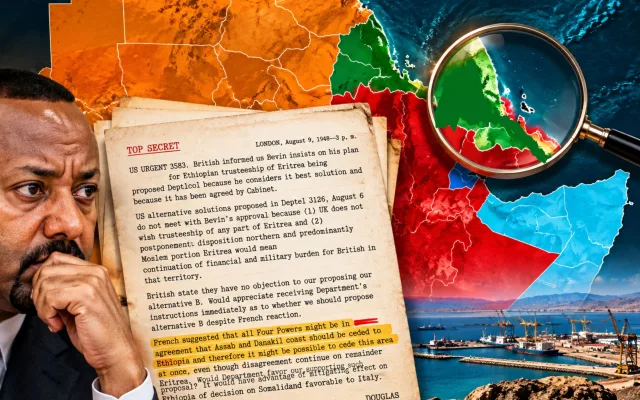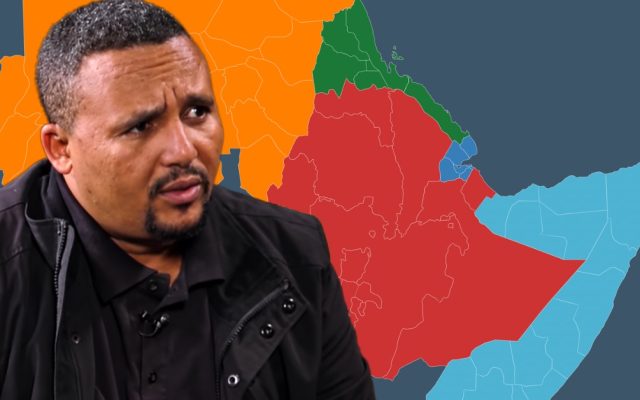

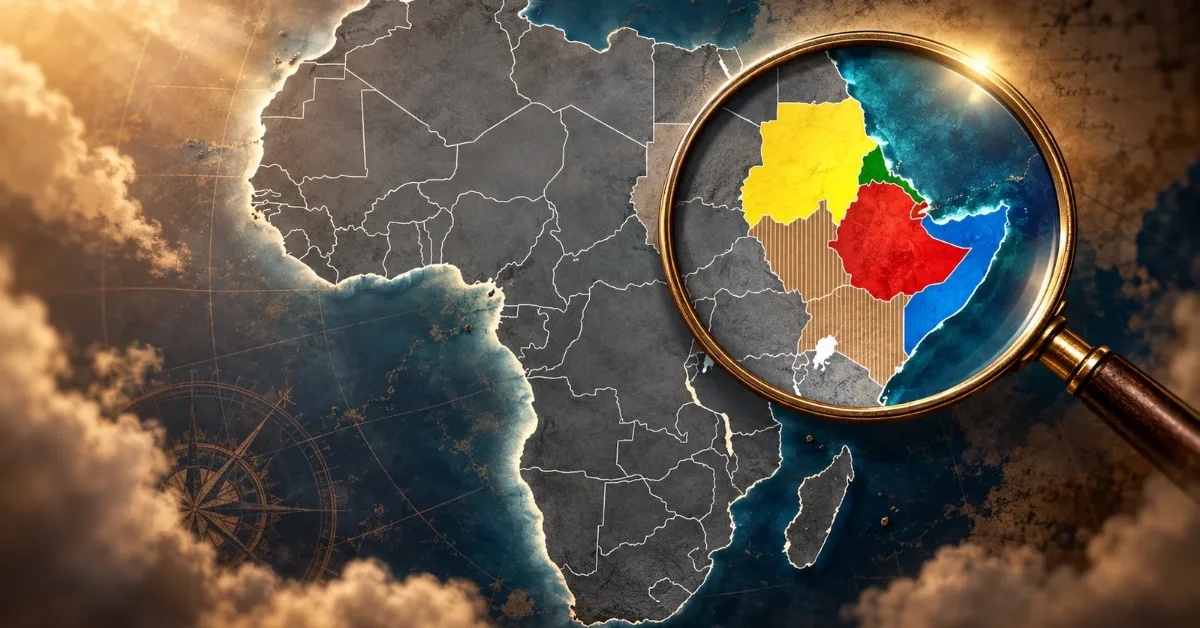
History has a way of challenging political narratives, especially when documents written long before today’s disputes are brought back into public discussion. At a time when Ethiopia’s political leadership continues to portray access to the Red Sea as a historical necessity, a British government publication from 1920 provides an important perspective. It describes a political and geographical reality that is difficult to reconcile with claims that Eritrea’s coastline historically belonged to Ethiopia as a matter of unquestionable right.
The document, titled Abyssinia, was published in London by His Majesty’s Stationery Office under the direction of the Historical Section of the British Foreign Office. It examines the geography, political history, foreign relations, economy and territorial boundaries of the Abyssinian Empire. More than a century later, its observations remain relevant to the debate over Ethiopia’s historical relationship with the Red Sea.
Credit goes to Sirak Bahlibi (@SirakBahlbi), whose recent research and commentary brought renewed attention to this publication. Bahlibi highlighted several important passages concerning Abyssinia’s boundaries, its relationship with coastal communities and the historical question of access to the sea. His work inspired this expanded analysis and deserves recognition for returning a valuable historical document to public discussion.
A British Record That Separates Eritrea From Abyssinia
The opening chapter of the 1920 publication, titled Geography Physical and Political, describes the boundaries of the Abyssinian Empire. It identifies Eritrea as the Italian-controlled territory to the north and north-east of Abyssinia, placing the two territories on opposite sides of a clearly described frontier.
The authors go further, tracing the boundary from Daddato, approximately 30–40 miles inland from the Red Sea, across the Assale Plain and westwards through a series of rivers and geographical landmarks, including the Mereb and Setit.
This description is significant because it demonstrates that Eritrea and Abyssinia were recognised as distinct political territories in the early twentieth century. The British authors were not describing Massawa or Assab as Ethiopian ports temporarily administered by another government. They were describing a territorial boundary separating Abyssinia from Italian Eritrea.
The distinction matters today because some Ethiopian political narratives treat Eritrea’s independence as though it deprived Ethiopia of territory that had always been part of its natural national geography. Yet the historical record is considerably more complicated. Ethiopia’s later administration of Eritrea cannot be projected backwards to erase the earlier territorial separation.
The British publication is not the only evidence of that distinction. The late nineteenth-century treaties between Ethiopia and Italy, including the agreements of 1900, 1902 and 1908, also form part of the legal and diplomatic history through which the boundary between Eritrea and Ethiopia was established.
The Red Sea Coast Had Its Own Political History
One of the most revealing sections concerns the relationship between Abyssinia, the Ottoman Empire and the coastal communities along the Red Sea.
The British authors explain that Ottoman claims extended along much of the coast, but effective authority was often limited. They specifically describe the Danakil chiefs whose territories reached the coastline as enjoying practical independence from both Ottoman and Abyssinian rule.
This observation challenges the assumption that the coastal lowlands were simply an extension of the Abyssinian highlands. The people inhabiting these territories maintained their own political authority, social structures and commercial relationships long before the emergence of modern Eritrea and Ethiopia.
The book also describes Massawa as the natural commercial gateway for Tigray and northern Abyssinia. This is historically important, but it must be understood correctly. A commercial gateway is not necessarily sovereign territory. Inland communities can depend upon a neighbouring port without possessing political authority over it.
For centuries, trade connected the highlands to the Red Sea. Merchants, goods and communities moved across territories governed by different authorities. Those economic relationships are part of the region’s shared history, but they do not establish that Abyssinia possessed an uninterrupted sovereign right to the coast.
This distinction between trade and territorial ownership is central to understanding the current dispute. Ethiopia may have legitimate economic interests in accessing Red Sea ports, but those interests cannot automatically become territorial claims against Eritrea.
Did Abyssinian Rulers Consider Sea Access a National Priority?
Perhaps the most challenging passage in the book concerns the priorities of earlier Abyssinian rulers in their dealings with foreign powers.
The authors observe that the question of access to the coast appeared to have been neglected in several early treaties with rival powers. This is particularly interesting given the modern argument that sovereign Red Sea access has always been an overriding Ethiopian national objective.
The 1920 observation does not mean that every Abyssinian emperor ignored the coastline or that Ethiopia never attempted to expand its influence towards coastal territories. Historical records show ambitions, conflicts and commercial interests that varied between rulers and periods. But it does challenge the sweeping claim that a single, uninterrupted national mission to secure sovereign access to the sea governed Abyssinian policy across the centuries.
There is a considerable difference between historical ambition and historical entitlement. An emperor’s interest in obtaining a port does not establish a permanent legal right to another people’s territory. Nor does dependence upon maritime commerce make a neighbouring coastline part of a country’s sovereign domain.
This is where contemporary arguments frequently become misleading. Ethiopia’s economic need for port access is presented alongside claims of historical ownership, as though one automatically proves the other. The British publication gives us good reason to question that reasoning.
A Landlocked Empire, Not a Stolen Coastline
The book offers another important observation about Abyssinia’s geographical position in 1920. Its authors describe an empire whose access to the sea was blocked by European-controlled coastal territories.
This statement requires careful interpretation. It confirms that Abyssinia did not possess sovereign access to the coastline at the time the book was written. It also demonstrates that the authors understood European colonial expansion as an important factor in the region’s political geography.
What it does not establish is that the coastline previously belonged entirely to Abyssinia. The distinction is essential. Being separated from the sea by territories controlled by other powers is not the same as having those territories unlawfully taken from one’s sovereign possession.
Ethiopia’s modern political leadership frequently emphasises the economic difficulties associated with being landlocked. Those difficulties are real, particularly for a country with a large population and substantial trading requirements. But economic necessity cannot substitute for historical evidence, and neither can it create territorial ownership.
The British authors were describing the circumstances of their own time, not determining the permanent rights of modern states. Nevertheless, their observations weaken the argument that Ethiopia’s sovereign ownership of the Eritrean coast is an established historical fact.
The Imperial Narrative and the Question of Historical Legitimacy
Sirak Bahlibi’s commentary also raises a broader question about how Ethiopian imperial history was presented during the reign of Haile Selassie. He argues that the monarchy promoted narratives of ancient continuity, divine legitimacy and uninterrupted statehood to strengthen its political authority.
There is a legitimate historical debate about how the Ethiopian monarchy used the Solomonic tradition to support its claims to power. However, the tradition itself predates Haile Selassie by centuries. What deserves scrutiny is how historical and religious narratives were employed politically, particularly when they were used to justify imperial authority over diverse communities and territories.
Eritrean history cannot be reduced to an extension of Abyssinian imperial history. The highlands, western lowlands, eastern coastal regions and Red Sea islands experienced different political systems, commercial relationships and forms of external influence. Their histories interacted with Abyssinia, but they were not identical to it.
Any attempt to construct a single historical narrative that absorbs these distinct experiences into an uninterrupted Ethiopian territorial claim is therefore open to serious challenge.
The strength of the 1920 publication is that it offers a reference point from a different political period. It was produced before Eritrea’s federation with Ethiopia, before the annexation of 1962 and before Eritrea’s internationally recognised independence in 1993. Its territorial descriptions help readers separate historical geography from later political claims.
Yet it must also be approached critically. British officials operated within a colonial system, and their accounts were not free from limitations or imperial assumptions. The publication is valuable historical evidence, not an infallible judgment on every territorial question.
International Law Settled What Imperial Narratives Cannot
Whatever competing historical interpretations may exist, the modern legal position is considerably clearer.
Eritrea became an internationally recognised independent state in 1993, following decades of armed struggle and a referendum on self-determination. Its sovereignty includes its internationally recognised territory and coastline.
The Eritrea–Ethiopia Boundary Commission, established under the December 2000 Algiers Agreement, delivered its delimitation decision in April 2002 on the basis of the relevant colonial treaties and international law. The Commission’s determinations were final and binding.
These legal developments are more decisive for present-day sovereignty than selective interpretations of ancient kingdoms or imperial history.
Ethiopia’s geographical position does not eliminate its legitimate right to seek maritime transit arrangements. Article 125 of the United Nations Convention on the Law of the Sea recognises the right of landlocked states to access the sea and provides for transit arrangements negotiated with neighbouring countries. It does not confer ownership of another state’s coastal territory.
This distinction is central to the future of Eritrea–Ethiopia relations. Ethiopia can pursue trade agreements, port services and mutually beneficial economic cooperation. Such arrangements, however, must respect Eritrea’s sovereignty and be reached through negotiations rather than territorial demands or threats.
A country cannot turn its economic needs into a legal entitlement to another country’s land.
History Must Not Become an Excuse for Another War
The renewed debate over the Red Sea is taking place at a dangerous moment for the Horn of Africa. Political rhetoric that portrays sovereign access to the coastline as a historical necessity risks turning a manageable economic and diplomatic question into a confrontation over territorial integrity.
Eritrea has consistently maintained that its sovereignty and territorial boundaries are not matters for unilateral revision. That position is consistent with the fundamental international principle that states must respect the territorial integrity and political independence of their neighbours.
Ethiopia’s leaders have a responsibility to distinguish between the country’s development interests and territorial ambitions. Port access can be negotiated. Trade corridors can be developed. Economic partnerships can be established. None of these requires a challenge to Eritrea’s independence.
The responsibility of historians, journalists and political commentators is equally important. Historical documents should be examined in their full context, including evidence that complicates preferred national narratives. The aim should not be to replace one mythology with another, but to establish what the available historical record actually demonstrates.
Conclusion: A Century-Old Document With a Contemporary Warning
The rediscovery of Abyssinia is a timely contribution to the public debate over Ethiopia’s relationship with the Red Sea. The 1920 British publication identifies Eritrea as a separate territory, describes the independent political authority historically exercised by coastal communities and questions the attention earlier Abyssinian rulers gave to securing access to the coast.
These observations do not settle every historical dispute between the two countries. They do, however, undermine the sweeping claim that Ethiopia possesses an unquestionable, uninterrupted historical title to Eritrea’s Red Sea coastline.
Sirak Bahlibi deserves credit for drawing public attention to this important source and encouraging a closer examination of the historical evidence.
The central lesson is straightforward. Ethiopia has a legitimate interest in maritime trade, but that interest does not create a right to Eritrean territory. The region needs practical economic cooperation grounded in mutual respect, not an attempt to reopen settled questions of national sovereignty.
Eritrea’s coastline is not an outstanding Ethiopian historical claim awaiting settlement. It is part of the sovereign territory of an independent state.
Sources and acknowledgment
This analysis was inspired by the research and commentary of Sirak Bahlibi (@SirakBahlbi), who highlighted the document’s significance for understanding Abyssinia’s historical boundaries and relationship with the Red Sea. Setit Media acknowledges his contribution to bringing this historical evidence back into public discussion.