
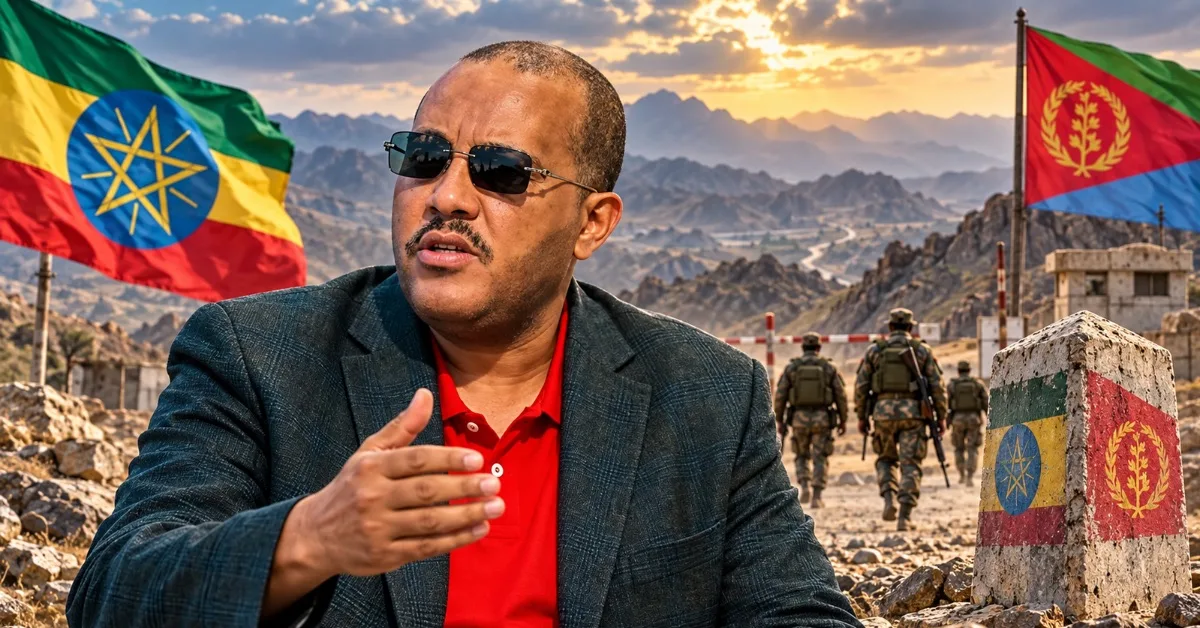
Ethiopian Prime Minister Abiy Ahmed’s adviser, Getachew Reda, has reportedly stated that Eritrean forces have returned to their pre-1998 border positions, an account that raises questions about the Ethiopian federal government’s recent accusations of an Eritrean invasion.
Getachew, the former spokesman of the Tigray People’s Liberation Front (TPLF) and former president of Tigray’s interim administration, made the remarks during a Zoom meeting, according to a firsthand account provided to Setit Media.
His statement comes amid heightened tensions between Ethiopia and Eritrea, following allegations by Addis Ababa that Eritrean troops had crossed into Ethiopian territory and occupied parts of northern Ethiopia. Eritrea has rejected the accusations.
On 9 October, Ethiopian Foreign Minister Gedion Timothewos alleged that Eritrean forces had advanced as far as 60 kilometres into Ethiopian territory. Ethiopia raised the matter with the United Nations Security Council, describing the alleged military movements as an invasion and invoking its right to self-defence under Article 51 of the UN Charter.
The allegations received widespread international media coverage. However, reports citing the Ethiopian government’s account do not, by themselves, independently establish the alleged military movements. Some reporting acknowledged that the battlefield claims could not be independently verified.
Getachew’s remarks now introduce an important question about the account coming from Addis Ababa. While the federal government has accused Eritrea of occupying Ethiopian territory, a senior adviser to the prime minister is saying that Eritrean forces have returned to their earlier border positions.
The Ethiopian government has not publicly explained how his reported statement relates to its accusations, including when the alleged incursion occurred, whether Eritrean forces subsequently withdrew and what territory, if any, remains under Eritrean military control.
The distinction is important for Eritrea, which has consistently rejected accusations of aggression and warned that Ethiopian rhetoric could create a pretext for military confrontation. Allegations of invasion carry serious consequences, particularly when accompanied by claims of a right to military self-defence.
Getachew’s political background adds further significance to the remarks. During the 2020–2022 Tigray war, he was among Eritrea’s most vocal critics. As the TPLF’s principal spokesman, he repeatedly accused Eritrean forces of involvement in the conflict and demanded their withdrawal. He also spoke in 2021 about the possibility of Tigrayan forces entering Eritrea.
Following the November 2022 Pretoria Agreement, Getachew was appointed president of Tigray’s interim administration in March 2023. His relationship with the TPLF leadership later deteriorated, leading to his removal and subsequent political realignment with Prime Minister Abiy Ahmed’s government.
He now serves as an adviser to the prime minister, making his reported account particularly noteworthy. The remarks come from a politician who previously challenged Eritrea’s military role in Tigray but is now working within the Ethiopian federal government’s political establishment.
During the same Zoom meeting, Getachew said he was one of three individuals advising Tigray’s newly established caretaker government.
“We are three individuals advising the caretaker government,” he said, according to the account provided to Setit Media.
Getachew also described the caretaker administration as an extension of Ethiopia’s ruling Prosperity Party. He did not identify the other two advisers in the account available to Setit Media, although speculation has mentioned former Defence Minister Abraham Belay and General Tsadkan Gebretensae. Their involvement has not been confirmed.
The caretaker government was established by the Ethiopian federal authorities on 16 October following renewed fighting in Tigray. It has been given a six-month mandate to restore essential services, stabilise the region and prepare for elections.
The TPLF has rejected the new administration, describing it as a structure imposed by the Prosperity Party. Getachew’s reported description of the caretaker government adds another dimension to the dispute over its political independence and relationship with Addis Ababa.
Getachew also claimed that TPLF forces had retreated towards Tsorona and Adi Quala, inside Eritrea, and alleged that their eventual plan was to move into Sudan and align themselves with forces loyal to Sudanese army chief General Abdel Fattah al-Burhan. These allegations have not been independently verified.
He further stated that the TPLF was no longer a viable political organisation capable of leading the people of Tigray, marking a sharp departure from his earlier role as one of the movement’s leading political representatives.
For Eritrea, however, the central question arising from the meeting concerns the border. Addis Ababa has accused Eritrea of aggression at a time when Ethiopian officials have continued to raise the issue of access to the Red Sea. Eritrea maintains that its internationally recognised sovereignty and territorial integrity must be respected and rejects any attempt to pursue territorial claims through military pressure.
Getachew’s reported account provides grounds for challenging the Ethiopian government’s portrayal of an ongoing Eritrean occupation. It does not establish that no earlier incursion occurred, nor does it independently confirm the current positions of all Eritrean forces. Those questions require evidence beyond statements from either side.
The immediate issue is whether Addis Ababa can substantiate its continuing accusations and reconcile them with the account reportedly given by an adviser to its own prime minister.
If Eritrean forces have returned to their pre-1998 border positions, as Getachew says, the Ethiopian government faces a straightforward question: what evidence supports the claim that Eritrea is still occupying Ethiopian territory?
As tensions persist along the border, establishing the facts remains essential to preventing another conflict that could have devastating consequences for the people of Eritrea and Tigray.
Editor’s note: Setit Media’s account of Getachew Reda’s Zoom meeting is based on firsthand reporting. The complete recording has not been independently reviewed. Statements attributed to Getachew are presented as his reported remarks, while his military allegations, the identities of the other advisers and the claims involving Sudan remain unverified.