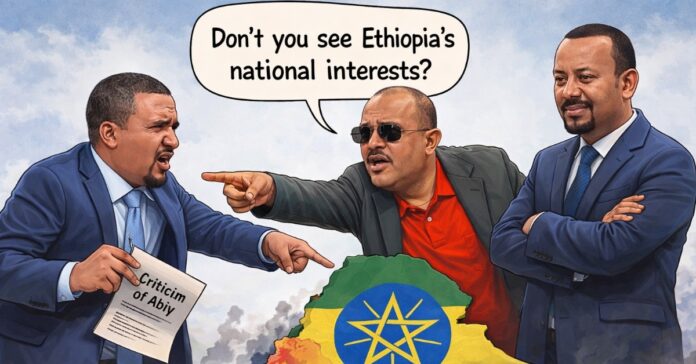
The current exchange between Jawar Mohammed and Getachew Reda over Ethiopia’s alleged role in supporting Sudan’s Rapid Support Forces is more than a social media quarrel. It exposes deeper contradictions in Ethiopian political discourse and raises serious questions about consistency, credibility, and regional stability.
Jawar’s allegation was direct. He claimed that Prime Minister Abiy Ahmed’s government has allowed the RSF to establish a training camp inside Ethiopia and facilitated the recruitment of Ethiopians, including former members of the national army, regional special police, and ex rebel fighters, to fight alongside Sudanese rebels. According to his statement, these recruits are reportedly operating around Damazin in preparation for cross border operations.
If accurate, that would mean Ethiopia is not merely observing Sudan’s civil war. It would mean active involvement.
The RSF is not an ordinary political faction. It emerged from the Janjaweed militias and has been widely accused by international organizations of committing atrocities in Darfur and other parts of Sudan. Any perceived association with such a force carries moral, diplomatic, and strategic consequences.
Getachew Reda, now Ethiopia’s State Minister for Horn of African Affairs, responded not by focusing on the operational details of the accusation but by reframing the issue. He argued that critics are conflating opposition to Abiy Ahmed with opposition to Ethiopia’s long term national interests. In his view, Ethiopia cannot afford to remain passive while Sudan collapses and regional actors maneuver for advantage.
On the surface, that is a familiar realist argument. States do have enduring interests. Geography does not change when governments do. Ethiopia shares a long border with Sudan. Instability there has direct implications for trade, migration, and security. No responsible government ignores developments next door.
However, the credibility of this defense is complicated by political memory.
Getachew himself was once one of the most vocal critics of Abiy’s federal government during the Tigray war. He publicly characterized the federal campaign in severe moral terms and demanded international accountability. Today, as a member of Abiy’s government, he defends federal foreign policy as strategic necessity. Political roles evolve, and there is nothing inherently illegitimate about that. But such transitions require consistency in standards.
If allegations of genocide were once central to condemning federal actions domestically, it is difficult to dismiss similar accusations surrounding a regional partner as irrelevant to strategic calculation. Strategy and morality are not separate universes. In modern geopolitics, reputational cost translates into real consequences such as diplomatic isolation, sanctions risk, and long term instability.
There is also a broader regional dimension that cannot be ignored.
For years, Ethiopian political leaders across different parties accused Eritrea of destabilizing the Horn of Africa through proxy involvement and support for armed groups. Eritrea was portrayed as a state that operated through indirect leverage and cross border alignments. Whether those accusations were always balanced or not, they formed a consistent narrative that proxy politics was dangerous and destabilizing.
Now Ethiopia faces accusations of engaging in similar behavior. If RSF training or recruitment is occurring inside Ethiopian territory, critics will inevitably compare it to the very conduct Ethiopia once condemned in others.
This is not about scoring rhetorical points. It is about standards. A state cannot credibly argue that regional interference is destabilizing when carried out by its neighbor, yet strategic when carried out by itself. Consistency is essential for long term legitimacy.
Prime Minister Abiy’s relative silence in this exchange adds another layer. The public defense has been carried primarily by his state minister. In high stakes matters involving alleged cross border military activity, silence invites speculation. If the reports are inaccurate, they warrant a clear denial. If there is a deliberate strategic policy, it warrants explanation. National interest is not weakened by transparency; it is strengthened by it.
From an Eritrea first strategic perspective, the lesson is straightforward. The Horn of Africa is fragile precisely because states often justify short term tactical moves without fully accounting for long term consequences. Proxy alignments, militia engagement, and cross border entanglements rarely remain contained. They harden divisions and create cycles of retaliation.
Eritrea has long argued for sovereignty, non interference, and clarity in regional relations. When larger neighbors shift between moral condemnation and strategic justification depending on circumstance, it reinforces the importance of consistency. Stability in the Horn will not come from selective standards. It will come from predictable behavior grounded in respect for borders and long term regional balance.
The debate between Jawar and Getachew ultimately comes down to one question: what truly serves Ethiopia’s enduring interests? If involvement in Sudan’s civil war strengthens Ethiopia’s security and diplomatic standing, that case should be articulated clearly and factually. If it carries risks of deeper entanglement and reputational damage, those risks should be acknowledged honestly.
The Horn of Africa has paid a heavy price for policies driven by short term calculation. Memory in this region is long. Contradictions are not easily forgotten.
Strategic language alone cannot resolve that tension. Only consistency can.
During a recent parliamentary address, Abiy Ahmed delivered statements that many have called misleading, sparking a pressing question: what drives this lie? This analysis contends that Abiy Ahmed’s growing desperation stems from mounting pressure on his administration, pushing him to manipulate public perception and cling to power through questionableelections. His controversial assertions about the Ethiopian federal army’s cooperation with Eritrea during the Tigray conflict have eroded his credibility and exposed cracks in his government. The following factors deepen this sense of urgency:
Fano Unity.
After fighting against the Abiy government, in a fragmented way, for two years, Fano leaders decided to create a united front. To abort such a move, Abiy Ahmed tried to create friction among Fano leaders and was able to lure some of them to his camp. However, in the end, Fano’s unity doubled the pressure on Abiy Ahmed’s rule, and that is making him desperate. The recent coordinated attacks by Fano led to the killing of several generals and colonels on the battlefield, and he understands where the security situation in the Amhara is heading. Now he is mobilizing his army from areas in Amhara and stationing them in very select areas. Such activity will enable him, at least during the election, to defend himself and secure the Amhara border with Tigray.
TPLF’s Resurrection and XMDO.
TPLF is cleaning its structures and is on its way to challenging the Abiy government. Surprisingly, when the TPLF Army ordered the Federal Army to leave Alamata, a town in southern Tigray, they left immediately. This shows the extent to which Abiy Ahmed’s Government fears the TPLF army. Emboldened by such gains, Abiy Ahmed thinks TPLF could attack South Wollo. Thus, Abiy found it necessary to build an army in North Wollo. TPLF’s resurrection is also facilitated by peace on the Tigray’s border with Eritrea. XMDO allows TPLF to mobilize its army on the Tigray-Eritrea border towards Southern and Western Tigray. Abiy Ahmed wanted TPLF and Eritrea to fight. However, XMDO turned his plan upside down and does not like that. That is why Abiy Ahmed accused Eritrea of supporting Ethiopian opposition groups. His lies also targeted the possible alliance between Fano and TPLF. By blaming TPLF for Human rights abuses in Amhara, he is trying to create friction between Fano and TPLF. Such a strategy suits his long-term plan to stay in power.
Upcoming Sham Election.
Abiy Ahmed plans to conduct a Sham Election during the Summer of 2026. If he is to claim to be an elected leader, he must conduct the election at any cost. Many people believe the current withdrawal of the federal army from areas in Amhara and Oromia is a plan to conduct war in Tigray. This writer has a different understanding of the situation. Abiy Ahmed wants to protect Wollo, Afar, and Shewa, where the sham election is going to be conducted. There is a precedent for such a plan. During the 2020 Tigray conflict, after Abiy declared victory, he withdrew some of his army from Tigray without notifying his then ally, Eritrea. The objective of the army withdrawal was to secure the then-election. TPLF grabbed the opportunity and conducted the Alula operation, capturing close to five thousand Abiy Ahmed’s soldiers. Accordingly, Abiy’s current mobilization of the army towards the Tigray Amhara border could be an effort to secure the upcoming sham election.
His involvement in the Sudan War.
Ahmed lacks the political and economic capital to refuse what the United Arab Emirates (UAE) government wants him to do in the Horn of Africa, specifically in the Sudan. His complete dependence on the UAE has forced him to get involved in the Sudan war. Such involvement is very risky and could invite another war to the BeneshangulGumuz area of Ethiopia, where the GERD is located. Now, Abiy Ahmed is celebrating Ahmad Dagalo’s Army’s symbolic victory in the Blue Nile region of Sudan. What is clear is that Abiy Ahmed has become a party to the Sudan war, and this directly brings him into conflict with Sudan and Egypt. The outcome of such fateful involvement could be revealed in the months to come.
Conclusion.
In summary, this text argues that Abiy Ahmed’s desperation is the central driving force behind his recent actions and misleading statements. Intensified fighting in Amhara and Oromia, the possibility of a TPLF advance in North Wollo and Wolkaite, putting immense pressure on his government. His attempts at divide-and-rule and control through misinformation have been unsuccessful. As a result, his strategy now centers on orchestrating a sham election to maintain power, while continuing conflicts in Amhara and Oromia. His approach to Tigray and Eritrea is limited to containment, as he lacks the means or resolve to attack them directly.
Eternal Glory to our Martyrs and Victory to the Masses.
Introduction: Landlocked Ethiopia’s ruling elite have revived an age-old obsession: obtaining direct access to the Red Sea through Eritrean territory. In doing so, they have unfurled a tapestry of contradictions, historical amnesia, and legal defiance. With biting irony, Addis Ababa’s power brokers preach regional brotherhood and dialogue even as they trample binding international agreements and openly covet their neighbor’s coastline. This exposé dissects Ethiopia’s recent campaign – from bombastic speeches in 2023 to diplomatic posturing in 2026 – revealing how Ethiopian officials manipulate narratives to cast themselves as victims of geography while undermining Eritrea’s hard-won sovereignty. International law and African unity principles, it appears, are invoked by these elites only when convenient. Below, we chronicle their rhetoric and actions, the inversion of aggressor-victim roles, and the sharp global rebukes that have met their Red Sea ambitions. The result is a principled, evidence-rich account that unapologetically asserts Eritrea’s rights and dignity in the face of Ethiopia’s two-faced pursuit of a coastline.
Ignoring International Law: From Algiers to Badme (2000–2018)
To understand the current Red Sea saga, one must start with Ethiopia’s blatant disregard for international law in its past dealings with Eritrea. After the brutal 1998–2000 Eritrea-Ethiopia border war, both nations signed the Algiers Peace Agreement in 2000 – a binding treaty committing them to accept whatever border demarcation an independent commission would decide. In April 2002, the Eritrea–Ethiopia Boundary Commission (EEBC) delivered its verdict, drawing the boundary based on colonial treaties and awarding the flashpoint town of Badme to Eritrea. Eritrea immediately accepted the ruling “in full and without reservation,” honoring its treaty obligation. Ethiopia did the opposite – rejecting the EEBC decision, demanding “dialogue” as a substitute for compliance, and physically blocking demarcation on the ground. For sixteen years, the award remained unimplemented only because one party – Ethiopia – refused to obey international law.
This was no minor technicality; it was a flagrant breach of a U.N.-registered peace accord. Eritrea repeatedly petitioned the U.N. Security Council, warning that such selective enforcement of law would undermine the U.N.’s credibility. Sure enough, the world’s response was tepid: instead of insisting on Ethiopia’s compliance, global actors lapsed into euphemisms about “disputes” and encouraged endless talks. The illegal occupation of Eritrean territory was sanitized as a mere difference of opinion, normalizing Ethiopia’s impunity. As one retrospective analysis noted, “Addis Ababa rejected the ruling, pushed for ‘dialogue’ … and obstructed border demarcation… for 16 years”. Meanwhile, Eritrea – the lawful party – was paradoxically treated as equally recalcitrant in calls for “both sides” to cooperate. Such false equivalence masked the real issue: one side honored its word, the other did not.
This history is vital. It shows a pattern: Ethiopia’s elites trumpet international principles when convenient, but trample them when those same rules affirm Eritrea’s rights. The Algiers Agreement explicitly upheld the inviolability of colonial borders, reflecting the African Union’s uti possidetis norm. Ethiopia signed this gladly in 2000; yet today, the same Addis Ababa elite wax poetic about adjusting borders and “correcting” history to regain a coastline. In short, they seek to rewrite what was settled by law. As Eritrea’s President Isaias Afwerki once pointed out, Ethiopia “pretended to abide by the Algiers Agreement” even while trying to renegotiate its core outcome. The double standard was glaring: Eritrea was expected to cede its legal victory for Ethiopia’s political comfort. Fast-forward to the present, and those double standards have only grown more audacious.
“Existential” Ambitions: Ethiopia’s Open Quest for Eritrea’s Coast
After a 2018 rapprochement (during which Ethiopia’s new Prime Minister Abiy Ahmed formally accepted the EEBC border in principle), many hoped the era of Ethiopian irredentism was over. Not so. By 2023, Addis Ababa’s tone had shifted dramatically, unveiling an open ambition for Red Sea access that tossed diplomatic niceties aside. In an address to parliament on October 13, 2023, Abiy Ahmed declared that securing a Red Sea outlet is “an existential matter” for Ethiopia’s survival. He painted a dramatic picture of a nation unjustly trapped: “By 2030 [our population] will be 150 million. A population of 150 million can’t live in a geographic prison,” Abiy thundered. The “prison,” of course, was Ethiopia’s landlocked status – a not-so-subtle swipe at Eritrea’s coastline to the north and Djibouti’s to the east.
Using language that virtually ordains expansion, Abiy asserted Ethiopia has a “natural right” to the Red Sea. He argued that nature itself intended Ethiopia to have the Red Sea, just as it has the Blue Nile, claiming “it won’t work to say, ‘This water (the Nile) concerns you, but this one (Red Sea) doesn’t.’”. According to Abiy, such artificial separation defies the natural order – a rhetorical framework blatantly designed to undermine Eritrea’s sovereignty by treating Eritrean territory as somehow inherently Ethiopia’s concern. He even dug up 19th-century quotes from an Ethiopian general, Ras Alula, who said “The Red Sea itself has been and will continue to be Ethiopia’s natural boundary”, suggesting history bestows on Addis Ababa a birthright to a coastline it hasn’t possessed since Eritrea’s independence in 1993.
In the same speech, Abiy issued a barely veiled threat: if Ethiopia’s “right” to the sea is not accommodated, “there will be no fairness and justice and if there is no fairness and justice… we will fight”. This jaw-dropping statement – “it’s a matter of time, we will fight” – marked the first time an Ethiopian leader so openly raised the specter of war to claim a neighbor’s territory in peacetime. (The irony of threatening war barely four years after accepting a Nobel Peace Prize was not lost on observers.) Though Abiy added a perfunctory line that he was “not threatening violence,” his message was clear: Ethiopia’s patience with being landlocked is running out. Indeed, a few months earlier in July 2023, Abiy told a group of investors in Addis Ababa that while Ethiopia wants a port “through peaceful means,” if that fails, it “would not hesitate to use force”. In effect, the Prime Minister signaled to the world that might could become right if Ethiopia’s demands were not met.
Adding to the surreal nature of this address, Abiy floated a pan-African fig leaf for his ambitions. He mused that maybe the “solution” was for Ethiopia, Eritrea, Djibouti, and Somalia to merge into one country, which would then have ample coast. Such a behemoth, he claimed, “would become another Russia, China, or America” – a superpower of the Horn. Of course, this notion of “unity” rings hollow; given Ethiopia’s outsized population and economy, it scarcely conceals a vision of Eritrea and others being subsumed under Ethiopian dominance. As one regional commentator drily noted, Abiy’s proposal was “a textbook colonial annexation… removing all sovereignty from its neighbors” under the euphemism of unity. In any case, Eritreans heard his message loud and clear: short of literally erasing Eritrea’s existence through federation, Addis Ababa intends to secure its hands on Eritrean ports one way or another – by deal, diplomacy, or dagger.
This unabashed posture was a far cry from the conciliatory tone Ethiopia had struck in years prior. Gone was the talk of respecting past treaties; in its place was a revival of imperial nostalgia (references to Ethiopia’s Axumite Empire once controlling Red Sea shores) and realpolitik calculus about population pressure. Abiy argued Ethiopia’s booming populace and economy make it inevitable that the issue “will inevitably ‘blast’” if unresolved. In a particularly audacious analogy, he complained that all Ethiopia’s neighbors draw water from Ethiopia’s rivers (the Nile, Tekeze, Omo, etc.) while Ethiopia alone is denied access to their seas. “It’s not right to say, ‘let us share what you have, but don’t ask us what we have’,” Abiy said, calling it an injustice that must be rectified for the sake of “fairness”. In other words, he framed Eritrea’s sovereign Red Sea coast as something unfairly hoarded, which should be “shared” lest Ethiopia’s goodwill evaporate. Such logic turns international law on its head: instead of borders being inviolable, here a powerful state implies its need outweighs a smaller neighbor’s rights.
Double Talk and Diplomatic Duplicity
Ethiopian officials soon learned that shouting about war and “geographic prisons” would rattle the region – and it did. Within days of Abiy’s October 2023 outburst, alarm bells rang from Asmara to Mogadishu. Facing broad backlash, Addis Ababa switched to damage-control mode, engaging in a remarkable display of diplomatic double-speak. On October 26, 2023, barely two weeks after warning “we will fight,” Abiy struck a pacifist note. “Ethiopia has never invaded any country and now has no intention to invade any country,” he proclaimed, reassuring an audience of military cadets that Ethiopia “would not pursue its interests through force”. The Prime Minister insisted Ethiopia “wouldn’t pull the trigger on its fellow brothers”, an apparent attempt to calm neighboring states unnerved by his earlier bluster. For added measure, Abiy’s government had its Foreign Ministry stress that any quest for port access would be “through peaceful means”. The contrast was stark: the same leader who one week roared about justice “by one way or another” was now cooing about brotherly love.
This contradictory messaging continued into 2024 and 2025. Even as Ethiopia pursued provocative moves (as we’ll see below), Abiy periodically tried to paper over his threats. Perhaps the clearest example came in March 2025, when regional tensions were at a fever pitch. That month, following reports of troop build-ups on the Eritrean border, Abiy told Ethiopia’s parliament that “Ethiopia does not have any intention of engaging in conflict with Eritrea for the purpose of gaining access to the sea.” It was a direct contradiction of his own prior insinuations. He acknowledged Red Sea access was still “an existential matter” for Ethiopia, but claimed his government sought to address it “peacefully via dialogue”. Abiy’s office even posted this assurance on social media for the world to see.
Of course, these soothing words often came after Ethiopia had already rattled its saber. The pattern became almost comical: first an Ethiopian official would issue a maximalist statement about ports or even float historical claims to Eritrean territory, then another official would backpedal and insist Ethiopia only meant access through negotiation. Such “calculated ambiguity” did not fool attentive observers. An Eritrean government statement politely described the frenzy over Red Sea access as “excessive” and warned parties “not to be provoked”. In private, diplomats noted that Addis Ababa was sending “conflicting signals” – fiery one day, conciliatory the next. This two-faced approach appeared designed to keep neighbors off-balance: Ethiopia floated grand ambitions (and even threats) to stake its claim, yet sought to avoid outright condemnation by later professing innocent intentions.
Nowhere was this duplicity more evident than on the international stage. At home, Ethiopian leaders spoke of historical rights and even questioned Eritrea’s very existence as a separate nation. Yet at the United Nations, Ethiopia’s tone was sugar-coated. In September 2025, addressing the U.N. General Assembly, Ethiopia’s representative (President Taye Atske-Selassie, by then Ethiopia’s ceremonial head of state) reassured the world: “All that Ethiopia asks for is access to the sea.”. He carefully invoked international law about landlocked states’ transit rights, emphasizing Ethiopia sought an agreement with neighbors – nothing more dramatic. Gone were Abiy’s belligerent hints; in New York, Ethiopia spoke the language of compromise and legality, echoing the UN Convention on the Law of the Sea which indeed allows landlocked countries a right of access (but pointedly not ownership) of transit routes. The right to transit is contingent on agreement with the coastal state, as legal experts note, and “not absolute”. By highlighting this moderate stance abroad, Addis Ababa tried to project an image of a reasonable actor seeking its due rights.
However, back in Ethiopia, a very different narrative was being fed to the public. Prominent figures in the Ethiopian security establishment began openly challenging Eritrea’s sovereignty in ways that belied the diplomatic niceties. In late 2025, Major General Teshome Gemechu – a high-ranking defense official – gave an incendiary interview questioning the legitimacy of Eritrea’s 1993 independence. He suggested that the Red Sea port of Assab was “wrongly ceded” to Eritrea and hinted that Ethiopia had “unfinished business” on that front. This was effectively a call to revisit Eritrea’s very border – a more naked form of irredentism is hard to imagine. Around the same time, Brigadier General Bultii Taaddasaa, who heads Ethiopia’s military academy, took to framing Eritrea’s coastline as a matter of Ethiopian national destiny, further whipping up the officer corps on the issue. Such military revisionism was no accident; it served to normalize the idea that Ethiopia deserves part of Eritrea’s coast, even as diplomats mouthed platitudes abroad. The double standard could not be more glaring: Ethiopia told the world it respects sovereignty, while its generals and state media peddled a narrative that essentially nullifies Eritrea’s sovereignty. As one analysis aptly observed, Addis Ababa was “presenting moderation at the U.N., while at home floating sovereignty revisionism”.
Inversion of Roles: Casting Eritrea as Aggressor, Ethiopia as Victim
Perhaps the most cynical aspect of Ethiopia’s campaign is the perverse role-reversal in its rhetoric. Ethiopian elites consistently cast themselves as the long-suffering victim – a populous nation unfairly “handcuffed” by geography – and paint Eritrea as the unreasonable villain, selfishly blocking Ethiopia’s rightful outlet to the sea. This narrative is pushed in spite of the historical and legal record that shows the opposite. Recall that Eritrea’s independence (and thus Ethiopia’s loss of coastline) was not some capricious act of malice, but the result of a 30-year Eritrean liberation struggle against brutal Ethiopian annexation. Eritrea paid in blood for its sovereignty. The OAU/AU founding principles and the Algiers Agreement both recognize Eritrea’s borders as final. Yet Ethiopian discourse often ignores this, implying Eritrea owes its giant neighbor special access or even territorial cession.
The Ethiopian media has gone to great lengths to portray Eritrea as an aggressor state that is destabilizing the region – a classic case of projection. When Prime Minister Abiy faced armed uprisings and conflicts within Ethiopia (Tigray in 2020–22, and later unrest in Amhara), his government frequently blamed Eritrea for meddling or backing opposition forces. In an especially contorted propaganda line in 2025, state-affiliated outlets in Addis Ababa claimed that the Tigray People’s Liberation Front (TPLF) – a group that had been Eritrea’s bitter enemy for decades – was somehow in league with Eritrea during Ethiopia’s civil war. The narrative accused Eritrea of “backing insurgencies” in Ethiopia’s north, conveniently ignoring the fact that Eritrean troops had actually fought alongside Ethiopia against the TPLF in 2020–21. By branding any internal dissident as an “Eritrean proxy,” Ethiopian officials attempt to have it both ways: Eritrea is simultaneously maligned as a destabilizer, even as Addis Ababa was perfectly happy to invite Eritrean forces to help subdue Tigray when it suited them. The hypocrisy is rich. As one analysis noted, calling the TPLF an Eritrean proxy is “politically convenient, but factually dubious”.
This rhetorical inversion serves a purpose: to erode Eritrea’s moral standing and paint Ethiopia as the reasonable actor constrained by a recalcitrant neighbor. In reality, Eritrea has been remarkably consistent and restrained. It has repeatedly affirmed that its sovereignty and territory are non-negotiable – hardly an aggressive posture, merely a defensive one. For instance, Eritrean officials reacted to Abiy’s 2023 remarks by stating unequivocally: “There is no if and but about Eritrea’s sovereignty and territorial integrity. No amount of illegitimate instigation, propaganda, conspiracy and defamation can change this truth.”. This statement, from Eritrea’s Ambassador Estifanos Afeworki, encapsulates Eritrea’s stance: firm and unapologetic about its rights. Far from seeking conflict, Asmara’s response to Ethiopia’s sea-access musings was to warn against conflict and advise adherence to established agreements. Eritrea has even refused to “discuss” port sovereignty with Ethiopia because doing so inherently legitimizes Ethiopia’s improper claims. As an Eritrean government release noted, raising the Red Sea issue in negotiation is provocative in itself – “we don’t want conflict, but we will discuss the issue,” Abiy says, to which Eritrea effectively replies: our independence and ports are not up for discussion. This stance is not belligerence; it is the expected position of any sovereign state guarding its territory.
Meanwhile, Ethiopia’s portrayal of itself as a victim of landlocked fate rings hollow against the facts. Despite its lack of a coast, Ethiopia has managed quite fine using Djibouti’s and other neighbors’ ports for the last 30 years. In fact, from 1998 to 2018 – a period when it pointedly did not use Eritrean ports at all – Ethiopia enjoyed one of Africa’s highest economic growth rates. The country currently sends over 95% of its trade through Djibouti without issue. International law already guarantees Ethiopia the right of access to the sea for transit – a right no neighbor has denied. Thus, Ethiopia’s narrative of being strangled and “imprisoned” by lack of a coastline is more melodrama than reality. Indeed, analysts have concluded that “Ethiopia faces no existential threat due to its landlocked status” and that its “proximity to multiple ports” (Djibouti, Sudan’s Port Sudan, Kenya’s Lamu, Somaliland’s Berbera, etc.) keeps its transport costs lower than many landlocked nations. In short, Ethiopia’s economy is not collapsing for want of Massawa or Assab. The real drivers of instability in Ethiopia are internal political conflicts and governance issues – problems which no Eritrean port will solve. Yet by fixating on Eritrea’s coast, Ethiopian elites attempt to externalize their woes and invoke nationalist fervor. It is a time-worn diversion tactic: unite the populace by conjuring a vision of a common enemy or a stolen birthright.
International Response: “Sovereignty Is Not Open for Negotiation”
Ethiopia’s brazen talk of revising borders and “exercising its right” to someone else’s coastline has not gone unanswered. International and regional reactions have largely upheld Eritrea’s position and called out Addis Ababa’s dangerous gambit. Neighboring countries in particular delivered swift rebukes to Abiy’s 2023 rhetoric. Djibouti, which might have been another target of Ethiopia’s “sea access” dreams, responded firmly through a presidential advisor: “Djibouti is a sovereign country, and therefore, our territorial integrity is not questionable, neither today nor tomorrow.”. In other words: no Ethiopian land rush at Djibouti’s expense will be tolerated either. Somalia – which saw Ethiopia’s outreach to the breakaway region of Somaliland as a direct threat – was even more forceful. A senior Somali official warned in early 2024, “We are ready for a war if Abiy wants a war,” calling Ethiopia’s port deal with Somaliland an act of aggression. Mogadishu recalled its ambassador from Addis Ababa in protest of Ethiopia’s backdoor dealings to secure Somaliland’s Berbera port. The message from Somalia was clear: Ethiopia’s ambitions were destabilizing the region, and Somalia would not hesitate to defend its own territorial integrity (Somaliland being legally part of Somalia) against Ethiopian encroachment.
Multilateral African bodies also reacted. In January 2024, the Intergovernmental Authority on Development (IGAD), which includes both Ethiopia and Somalia, convened an emergency session on the Red Sea tensions. IGAD’s communiqué expressed “deep concern” and reaffirmed the “cardinal principles of respect for the sovereignty, unity and territorial integrity” of all member states. It was a diplomatic way of chastising Ethiopia: a reminder that African norms do not allow altering borders by force or coercion. IGAD urged Ethiopia and Somalia to de-escalate, and implicitly told Addis Ababa that its “coastal ambitions” were out of line. Similarly, the African Union (AU) has long maintained the sanctity of colonial borders; though the AU did not publicly single out Ethiopia by name, it worked through quiet diplomacy to cool tensions. Later, in October 2024, a noteworthy summit took place in Asmara uniting Eritrea, Somalia, and Egypt – three nations with their own grievances towards Ethiopia’s policies. Their joint statement emphasized “respect for the sovereignty [and] territorial integrity” of countries in the region. Observers dubbed this an “axis against Ethiopia” forming, as all three states share an interest in checking Addis Ababa’s ambitions (Egypt’s concern was Ethiopia’s Nile dam, Somalia’s was its coast, and Eritrea’s was its independence). Though those governments denied targeting Ethiopia, the timing and language of their meeting clearly countered Abiy’s narrative.
Perhaps the most remarkable international response came in late 2025 from a joint Africa–Europe summit, where leaders from across the AU and EU weighed in on the Horn of Africa tensions. In an unusually blunt declaration, the summit asserted that sovereignty and territorial integrity “are not open for negotiation”. The communique vowed to uphold the U.N. Charter and protect every African state’s political independence, stating these principles “cannot be negotiated or compromised.”. Such strong wording in a high-level forum is rare; it signaled broad disapproval of any talk of redrawing maps. “Borders in the Horn of Africa are recognized, final, and protected,” the declaration affirmed, adding that all countries “must avoid any threat or use of force to achieve political goals.”. This was an unmistakable reproach of Ethiopia’s Red Sea agenda, even if Ethiopia wasn’t named outright. As one analysis of the summit put it, the world expects states to follow the law, “not to revise borders or demand access by pressure.”. For Eritrea, this was a vindication: the international community (including Africa and Europe together) underscored that Eritrean sovereignty is sacrosanct and that no nation – no matter how populous – has the right to threaten it.
Even the United Nations has implicitly backed Eritrea’s stance. U.N. Secretary-General António Guterres, on the 25th anniversary of the Algiers Agreement (December 2025), urged both countries to “respect the border pact.” While couched in even-handed language, his call was effectively a reminder that Eritrea’s border is settled law. Given the record, it’s evident which party needed that reminder. In Security Council meetings (often behind closed doors), member states have reiterated that any dispute must be resolved legally and peacefully. Thus, Ethiopia finds itself isolated in this Red Sea quest – out of step with international law and increasingly at odds with neighbors who see its overtures as a threat to regional stability.
Timeline of Key Events and Statements (2023–2025)
To appreciate the progression of Ethiopia’s sea-access gambit, below is a timeline of major events and telling quotes from officials. This chronology highlights how Ethiopian rhetoric evolved and how the region responded at each step:
April 13, 2002 – EEBC Ruling: The Eritrea-Ethiopia Boundary Commission awards Badme to Eritrea. Eritrea accepts immediately; Ethiopia rejects and obstructs implementation. (Sets precedent of Ethiopia flouting international law.)
July 2023 – “Peaceful or By Force” Remark: At an investors’ forum, PM Abiy Ahmed says Ethiopia hopes to “get a port through peaceful means,” but if that fails it “would use force” as a last resort. (Rare public admission of considering force.)
Oct 13, 2023 – Abiy’s Parliament Speech: Abiy calls Red Sea access “an existential matter” and warns if Ethiopia’s “natural right” to the sea is denied, “it’s a matter of time, we will fight”. He suggests uniting Ethiopia, Eritrea, Djibouti, Somalia into one country to solve the issue. (Triggers regional alarm over Ethiopia’s intentions.)
Oct 14, 2023 – Draft Policy Leaks: Ethiopian media report a draft government document asserting Ethiopia must “ensure access to the Red Sea” and “exercise its right to port development” as part of a new national strategy. (Shows institutional planning behind sea-access push.)
Oct 26, 2023 – Abiy Denies Invasion Plans: Facing backlash, Abiy says Ethiopia “has no intention to invade any country” and “would not pursue its interests through force”, calling neighboring peoples “brothers”. Ethiopia’s military movements are still reported on the Eritrean border. (Attempt to reassure neighbors after his own threats.)
Jan 1, 2024 – Somaliland Port Deal: Ethiopia announces a deal with Somaliland (a breakaway Somali region) to gain access at Berbera port, in exchange for recognizing Somaliland’s “independence”. Somalia (federal government) condemns this as “an act of aggression” and recalls its ambassador. A Somali presidential advisor warns “we are ready for war if Abiy wants a war.”(Regional tensions spike between Ethiopia and Somalia.)
Jan 18, 2024 – IGAD Emergency Summit: IGAD issues a communique “deeply concerned” by Ethiopia-Somalia tensions over the port issue. Reaffirms respect for sovereignty and territorial integrity, urging dialogue. (Regional bloc sides with Somalia’s and Eritrea’s position on inviolable borders.)
Aug–Oct 2024 – Realignment of Alliances: Somalia, feeling threatened, signs a security pact with Egypt (Ethiopia’s rival) and begins receiving Egyptian arms. On Oct 10, 2024, leaders of Eritrea, Somalia, and Egypt meet in Asmara, declaring respect for each other’s sovereignty and implicitly opposing Ethiopia’s pressure. The BBC dubs it an “axis” countering Ethiopia. (Ethiopia’s moves produce a counter-coalition of concerned states.)
Mar 20, 2025 – “No War for Sea” Statement: Abiy Ahmed, amid reports of Eritrea mobilizing and Ethiopian troop movements, tells his parliament “Ethiopia does not have any intention of engaging in conflict with Eritrea for the purpose of gaining access to the sea.” He insists the issue, while existential, will be pursued “peacefully via dialogue.”(Another public reversal to calm war fears, likely under international pressure.)
Sept 2025 – Mixed Messages: At the UN General Assembly, Ethiopian President (and UN envoy) Taye A. Selassie proclaims “All Ethiopia asks for is access to the sea” through amicable agreements, reasserting landlocked states’ transit rights. Simultaneously, Ethiopian Major General Teshome Gemechu declares Eritrea’s port of Assab was “wrongly ceded” in 1993 and questions Eritrean independence. (Diplomacy abroad vs. irredentism at home – Ethiopia speaks out of both sides of its mouth.)
Dec 2025 – AU–EU Summit in Luanda: A joint Africa-Europe declaration pointedly states “sovereignty and territorial integrity are not negotiable or compromise-able.” It reminds states to follow the UN Charter and avoid any use of force, reaffirming that Horn of Africa borders are final. Analysts call this a direct response to Ethiopia’s Red Sea claims. (International community draws a red line against Ethiopia’s pressure tactics.)
As this timeline shows, Ethiopia’s campaign for sea access has been a rollercoaster of bold claims and backpedaling. The pattern of provocation followed by partial retreat repeats, but each provocation has nudged regional tensions higher. By late 2025, Ethiopia’s intentions were thoroughly exposed, and its neighbors – as well as global powers – had grown increasingly explicit in rejecting any violation of Eritrea’s sovereignty.
Conclusion: Eritrea – Firm on Principles, Unbowed by Pressure
In exposing the hypocrisy and double standards of Ethiopian elites, one thing becomes abundantly clear: Eritrea’s stance, grounded in international law and the sanctity of its sovereignty, has been vindicated. Despite Addis Ababa’s attempts to rewrite the narrative, the facts and legal principles are on Eritrea’s side. The 2002 EEBC border ruling remains final and binding – Eritrea honored it, Ethiopia did not. The U.N. Charter and African Union principles bar any acquisition of territory by force, and no amount of Ethiopian rhetoric about “natural boundaries” or “historical claims” can erase that. Eritrea’s independence and coastal integrity are non-negotiable realities, not bargaining chips to be traded for shares in Ethiopian airlines or dams (as Abiy awkwardly suggested offering).
Through measured statements, Eritrea has asserted its rights with quiet dignity. It has not resorted to equivalent threats or bombast, because it doesn’t need to – international law is its shield. As President Isaias Afwerki and other officials have emphasized, there is nothing to discuss about Eritrea’s sovereignty; the very notion of “talks” on Eritrean ports is an affront. Eritrea’s insistence is simply that Ethiopia respect agreements it has already signed and the borders that already exist. Far from isolating Eritrea, Ethiopia’s recent behavior has isolated itself, drawing admonitions from across Africa and beyond. The spectacle of a Nobel Peace Prize laureate musing about war for a sea outlet, or proposing the dissolution of neighboring states into a mega-Ethiopian federation, has not inspired confidence—indeed, it has confirmed many Africans’ worst fears about revived Ethiopian hegemonic dreams.
In the end, Ethiopian elites have attempted to play a double game, but the mask has slipped. They invoke “fairness” while defying a peace treaty they signed; they speak of “justice” even as they fantasize about carving up Eritrea; they assure the U.N. of peaceful intent even as their generals allude to reversing Eritrea’s independence. This duplicitous conduct has now been laid bare. Eritreans, with justifiable skepticism, see through the diplomatic parlance to the strategic pressure underneath. They recall that their nation was once forcibly annexed by Ethiopia in the 1960s – a mistake of history that cost tens of thousands of lives to correct. They are determined never to allow a repeat. As one Eritrean commentator noted, “peace is not sustained by ambiguity… it is sustained when law is respected – fully, equally, and without political convenience.”. Eritrea chooses clarity: the law is the law, the border is the border, period.
Ultimately, Ethiopia’s leaders must confront reality. There is no legal pathway for them to obtain “Assab or bust” as a trophy; Eritrea will not hand over its coastline, nor will it accept a diluted sovereignty under joint schemes that undermine its control. If Ethiopia truly seeks improved access to the sea, the only legitimate avenue is sincere negotiation and cooperation – perhaps expanding usage of Djibouti’s port, or even renting port facilities from Eritrea under Eritrean terms. Indeed, Eritrea has in the past not objected to mutually beneficial arrangements (for years after 1993, Ethiopia used Eritrean ports by agreement, until war ruptured ties). What Eritrea cannot accept, and the world should not accept, is coercion cloaked in diplomacy. The Ethiopian elite’s attempt to claim moral high ground while menacing its neighbor has fallen flat. As the AU–EU joint declaration affirmed, sovereignty is untouchable and force is forbidden. That principle was enshrined to prevent exactly the kind of imperial irredentism now rearing its head.
In exposing Addis Ababa’s hypocrisy, we also highlight Eritrea’s consistent call: that regional peace and integration cannot be built on wishful revanchism, but on respect for each nation’s dignity. Eritrea does not seek special treatment – only the equal application of rules. If Ethiopia’s leaders choose to finally respect those rules (as they belatedly did in accepting the border in 2018), there is plenty of room for cooperation and shared prosperity in the Horn of Africa. But if they continue down the path of double standards – preaching unity while plotting land grabs – they will find themselves increasingly isolated and mistrusted. Eritrea, for its part, will remain vigilant. It has heard the sabers rattling next door and has drawn its own red line: its sovereignty and Red Sea coast are not for sale, not for lease, and certainly not for forceful taking. No amount of grandstanding about “geopolitical prisons” will change that truth. In the court of international justice and in the hearts of Eritreans, the case is closed.
Sources: The analysis above is grounded in official statements, international rulings, and expert commentary. Key references include the 2000 Algiers Agreement and the 2002 EEBC decision (finalizing the Eritrea-Ethiopia border), public speeches by Ethiopian Prime Minister Abiy Ahmed in 2023–25 (documented in news reports and transcripts), and reactions from regional leaders and organizations such as IGAD, the African Union, and the United Nations. These sources collectively underscore the disconnect between Ethiopia’s rhetoric and its legal obligations, as well as the broad international consensus upholding Eritrea’s sovereignty and the rule of law in the Horn of Africa. The timeline of events from 2023 onward is corroborated by Reuters dispatches, analyses by regional experts, and commentary from Al Jazeera and others. Together, they paint a compelling picture of a principled small nation facing down a neighbor’s double standards with nothing more than facts, law, and unyielding national dignity.
Citations
Algiers at 25: International Law, Sovereignty, and Eritrea’s Record • Mesob Journal
In the language of the social sciences, agency is not a decorative concept. It is the point at which history stops looking like fate and becomes a field of choice. To speak of political agency is to ask who acts, how they act, and with what room for decision inside contexts shaped by material constraints, institutions, economic hierarchies, and international pressures. Much of contemporary social theory moves within this tension between structure and action. Anthony Giddens described structures as sets of rules and resources that both limit and enable action. Charles Tilly showed that the modern state does not arise from abstract design but from conflict, bargaining, and collective mobilization. Amartya Sen linked agency to the substantive freedom to shape one’s own life, shifting the focus of development from income alone to capabilities and choice.
In political life this means rejecting two opposite shortcuts. The first is determinism, the belief that everything can be explained by global structures, economic dependency, or historical legacies. The second is the myth of the heroic individual who bends history by sheer will. Agency lies in the space between. Individuals, elites, movements, armies, and civil societies operate within real constraints, but they are never mere objects. They interpret, calculate, misjudge, and learn. In moments of crisis, when institutions weaken and uncertainty widens, this capacity becomes more decisive, not less. Political choices do not disappear under pressure. They grow heavier. To speak of agency, ultimately, is to return politics to the realm of responsibility.
African States Between External Constraints and Convenient Sovereigntism
Debates about African states often trap the question of agency between two mirror narratives. The first emphasizes colonial legacies, arbitrary borders, dependent economies, and subordinate integration into global markets. These are real factors, and they have profoundly shaped institutions and opportunities for development. The second narrative, less examined but equally powerful, presents itself as radically autonomous and anti-Western. Some leaders claim a full recovery of sovereignty, invoke pan-Africanism, and denounce Western financial institutions, only to replace one dependency with another by shifting alignment toward China or Russia.
Here lies a central ambiguity. Rejecting the West does not automatically translate into political autonomy. Often it produces new asymmetric alliances, opaque exchanges between resources, security, and political backing, and forms of externalized regime survival. The language of foreign pressure becomes a rhetorical tool to justify the closure of domestic political space, the marginalization of opposition, and the militarization of the state. Agency does not disappear in this process. It is exercised, but in a specific direction: the preservation of power. Explaining every failure as externally imposed produces a perverse effect. It absolves ruling elites, reduces societies to spectators, and turns geopolitics into a permanent excuse. Yet the choices of leaders, the role of armed forces, the quality of institutions, and the vitality of civic movements remain decisive variables. Dependency is a condition, not a destiny.
Sudan After 2019: The Window That Closed
The fall of Omar al-Bashir in 2019 opened a rare political space in Sudan. A broad, intergenerational civilian mobilization, with strong female leadership, forced a transition that, though fragile, contained a real project of institutional reconstruction. At that moment Sudanese society displayed a clear form of collective agency. It was not only protest. It was political vision.
That window gradually closed under the pressure of two armed poles. On one side stood the national army led by Abdel Fattah al-Burhan. On the other were the Rapid Support Forces commanded by Mohamed Hamdan Dagalo. Their competition for power devolved into open war, devastating urban life, the economy, and social cohesion. Regional and international actors have fueled the conflict through political, financial, and military support. External interference exists, and it matters. But the central dynamic remains an internal struggle over control of the state. The two generals are not bit players in someone else’s script. They are actors with networks, economic interests, and personal ambitions. They chose to subordinate the transition to military competition. In that choice, agency reveals its hardest edge: responsibility.
External Interference and Internal Responsibility
An interpretation that places foreign interference at the center captures a real part of the problem, but becomes misleading when it claims to explain everything. If every crisis is only the result of external maneuvering, then no local leadership is responsible, no society is a subject, and no decision carries weight. Such a view ends up denying precisely what it claims to defend: the political dignity of peoples.
In the Sudanese case, the same civilian forces that demonstrated remarkable political intelligence in 2019 were gradually sidelined by armed actors who favored control over institutional construction. Had the military leadership consolidated that transitional path instead of bending it to personal rivalry and entanglement with outside interests, a decisive part of today’s crisis might have been contained. Interference would not have disappeared, but it would have encountered stronger institutions and a less militarized political sphere. Recognizing Sudanese agency does not minimize international responsibility. It means rejecting a narrative that turns geopolitics into a total explanation and systematically removes internal actors from the consequences of their choices. Deep crises always emerge from the interaction between external pressures and domestic decisions. Remove one variable from the equation, and analysis gives way to simplification, which, in time, becomes part of the problem it claims to describe.
Bibliography
Giddens, Anthony. The Constitution of Society: Outline of the Theory of Structuration. Berkeley: University of California Press, 1984.
Tilly, Charles. Coercion, Capital, and European States, AD 990–1992. Cambridge, MA: Blackwell, 1992.
Sen, Amartya. Development as Freedom. New York: Alfred A. Knopf, 1999.
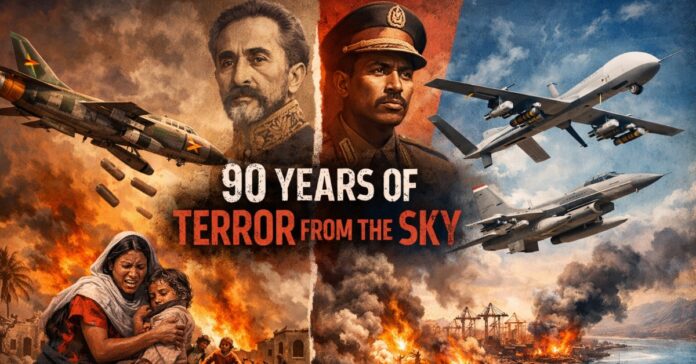
There are moments when a military parade tells you more by what it hides than by what it shows. Ethiopia’s recent celebration of the 90th anniversary of its air force was one of those moments. Fighter jets roared overhead. Drones were displayed like symbols of modern genius. Foreign aircraft, including UAE-supplied jets, joined the spectacle. The message was confidence, power, and ambition, delivered at a time when Ethiopian officials speak loudly about the Red Sea and regional influence, while the country itself remains deeply fractured by internal conflict.
For Eritreans, this was not a neutral celebration. It was a reminder.
Because for most of its ninety-year existence, the Ethiopian Air Force has not been known for defending civilians or deterring foreign invasion. It has been known for something else. It has been used again and again against people the state claims as its own. Towns. Villages. Markets. Ports. Families. Entire communities punished from the sky when they refused submission on the ground.
The machinery has changed. The habit has not.
How the sky became a shortcut
Ethiopia’s use of air power against its own population did not begin with modern politics. It goes back to the imperial period. After the Italian occupation ended in 1941, Emperor Haile Selassie drew a clear lesson. Air power terrified. It worked quickly. It bypassed negotiation and resistance alike.
In 1943, when rebellion broke out in Tigray, the imperial state relied on foreign bombers to restore control. This was an early signal of how authority would be enforced. Internal problems would be solved from above, even if that meant inviting outsiders to bomb Ethiopian soil.
As Eritrea was forcibly absorbed in the 1950s and resistance began to grow in the 1960s, that same logic followed. Aircraft became part of counterinsurgency. Villages suspected of sympathy were not reasoned with. They were targeted. For Eritreans, the sky slowly stopped being just sky. It became a threat.
The Derg years: when air power declared war on life
If the imperial era introduced the idea, the Derg perfected it.
After seizing power in 1974, the military junta under Mengistu Haile Mariam turned Ethiopia into a heavily armed state backed by the Soviet bloc. The air force expanded rapidly. MiG fighter-bombers, helicopter gunships, and transport planes converted into bombers filled the hangars. Napalm, incendiaries, and cluster munitions entered the arsenal. Foreign advisers trained the crews. Eritrea became the main testing ground.
What followed was not conventional war. It was punishment from the air.
Eritrean towns were not bombed because they were military bases. They were bombed because people lived there. Markets were struck on market days, when farmers and traders gathered because they had no choice. Churches and mosques were hit when civilians fled inside, believing stone walls might offer protection. Food warehouses and ports were bombed to deepen hunger, not to win battles.
Nakfa, the heart of Eritrean resistance, was bombed year after year until almost nothing remained standing. It was never conquered. It was simply worn down, as if the goal was to erase the idea that a community could endure.
The thinking behind this was blunt. A captured Ethiopian pilot once explained that civilians were targeted because they supported the rebels. In Eritrea, support did not mean ideology. It meant surviving in your own home.
Massawa: revenge from above
The clearest example of this mentality came after Operation Fenkil in February 1990, when Eritrean forces liberated the port city of Massawa. The Derg could not retake the city on the ground. So it chose another option.
It tried to destroy it.
For weeks, Ethiopian aircraft bombed Massawa’s residential areas, port facilities, and civilian infrastructure. Food aid stockpiles were burned. Incendiaries and cluster weapons were reportedly used. Bombings were timed in ways that caught civilians when they emerged from shelters. Aid workers described scenes of devastation. Eritrean survivors described something simpler. They said the state decided to punish the city for refusing to be ruled.
This was not about military necessity. It was about revenge.
Collapse without reckoning
When the Derg collapsed in 1991, it did not face real accountability. Mengistu fled into exile. Some officials were later convicted, but the institution itself survived largely untouched. Its doctrine, its culture, and its view of air power as a political tool remained intact.
Eritrea’s independence closed the door just in time. Many feared Asmara would be next, reduced to rubble rather than surrendered. That catastrophe did not happen because the regime fell, not because it chose restraint.
New paint, old habits
Post-1991 Ethiopia did not reform the role of its air force. It modernized it. Old allies were replaced by new ones. Equipment was upgraded. Procurement channels expanded. What did not change was the instinct.
When authority weakened, the answer was still to look upward.
This became painfully clear again during the war in Tigray from 2020 to 2022. This time, the tools included armed drones. Markets were struck. Towns were hit. Civilians died. Official statements spoke of precision and legality. Families buried their dead.
Technology made the violence quieter and politically easier. Drones do not come home in coffins. But the effect on people below was familiar.
What the anniversary really means
So what does a ninety-year celebration mean in this context?
It is like celebrating the sharpness of a blade while refusing to discuss what it has been used for. The display of drones and foreign jets, staged amid Red Sea rhetoric and internal instability, does not suggest confidence. It suggests that the Ethiopian state still believes air power can substitute for political legitimacy.
For Eritreans, the meaning is clear. We have lived this story before. We know how it begins. We know how it ends.
Eritrea’s insistence on sovereignty was never about pride for its own sake. It was learned the hard way, like a family learning to guard its only well during a long dry season. Once you have watched fire fall from the sky because you refused obedience, independence stops being an abstract idea. It becomes survival.
Ethiopia may celebrate ninety years in the air. History records something else. Ninety years of using the sky to compensate for failure on the ground.
Until that history is faced honestly, the roar of engines will not sound like progress. It will sound like memory repeating itself.
Ninety years above the people.
Too many of them spent teaching civilians to fear the sky.
In Europe, the figure of the intellectual takes shape when knowledge ceases to be a private possession and becomes a public voice. It does not coincide with the professor or the specialist confined within a single discipline, but with someone who feels compelled to speak when society moves through tension and crisis. This figure emerges in direct engagement with concrete history, at moments when reality raises questions that cannot remain merely technical. Thinkers such as Antonio Gramsci clarified that every society produces intellectuals, though not all play the same role. Traditional intellectuals tend to see themselves as separate from social conflicts, guardians of a knowledge that appears neutral. Organic intellectuals, by contrast, are bound to the lived experience of social groups, translating needs, tensions, and aspirations into language, ideas, and worldviews. Later figures such as Jean-Paul Sartre insisted on a similar point. An intellectual is not the person who knows the most, but the one who accepts that knowledge demands involvement. It is not a comfortable position. It is a responsibility.
Education Is Not Yet Public Thought
This is where a common misunderstanding begins. Education is often equated with intellectuality. Yet if that were true, literacy alone would suffice to make someone an intellectual, and with the expansion of higher education almost everyone would qualify. Clearly this is not what the term means. A person may hold degrees, advanced training, refined expertise, and still remain enclosed within the boundaries of a profession. Such a person is a highly qualified professional, essential to the functioning of society, but not necessarily an intellectual in the full sense. The distinction becomes clear through examples. An engineer who designs infrastructure performs an essential task. That engineer becomes an intellectual when reflecting publicly on the model of development those projects promote, on their social and environmental consequences, on collective priorities. A physician is highly educated. That physician becomes an intellectual when engaging public debates about inequality in healthcare, the ethics of treatment, or health policy. The intellectual does not remain confined to private reflection. The intellectual steps beyond a narrow field and turns expertise into an interpretation of the concerns that affect society as a whole. The contribution is not only information, but meaning.
Common Usage and the Word ምሁር in Eritrea
This distinction becomes especially clear in Eritrea. In everyday language, the word ምሁር, mihur, is often used to describe anyone with higher education. A university graduate, a fluent speaker, someone with formal credentials may easily be labeled a scholar. Yet here a shift occurs. Education automatically becomes cultural prestige. In a deeper Eritrean sensibility, however, mihur means something more. It does not refer simply to a person who has accumulated knowledge, but to someone who connects knowledge to society. One may hold a degree in economics and be an excellent civil servant, and still not perform an intellectual function. One becomes a mihur in the fuller sense when attempting to read collective problems, to discuss economic choices in public, to identify contradictions between official narratives and lived reality, and to articulate possible paths of change. The transition is not from ignorance to culture, but from private competence to public speech.
Knowledge as Public Action
The intellectual does not operate only in isolation from public life. Engagement takes concrete forms in public life. Intellectuals write articles, editorials, essays, and pamphlets. They participate in conferences, organize meetings, and foster debates. They edit journals, curate publications, and collaborate with others in shaping cultural and political conversations. In doing so, they help orient discussion, build shared vocabularies, and make alternatives thinkable. In sociological terms, one may speak of an intellectual class composed of those who possess cultural capital and seek to transform it into symbolic influence, into the capacity to shape public opinion. In the Eritrean context, this function is not confined to universities. Elders who safeguard customary law, religious authorities who interpret moral texts, and masters of oral tradition who transmit memory and worldview perform similar roles when they link knowledge to collective life. They offer interpretations, give form to problems, and help the community understand itself. Here the central point becomes clear. The intellectual, or the mihur in its fuller sense, is not the one who has studied the most, but the one who feels that knowledge carries an obligation toward others. Knowledge becomes a public responsibility, and culture ceases to be private property.
The unipolar world order that followed the Cold War is coming to a definitive close. In a candid speech at the World Economic Forum in Davos (2026), Canadian Prime Minister Mark Carney openly admitted that the so-called “rules-based international order” was always only “partially false” – a convenient fiction that masked great power dominance . Carney recalled that Western leaders “participated in the rituals” of this order, privately aware of its double standards, but kept up symbolic compliance to “avoid trouble” . “We knew the story of the international rules-based order was partially false — that the strongest would exempt themselves when convenient, that trade rules were enforced asymmetrically,” Carney confessed, noting how international law was applied with varying rigor depending on who was accused . This frank acknowledgment marks the end of an era: the end of a U.S.-led global system that claimed mutual benefit and rules for all, even as it largely served the strongest powers.
Carney’s address set the tone by invoking Václav Havel’s notion of “living within a lie.” In Havel’s parable, a shopkeeper places a sign in his window proclaiming a slogan he doesn’t believe, merely to signal obedience . Likewise, countries have long performed rituals of fealty to a “rules-based order” they knew was imperfect. As Carney put it, “we placed the sign in the window… and largely avoided calling out the gaps between rhetoric and reality” . That complacent bargain has now collapsed. The global consensus that papered over power imbalances is unravelling, and even Western middle powers now concede that the old order’s stability rested on “pleasant fiction” . The stage is set for a historic inflection point – a rupture rather than a gentle transition. “Let me be direct. We are in the midst of a rupture, not a transition,” Carney stated bluntly , signaling that the post-Cold War unipolar moment is definitively over.
The Legacy of Unipolar Order: Stability and Subordination
The unipolar order that emerged after 1991 was often justified in idealistic terms: a “rules-based” framework to ensure global stability, free trade, and collective security under U.S. leadership. In practice, as now admitted, it was a “pleasant fiction” that preserved U.S. primacy even as it offered other nations some benefits . This order’s legacy is paradoxical. On one hand, it provided public goods – “open sea lanes, a stable financial system, collective security, and frameworks for resolving disputes” under American hegemony . Many countries in the Global South did profit, to a degree, from integration into this system through access to markets and development aid. On the other hand, the order entailed a clear hierarchy: “the strongest would exempt themselves when convenient” and enforce rules to their advantage . Weaker states often found that norms were invoked selectively, and promises of equal rules were in part a myth. In Carney’s words, “international law applied with varying rigour depending on the identity of the accused or the victim” .
Crucially, the unipolar system also demanded compliance – real or performative – from lesser powers. Many governments felt pressure to align with U.S. policies or risk political and economic repercussions. Rather than truly rules-based, the order functioned as a patronage system where allies were rewarded and dissenters penalized. Carney noted that even U.S. allies “avoided calling out the gaps between rhetoric and reality” because they benefited from the lie as long as their own prosperity and security were assured . This was “the bargain” of the unipolar era: go along with the dominant power’s system, and in return enjoy stability. However, this bred a form of “living within a lie” – a habit of symbolic compliance by middle powers and developing countries, who often bit their tongue on double standards in order to get along . Nations placed the placard of acquiescence in the proverbial window to signal cooperation, even when they privately chafed at unequal treatment.
For countries in the Global South, the unipolar legacy is mixed. Some gained development assistance and conflict mediation via multilateral institutions championed by the West. Yet many also experienced the sharp edges of an order that could quickly turn coercive. The “rules” did not prevent punitive sanctions, military interventions, or biased arbitration when the interests of the hegemon were at stake. Eritrea, for example, saw the UN and powers hesitate to enforce an international border ruling in its favor after 2002, and later suffered sanctions that it regarded as unjust . Such episodes reinforced the view in Asmara and beyond that the “rules-based order” often masked “a system of intensifying great power rivalry, where the most powerful pursue their interests” with impunity . In sum, the unipolar order’s legacy includes decades of relative global stability and economic integration, but also a trail of unresolved grievances in the Global South about sovereignty compromised and promises unfulfilled.
A Multipolar “Rupture”: Strategic Autonomy and Weaponized Integration
Today, the world is entering an emerging multipolar order defined less by universal rules and more by raw competition. Carney described a stark new reality: “Every day we’re reminded that we live in an era of great power rivalry, [where] the strong can do what they can and the weak must suffer what they must” . In this environment, the old assumptions no longer hold. Great powers are explicitly weaponizing global integration – turning economic links into leverage. “Great powers have begun using economic integration as weapons,” Carney warned, “tariffs as leverage, financial infrastructure as coercion, [and] supply chains as vulnerabilities to be exploited.” . This is a profound shift: globalization, once sold as a win-win engine of mutual growth, is now openly “subordinated to geopolitical rivalry” . Trade wars, sanctions, tech decoupling, and even the control of critical resources have become instruments of power politics.
For many countries, especially middle powers and developing states, these trends pose a dilemma. The implicit bargain of the old order – silence in exchange for stability – “no longer works” . Instead, nations face a future where “when the rules no longer protect you, you must protect yourself.” . This imperative is driving a turn toward strategic autonomy. Around the world, states are rushing to secure their own food supply, energy, critical minerals, and technological capacity . Carney observed that “many countries are drawing the same conclusions – that they must develop greater strategic autonomy in energy, food, critical minerals, finance and supply chains.” The impulse is understandable: a country that cannot feed or fuel itself, or defend itself, has few options in a volatile multipolar climate .
Yet pursuing self-reliance in an atmosphere of zero-sum rivalry comes with risks. If every nation becomes a siloed fortress, the world economy could fragment, leaving all sides poorer and more insecure. “A world of fortresses will be poorer, more fragile and less sustainable,” Carney cautioned . Likewise, the emerging multipolarity is not a tranquil balance-of-power; it is “a contested system of spheres of influence [and] geopolitical tensions” in which global norms may be weaker . In such a climate, middle and small states could be squeezed between giants or find their interests trampled as rules give way to might. The international system itself is exposed to “profound instability” as it rapidly shifts from unipolarity to multipolar competition . These geopolitical cracks in the old architecture present both an opportunity and a danger: space for new actors to assert themselves, but also fewer guarantees for the weak. The key question is how nations of the Global South can navigate this rupture to their advantage, rather than becoming collateral damage in great power contests.
From Compliance to Integrity: Middle Powers Banding Together
One clear theme from Davos was a call for middle powers to change their strategy. No longer, Carney argued, should countries “go along to get along” in hopes that compliance with a superpower will buy them safety . “It won’t,” he bluntly added . Instead, he urged those in the “middle” of the global hierarchy – neither superpower nor insignificant – to exercise collective agency. “The middle powers must act together, because if we’re not at the table, we’re on the menu,” Carney said, invoking a striking metaphor . Rather than competing against each other for a great power’s favor, these nations should coordinate and build coalitions of their own . Indeed, when middle powers only negotiate one-by-one with a hegemon, they end up bargaining from weakness and “accept what’s offered”, often performing sovereignty while “accepting subordination.” . To escape that trap, likeminded countries need to “combine to create a third path with impact.”
Acting together also means standing on principle and integrity, not just convenience. Carney suggested that the so-called “power of legitimacy and rules” can still be strong if wielded collectively . This requires honesty: “Stop invoking [the] rules-based international order as though it still functions as advertised. Call it what it is – a system of intensifying great power rivalry…using economic integration as coercion.” In practical terms, “living in truth” for middle powers means consistently upholding the same standards for all sides. As Carney noted, if they “criticize economic intimidation from one direction, but stay silent when it comes from another, we are keeping the sign in the window.” In other words, selectively objecting to only one superpower’s abuses while ignoring another’s is just a new form of the old lie. Genuine integrity would involve calling out violations of sovereignty and law regardless of who commits them – a stance that requires courage and unity among smaller states.
Crucially, building resilience is part of this strategy. Carney emphasized developing a “strong domestic economy” to reduce vulnerabilities . Diversifying trade and technology partners is not only good economics, it provides insurance against coercion . “Countries earn the right to principled stands by reducing their vulnerability to retaliation,” Carney observed . In short, middle powers should fortify themselves at home – energy independence, food security, financial stability – and cooperate abroad to withstand pressure. Where the old order asked them for compliance, the emerging approach asks for integrity and collective resilience. We see this mindset taking hold in various forms: for example, medium-sized nations forming issue-based alliances or “plurilateral” agreements that exclude superpowers, or coordinating positions in multilateral forums to amplify their voice. By acting together on their own terms, these countries aim to transform their role from passive rule-takers to proactive shapers of new norms.
Opportunities for the Global South in a Multipolar World
As the Western-led order frays, the Global South is finding new latitude to chart its own course. Freed from a singular hegemon’s shadow, developing nations can seek diverse partners and pursue policies aligned with their own interests. In fact, “as the Western-led order frays, the Global South is rising to craft its own economic and diplomatic path in a multipolar world.” Many emerging economies are now driving global growth and looking beyond the traditional North-South aid paradigm. They are deepening South-South trade, investing in regional supply chains, and leveraging their youthful populations and natural resources to gain bargaining power . Unlike during the unipolar era, where alignment with Washington or its allies was often expected, most Global South states are now “multi-aligned.” This means they engage pragmatically with all major powers – striking infrastructure deals with China, security cooperation with the US, technology partnerships with Europe, etc. – without binding themselves exclusively to any bloc . Such flexibility allows middle and low-income countries to maximize opportunities: for instance, securing investment on better terms or accessing multiple sources of financing and technology.
New South-led institutions and alliances are also emerging. The BRICS grouping (Brazil, Russia, India, China, South Africa) has expanded its vision, attracting interest from dozens of developing nations eager for alternatives to Bretton Woods institutions. Regional development banks, trade agreements outside Western frameworks, and forums like the “Global South Summit” are giving these countries greater collective influence. If managed wisely, a more multipolar system could become more inclusive – with global rules reflecting input from Asia, Africa, and Latin America rather than just the G7. Indeed, by 2026 the international system is set to be not only more multipolar but potentially more representative of diverse interests, provided rising powers from the South take on responsible roles .
For Africa and the Horn of Africa specifically, multipolarity can open space to assert regional priorities long overshadowed by big power agendas. Countries may now have a chance to prioritize economic integration within Africa – such as the African Continental Free Trade Area – under their own terms, without as much external dictate. They might also capitalize on great power competition: for example, attracting infrastructure funding from China’s Belt and Road Initiative while simultaneously leveraging U.S. and European interest in countering that influence to negotiate better deals or security support. The cracks in the old system give savvy leaders room to maneuver, playing one side against another or choosing a path entirely of their own. Eritrea’s neighborhood has seen this dynamic: Gulf Arab states, Turkey, China, the U.S., and EU are all vying for partnerships in the Horn of Africa – which means countries like Eritrea, Ethiopia, and Sudan have multiple suitors rather than a single patron. With careful strategy, they can avoid dependency on any one power and secure investments with fewer strings attached. In short, the opportunity for Global South nations lies in exploiting the greater strategic autonomy available – crafting development models that suit their conditions, asserting sovereignty in international forums, and building coalitions that amplify their voice globally.
New Geopolitical Risks and Challenges for the Global South
On the flip side, the multipolar moment brings significant risks. The erosion of a single rules framework means that smaller states can more easily become arenas for proxy contests or great power spheres of influence. The emerging order is being shaped by “a contested system of spheres of influence, [heightened] geopolitical tensions, and [a diminished] common denominator” of global norms . Without a strong multilateral referee, power politics can run rampant. For many developing countries, this raises the danger of being pulled into rival camps or punished for refusing to pick a side. For example, a country that welcomes Chinese investment might face Western trade retaliation; conversely, one that signs a security pact with the U.S. might invite overtures or pressure from Russia and China. The Horn of Africa is unfortunately familiar with such tug-of-war dynamics – recall how Cold War rivalries and the War on Terror both played out through client relationships in the region. A multipolar world could see new forms of intervention or destabilization as major powers jostle for footholds (such as ports, bases, or resource concessions) in strategically located nations.
Economic fragmentation is another challenge. If global trade splinters into blocs (e.g. a U.S./EU-led bloc and a China/Russia-led bloc with separate technology standards and payment systems), developing countries may struggle to navigate the divided landscape. Those with fragile economies could be hit hard by volatility in currency values, sanctions on partners, or breakdowns in supply chains. For instance, countries heavily indebted to or reliant on one major power could suffer if that patron’s rivalry leads to sudden funding cutoffs or asset freezes. The weaponization of finance – such as exclusion from dollar-based systems – has already been seen in cases like Iran and could be applied more broadly. Carney’s Davos remarks underscored this risk, noting how “financial infrastructure [can serve] as coercion” and supply dependencies become strategic vulnerabilities . The lesson is that interdependence now cuts both ways: it can assure prosperity in good times, but be turned into leverage in conflict.
Moreover, global problems that require collective action – climate change, pandemics, migration crises – could worsen if great power rivalry stymies cooperation. A divided UN Security Council or a weakened World Trade Organization leaves smaller countries with fewer avenues to seek justice or resolve disputes. Weaker international law enforcement means that if a small nation’s sovereignty is violated (by aggression or proxy militias), it may not receive timely help or solidarity. Many African and Asian nations worry that a might-makes-right era could permit regional hegemons to throw their weight around more freely. In the Horn of Africa, for example, one could imagine more unilateral interventions by powerful neighbors under the guise of security or economic interest if global oversight slackens. Finally, internal governance problems in developing states could be exacerbated: authoritarian leaders might feel emboldened when there is no unified external pressure for democracy or human rights. The challenge for the Global South, therefore, is to avoid the pitfalls of multipolarity – being divided and ruled by larger powers, or becoming overly dependent on one new patron – while seizing its opportunities. This demands astute diplomacy, diversification, and an emphasis on regional solidarity to avoid isolation.
Eritrea’s Sovereign Stance: Resisting Unipolar Dominance
Eritrea offers a unique and instructive case of a small nation that has long prioritized sovereignty and self-reliance above all else. Even at the height of unipolarity, Eritrea charted an independent course, often at great cost. Since achieving independence in 1993 after a 30-year liberation war, Eritrea’s leadership (headed by President Isaias Afwerki) has been deeply suspicious of external domination – whether by superpowers or international financial institutions. The country famously adopted a policy of minimal foreign aid and external loans, arguing that dependency would compromise its hard-won independence. In fact, by the mid-2000s Eritrea had scaled down or stopped accepting most foreign aid, insisting that such aid “undermines the sovereignty of recipient states.” Instead, the government embraced a philosophy of “self-reliance,” attempting to mobilize domestic resources and Diaspora contributions to meet development needs. As one official commentary put it, “to be a self-reliant country in a continent plagued by the virus of ‘other-reliance’ is what makes Eritrea a target” for pressure . In Eritrea’s view, nations that “grovel at the feet of the rich and powerful just to be fed” sacrifice their dignity – a mindset that Eritrea’s leaders have refused to accept, even during droughts and hardship.
This uncompromising stance can be seen as historical resistance to unipolar dominance. Eritrea not only declined the tutelage of Western donors, it also stood outside many integration schemes that it believed would infringe on its autonomy. The government maintained tight control over the economy and external commerce, resulting in “isolation from global free market trade.” Eritrea remained one of the few African countries not to join the World Trade Organization or take IMF structural adjustment loans, and it only belatedly signed onto the African Continental Free Trade Agreement. Such wariness stemmed from a conviction that global economic integration often comes with strings attached – “aid packages arriving with an appalling number of strings…create a confusion of priorities upon the recipient”, as President Afwerki once remarked . He and his party viewed Western-backed globalization as a potential threat to Eritrea’s policy independence and socialist-influenced development path.
Unsurprisingly, this posture led to friction with the U.S. and its allies. Eritrea fell out with Washington early on, and by the late 2000s it was hit by UN sanctions (ostensibly over regional conflicts). Asmara perceived these measures as punishment for refusing to align with U.S. regional policy – essentially, the cost of insisting on an independent path . “The various assaults against Eritrea [were] to punish the country for the ‘crime’ of the rejection of subservience,” an Eritrean Ministry of Information analysis contended . The government saw its isolation not as a failure, but as a badge of principled resistance: “pursuit of self-reliance…is the real threat that Eritrea poses to the…system of hegemony” designed by global powers . In other words, Eritrea’s very defiance of the unipolar “rules” was, in its eyes, a challenge to the world order’s inequities. This narrative of martyrdom for sovereignty has deeply shaped Eritrea’s political identity. While it resulted in economic stagnation and international pariah status for years, it also meant Eritrea never became a client state or proxy. As the unipolar era ends, Eritrea’s long-held stance appears vindicated to some degree – the inequities and double standards it railed against are now openly acknowledged by erstwhile defenders of the system .
Eritrea’s Cautious Engagement in a Shifting Global Landscape
With the geopolitical tectonic plates shifting, Eritrea is carefully adjusting its foreign relations to capitalize on the multipolar opening while safeguarding its core principle of sovereignty. As President Afwerki recently noted, the world’s move from a unipolar to a multipolar order brings greater complexity but also the chance for a “more just and equitable international order” based on mutual respect . Asmara no longer faces a monolithic Western front; it now has alternate partners who respect its non-aligned stance. In recent years, Eritrea has strengthened ties with emerging powers: China has become a key economic partner (providing loans and investing in mining projects), and Russia has found in Eritrea a willing diplomatic ally on issues like Ukraine. Indeed, Eritrea welcomed the global power shift as “an opportunity,” with Afwerki stating “the unipolar global order is beginning to unravel.” This unraveling, he suggested, validates Eritrea’s long resistance to U.S. pressure and allows it to “claim space within a new world order.” In practical terms, Eritrea is forging deeper links with the BRICS axis. Afwerki has held multiple meetings with China’s President Xi Jinping – Beijing praised the “deep bond of friendship in an uncertain and unstable world,” signaling firm support for Eritrea . Eritrea has also openly aligned with Russia’s critiques of Western hegemony; in mid-2023, Afwerki even urged Moscow to lead an anti-hegemonic global struggle, framing the Ukraine war as part of a fight in which Africa must take sides . Such moves demonstrate Eritrea’s intent to be “on the table” with new power centers rather than isolated on the menu.
The Horn of Africa nation is also recalibrating its regional posture. After decades of hostility with neighbors (Ethiopia, Djibouti, Sudan) partly fueled by external meddling, Eritrea sees value in regional self-reliance and cooperation. It played a key role in the 2018 peace with Ethiopia, ending a 20-year stalemate without heavy outside mediation. Along with Ethiopia and Somalia, Eritrea briefly formed a “Horn of Africa Cooperation” trilateral forum in 2019 aimed at solving regional issues ourselves – an initiative reflecting the desire to keep the Horn’s affairs in local hands, free from excessive superpower or neo-colonial intervention . Eritrea has advocated for Red Sea literal states to jointly manage their security and resources, cautioning against great power rivalry in these strategic waters. Such an “Eritrea-first” lens on multilateralism means Asmara will engage in collective efforts only if they uphold equality and sovereignty. For instance, Eritrea has cautiously participated in the African Union and IGAD (Intergovernmental Authority on Development) again after years of boycott, but it consistently voices against hierarchical decision-making that favors big states. President Afwerki emphasizes that a multipolar world order must be based on fairness and cooperation – “equal partnership among states” – if it is to deliver stability . This suggests Eritrea will champion reforms that give smaller nations an equal say, whether in the UN system or regional bodies.
All the same, Eritrea remains wary of over-integration. The leadership in Asmara is unlikely to suddenly embrace globalization or dependency just because the West’s dominance is diluted. If anything, Eritrea will double down on building self-reliance at home as a shield against unpredictability. Carney’s dictum that “sovereignty…will increasingly be anchored in the ability to withstand pressure” resonates strongly with Eritrea’s approach. This means continuing to invest in agriculture for food security, developing local industries (albeit slowly), and maintaining control over strategic sectors. Eritrea will seek foreign investment but on its own terms – for example, insisting on joint ventures in mining and retaining state ownership in critical infrastructure . The government has even been willing to forego opportunities rather than accept conditionalities that it perceives as compromising (such as IMF loans that demand policy changes, or NGO aid that might influence local priorities). In a multipolar context, Eritrea can leverage competition to obtain assistance with fewer strings. We see this in how it negotiates with China: Chinese firms build roads and ports in Eritrea, and in return Eritrea grants mining concessions – a transactional relationship with less lecturing about internal governance than Western aid would entail . However, such alignments carry their own risks: high indebtedness to new patrons, or becoming entangled in their rivalries. Eritrea’s challenge will be to maintain its balancing act – welcoming investment from various partners (China, Gulf states, Europe) but not becoming beholden to any. Thus far, Asmara has shown itself adept at playing hardball and extracting what it can while yielding little in political concessions.
Multilateralism and Regional Resilience: An Eritrea-First Lens
In the emerging world order, Eritrea and countries like it will have to creatively rethink multilateralism. The old multilateral institutions (from the UN to the World Bank) are viewed with skepticism in Asmara, given their history of bias and hierarchical control by big powers. Eritrea’s preference is for “coalitions of the willing” that reflect shared interests rather than universal bodies that might impose on national sovereignty. This aligns with Carney’s notion of “building coalitions that work – issue by issue, with partners who share enough common ground to act together.” For example, Eritrea might favor “plurilateral” agreements on specific goals: a regional pact on Red Sea maritime security strictly among coastal states, or a development initiative among Horn of Africa countries to jointly build infrastructure (roads, power grids) linking their economies. Such arrangements can strengthen collective resilience by pooling resources and presenting a united front, all while sidestepping distant arbiters. We have already seen the Horn of Africa states discuss integrating their electric grids and transportation networks – plans that could reduce reliance on overseas aid and facilitate intra-African trade . Eritrea, despite its prior isolation, stands to gain from these projects if it can trust that they are mutually beneficial and devoid of neocolonial agendas.
Regional cooperation is particularly vital in the Horn of Africa, a region that has historically been fragmented and vulnerable to outside interference. An Eritrea-first perspective on regionalism would prioritize sovereign equality: no single country (however large, like Ethiopia) should dominate the others, and external powers should not be allowed to play client states against each other. Eritrea has floated the idea of a Horn of Africa “forum” where all states – Eritrea, Ethiopia, Djibouti, Somalia, Sudan, South Sudan, and perhaps Kenya/Uganda – come together to address conflicts and economic ties without outside mediators. The underlying principle is “African solutions to African problems.” If successful, such a bloc could collectively bargain with external investors and powers, thereby preventing divide-and-rule tactics. For example, a coordinated Horn position on Red Sea maritime rights could ensure that outside navies (American, Chinese, or others) respect the region’s interests, or that the terms of port investments are not exploitative. Eritrea often cites the Non-Aligned Movement traditions – the idea that developing nations should unify to increase their leverage globally. In practice, this could mean Asmara investing diplomatic capital in the G77 coalition at the UN or South-South initiatives where it feels its voice won’t be marginalized.
Throughout all these engagements, national sovereignty remains the north star for Eritrea. Multilateralism is seen not as an end in itself, but as a means to bolster sovereignty through strength in numbers. Eritrea will likely continue to reject any cooperation that smells of dependency or paternalism. Its representatives frequently call for the UN and international bodies to respect the choices of nations and to abandon coercive measures like sanctions in favor of dialogue. Indeed, Eritrea’s experience on the UN Human Rights Council (to which it was elected in 2022) has been to champion non-interference, arguing for constructive engagement over naming-and-shaming. This stance appeals to many in the Global South who similarly resent what they view as Western double standards on human rights and governance. As multipolarity takes hold, countries like Eritrea will push for multilateral norms that protect sovereignty – for example, stricter prohibitions on unilateral sanctions, or UN reforms giving greater voice to Africa and Asia. They will also advocate collective resilience mechanisms: sharing best practices on self-reliance, forming regional rapid-response teams for disasters (to not depend solely on Western NGOs), and developing joint financial tools (perhaps an African Monetary Fund) to reduce reliance on dollar-based systems.
Importantly, Eritrea’s emphasis on sovereignty does not equate to isolation in this new era. Rather, it seeks interdependence without dependency – cooperation with others on equal footing. The Eritrean leadership often invokes the ideal of mutual self-reliance: each nation standing on its own feet, yet supporting one another through trade and aid that empower rather than weaken. As one Eritrean commentary put it, “the experience of Eritrea can serve as a starting point…for cooperation based on mutual interdependence” among African countries . The nation envisions a regional and global order where no country is forced to choose between poverty with sovereignty or riches with servility. That is a high bar to meet, but the cracks in the old system offer a chance to move in that direction.
Navigating a New Multipolar Era: An Eritrea-Focused Roadmap
As the unipolar world order fades into history, Eritrea and similar Global South nations face a delicate but potentially rewarding path forward. They must leverage the opportunities of multipolarity – greater agency, diverse partnerships, and the ability to assert their own development models – while vigilantly managing the risks of a more anarchic international arena. The following strategic approaches, viewed through an “Eritrea-first” lens, outline how these countries can navigate the cracks in the old system to build strategic autonomy on their own terms:
Strengthen Domestic Self-Reliance: Prioritize food security, energy sufficiency, and essential industries at home. As Carney observed, “a country that can’t feed itself, fuel itself or defend itself has few options” . Eritrea’s long-standing focus on self-reliance – from agriculture to avoiding debt – should continue, as a resilient domestic foundation is the best insurance against external shocks or coercion.
Diversify External Partnerships: Embrace a multi-aligned foreign policy to avoid overdependence on any single great power. Engaging with a range of partners (China, Russia, the EU, the U.S., regional powers) allows small nations to extract benefits from each relationship while maintaining balance. For instance, Eritrea can welcome Chinese investment in mines and European markets for its products, and still seek a “constructive and principled engagement” with the U.S. on regional security . By not putting all eggs in one basket, countries preserve flexibility.
Build Issue-Based Coalitions and South-South Alliances: In a world of fluid alignments, collaborate with other middle powers and developing countries on specific goals. Whether it’s a coalition to negotiate better terms for mineral exports, a bloc of non-aligned states opposing unlawful sanctions, or a regional Horn of Africa pact on infrastructure, acting in concert amplifies influence. “Middle powers must act together… if we’re not at the table, we’re on the menu,” is a lesson small states should heed . Collective efforts can also share the “cost of strategic autonomy” by pooling resources for mutual benefit .
Stand on Principle with Consistency: Adopt a foreign policy that upholds core values – sovereignty, territorial integrity, non-aggression – consistently in all cases, not selectively. As Carney challenged, call out violations of international law by any actor, friend or foe . Eritrea and its peers gain moral credibility and long-term partners’ trust by demonstrating integrity. This might mean, for example, speaking against the breach of any country’s borders (as a matter of principle) even if committed by a preferred ally. Consistent integrity helps build the “power of legitimacy” that can restrain larger powers when wielded by a united smaller states .
Leverage Multilateral Forums for Equal Voice: Continue pushing for reforms and using platforms (UN General Assembly, African Union, Non-Aligned Movement) to assert the perspectives of smaller nations. An Eritrea-first approach would be to ensure these forums are not simply echo chambers for big power interests but serve as arenas where Global South countries can set agendas (e.g. development financing rules, security guarantees for small states). By actively participating and sometimes leading on issues (such as Eritrea championing an African initiative for Red Sea security), these nations can shape emerging norms in their favor.
Foster Regional Integration and Collective Resilience: Invest in neighborly cooperation that reduces external dependency. This includes regional trade, joint infrastructure, and conflict resolution mechanisms. In the Horn of Africa, Eritrea can deepen ties with Ethiopia, Somalia, Sudan and others through projects that connect economies – from power grids to transport corridors – thereby making the region more self-sustaining. A stable, economically interlinked neighborhood is less susceptible to divide-and-rule and can collectively negotiate with external powers from a position of strength. As Carney noted, “risk management comes at a price, but that cost… can also be shared.” The Horn of Africa states pooling their risk through integration exemplifies this principle.
Ultimately, Eritrea’s guiding star will remain national sovereignty and dignity. The multipolar era, if approached wisely, can validate Eritrea’s longtime mantra that nations big or small have the right to determine their own destiny free of coercion. “Nostalgia is not a strategy,” as Carney said – there is no going back to the unipolar “business as usual.” For countries like Eritrea, this is for the best. The task now is to seize the moment of rupture to build a fairer order. That means taking down the old sign of false compliance and, instead, raising a new banner of truth: a commitment to an international system that truly respects the sovereignty and development aspirations of all nations, not just the most powerful . Eritrea and its Global South peers have paid a high price under the old order’s injustices; in the emerging multipolar world, they intend to ensure that their resilience, solidarity, and principled stance earn them an equitable place at the table – not as compliant subjects, but as confident partners shaping their own future.
Sources:
C.J. Atkins, People’s World – “Carney’s Davos confession: Globalization’s ‘rules-based order’ was a lie” (Jan 21, 2026)
Times of India – “‘Rules-based order a fiction’: Canadian PM says West excused US hegemony; Mark Carney hints at rupture” (Jan 21, 2026)
Mark Carney – WEF Davos 2026 Address (full transcript via World Economic Forum)
Mark Carney – WEF Davos 2026 (on middle powers and sovereignty)
Aparna Bharadwaj et al., BCG – “In a Multipolar World, the Global South Finds Its Moment” (Apr 22, 2025)
Nadia Batok, Meer – “A new world order emerges: The shifting dynamics of global power” (Apr 15, 2025)
Shabait (Eritrea Ministry of Information) – “Self-reliance key to Eritrea’s independence and development” (Sept 6, 2017)
There is a persistent tendency in some academic and advocacy circles to treat Eritrea’s national unity as a contrivance rather than a lived political achievement. A recent article by Mahder Nesibu, published by Horn Review—a state-affiliated propaganda platform masquerading as an independent research and publication think tank—follows this familiar path. It presents Eritrea’s cohesion as a surface narrative masking deeper fractures allegedly produced by the political philosophy of the Eritrean People’s Liberation Front and its successor, the People’s Front for Democracy and Justice.
What is striking is not the article’s criticism of authoritarian governance—an area where Eritreans themselves have long raised serious concerns—but its deeper implication: that Eritrea’s foundational choice of unity over identity-based politics was misguided, suppressive, and historically illegitimate. From an Eritrean perspective, this is not simply an analytical error. It reflects a fundamental misunderstanding of how states are born, how sovereignty is defended, and how diverse societies survive in hostile regions.
An African proverb reminds us: When spider webs unite, they can tie up a lion. Eritrea’s unity was never about denying difference. It was about binding fragile strands into something strong enough to resist annihilation.
Liberation as State Formation, Not a Social Experiment
Eritrea’s armed struggle was not a seminar on pluralism. It was a protracted war against an imperial state that denied Eritreans legal personality, political voice, and even historical existence. The early fragmentation of the liberation movement—particularly during the dominance and subsequent crisis of the Eritrean Liberation Front—was not evidence of healthy diversity. It was a lesson in strategic vulnerability. Factionalism, regionalism, and identity-based mobilization weakened military coordination and exposed the struggle to external manipulation.
The emergence of the Eritrean People’s Liberation Front was a corrective to that failure. Its insistence on discipline, ideological coherence, and a supra-ethnic national identity was not accidental authoritarianism. It was a conscious doctrine of survival rooted in an understanding of Eritrean reality. The EPLF grasped what many theorists prefer to ignore: societies confronting existential threats do not first negotiate identity accommodation. They first secure collective existence.
To judge that choice retroactively by peacetime liberal standards is to misunderstand the nature of liberation movements as proto-states operating under siege.
Unity as a Civic, Not Sectarian, Principle
A central flaw in Mahder’s argument is the conflation of unity with homogenization. Eritrean unity was never racial, religious, or ethnic. It was civic and political. Muslims and Christians fought, bled, and governed together. Highlanders and lowlanders shared trenches and command structures. Languages, customs, and faiths persisted—not erased, but politically subordinated to a common national purpose.
This distinction matters. Eritrea did not deny diversity; it denied the right of diversity to become a competing sovereign claim. It rejected religious or ethnic supremacy and paved the way for a citizenship-based Eritrean national identity.
That choice stands in sharp contrast to Ethiopia’s post-1991 political order, where ethnicity was constitutionalized as the primary axis of political legitimacy. The results are no longer theoretical. Ethiopia today faces chronic internal conflict, mass displacement, ethnic cleansing, and the progressive erosion of state authority. Ethnic conflicts are widespread. Afars distrust Oromos. Oromos distrust Amharas, Amharas do not trust Tigrayans vise versa and etc. Identity was meant to manage diversity; instead, it institutionalized grievance and normalized political violence.
Eritrea, for all its profound governance deficiencies, has not experienced ethnic civil war or sectarian militias. That is not because diversity does not exist, but because it was never weaponized as the organizing principle of the state. Eritreans understand a simple truth: a house divided against itself cannot stand. The Horn of Africa offers daily proof.
Governance Failure Is Not a Philosophical Failure
None of this absolves the Eritrean state of responsibility for its current condition. The absence of a constitution, the lack of an elected legislature, the subordination of law to executive discretion, indefinite national service, and restrictions on civil liberties constitute serious violations of political and legal norms. These are failures of constitutionalism, accountability, and institutional development—and they are concerns for Eritreans to confront, not for Ethiopian imperialists to instrumentalize.
They are also not evidence that Eritrea’s foundational philosophy of unity was inherently flawed.
Legally speaking, Eritrea suffers from a deficit of the rule of law, not from an excess of national identity. The problem is not that the state rejected ethnic federalism. It is that it failed to transition from revolutionary legitimacy to constitutional legitimacy. Power remained centralized without being legalized. Authority endured without being institutionalized.
By collapsing governance shortcomings into an identity critique, Mahder’s analysis shifts responsibility away from reform and accountability and toward a far more dangerous conclusion: that Eritrea must revisit the very basis of its statehood. That is not reformist analysis. It is structural delegitimization.
Religion, Regulation, and Regional Reality
The regulation of religious institutions in Eritrea has rightly drawn criticism, particularly where it violates freedom of belief and association. Yet critique must be grounded in comparative and empirical reality. Eritrea has not experienced religious civil war, sectarian insurgency, or faith-based political fragmentation. Churches and mosques coexist without organized communal violence.
This is not incidental. It reflects a deliberate legal posture that treats religion as a social institution rather than a political constituency. One may dispute the excesses of this approach, but to ignore its stabilizing effects in a volatile region is intellectually dishonest.
In Ethiopia, by contrast, religion increasingly intersects with ethnic politics and armed mobilization. Faith becomes identity. Identity becomes territory. Territory becomes bloodshed. Eritrea consciously chose a different legal and political trajectory.
As elders say, The one who has not crossed the river calls the crocodile a log. Eritreans know what they avoided.
On Positionality and Perspective
It is necessary to acknowledge positionality—not to dismiss arguments, but to contextualize them. Mahder Nesibu writes as an Ethiopian researcher operating within an Ethiopian policy ecosystem. Eritrea’s rejection of identity-based governance is not a neutral subject in that context. It is a direct critique of Ethiopia’s own state model.
Eritreans speak from lived consequence, not abstract preference. Unity was not chosen to silence difference. It was chosen to prevent national disintegration. That historical memory cannot be edited out through academic framing.
The Way Forward: Reform Without Fragmentation
Eritrea’s future does not lie in dismantling its national cohesion. It lies in completing the unfinished transition from liberation movement to constitutional state. Unity must be anchored in law. Citizenship must be protected by rights. Authority must be constrained by institutions.
The task is the democratization of unity, not its abandonment.
No matter how long the night, the day will surely come. Eritrea’s night has been long. But its dawn will not come through importing the politics of division that have devastated others. It will come through reform rooted in sovereignty, accountability, and the hard-earned lesson that unity—however imperfect—was Eritrea’s shield, not its curse.
That truth deserves to be defended with clarity, not surrendered to fashionable but dangerous narratives.
This article examines the imbalance in President Isaias Afwerki’s recent media interview, where extensive attention was given to global and regional geopolitics while domestic Eritrean issues received comparatively limited focus. Acknowledging the importance of strategic global awareness, the piece argues that Eritrea has reached a stage where internal priorities development timelines, institutional reform, human capital, and citizen experience must receive equal analytical weight. The article offers a pragmatic, Eritrea-first critique aimed not at undermining leadership, but at strengthening national alignment and ensuring that sovereignty is matched by tangible progress in everyday life
Earlier this week, President Isaias Afwerki delivered a wide-ranging interview to local media that was unmistakably global in scope and strategic in tone. He spoke at length about the end of the unipolar world order that emerged after 1991, the relative decline of U.S. dominance, the logic and limits of Donald Trump’s doctrine, NATO’s internal contradictions, Africa’s structural marginalization, and the enduring geostrategic importance of the Red Sea and the Horn of Africa.
This kind of analysis matters. Eritrea has never had the luxury of strategic innocence. From the armed struggle to the post-independence years of sanctions, isolation, and regional confrontation, Eritrea’s survival has depended on reading global power shifts accurately and responding to them without illusion. On this front, the president sounded confident, experienced, and consistent with a worldview shaped by history rather than fashion.
Yet there is an imbalance in the interview that deserves careful attention not as an attack, but as a necessary national conversation. Domestic Eritrean issues received far less analytical depth and urgency than regional and international ones. In Eritrea’s current phase, that imbalance matters.
Global clarity versus domestic distance
The president’s global analysis was coherent and internally consistent. He traced the trajectory from the Cold War to unipolarity, and from unipolar dominance to fragmentation and contestation. He warned against exaggerating Trump’s actions while still situating them within a broader effort to reassert American leverage through tariffs, sanctions, selective alliances, and resource pressure. He also underscored a long-standing Eritrean observation: that Africa, despite possessing the majority of the world’s natural resources, remains structurally marginalized within the global system.
Analytically, this framing is difficult to dispute. But analysis does not exist in a vacuum. The tension emerges when this global clarity is contrasted with the treatment of domestic realities. Most Eritreans are not navigating tariff wars, NATO’s crisis, or U.S.–China rivalry in their daily lives. They are navigating water access, electricity shortages, job uncertainty, family separation, constrained mobility, education bottlenecks, and delayed life transitions.
When domestic realities appear later in the conversation and in broader strokes the perception that forms is not necessarily the one intended. The risk is that urgency appears external rather than internal, and that domestic challenges are implicitly framed as stable enough to wait. For a society that has absorbed decades of sacrifice in the name of sovereignty and survival, perception carries real weight.
Development vision without temporal anchors
To be clear, the interview did outline a comprehensive domestic development agenda. Roads, dams, energy generation, mining, agriculture, fisheries, housing, and education were all cited as priorities. The scale of ambition is evident, and in many respects admirable. Eritrea has never lacked long-term vision.
The pragmatic critique is not about ambition, but about communication. Vision alone no longer carries the same mobilizing power it once did. Eritreans today are not primarily asking what will be built; they are asking when, how, and in what sequence. Timelines, even broad ones, serve a critical function: they translate national goals into personal expectations.
The absence of phased benchmarks or short-term deliverables weakens confidence, not because people doubt intent, but because lived experience increasingly demands clarity. In a mature national phase, credibility is reinforced by specificity. Three-year horizons, pilot regions, or sector-by-sector sequencing can turn abstract commitment into measurable trust.
Stability and the question of reform
Stability was repeatedly emphasized as the foundation of development, and rightly so. Eritrea’s history demonstrates that without security and cohesion, development collapses into dependency or chaos. However, stability cannot be treated as an end state. At this stage, it must function as a platform for institutional evolution.
The interview spoke little about administrative efficiency, legal predictability, civil governance modernization, or institutional renewal. These are not imported demands or ideological concessions. They are internal performance tools. A resilient state is not only one that resists external pressure, but one that adapts its internal systems so citizens can function productively, predictably, and with dignity.
The absence of this discussion leaves a noticeable gap, particularly for professionals, entrepreneurs, and skilled workers who want to contribute but encounter friction from outdated procedures and opaque processes. Over time, such friction erodes energy and initiative, even among the most committed citizens.
Human capital beyond schooling
Education was correctly identified as the highest priority, and this emphasis reflects long-standing Eritrean values. But education cannot be examined in isolation from social and economic pathways. Young Eritreans today face long delays before entering civilian economic life, limited career pathways outside a narrow set of sectors, and skills that do not always align with labor market demand.
Human capital development is not only about classrooms and curricula. It is about transition how people move from learning to living, from training to contribution. This transition phase is where frustration accumulates and morale is tested. The interview largely bypassed this dimension, even though it sits at the heart of national productivity and social cohesion.
Addressing these pressures directly would not weaken the state. On the contrary, it would strengthen it by aligning policy vision with lived reality.
Diaspora: resource or partner?
The diaspora’s historic and ongoing contributions were rightly acknowledged. Investment, technology transfer, skills, and expertise were presented as pillars of future engagement. Yet engagement framed primarily in financial or technical terms risks missing a deeper opportunity.
Many Eritreans abroad are not only sources of capital; they are repositories of experience, institutional knowledge, and comparative insight. They seek structured dialogue, policy feedback mechanisms, and meaningful participation not simply investment channels. A diaspora treated only as capital risks fatigue and disengagement. A diaspora treated as a partner becomes a strategic multiplier.
Realizing this requires institutional frameworks, data systems, and channels of communication that go beyond ad hoc appeals. It requires trust built through inclusion, not only through obligation.
Security discourse and domestic acceleration
The president’s dismissal of hostile rhetoric from Ethiopia’s ruling party and his reaffirmation of Eritrea’s readiness to defend itself while avoiding war were consistent with long-held positions. Few Eritreans underestimate the volatility of the region or the reality of external threats.
Still, there is a strategic cost when security discourse dominates national messaging. National resilience is built not only through deterrence, but through reliable services, livelihoods, and institutional trust. Deterrence without domestic acceleration becomes expensive economically, socially, and psychologically.
Security and development are not competing agendas, but they must advance in tandem. Overemphasis on one risks stagnation in the other.
Eritrea’s current inflection point
Eritrea’s preservation of sovereignty under extraordinary pressure is a genuine achievement. Few nations of comparable size and exposure have endured similar constraints without fragmentation or collapse. That history deserves recognition.
But the next phase of Eritrea’s journey is different. The defining challenges ahead are less about resisting external imposition and more about internal calibration: how fast systems adapt, how clearly priorities are communicated, and how citizens experience progress in their daily lives.
The interview leaned heavily toward geopolitical diagnosis. Eritrea’s decisive work in the coming years will be administrative, economic, and social. These are quieter battles, but no less consequential.
Criticism as a form of responsibility
This critique is not an argument against leadership, nor is it a dismissal of the president’s global analysis. It is an argument for balance. Eritrea does not need less global awareness; it needs equal domestic intensity.
When domestic issues receive the same analytical rigor as geopolitics, public trust deepens. When development plans are paired with timelines, confidence grows. When reform is framed as an expression of strength rather than concession, sovereignty matures.
This is not a call for noise or spectacle. It is a call for alignment between where Eritrea looks and where Eritreans live. That conversation is not only healthy; it is necessary for the next chapter of Eritrea’s national project.
Let me start by mentioning the obvious, Eritrea is rarely examined with patience. It is more often assessed through borrowed lenses that flatten history, ignore security realities, and confuse restraint with stagnation. When Eritrea refuses prescribed paths, it is labeled immobile. When it withstands pressures that fracture other states, that endurance is treated as accidental. This habit misses the more honest accounting: what Eritrea has consciously preserved, what it has deliberately deferred, and what now demands adjustment rather than denial.
Recent analysis contributed by In On Africa (IOA) offers a useful reference point precisely because it avoids caricature. It acknowledges that Eritrea has extracted tangible benefit from shifting regional and global conditions while remaining constrained by its own political and economic architecture. That duality is not a flaw in logic. It is the operating environment Eritrea has chosen—shaped by lived experience, not abstract theory.
The easing of hostilities with Ethiopia altered Eritrea’s external posture in measurable ways, though never as definitively as some narratives suggest. For decades, Eritrea functioned under conditions shaped by war preparedness, border closure, and sanctions. Partial normalization reduced pressure. Limited trade routes reopened. Transport links resumed. The sense of permanent encirclement softened. These changes did not transform the economy, but they reduced friction. For a small state, reduced friction is not cosmetic. It is structural relief.
Yet that relief has proven fragile. Ethiopia has in recent months escalated its rhetoric on Red Sea access and maritime “rights,” presenting strategic entitlement as economic necessity. For Eritrea, this language is not theoretical. It echoes a long history in which sovereignty was challenged not only through arms, but through normalization of coercive claims dressed up as regional logic. When a much larger neighbor speaks loosely about access rather than negotiation, Eritrea’s caution ceases to look ideological and begins to look empirical.
This external context matters when assessing Eritrea’s internal restraint. Economic openness cannot be evaluated in isolation from security environment. Infrastructure integration, regulatory liberalization, and cross-border dependence are weighed against credible risks, not imagined threats. Eritrea’s policy posture reflects this arithmetic. One may argue it has been over-applied, but it cannot be dismissed as irrational.
At the same time, global commodity dynamics have intermittently worked in Eritrea’s favor. Higher prices for gold, copper, zinc, and potash have strengthened export earnings and supplied foreign exchange otherwise difficult to secure. The mineral sector, long spoken of as future promise, has become a present stabilizer. It cushions the balance of payments and supports macroeconomic control.
Stabilization, however, is not expansion. GDP growth remains modest according the report, and here precision matters. Mining cannot carry a national economy, particularly one with a young population and limited private-sector depth. Eritrea’s economic base remains narrow, and its structure centralized. Resource income has been used largely to maintain balance rather than to drive diversification. That choice has insulated the economy from volatility, but it has also limited spillover into employment, entrepreneurship, and innovation.
Agriculture reveals the limits of this approach most clearly. Eritrea’s rural sector should be the backbone of resilience and food security. Instead, it remains exposed to drought, erratic rainfall, and recurring pest outbreaks—now predictable features of climate stress across the Horn. Without sustained investment in irrigation, storage, inputs, and adaptation, agriculture cannot stabilize livelihoods or absorb labor productively. Stability without productivity risks freezing vulnerability in place.
These outcomes are not technical accidents. They reflect priorities shaped by history. Eritrea’s state-centered economic model has delivered discipline, relative price stability, and minimal external debt. In a continent where debt distress has become a recurring crisis, this restraint is not trivial. Eritrea has refused to mortgage future generations for short-term growth or surrender policy autonomy in exchange for liquidity.
But restraint extracts its own price. Eritrea lacks a formal, transparent, and predictable investment framework. Decisions often appear negotiated rather than codified. For a narrow set of state-aligned projects, this can function. For broader domestic initiative and diaspora capital, it does not. Capital does not demand indulgence; it demands rules. The absence of clear frameworks concentrates activity around the state, where incentives are weak and timelines slow.
Governance dynamics reinforce this rigidity. Eritrea’s model prioritizes cohesion, security, and control—priorities forged in liberation and hardened by isolation. They preserved the state. They also produced side effects that can no longer be treated as temporary. Indefinite national service, restrictions on movement, arbitrary detention, and the absence of institutional legal recourse have eroded trust between citizen and state.
Trust does not register neatly in national accounts, yet it governs behavior. Human capital is not only education and skills; it is confidence and continuity. When young Eritreans cannot see a credible transition from sacrifice to stability, they do not plan investments. They plan exits. Migration, stripped of slogans on both sides, is an economic signal of deferred opportunity.
None of this negates Eritrea’s achievements. Social order has largely held in a volatile region. Debt exposure remains low. Urban centers function rather than implode. These outcomes are the product of deliberate choices informed by hard memory. Many states are now renegotiating sovereignty under the weight of debt. Eritrea is not among them.
Urbanization trends reflect controlled stability. Eritrea has avoided explosive sprawl. Asmara has not collapsed into informal chaos. Secondary towns retain coherence. Rural areas, though strained, have not emptied entirely. But control cannot anchor this balance indefinitely. Opportunity must eventually replace restriction as the foundation of stability.
Opportunities exist, but they require calibration, not rupture. Regional trade can expand on Eritrea’s terms—through reciprocity, not coercion. Eritrea’s ports are assets, not concessions. Integration must strengthen sovereignty, particularly in a climate where Ethiopian rhetoric increasingly blurs the line between cooperation and entitlement.
Mineral wealth can anchor development if paired with value addition and skills transfer. Tourism can grow if predictability replaces discretionary obstruction. National service can be modernized through timelines and civilian pathways without weakening preparedness.
Eritrea does not face a theatrical crossroads. It faces an accumulation problem. Policies designed for survival under pressure have produced side effects that can no longer be deferred indefinitely. The task is not abandonment of restraint, but refinement of it.
Eritrea has proven it can withstand pressure—sanctions, isolation, and renewed rhetoric alike. The harder test is whether it can now convert endurance into opportunity, stability into confidence, and control into consent without exposing itself to the vulnerabilities it spent decades resisting.
The balance sheet is clear. Much has been preserved. What has been deferred must now be allowed to mature, even as vigilance remains non-negotiable.
One last note, I will watch President Isayas Interview, and try to give my opinion regarding the economic recovery, if he talks about it.