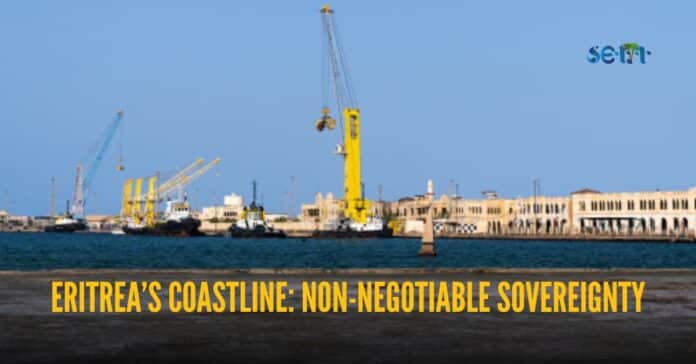
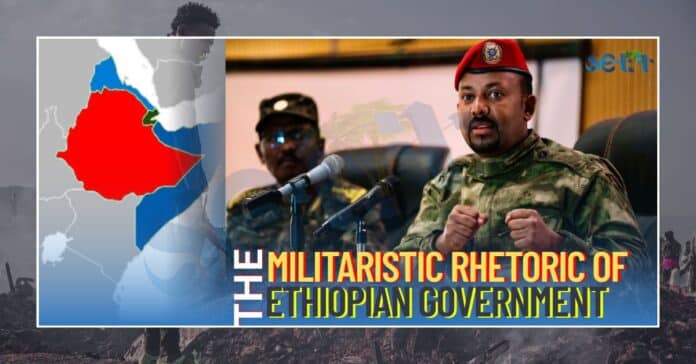
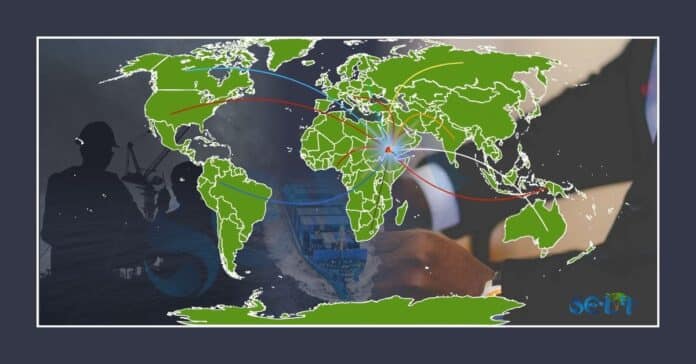
Eritrea has firmly rejected renewed rhetoric from Ethiopian political and military leaders pushing for access to the Red Sea, asserting that Eritrea’s sovereignty—particularly over its coastline—is non-negotiable and not subject to historical revision or diplomatic pressure.
The response follows a new campaign led by Ethiopian officials and state-affiliated media. On Saturday, Fana Media Corporation published a report framing Ethiopia’s lack of sea access as a national crisis, tying it to economic growth, security, and generational justice. Scholars cited in the article argued that being landlocked places Ethiopia at a disadvantage and suggested that maritime access should be pursued as a “vital national objective.”
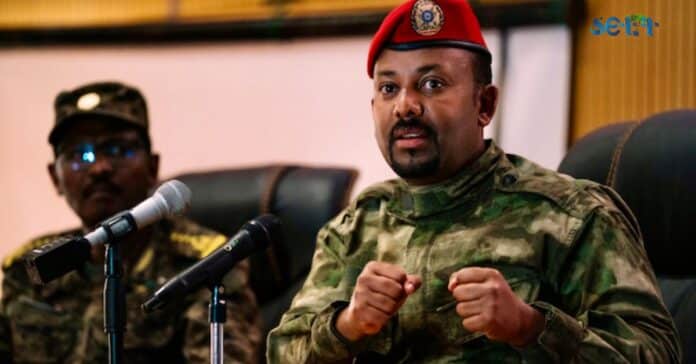
Tensions escalated further when Field Marshal Berhanu Jula, Chief of General Staff of the Ethiopian Army, claimed during a closed meeting that unnamed regional forces are actively working to prevent Ethiopia from reaching the Red Sea. He described this as part of a long-standing effort to isolate the country and limit its strategic influence. He also pointed to what he described as internal political failings by previous Ethiopian governments, particularly the TPLF, which he accused of failing to advance Ethiopia’s maritime ambitions.
Eritrea, however, views these arguments as dangerous and disconnected from international legal norms. Eritrean officials emphasize that their country’s sovereignty—solidified through a 1993 UN-supervised referendum and recognized by international law—includes full and exclusive control over its Red Sea coastline. Any suggestion that this territory should be shared or negotiated is seen in Asmara as an affront to the hard-won independence of the Eritrean people.
Responding to these developments, Eritrean Information Minister Yemane G. Meskel issued a clear and strongly worded statement on social media:
“Repetition ad nauseam of their toxic/elusive agenda aside, the stale arguments that PP officials and trolls are advancing these days increasingly defy simple logic, common sense, as well as elementary (101) principles and norms of international law and diplomacy,” he posted on X (formerly Twitter).
“In this respect, the latest version in town is that they became ‘disillusioned’ in the rapprochement between the two countries when they realized that Eritrea never contemplated, and was not indeed prepared, to partially mortgage or auction its inalienable sovereignty over its maritime assets.”
This response reflects Eritrea’s long-standing position that regional peace and development must be based on mutual respect, sovereign equality, and non-interference. While Eritrea remains committed to regional cooperation and integration, it rejects any notion that its ports are up for negotiation under economic or political pressure.
Some in Ethiopia have interpreted Eritrea’s foreign relations—such as the October 2024 tripartite Horn of Africa security pact with Egypt and Somalia—as exclusionary. Eritrean officials, however, maintain that such partnerships are based on mutual interests, not hostility, and are open to any state that respects sovereignty and regional balance.
As Ethiopia continues to raise its maritime ambitions on the international stage, Eritrea’s position remains unambiguous: sovereignty is not for sale, and the Red Sea is not up for bargaining.
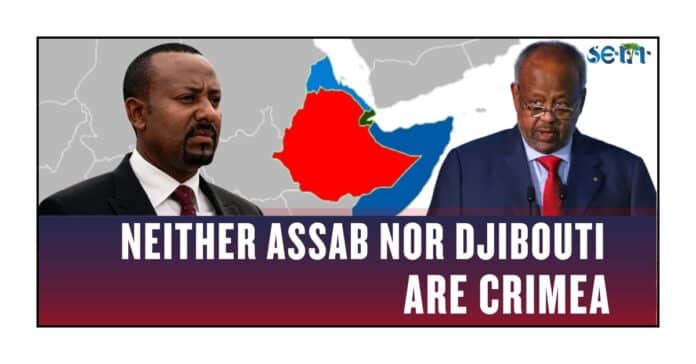
In a powerful and unambiguous interview with Jeune Afrique, Djibouti’s President Ismaïl Omar Guelleh delivered his strongest message yet to Ethiopian Prime Minister Abiy Ahmed, bluntly rejecting any notion of seaport acquisition by force or coercion. Referring to the Ethiopian PM’s recent assertions, President Guelleh declared: “Djibouti is not Crimea.” The statement resonated widely across the region and internationally, reflecting growing alarm over Ethiopia’s escalating rhetoric regarding sovereign access to the Red Sea.
For nearly two years, Prime Minister Abiy has intensified a campaign pushing Ethiopia’s need for a seaport of its own, repeatedly stating that his country must gain maritime access “by any means necessary.” These remarks, perceived as veiled threats, have sparked regional unease, drawing sharp rebukes from neighboring states who view them as a direct challenge to their sovereignty and territorial integrity. The situation has become particularly concerning given Ethiopia’s history of regional conflict and internal unrest.
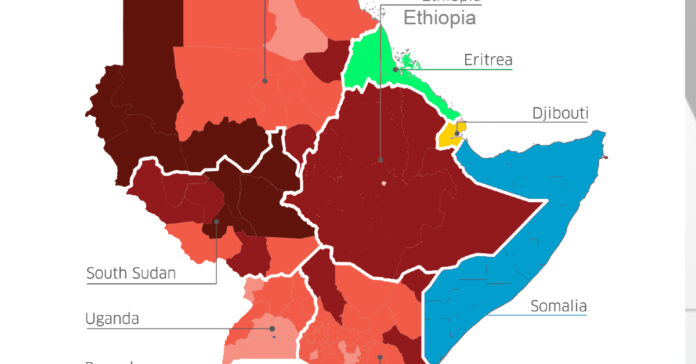
This assertive posture has led to a series of diplomatic setbacks for Ethiopia. Neighboring countries, including Eritrea, Djibouti, and Somalia, have responded with strong warnings, asserting that any infringement on their borders will be met with a strong response. These tensions risk plunging the already volatile Horn of Africa into further instability.
What compounds the danger is the growing belief that foreign actors are fueling Ethiopia’s aggressive stance. Reports and public statements from senior Ethiopian officials, including Getachew Reda — a key adviser on East African affairs — have indicated that preparations for conflict with Eritrea may be influenced, or even dictated, by external powers with vested interests in the Red Sea corridor. Such influence not only undermines Ethiopian sovereignty but poses a broader threat to peace and cooperation across the region.
Among the primary targets of Ethiopia’s maritime ambitions is the Eritrean port city of Assab. Located strategically on the Red Sea, Assab has frequently featured in speculative discussions about access corridors and military arrangements. But just as President Guelleh made clear that Djibouti is not Crimea, the international community must also recognize that Assab is not a disputed zone. It is sovereign Eritrean territory — full stop. Any attempt to seize it or force Eritrea into a concession would be a blatant violation of international law.
In this context, the silence of the United Nations and the African Union has become increasingly untenable. These institutions, both charged with upholding peace and the integrity of state boundaries, must break their silence and unequivocally condemn any rhetoric or actions aimed at redrawing borders through coercion or military might.
The crisis in the Horn of Africa is not theoretical. The region is already burdened with humanitarian crises, fragile states, and unresolved conflicts. Further destabilization over sea access would be catastrophic.
The message is clear: Neither Assab nor Djibouti are Crimea. The era of colonial-style land grabs must remain in the past. Peace, sovereignty, and regional cooperation should be the cornerstones of 21st-century diplomacy. Anything less is a recipe for chaos.
In a series of recent interviews aired by Ethiopian State Television, Prime Minister Abiy Ahmed once again lamented what he calls Ethiopia’s “loss” of a seaport. As an Eritrean, I find it necessary to respond to this narrative—not because it is new, but because it is being repeated with growing insistence, threatening to reshape public perception and potentially destabilize the Horn of Africa.
Regional cooperation and integration are essential for peace and development. But the Ethiopian Prime Minister’s narrative is not about collaboration; it is about historical distortion and territorial ambition. Worse, it appears to echo agendas dictated by foreign interests rather than genuine domestic priorities. This has been a recurring flaw of Ethiopian leadership since the end of World War II.
Ethiopia Never Owned a Seaport
Despite repeated claims, Ethiopia has never legally owned a seaport. During the 1952 UN-mandated federation with Eritrea, Ethiopia gained access to the ports of Massawa and Assab. But this access came through a federal arrangement, not ownership. When Ethiopia unilaterally dissolved the federation in 1962 and annexed Eritrea, it violated international law—specifically, UN General Assembly Resolution 390 (A) of 1952, which had established the federation.
Eritrea, which had been a distinct colonial entity under Italy, waged a 30-year war to reverse this illegal annexation. That war ended in 1991, and Eritrea’s independence was formally affirmed in a 1993 referendum overseen by the United Nations, in which 99.8% of voters chose sovereignty. Eritrea’s borders were drawn in accordance with colonial treaties—the recognized legal standard for territorial boundaries in Africa.
Ambiguity as Strategy
Prime Minister Abiy claims Ethiopia will pursue access to a seaport through “peaceful and legal means.” Yet he has never clarified what these legal means are. Is it through bilateral negotiation, regional trade agreements, leasing arrangements, or something more coercive, masked in the language of diplomacy?
This deliberate vagueness raises serious concerns. It blurs the line between peaceful intentions and veiled threats. And it reflects a deeper unwillingness to accept internationally recognized borders and the sovereign rights of neighboring states.
A Precedent Africa Cannot Afford
The notion that Ethiopia was unjustly “deprived” of a seaport sets a dangerous precedent. If historic grievances—especially those rooted in imperial or colonial control—are used to justify modern territorial claims, the borders of every African nation are at risk. That is precisely why the African Union, the United Nations, and other international bodies uphold the inviolability of borders drawn at independence.
The last time Ethiopia pursued this path, it led to war—and defeat. Eritrea did not “secede,” as some Ethiopian elites claim; it won back its sovereignty through a legitimate liberation struggle. That reality cannot be erased or revised.
The Way Forward: Partnership, Not Provocation
Ethiopia does not need to manufacture grievances over seaports. Instead, it should pursue access through trade, investment, and diplomatic engagement. Eritrea and other coastal nations have a shared interest in regional stability and economic integration. But such cooperation must be based on mutual respect—not historical revisionism or geopolitical pressure.
Conclusion
Eritrea is a sovereign, internationally recognized state with legally established borders. There is no legal framework, nor any ethical justification, that could compel it to cede territory—including its seaports. Attempts to do so by framing it as a historical injustice not only mislead the Ethiopian public but also risk reigniting conflict in a fragile region.
History should guide us, not be manipulated to serve political agendas. If Ethiopia is serious about peace and progress, it must abandon the myth of a “lost” seaport and embrace diplomacy grounded in fact and respect. The Horn of Africa deserves stability—not another chapter of avoidable confrontation.
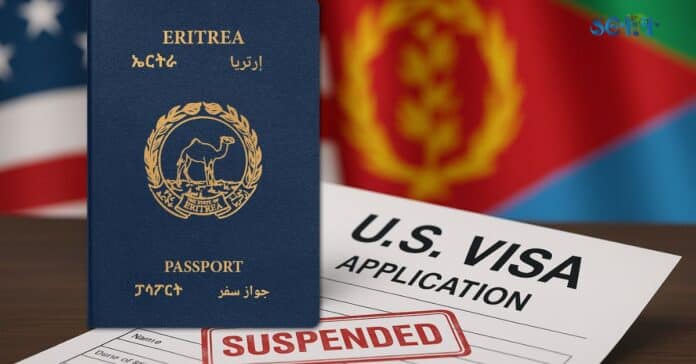
Eritrea has been swept into a sweeping U.S. immigration ban not for harboring terrorism or descending into internal chaos—but for its persistent refusal to engage with international norms, according to a new presidential proclamation issued by President Donald J. Trump on June 4.
The executive order fully suspends the entry of both immigrant and nonimmigrant Eritrean nationals into the United States. While several countries made the list due to internal conflicts or terrorist threats, Eritrea stands out for a different reason: its government’s systemic failure to share identity, security, and immigration-related data with the United States.
Not About Terror — About Transparency Unlike nations like Afghanistan, Yemen, or Libya, which were also banned due to active conflicts or extremist threats, Eritrea’s inclusion is rooted in bureaucratic and diplomatic non-compliance. U.S. authorities cited multiple areas of concern, including:
Questionable civil documentation: The central authority’s passport and identity systems lack credibility, making it difficult for U.S. officials to confirm the identity of Eritrean applicants.
Lack of criminal record sharing: Eritrea does not provide U.S. agencies access to criminal histories of its citizens.
Refusal to accept deportees: The Eritrean government has long refused to repatriate nationals who are ordered removed from the U.S.
Excessive visa overstays: Eritrea posted one of the highest overstay rates—over 55% among students and exchange visitors, and 20% for tourist and business travelers.
These issues place Eritrea in direct violation of international standards for cooperation on immigration enforcement, identity verification, and information sharing—cornerstones of U.S. national security and visa vetting policy.
Diplomatic Isolation Deepens The proclamation categorizes Eritrea alongside countries that are either unwilling or incapable of meeting U.S. vetting standards. However, countries like Turkmenistan and Sierra Leone, which showed some signs of cooperation, received only partial restrictions. Eritrea, by contrast, has made little effort to engage or reform.
This latest move deepens Eritrea’s growing diplomatic isolation and could significantly affect Eritrean-American families, students, and travelers, cutting off nearly all legal pathways into the U.S.
A Reversible Ban, If Cooperation Improves Despite the tough stance, the administration emphasized that the restrictions are conditional. Should Eritrea begin to share information, accept deported nationals, and improve identity management, the suspension could be lifted.
“This is not a punishment—it’s a security measure,” said the President in the proclamation. “The door remains open for countries willing to act in good faith.”
Conclusion Eritrea’s inclusion in the U.S. travel ban sends a clear message: diplomatic non-cooperation can carry the same consequences as security threats. In a global system that increasingly relies on transparency and shared standards, Eritrea’s insular policies have placed it on the outside looking in—not because of war, but because of willful disengagement.
In response to the Eritrean President Isaias Afwerki’s criticism of Abiy Ahmed’s Prosperity Party for hijacking Oromummaa for political purposes, some Oromo activists argued that Oromummaa has nothing to do with politics. They went on to explain that Oromummaa is about Oromo identity, culture, and heritage. This characterization of Oromummaa is correct. Yet, the argument that Oromummaa has not been abused by the Prosperity Party is flawed. Here is why.
Irreecha Celebration and the Claim to the Red Sea
Next to the Oromo Gadaa governance system, Irreecha is an important manifestation of Oromummaa. “It is a time of gratitude to Waaqa (the universal God) for the previous year’s blessings and a celebration of the end of winter and the beginning of spring (Birraa).” Yet, in recent years, Irreecha has become controversial. In a nutshell, it has become a venue where the Prosperity Party’s misguided and delusional war policies are unveiled.
When the President of the Oromo regional administration—and Prime Minister Abiy Ahmed’s confidant—Shameless Abdissa said, “Next year, the Oromo will celebrate Irreecha at the Red Sea,” no one asked how or why. Ethiopia is a landlocked country. The only way the Oromo could celebrate Irreecha at the Red Sea would be by invading and occupying land that belongs to a neighboring country—Eritrea. This is clear evidence that Irreecha, a central component of Oromummaa, has been hijacked for political purposes. Those who deny this are not telling the truth.
Irreecha Celebration and the Defeat of the Amhara
During a previous Irreecha celebration, the same individual, Shameless Abdissa, boasted about how he used a strategy of confusion and manipulation on the Amhara elite, declaring that the Oromo defeated the Amhara and took power in Ethiopia. These examples are only the tip of the iceberg. If such issues are being celebrated at Irreecha, can the event still retain its original meaning?
Ethnic-Based Governance and Its Dangers
It is common for political leaders who assume power in Ethiopia to use their ethnic group for political gain. Emperors Menelik and Haile Selassie used the Amhara as instruments to maintain their grip on power. The Tigray People’s Liberation Front did the same. Now, the Prosperity Party is following in the footsteps of previous Ethiopian governing elites. It is using Oromummaa to advance its disastrous war policies and to strengthen its hold on power.
Hidden behind such ethnic abuse for political gain is the inevitable consequence: retaliation and revenge after those regimes fall. When the Tigray People’s Liberation Front assumed power in 1991, the Amhara were treated as remnants of the Menelik, Haile Selassie, and Mengistu regimes, and they suffered as a result. Their code name was “Neftenya,” meaning armed settler. The tragic part is that those regimes never truly benefited the Amhara people.
Similarly, the 2020–2022 Tigray civil war and its consequences on the Tigrayan population reflect the dangers of mixing politics with ethnicity.
Conclusion
The speech delivered by the President of Eritrea, Isaias Afwerki, during the 34th Eritrean Independence Day celebration, is a wake-up call for the Oromo population. The message is clear: the Prosperity Party is abusing Oromummaa, and it is time for the Oromo people to protect their identity, culture, and heritage.
Oromo opposition elites can speak about the true meaning of Oromummaa, but if they do not protect it from the abuse perpetrated by the Prosperity Party, the original meaning of Oromummaa may no longer be applicable.
The Eritrean People’s Liberation Front—the current government of Eritrea—worked with influential Oromo figures for decades. Additionally, the prominent Eritrean scholar Professor Asmerom Legesse was the first to publish books on the Oromo Gadaa governance system. Likewise, the late Eritrean laureate Tesfaye Gebreab made immense contributions to the advancement of Oromo literature.
Therefore, for Oromo elites to think that the Eritrean President does not understand what Oromo and Oromummaa are is simply self-deception.
Victory to the Masses and Eternal Glory to Our Martyrs.
We are living in a transformative era in which the long-standing global order is giving way to a more complex structure defined by the emergence of multiple regional powers. The notion that the world had reached “the end of history,” as famously argued by Francis Fukuyama, has proven to be not only premature but fundamentally flawed. History has not ended; it has evolved. Societies, driven by diverse identities, aspirations, and power dynamics, continue to reshape global political landscapes. Nowhere is this more evident than in the Horn of Africa—a region marked by centuries of conflict, colonial legacies, and rich civilizational narratives.
Among the most consequential developments in this region is the slow but visible unraveling of Ethiopia’s national unity. After the fall of the Derg regime, the Ethiopian People’s Revolutionary Democratic Front (EPRDF) introduced a federal system based on ethnicity, aiming to empower Ethiopia’s diverse national groups—most notably the Amhara, Tigray (Tegaru), and Oromo. While this structure was intended to foster inclusion and autonomy, it inadvertently planted the seeds for future disintegration. By organizing the state as a federation of ethnically defined regions, the EPRDF set the stage for the rise of subnational identities that often viewed themselves as distinct political entities. Over time, these regions increasingly operated as states-in-waiting, not as components of a unified Ethiopian polity.
From Eritrea’s perspective, this ethnic federalism has always been a cause for concern. Eritrea’s identity is built upon a civic nationalism that transcends ethnic divisions—a unity forged through a protracted war for independence and solidified by a commitment to shared citizenship. The prospect of Ethiopia fragmenting into ethnic micro-states threatens this cohesion by reigniting historical rivalries and encouraging cross-border ethnic allegiances. Ethiopia’s disintegration would not remain a domestic issue; its effects would spill over into neighboring states, particularly Eritrea.
One of the most pressing dimensions of this threat is the growing demand for Tigrayan nationhood. In recent years, some Tegaru elites have increasingly called for full sovereignty. While their grievances—rooted in political marginalization and recent armed conflict—may be legitimate, the consequences of such a move extend far beyond Ethiopia’s borders. Eritreans must examine this issue critically, not out of hostility, but because of the profound implications it carries for Eritrea’s own stability.
Tigray has several elements that support a claim to nationhood: a common language, a cohesive cultural identity, and historical significance within the Ethiopian empire. However, there is a critical shortcoming in this national vision—the implicit dependence on the Tigrinya-speaking population of Eritrea. Many Tigrayan nationalists view the Tigrinya cultural and linguistic connection across the border as a potential unifying force for a broader Tigrinya nation. This is where the danger lies.
Eritrean Tigrinyas, despite cultural affinities with the Tegaru, have never defined themselves ethnically. Their national consciousness is firmly Eritrean, shaped by shared sacrifice, an inclusive identity, and decades of resistance against foreign domination. Eritrean Tigrinyas did not fight for an ethnic homeland—they fought for an Eritrean nation composed of many ethnicities and religions, united by citizenship and mutual respect. The idea that they would now abandon that national identity to join an ethnic union with Tigray is deeply flawed and dangerous.
This miscalculation by some Tigrayan elites reflects a misunderstanding of Eritrean society. Eritrean nationalism deliberately avoids the ethnicization of politics. Suggesting that one segment of the population would betray that consensus not only ignores the social fabric of Eritrea but also threatens to provoke division among its various ethnic groups. If the Tigrinya-speaking Eritreans are seen—even mistakenly—as aligning with Tigray, it could cause unrest among other Eritrean communities such as the Tigre, Afar, Saho, Bilen, and others, who might fear marginalization in a redefined national context.
Moreover, the danger is not limited to the Tigrinya question. Should other Ethiopian ethnic groups—like the Afar—pursue independence, they may also lay claim to their ethnic kin inside Eritrea. This would escalate tensions further and risk dragging Eritrea into ethnic disputes that it has spent decades working to avoid. Eritrea’s current national framework, rooted in civic rather than ethnic identity, would come under immense pressure.
Ethiopia’s disintegration could mark the beginning of a new and dangerous chapter in the Horn of Africa—one characterized by border disputes, contested identities, and endless political reconfigurations. For Eritrea, this could mean decades of macro-level crisis management, social destabilization, and even renewed conflict. What’s at stake is not just territorial integrity but the ideological foundation of the Eritrean state itself.
This is why Eritrea must approach the current situation with strategic clarity. It must not treat Ethiopia’s internal fragmentation as a distant issue or a manageable technical matter. It is a geopolitical emergency with direct consequences for Eritrea’s future. Eritrea must adopt a firm but balanced stance—supporting Ethiopia’s territorial unity while resolutely defending its own national cohesion.
Under no circumstances should Eritrea encourage or give credibility to secessionist movements in Ethiopia, particularly those that implicitly or explicitly seek to incorporate parts of Eritrea’s population. Doing so would not only compromise Eritrea’s sovereignty but also provide a dangerous precedent for ethnic irredentism in the region. Eritrea knows, more than any other country in the Horn, what it takes to become a nation. It must not allow that hard-earned wisdom to be undermined by speculative dreams of ethnic solidarity across borders.
Eritrea’s strategy should be twofold: diplomatically, it should act as a stabilizing force in the region, promoting dialogue and unity in Ethiopia while reinforcing international respect for its own borders. Internally, Eritrea must invest in strengthening its national institutions, promoting inclusive development, and reinforcing a unified national identity that resists ethnic division. The state should reaffirm that citizenship, not ethnicity, defines what it means to be Eritrean.
Eritrea has unfinished business at home—economic revitalization, political reform, and the empowerment of its youth. The last thing it needs is to be swept into a regional crisis that threatens to undo its revolutionary vision. The unraveling of Ethiopia, if allowed to continue unchecked, could become a regional earthquake. Eritrea must ensure that it is not standing at the epicenter when it hits.
In conclusion, the aspirations of Tigray or other ethnic regions for nationhood must be examined not only through the lens of justice and self-determination but also through the lens of regional security and mutual respect. Eritrea must be proactive, vigilant, and principled in its response—defending its identity, its sovereignty, and its vision of a united, inclusive, and stable nation in the midst of growing regional uncertainty.
The Tigray People’s Liberation Front (TPLF) has advanced a calculated narrative to portray Eritrea as a militarized, ethnically exclusive, and aggressive state. This effort aims to undermine Eritrea’s sovereignty, delegitimize its identity, and justify the TPLF’s own regional ambitions, including the creation of a Greater Tigray.
Since the 1990s, the TPLF has sought to reframe Eritrean nationalism as a derivative of Tigrigna culture, ignoring the country’s multi-ethnic foundation. Eritrea comprises nine recognized ethnic groups—including Afar, Bilen, Kunama, Saho, Tigre, Nara, Hidareb, and Rashaida—who contributed equally to the independence struggle. By emphasizing linguistic and cultural similarities between Tigray and Eritrean Tigrigna speakers, the TPLF argues for ethnic unity while downplaying Eritrea’s pluralistic identity. This narrative facilitates claims that Eritrean nationalism is artificial or externally imposed, setting the stage for interference under the pretext of ethnic solidarity.
Eritrea’s vision of economic self-reliance clashed with the TPLF’s goal of regional hegemony. After Eritrea introduced an independent currency and pursued port-based development, the TPLF seized Eritrean assets, imposed trade blockades, and restricted access to regional markets. Eritrea’s ambition to become the ‘Singapore of Africa’ was portrayed by the TPLF as destabilizing, when in fact it threatened Ethiopia’s monopolization of trade through Djibouti. These actions not only hindered Eritrea’s growth but framed self-reliance as a threat to peace.
Eritrea’s military orientation stems from a 30-year war for independence and a hostile regional environment. The 1998–2000 Eritrea-Ethiopia war resulted in over 100,000 deaths. In 2002, the Eritrea-Ethiopia Boundary Commission (EEBC) ruled that the disputed town of Badme belonged to Eritrea, but the TPLF-led government refused to comply. While Eritrea maintained a defense posture, the TPLF cast it as belligerent militarism. TPLF leaders, including Getachew Reda, admitted to encouraging the defection of Eritrean youth to drain the country’s human capital and weaken its army—a tactic that exploited refugee routes and international sympathy.
Following the Tigray conflict, the TPLF demanded that Eritreans admit guilt as a condition for dialogue. These demands serve to rewrite the record, casting Eritrea as the aggressor and ignoring Ethiopia’s long-standing occupation of Eritrean territory in defiance of international law. This tactic is not about reconciliation but about eroding Eritrean morale and sowing division. The weaponization of guilt aims to legitimize future political or territorial claims under the guise of justice.
The TPLF’s influence reached global institutions, distorting Eritrea’s image on the world stage. In 2009 and 2011, the UN Security Council adopted Resolutions 1907 and 2023, sanctioning Eritrea based on claims it supported Al-Shabab in Somalia. No credible evidence was ever produced. These sanctions crippled Eritrea’s economy and reinforced its international isolation. In 2018, UNSC Resolution 2444 lifted the sanctions, acknowledging they were politically motivated. This marked the first formal recognition of the injustice Eritrea had endured.
The TPLF’s victimhood narrative has been a powerful tool to distort Eritrean identity, stifle its development, and justify interference. Eritrean nationalism was not born out of hostility but from a multi-ethnic struggle for dignity, self-rule, and independence. In 1993, over 99% of Eritreans voted for independence, signaling a strong, shared national identity. The systematic attempt to portray Eritrea as a failed or hostile state is a projection of the TPLF’s own expansionist goals. To defend Eritrea’s future, it is essential to expose this narrative warfare, assert historical truth, and maintain unity in the face of political manipulation.
Editor’s Note:At Setit, we’re committed to amplifying important voices and narratives that deepen our understanding of Eritrea’s history and its lasting impact. The following article by Andargachew Tsege shines a spotlight on “An African People’s Quest for Freedom and Justice: A Political History of Eritrea 1941–1962” by Alemseged Tesfai.An African People’s Quest for Freedom and Justice: A Political History of Eritrea 1941–1962” by Alemseged Tesfai. This isn’t our work, but it’s a powerful reflection on a crucial era that continues to shape the present. We believe it’s a conversation worth having—and a book worth reading.
This is a meticulously researched political history, offering fresh interpretations of well-known facts alongside a wealth of new insights. Written with exceptional intellectual and academic integrity, it is a beautifully crafted book—engaging, accessible, and narrated with a gripping flow that draws the reader in.
When I began reading, I had initially contemplated writing a thorough review of this brilliant work. Unfortunately, due to time constraints that would force me to rush, I am convinced I would not do justice to either the book or the author. Thus, I have chosen instead to offer a heartfelt recommendation.
This is a book that deserves to be accessible to a wider audience. The privilege of reading it should not be confined to a select few within academic circles. Anyone with a genuine interest in understanding the history of Eritrea, Ethiopia, and the Horn of Africa between 1941 and 1962 must read this book. This period, the most consequential in Eritrean history, left tragic and lasting repercussions for the people of Eritrea, Ethiopia, and the region beyond. Indirectly, the book offers insight into the tragic state of affairs that persists in the Horn of Africa today. It reveals how the hidden, destructive hand of history, through the actions of the superpowers of the time and the shortsightedness of Ethiopian rulers, contributed to the collective misfortune of both Eritreans and Ethiopians.
Of course, like all works of history, absolute objectivity is impossible. The very act of selecting facts from a vast sea of information presents an inherent challenge to any historian. I do not believe Alemseged is entirely free from subjectivity, and from that angle, one might find grounds to critique aspects of his work.
Nevertheless, what is most remarkable is that Alemseged—himself a former freedom fighter in the Eritrean struggle for independence—has written a book untainted by emotional bias or propagandist narrative. There is not an ounce of propaganda or cadre-style rhetoric in this work. It is a book constructed with facts, logic, and reason.
It is worth noting that Alemseged Tesfai was already a well-educated intellectual, before joining the Eritrean People’s Liberation Front in 1975.
The book offers profound and multifaceted insights into the complex history of Eritrea, Ethiopia, and the global geopolitics of the time. Perhaps its most significant contribution is Alemseged’s research-based assertion of the primacy of Eritrean national identity before the United Nations decided to join Eritrea with Ethiopia through a strange federal arrangement —a reality denied by those who determined Eritrea’s destiny, contrary to the widely accepted views of many outsiders, including Ethiopian historians.
I am aware that the politically charged and toxic climate of our region often discourages open conversations about the truth. However, I believe that more than any other book I have read on the complicated history of Eritrea and Ethiopia, “An African People’s Quest for Freedom and Justice” is packed with truth.
As we all know, truth has the power to liberate us, and I am confident that reading this book will awaken those of us who have been living with our own biases and prejudices about that shared chapter of our history. Both Ethiopians and Eritreans are the intended beneficiaries of this book’s liberating message.
I had the privilege of attending the book launch held at the Eritrean Embassy in London, where I also had the opportunity to speak with the author. Alemseged Tesfai has planned a worldwide tour to promote his book across the globe. He will soon be travelling to the United States—keep an eye out for an event in your area. The book is now available on Amazon.
Rhetoric and Political Implications
In a recent address to the House of People’s Representatives, Prime Minister Abiy Ahmed declared that access to the sea is an “existential issue” for Ethiopia. This choice of language raises significant concerns about the government’s communication strategy and its broader political implications. Defining an economic necessity in such dramatic terms introduces ambiguity and contributes to a climate of uncertainty and tension in the region.
Historically, when a government frames a national interest as existential, it implicitly suggests that obstacles to achieving that interest may justify extraordinary measures—including military action or the application of political and economic pressure. Such rhetoric is risky; it reduces the prospects for diplomatic resolution and heightens suspicions among neighboring states. It also raises international concerns about the already fragile stability of the Horn of Africa.
A more balanced and cooperative rhetorical approach—centered on mutual economic benefits—could build trust between Ethiopia and Eritrea. It would also create space for constructive dialogue aimed at resolving the longstanding issue of access to the sea through pragmatic and sustainable means.
Diplomacy and the Case for Bilateral Cooperation
Recent history has shown that economic cooperation between Ethiopia and Eritrea is both possible and mutually beneficial when approached with pragmatism and respect. From 1991 to 1997, Ethiopia utilized Eritrean ports for international trade, successfully avoiding the logistical challenges associated with being landlocked.
By pursuing a more focused diplomatic strategy, Ethiopia could negotiate renewed agreements with Eritrea, supported by international maritime law. Instead of stressing a purported existential necessity, Ethiopian leaders would do well to seek practical, precedent-based solutions.
Lessons from Switzerland and Paraguay
Several landlocked nations have adopted successful models to ensure access to global markets. Switzerland and Paraguay, for example, have managed to maintain economic stability and robust international trade without resorting to antagonistic rhetoric.
Switzerland, despite being entirely surrounded by foreign territory, has built strong partnerships with neighboring countries. Through trade agreements and sophisticated transportation infrastructure—including railway networks and river ports on the Rhine—it has secured unimpeded access to international markets. This illustrates that well-planned logistics can offset the disadvantages of lacking direct access to the sea.
Likewise, Paraguay has negotiated agreements with Argentina and Brazil to access maritime ports along the Río de la Plata. These treaties have allowed Paraguay to maintain a competitive position in international trade and develop its economy peacefully and effectively.
Ethiopia and Eritrea, following a similar model grounded in mutual benefit, could pursue joint infrastructure projects and enhance regional security—strengthening their standing in the global economic system.
A Path Toward Stability and Sustainable Development
To ease current tensions and promote regional stability, it is essential for the Ethiopian government to move away from a narrative that may be perceived as a threat to Eritrean sovereignty. Whether explicit or implicit, militaristic rhetoric breeds mistrust and obstructs the path to diplomatic progress.
Rather than emphasizing the “existential” nature of sea access, Ethiopia should engage in structured dialogue with Eritrea and relevant international institutions. A productive framework could include transit and trade agreements governed by international treaties—ensuring economic cooperation, legal clarity, and peaceful development.
A future of shared peace and prosperity in the Horn of Africa depends on a foundation of transparent negotiations, mutual respect, and full recognition of national sovereignty. Avoiding unnecessary provocations is key to building lasting regional stability.
The Eritrean diaspora, leveraging its substantial potential, is urging the Eritrean government to implement the long-anticipated reforms necessary to create a favorable climate for investment in the nation. Over the past two decades, a significant number of dynamic, educated, and patriotic Eritreans have emigrated in search of improved opportunities, establishing communities across the globe.
The Eritrean diaspora plays a crucial role in bolstering the national economy through significant remittance flows to their families. However, it’s important to note the absence of official data from the Eritrean government, making it challenging to accurately quantify the remittance volumes sent from abroad. Estimates suggest these transfers may amount to millions of dollars and euros annually. Currently, the remittance framework in Eritrea lacks the infrastructure for investment; instead, these funds are predominantly consumed by the recipients. This trend can be attributed to the lack of observable initiatives and a conducive business environment that would encourage diaspora investors to engage in entrepreneurial ventures within Eritrea.
Statements from the president of Eritrea and various high-ranking officials indicate that the country is stable, with diminished security threats, and poised for direct foreign investment—an essential objective for the Eritrean populace. This affirmation aligns with the aspirations and ambitions of Eritreans abroad, who consistently advocate for the opening of investment avenues in their homeland. Such initiatives are projected to yield substantial economic benefits, enhance prosperity, generate employment for the youth facing unemployment, and ultimately mitigate emigration trends.
What Should the Government Do?
Establishing robust legal frameworks that provide clear guarantees and protections in the event of disputes with government entities is critical to effectively attracting and retaining both diaspora and foreign investors. In today’s global financial landscape, it is imperative for banks and financial institutions to undergo modernization to align with international standards, especially in terms of advanced communication and digital infrastructure. This modernization transcends being a mere optional enhancement; it is essential for competitiveness and operational efficiency in the current economy.
Moreover, essential infrastructure such as airports, seaports, and road networks requires comprehensive development, alongside a reliable electricity supply, to support economic activity. Investors will demand an ecosystem conducive to market vitality and healthy competition, characterized by minimal state intervention and regulatory frameworks that do not obstruct investment initiatives. Such an environment fosters investor confidence and drives sustainable economic growth.
In conclusion, the government has a significant opportunity to enhance its credibility by moving away from unfulfilled promises and focusing on meaningful institutional reforms and trust-building initiatives. By prioritizing these actions, we can create an environment that fosters business growth and attracts investment. These constructive efforts should initiate within the government and political party frameworks, as well as the relevant institutions, to lay a solid foundation for sustainable economic development.