In the aftermath of the Ethiopian civil war, which took place from November 2020 to November 2022, the term genocide has been frequently invoked, particularly in reference to Eritrea’s involvement alongside the Ethiopian federal government against the Tigray People’s Liberation Front (TPLF). Such claims, however, often appear disconnected from the international legal framework that governs the use of this word, turning a strictly defined legal category into an instrument of political and propagandistic struggle. It is essential, instead, to restore conceptual and legal precision to the term genocide, avoiding the propagation of narratives that, rather than fostering justice, hinder any prospect of reconciliation. Otherwise, the risk is to entrench permanent hostility between neighboring and historically intertwined peoples by distorting and instrumentalizing concepts that carry profound moral and legal weight.
What the Genocide Convention says
The term genocide has a clear and binding legal definition under the Convention on the Prevention and Punishment of the Crime of Genocide, adopted by the United Nations General Assembly on December 9, 1948. Article II of the Convention defines genocide as “any of the following acts committed with intent to destroy, in whole or in part, a national, ethnical, racial or religious group.” These acts include: killing members of the group, causing serious bodily or mental harm, deliberately inflicting conditions of life calculated to bring about the group’s physical destruction, imposing measures intended to prevent births, and forcibly transferring children. This definition relies on two constitutive elements: the actus reus (the physical act) and a specific mens rea, that is, the deliberate intent to destroy a group as such. This latter component — the “intent to destroy” — is what sets genocide apart from other serious violations of international law, such as war crimes or crimes against humanity.
Genocide, crimes against humanity, and war crimes: crucial distinctions
In civil wars and internal armed conflicts, crimes are unfortunately common. However, referring indiscriminately to genocide whenever massacres or systematic violence occur obscures the essential distinctions between different categories of international crimes. War crimes are serious violations of the Geneva Conventions or international humanitarian law and include attacks against civilians, indiscriminate destruction, torture, and sexual violence. Crimes against humanity, as defined by the Rome Statute of the International Criminal Court, are acts committed as part of a widespread or systematic attack against a civilian population — such as persecution, deportation, and extermination — but do not necessarily involve an intent to destroy an entire group. Only genocide presupposes such an intent. The confusion or conflation of these concepts is often driven by political agendas rather than grounded legal evaluations. And yet, only competent authorities — such as the International Criminal Court or, in inter-state disputes, the International Court of Justice — can determine the existence of genocide through investigations, evidence gathering, witness testimony, and analysis of official orders and documents.
The need for caution and the danger of misuse
Nearly three years after the end of the conflict between the Ethiopian federal government and the TPLF, no formal investigation has been launched by the International Criminal Court, nor has any pronouncement been made by the International Court of Justice regarding the legal qualification of the crimes committed as genocide. Despite this, the term continues to be employed generically and accusatorily by political and intellectual actors, sometimes explicitly to prevent any dialogue between the people of Tigray and Eritrea. However, the political use of the word genocide risks causing long-term damage: it fuels a one-sided traumatic memory, entrenches intercommunal division, and makes any prospect of peace nearly impossible. International justice demands time, rigor, and impartiality. It is necessary to acknowledge the gravity of the crimes committed, pursue truth and accountability, but also avoid an inflated and improper use of legal terms that ultimately delegitimizes the justice process itself. In a post-conflict context, words must be chosen carefully — not to deny suffering, but to honor it with the precision it deserves.
Bibliography
1. United Nations. Convention on the Prevention and Punishment of the Crime of Genocide. Adopted December 9, 1948. https://www.un.org/en/genocideprevention/documents/atrocity-crimes/Doc.1_Convention%20on%20the%20Prevention%20and%20Punishment%20of%20the%20Crime%20of%20Genocide.pdf
2. Schabas, William A. Genocide in International Law: The Crime of Crimes. Cambridge: Cambridge University Press, 2009.
3. Power, Samantha. A Problem from Hell: America and the Age of Genocide. New York: Basic Books, 2002.
4. Straus, Scott. Fundamentals of Genocide and Mass Atrocity Prevention. Washington, DC: United States Holocaust Memorial Museum, 2016.
5. Chalk, Frank, and Kurt Jonassohn. The History and Sociology of Genocide: Analyses and Case Studies. New Haven: Yale University Press, 1990.
6. Totten, Samuel, William S. Parsons, and Israel W. Charny, eds. Century of Genocide: Critical Essays and Eyewitness Accounts. New York: Routledge, 2012.
7. International Criminal Court. Rome Statute of the International Criminal Court. The Hague: ICC, 1998. https://www.icc-cpi.int/sites/default/files/RS-Eng.pdf
Abstract Oromummaa—the concept of “Oromo-ness”— has emerged as a foundational ideology for contemporary Oromo political, cultural, and national identity. While the term is a recent linguistic innovation, its conceptual roots are deeply embedded in traditional Oromo institutions, particularly the Gadaa system, Safuu (moral order), and oral literature. This article examines the historical development, political articulation, and regional implications of Oromummaa. It traces its evolution from pre-colonial cultural frameworks through its ideological formalization by diaspora intellectuals, notably Asafa Jalata, and its central role in modern Oromo nationalist movements such as the Oromo Liberation Front (OLF) and the Qeerroo youth movement. In the diaspora, Oromummaa functions as both a cultural anchor and a political tool, reinforcing identity while enabling transnational activism. The article also addresses the contentious role of Oromummaa within Ethiopia’s ethnic federalism, where competing nationalisms and territorial claims have led to interethnic friction, especially with Amhara, Somali, and Afar groups. Additionally, it considers the geopolitical concerns raised by Eritrea and other regional actors in response to perceived Oromo ascendancy.
Through a strategic forecasting framework (2025-2030), the study outlines three potential trajectories for Oromummaa: civic reform, ethnic polarization, and state fragmentation. The findings highlight the importance of cultivating inclusive and pluralistic interpretations of Oromo identity to ensure stability in Ethiopia and the Horn of Africa.
Keywords: Oromummaa, Oromo nationalism, ethnic federalism, diaspora politics, Ethiopia, Horn of Africa, Gadaa system
Introduction
The emergence of Oromummaa as both a cultural identity and political ideology marks a significant transformation in the historical trajectory of Oromo self-definition. Within the framework of Ethiopia’s ethnically based federal system, Oromummaa has come to represent not only a reclamation of suppressed identity but also a framework for political mobilization and resistance. This paper explores the conceptual evolution of Oromummaa, its roots in Oromo traditions, its modern articulation by intellectuals and activists, and its geopolitical implications in a rapidly changing Horn of Africa.
Etymology and Conceptual Foundations
The term Oromummaa combines “Oromo” with the suffix -ummaa, meaning “-ness” or “state of being” in Afaan Oromo (Jalata, 2008). While the term itself gained currency in the late twentieth century, the concept it expresses— Oromo identity, culture, values, and worldview— has a much older lineage. It draws heavily from traditional institutions such as the Gadaa system, a cyclical and age-graded system of governance, and Safuu, the Oromo code of ethical conduct and social responsibility (Hassen, 1990; Buicha, 2011).
These cultural frameworks have historically governed community relations, leadership transitions, justice systems, and spiritual life. Oromummaa, therefore, is not an invention of modern nationalism but a revival and rearticulation of pre-existing identity structures through a contemporary lens (Jalata, 2007).
Historical Origins and Ideological Development
Pre-Colonial and Traditional Foundations
Oromo identity was historically anchored in systems of communal life, ritual leadership, and oral tradition. The Gadaa system, as a form of indigenous democracy, institutionalized leadership, military organization, and jurisprudence. Its cyclical transfer of power every eight years reinforced egalitarianism and collective responsibility (Hassen, 1990). Similarly, Safuu emphasized respect for life, elders, nature, and cosmic balance. Together, these formed the ethical and political foundation upon which later articulations of Oromummaa would build (Bulcha, 201 1).
Resistance under Imperial Rule
The late nineteenth century brought violent integration of Oromo regions into the Abyssinian empire under Menelik ll. The conquest resulted in mass land dispossession, forced assimilation, and marginalization of Oromo language and culture (Jalata, 2007). This colonial encounter catalyzed Oromo political consciousness, though it remained fragmented along regional and clan lines. By the early 20th century, oral narratives and folklore began to encode themes of resistance and communal identity that foreshadowed the later rise of Oromummaa.
The Political Articulation of Oromummaa
Oromo Liberation Front and Early Ideologues
The formation of the Oromo Liberation Front (OLF) in 1973 marked a critical institutionalization of Oromo nationalist ideology. Leaders such as Baro Tumsa, often credited with the slogan “Oromo first} emphasized a unified national identity that transcended internal divisions (Jalata, 2008). The OLF positioned the Oromo struggle as one of anti-colonial liberation rather than mere political dissent. While the term Oromummaa was not yet widely used, its ideological tenets— self-determination, cultural autonomy, and historical restoration—were being developed.
The Role of Asafa-Jalata
Sociologist Asafa Jalata played a seminal role in naming, theorizing, and disseminating Oromummaa as a master ideology. His 2007 book Oromummaa: Oromo Culture, Identity and Nationalism compiled speeches and essays that defined Oromummaa as a civilizational and political project rooted in indigenous Oromo values. In a subsequent 2008 article, Jalata described Oromummaa as the ideological core of the Oromo national movement, linking it to democratic values, social justice, and resistance against internal colonization (Jalata, 2008).
Oromummaa in Contemporary Oromo Politics
Identity Consolidation
Oromummaa serves as a unifying principle across Oromo communities divided by religion, dialect, or geography. It facilitates a pan-Oromo identity that centers collective memory and cultural continuity over sectarian or regional loyalties. This has been crucial in building solidarity across diverse constituencies within the Oromo nation (Bulcha, 201 1).
Political Mobilization and Protests
Movements such as Qeerroo—the youth-led mobilization that galvanized the 2014-2018 protests—used Oromummaa as both rallying cry and ideological framework. These protests,
triggered by land dispossession and political exclusion, led to significant shifts in Ethiopian politics, including the resignation of Prime Minister Hailemariam Desalegn and the rise of Abiy Ahmed (Jalata, 2014). While hailed as victories, these shifts have also sparked renewed debates over the meaning and limits of Oromummaa as a political force.
Cultural Renaissance
Oromummaa has catalyzed a cultural revival in music, education, and historical narrative. Artists like Hachalu Hundessa used music to articulate Oromo pride and resistance. The increased use of Afaan Oromo in media and education, the revalorization of Oromo heroes, and the celebration of traditional attire and festivals all reflect a growing confidence in Oromo cultural self-expression (Bulcha, 201 1).
Oromummaa in the Diaspora
Identity Formation and Cultural Transmission For second-generation Oromos in diaspora communities such as Minneapolis, Toronto, and Melbourne, Oromummaa provides an emotional and ideological bridge to ancestral heritage. Language schools, cultural centers, and Oromo led religious institutions help transmit values rooted in Oromummaa (Jalata, 2014).
Political Engagement and Transnational Advocacy
Diaspora Oromo communities have played a pivotal role in internationalizing the Oromo struggle. Hashtags like #0romoProtests and #JusticeForHachalu have brought global attention to local Ethiopian issues. Diaspora-led organizations such as the Oromo Studies Association (OSA) have produced a substantial body of academic work legitimizing the Oromo narrative and advocating for justice, equality, and federal reform (Jalata, 2008; Bulcha, 2011).
Regional Friction and Geopolitical Implications
Interethnic Tensions in Ethiopia
While Oromummaa is framed by its advocates as inclusive and democratic, it is perceived by some groups—especially Amhara, Somali, and Afar elites—as exclusionary or expansionist.
Territorial disputes in areas like Addis Ababa
(Finfinne) and the borderlands with Somali and Afar regions have occasionally escalated into violent confrontations. These frictions are exacerbated by Ethiopia’s ethnic federalism, which institutionalized ethnic identity as the basis for political power (Tronvoll, 2000).
The Eritrean Factor
Eritrea, under the leadership of president Isaias Afwerki, remains skeptical of both Ethiopia’s ethnic federalism and the rising influence of Oromo nationalism. While outright conflict between Eritrea and Oromia-led Ethiopia remains unlikely in the short term, scenarios involving state collapse, Oromo-led autonomy, or pan-Cushitic mobilization could trigger preemptive Eritrean action. Eritrea may also
support rival factions to curb Oromo ascendancy and maintain strategic balance in the Horn (Keller, 1995).
Strategic Outlook: Scenarios for 2025-2030
A strategic forecast identifies three plausible trajectories for Oromummaa:
Civic Nationalism: Oromummaa evolves into a multicultural, civic framework. Ethiopia undergoes peaceful reform. Eritrea remains neutral.
Cold Ethnic Competition: Oromummaa remains strong but contested. Political fragmentation occurs. Eritrea backs opposition groups.
State Fragmentation and Conflict: Oromummaa radicalizes. Oromia asserts autonomy. Civil conflict and foreign intervention follow.
The determining variable will be whether Oromummaa is institutionalized as an inclusive civic identity or leveraged as an exclusive nationalist tool.
9. Conclusion
Oromummaa encapsulates the historical, cultural, and political aspirations of the Oromo people. It is both a revivalist movement rooted in indigenous knowledge and a contemporary political project navigating Ethiopia’s contested statehood. Its potential lies in its ability to unify across differences and offer a democratic vision of federalism. Yet its risks stem from exclusivism, radicalization, or misinterpretation by rival groups and external actors. The future of Oromummaa—and by extension, Ethiopia— depends on the delicate balance between cultural pride and inclusive governance.
References
Bulcha, M. (201 1). Contested narratives and the quest for identity: The Oromo in contemporary Ethiopia. Addis Ababa: Shama Books.
Hassen, M. (1990). The Oromo of Ethiopia: A history 1 570-1860. Cambridge University Press.
Jalata, A. (2007). Oromummaa: Oromo culture, identity and nationalism. Atlanta, GA: Oromia Publishing.
Jalata, A. (2008). Oromummaa as the master ideology of the Oromo national movement. Journal of Oromo Studies, 1 5(2), 1 -30.
Jalata, A. (2014). Promoting and developing Oromummaa: The core element of the Oromo struggle. Journal of Oromo Studies, 21 (1 & 2), 1 -22.
Keller, E. J. (1995). Understanding conflict in the Horn of Africa. In M. Ayoob (Ed.), Regional conflict in the Horn of Africa (pp. 23-54). Lynne Rienner Publishers.
Tronvoll, K. (2000). Ethiopian identity and the politics of power: A study of the struggle between Oromo nationalism and the Ethiopian state. Brill.
Note: I dedicate this article to the memory of the late Sisai Ibssa, a towering Oromo intellectual and a champion of his people’s quest for recognition and justice, who, along with his surviving wife, Bonnie K. Holcomb, wrote Invention of Ethiopia: The Making of a Dependent Colonial State in Northeast Africa.
May his spirit guide Eritrean and Oromo intellectuals and inspire the deep-rooted cooperative work cultivated from the 1970s to the the very recent.
In a recent address commemorating Eritrea’s Independence Day, President Isaias Afewerki articulated accusations against the Ethiopian government, alleging that it is acting on behalf of foreign interests to undermine local initiatives aimed at fostering peace and development in the region. Numerous analysts and regional specialists speculate that these claims are primarily directed at the United Arab Emirates, identified as a key player in the destabilization of both Sudan and Somalia. This raises a critical inquiry: What are the strategic motivations behind the UAE’s apparent desire to weaken the political and economic stability of both Eritrea and Sudan?
Geopolitical Influence
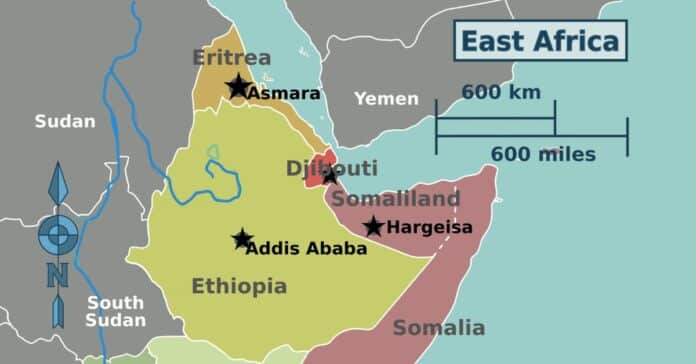
The United Arab Emirates (UAE) is actively competing with regional powers, including Qatar, Turkey, Saudi Arabia, and, to a lesser degree, Egypt, to enhance its influence in the Middle East and the Horn of Africa. The UAE’s support for various factions, such as those in Sudan, is a strategic move to shape political leadership that aligns with its objectives. Furthermore, the UAE’s substantial investment in the port of Berbera in Somaliland clearly indicates its intent to engage unilaterally with factions or secessionist movements that challenge the central government of Somalia, which maintains alliances with both Turkey and Qatar.
During the conflict in Yemen, the United Arab Emirates leveraged its geographic proximity to Eritrea, utilizing the port of Assab as a military base to conduct airstrikes against Houthi rebels. Furthermore, there are indications that this base was also employed in operations against Tigrayan forces during the Ethiopian conflict. However, the post-cessation of hostilities agreements have led to a notable cooling of relations between Eritrea and the UAE. The Eritrean government has expressed dissatisfaction with the UAE’s involvement in destabilizing Sudan through direct military and financial support to various rebel factions.
The UAE exerts significant influence in the Horn of Africa, notably shaping the dynamics of various crises and political settlements orchestrated by both international and regional actors. A pertinent instance was the conference convened on January 14, 2025, alongside the African Union summit in Addis Ababa. The event, convened by the UAE, sought to tackle the urgent humanitarian crisis in Sudan. While the initiatives did not fulfill their specified objectives, they underscore the UAE’s strategic involvement in interfering with and aggravating the socio-political complexities of the region.
Economic Interests
The United Arab Emirates (UAE) has established itself as a significant commercial hub, strategically positioned between Europe, Asia, and parts of Africa, bolstered by its free trade zones and advanced logistics services. However, the geographic proximity of Eritrea and Sudan along the Red Sea corridor presents a potential competitive challenge to the ports of Dubai and Abu Dhabi. Should Eritrea, for instance, develop its Red Sea ports and surrounding islands to attract foreign investment, it could significantly reduce shipping distances—potentially by several hundred, if not thousands, of kilometers—thereby lowering operational costs and enhancing profitability for producers and consumers.
The UAE harbors concerns that a cooperative relationship between Eritrea and Sudan could stabilize the Red Sea region, subsequently drawing foreign investment into port development and logistics hubs. As a countermeasure, the UAE appears to be actively involved in undermining the stability of these nations, potentially by providing support to local militias and rebel groups or by assisting nations like Ethiopia and Kenya financially, enabling them to meet obligations to international financial institutions such as the IMF and World Bank. These nations effectively become arenas for the UAE’s strategic interests.
Moreover, the UAE is investing substantially in countries like Ethiopia, acquiring land, stakes in state-owned enterprises, and funding government initiatives. These activities are likely intended to influence domestic policies and ensure alignment with UAE interests in the region.
Numerous international organizations have strongly criticized the United Arab Emirates for its complicity in the illicit appropriation of Sudan’s gold resources through illegal mining operations. Additionally, the UAE’s direct involvement in the Sudanese civil conflict, particularly through support for rebel factions in Darfur, has drawn allegations of facilitating atrocities and war crimes against the local population.
Conclusion
The United Arab Emirates (UAE) is pursuing a strategy to safeguard its sovereign interests by fostering discord among neighboring countries. This erodes trust and obstructs opportunities for cooperation and regional collaboration. This divide-and-rule tactic appears to be effective in the short term; however, local populations are increasingly vocal in denouncing the Emirates’ destabilizing policies. In the long run, such disingenuous strategies will likely backfire, positioning the UAE as the ultimate loser in the regional geopolitical landscape.
As Ethiopia renews its controversial campaign for sovereign access to the Red Sea, Eritreans and observers of the Horn of Africa are once again compelled to revisit enduring injustices that continue to shape the region. Closer examination reveals that this campaign is not merely about trade corridors or development. It is a manifestation of a deeper, unresolved issue: the failure to confront and account for Ethiopia’s illegal annexation and prolonged military occupation of Eritrea.
A Forgotten Crime Against Decolonisation
In 1962, Ethiopia unilaterally dissolved the United Nations–sponsored federal arrangement established in 1950 and annexed Eritrea in violation of international law. This act extinguished Eritrea’s nascent autonomy and began a brutal occupation, in stark contrast to the spirit of the post–World War II decolonisation movement. While many African territories gained independence, Eritrea was denied its most basic right: self-determination.
Two forces enabled this injustice:
• Geostrategic Interests of the United States: In the Cold War context, the U.S. prioritised strategic control over the southern Red Sea. Eritrea’s location and its military and intelligence installations—including the future Kagnew Station—were deemed too valuable to risk falling into non-aligned hands. Supporting Haile Selassie’s Ethiopia, Washington subordinated Eritrean aspirations to global power politics.
• Ethiopian Expansionism: For Ethiopia’s rulers, annexing Eritrea fulfilled a long-standing ambition to transform a landlocked empire into a coastal power. Cloaked in rhetoric about national unity, the annexation disregarded international norms and the will of the Eritrean people. It triggered a thirty-year war of liberation—one of Africa’s longest and most bitter anti-colonial struggles.
A War Without Accountability
During Eritrea’s long war for independence, civilians suffered immense atrocities. Entire villages were razed. Napalm and cluster bombs devastated communities. Haile Selassie’s scorched-earth policies in the 1960s caused mass displacement, forcing tens of thousands into refugee camps in eastern Sudan—many of which still exist today. The Derg regime continued the repression with campaigns marked by massacres and forced relocations.
Several atrocities exemplify this brutal legacy:
• Um Hajer Massacre – 14 December 1974: Ethiopian troops attacked the town of Um Hajer in western Eritrea, killing scores of civilians, including women and children.
• Ona Massacre – 14 December 1974: On the same day, Ethiopian forces surrounded the village of Ona near Keren and massacred over 625 civilians, many of whom were burned alive.
• Weki Duba (Woki Duba) Massacre – 2 February 1975: Between 80 and 103 civilians seeking refuge in a church were summarily executed by Ethiopian troops.
• Agordat Massacre – 9 March 1975: Following attacks by the Eritrean Liberation Front (ELF), Ethiopian forces retaliated by killing 208 residents of Agordat.
• She’eb Massacre – May 1988: Ethiopian forces killed nearly 500 civilians in She’eb, including 299 who were crushed under advancing tanks while attempting to flee.
These were not collateral damages—they were systematic violations of humanitarian law and war crimes.
After independence in 1991, Eritrea made a principled choice. It did not demand reparations or tribunals but prioritised peace, regional cooperation, and good neighbourliness. Hoping to inaugurate a new era of mutual respect and stability in the Horn, it rejected cycles of revenge that had long defined the region.
The Consequences of Forgoing Justice
Eritrea’s decision to forgo accountability came with risks. It assumed that diplomacy could replace retribution. Yet this moral restraint may have enabled successive Ethiopian regimes—and the international community—to evade responsibility. What should have been recognised as a historical crime came to be viewed as a political miscalculation.
Revisionist narratives have since resurfaced. Ethiopian officials and commentators now frame access to Eritrean ports as a correction of historical injustice. This entitlement—claiming Eritrea’s ports as unfairly withheld—echoes the imperial logic behind the original annexation.
This narrative extends beyond Eritrea. Ethiopia has challenged Djibouti’s sovereignty by falsely claiming colonial-era lease agreements. It has also signed a controversial MoU with Somaliland, undermining Somalia’s territorial integrity and violating the African Union’s founding principles.
A Dangerous Misreading of Eritrea’s Restraint
Eritrea’s post-independence restraint was never an admission of weakness—it was a strategic, moral stance. Yet, rather than deter aggression, it has emboldened expansionist elements in Ethiopia. Some now view Eritrea’s sovereignty as negotiable.
This misreading has normalised destabilising ideas about natural borders and historical rights. Such notions threaten not only Eritrea but the entire Horn. They undermine uti possidetis juris, the principle that colonial borders must be preserved to avoid conflict and ensure stability.
The Path to Lasting Peace
Peace in the Horn of Africa cannot rest on silence or selective memory. It requires truth, recognition, and mutual respect. Acknowledging Ethiopia’s illegal annexation and the human cost is not about reopening wounds—it is about laying a foundation for genuine reconciliation.
The question is not whether Ethiopia should seek maritime access. It is whether the international community will allow that pursuit to be framed through entitlement rather than lawful diplomacy.
Eritrea, like all African nations forged through anti-colonial struggle, has earned its sovereignty. It is not a bargaining chip. It is a legal, historical, and moral fact.
The world must respect it—and Ethiopia must accept it.
In a recent letter to the UN Secretary-General and several member states, the Ethiopian Ministry of Foreign Affairs accused Eritrea of “continued provocations” and alleged attempts to invade its territory. These claims are unsubstantiated and sharply contradicted by Ethiopia’s own conduct over the past two years.
Under Prime Minister Abiy Ahmed, Ethiopia has pursued an increasingly aggressive and revisionist regional agenda. This includes direct challenges to Eritrea’s sovereignty, the signing of a controversial Memorandum of Understanding (MoU) with Somaliland (a territory internationally recognised as part of Somalia), and repeated statements undermining the legitimacy of colonial-era borders that underpin the African state system.
A Pattern of Escalation and Revisionism
Top Ethiopian officials, including Prime Minister Abiy, have argued that Ethiopia was “unfairly deprived” of a seaport. These assertions, steeped in vague historical grievances, imply that Eritrea’s control over its ports, particularly Assab, is somehow illegitimate. In one of the most alarming statements, Abiy declared that Ethiopia would pursue Red Sea access “peacefully if possible, but by any means necessary if not.”
This rhetoric, cloaked in grievance but suggestive of coercion, has been widely interpreted as a threat not only to Eritrea but to the stability of the entire region. It signals a willingness to abandon diplomacy in favor of force.
The MoU with Somaliland, signed in January 2024, marked a particularly provocative step. By attempting to secure naval access through a region that remains unrecognised as sovereign by the international community, Ethiopia directly challenged AU principles and inflamed one of Africa’s most sensitive sovereignty disputes. The AU, UN, and most member states continue to uphold Somalia’s territorial integrity and have condemned the move as a breach of international norms.
Disregard for Colonial Borders
Ethiopia’s current trajectory reflects a consistent refusal to respect the sanctity of colonial borders, a foundational principle of post-independence African statehood. The AU’s adoption of uti possidetis juris was designed precisely to preserve stability by affirming colonial borders as the legal basis for modern states.
Eritrea’s internationally recognised boundaries were established during Italian colonisation and reaffirmed by a UN-supervised referendum in 1993. Undermining these borders risks eroding the legal framework that has supported continental peace since decolonisation.
Regional Tensions and Diplomatic Fallout
Ethiopia’s assertive stance has provoked a regional backlash. Djibouti’s President Ismaïl Omar Guelleh responded forcefully, declaring, “Djibouti is not Crimea,” a pointed reference to Russia’s illegal annexation of Ukrainian territory. Somalia reacted with equal vigour, recalling its ambassador and rallying international support to counter Ethiopia’s Somaliland MoU.
Ethiopia’s increasingly unilateral behaviour has left it diplomatically isolated at a time when regional cooperation is urgently needed. Rather than acting as a stabilising force, Ethiopia now finds itself viewed with growing caution by its neighbours and traditional allies alike.
Eritrea’s Measured Response
Despite repeated provocations, Eritrea has responded with restraint. It has defended its sovereignty without issuing threats or resorting to inflammatory rhetoric. Ethiopia’s portrayal of Eritrea as the aggressor in this context is a distortion of the facts.
If any states in the Horn of Africa have grounds to petition the UN Secretary-General, it is Eritrea and its coastal neighbours. These are the nations whose sovereignty is under rhetorical and strategic threat, not Ethiopia.
Legal and Historical Clarity
Ethiopia’s campaign hinges on a misreading of history. Its former access to the sea was via federation with Eritrea (1952–1962) and annexation (1962–1991), not lawful entitlement. Eritrea’s independence, won through decades of armed struggle and affirmed by a nearly unanimous referendum, resolved the question of sovereignty.
To redraw borders based on perceived historical injustices would unravel the fragile post-colonial consensus that has sustained African unity. That consensus, anchored in the AU’s foundational principles, seeks to avoid the proliferation of territorial disputes that would arise from reopening old claims.
A Contradictory Government Message
Adding to the confusion is the inconsistency within the Ethiopian government’s own statements. Just recently, the very same Minister of Foreign Affairs who sent the letter to the UN appeared before the Ethiopian Parliament and declared that Ethiopia is not in a “war of words” with Eritrea. He further suggested that the views expressed by certain current and former officials, including senior military leaders, do not reflect the government’s official stance.
This claim is difficult to reconcile with the repeated statements by the Prime Minister, the Chief of Staff, and the Defence Minister. These are not marginal figures but the central architects of Ethiopian policy. The contradiction reflects not only a breakdown in messaging but a broader strategic confusion.
A Question for the Global Community
The international community must now decide: will it allow one country to challenge the integrity of Africa’s state system under the guise of economic necessity? Ethiopia’s rhetoric and behaviour demand scrutiny. If global norms around sovereignty and peaceful coexistence are to mean anything, Ethiopia must be held to account.
Conclusion
Ethiopia’s accusations against Eritrea—vague claims of border incidents and military provocations—lack credibility when set against its own pattern of destabilising behaviour. From the Somaliland MoU to threats of force, from challenging colonial borders to regional isolation, the trend is unmistakable.
The Horn of Africa deserves stability built on lawful conduct, not revisionist ambition. The rules of sovereignty cannot be rewritten through coercion, no matter how powerful the claimant or how deep its historical grievances.
In recent weeks, something unexpected has begun to take root along the border areas between Eritrea and Ethiopia’s Tigray region. Two activists, one Eritrean, the other Tigrayan, have launched an informal initiative based on a simple yet powerful belief: peace between the two peoples should not have to wait for formal diplomacy or the slow pace of institutional politics. They named the project Engagement to emphasize the idea of direct, grassroots, spontaneous involvement.
From their personal dialogue, the initiative quickly expanded, reaching villages, border communities, and families divided by conflict. In some cases, public celebrations, peaceful gatherings, and small community events have already taken place, testifying to a shared desire to turn the page. In a region where every gesture can arouse suspicion, these images—smiling faces, extended hands, dancing and singing—carry profound symbolic weight. They speak of an alternative: a change that emerges from the margins and seeks to reconnect peoples long divided by war and unhealed wounds.
Mutual Wounds and Diverging Memories
To grasp the significance of this effort, one must consider it within the context of recent history. Eritrea took part in the Ethiopian civil war of 2020 to 2022, intervening at the invitation of the federal government in Addis Ababa against the Tigrayan forces. This involvement left behind a painful legacy: episodes of violence and substantial civilian and material damage. But Eritrea, too, bears a memory of suffering. During the war with Ethiopia over territorial disputes between 1998 and 2000, it endured serious losses, both human and infrastructural, which were never properly acknowledged or compensated.
These two memories do not cancel each other out; they overlap, feeding distrust, resentment, and reciprocal suspicion. This is precisely why the gesture made by the two activists and the local communities assumes such particular significance. It is not about erasing the past but confronting it without rhetoric, attempting to build a shared memory. During the recent celebrations, undoubtedly moving and sincere, a recurring message was emphasized: the idea that peace is possible because the two peoples speak the same language, share the same religion, customs, and traditions. While this cultural proximity is real and may ease the path to dialogue, it also risks reinforcing a perception that excludes parts of Eritrea that do not share those specific identities.
Eritrea is, in fact, a nation marked by remarkable diversity. Its internal cohesion and relative stability, even in the face of adversity, have long relied on the coexistence of various ethnic, linguistic, and religious groups. Christians and Muslims, highlanders and lowlanders, different cultural traditions have found ways to live side by side. The strength of the Eritrean social fabric lies not in uniformity, but in the capacity to hold together difference. This is why true peace cannot be reduced to shared origins or cultural familiarity. Peace is valuable in itself, regardless of whether people look, pray, or speak alike.
And yet, important questions remain: Are these wounds truly ready to heal? Is it possible to overcome trauma without restorative justice, or is there a risk that reconciliation will be perceived as forgetfulness?
Implicit Strategies and Political Ambiguities
It cannot be overlooked that this informal initiative also raises questions of a political nature. Although there has been no official statement, it seems likely that there is implicit consent, if not quiet support, from the Eritrean side to allow such dynamics to unfold. In the absence of direct dialogue with the Ethiopian federal government, the rapprochement between border communities might serve as a strategic buffer zone, a way to ease tensions without entering formal negotiations.
But this opens up delicate issues. Where is the line between genuine grassroots spontaneity and top-down instrumentalization? Who ensures that these informal channels will not be co-opted for political purposes? And how far can local communities take a peace process if institutional structures remain absent? Can this path truly lead to something lasting, or will it remain confined to the goodwill of a few? These are essential questions because they concern the viability of the initiative itself: if change lacks political grounding, it risks dissolving as soon as conditions shift.
A Fragile but Necessary Hope
And yet, despite the uncertainties and risks, the Engagement initiative stands as a signal that cannot be ignored. The region’s recent history is littered with missed opportunities, failed peace processes, and broken promises. If this attempt, too, ends in failure, it would represent perhaps the third or even fourth historic fracture in the last thirty years. And each fracture, as the history of interethnic and cross-border relations shows us, leaves behind not only rubble but also deepening disillusionment.
This is why, despite all necessary caution, it is worth believing in this beginning. Peace between the two peoples never arrives all at once: it is made of small gestures, rediscovered words, and faces learning once again to recognize each other. As Nelson Mandela once said, “If you want to make peace with your enemy, you have to work with your enemy. Then he becomes your partner.” This may well be the spirit that animates the communities now involved: not a naive desire to forget, but a concrete will to coexist, to look ahead, to ensure that pain does not become permanent.
In a world that too often repeats its mistakes rather than learning from its silences, what emerges from below, from the margins, from the cracks left by war, deserves to be heard. Engagement is not yet peace, but it is its breath. And in certain corners of the world, where for too long only the language of force has been spoken, even a whisper calling for recognition may carry the weight of a true beginning.
In recent months, Ethiopia’s leadership has escalated its rhetoric regarding access to a seaport—framing the issue not merely as a matter of trade or development, but as a strategic entitlement. In a widely viewed televised interview, Prime Minister Abiy Ahmed expressed “regret” over what he described as Ethiopia’s “loss” of access to the sea. This narrative, now embedded in the government’s messaging, is not only misleading—it is perilous. It distorts historical facts, disregards international law, and risks undermining stability in the already volatile Horn of Africa.
A Manufactured Narrative
Ethiopia has never legally possessed a seaport. Its only direct access to the Red Sea occurred between 1952 and 1962, during a United Nations-brokered federation with Eritrea. That arrangement—established by UN General Assembly Resolution 390 A(V) in December 1950—was intended to respect Eritrea’s internal autonomy while granting Ethiopia access to the coast for maritime trade. However, in 1962, Emperor Haile Selassie unilaterally dissolved the federation and annexed Eritrea—an act widely condemned as a violation of international law.
This illegal annexation triggered a thirty-year war for independence, culminating in Eritrea’s liberation in 1991. In 1993, following a UN-supervised referendum, 99.8% of Eritreans voted in favour of independence. Eritrea officially declared its independence on 24 May 1993 and was subsequently recognised by the international community—including Ethiopia.
Ethiopia also acknowledged Eritrea’s sovereignty and coastline, as defined in colonial treaties:
The Treaty of 1900, which demarcated the western boundary,
The Treaty of 1902, which defined the central border sector, and
The Treaty of 1908, which addressed the eastern sector, including key ports.
These borders were further reaffirmed by the Eritrea–Ethiopia Boundary Commission (EEBC) ruling on 13 April 2002, issued as part of the Algiers Peace Agreement signed in December 2000. Both parties agreed to accept the ruling as “final and binding.”
To portray Eritrea’s independence as a “loss” of Ethiopian territory is not only factually inaccurate—it constitutes a direct challenge to internationally recognised and legally affirmed borders.
Legal Boundaries Are Not Up for Renegotiation
Eritrea is a sovereign state—internationally recognised and legally defined. Its borders are not ambiguous under international law. Both the UN Charter and the Constitutive Act of the African Union uphold the inviolability of territorial integrity—principles specifically designed to prevent post-colonial Africa from descending into endless territorial disputes.
Today, Ethiopia conducts the majority of its international trade via the Port of Djibouti. Other coastal neighbours, such as Sudan and Kenya, have expressed a willingness to enhance regional cooperation. If Ethiopia seeks broader access to seaborne trade, legitimate diplomatic avenues are available. What is not acceptable is the assertion that strategic necessity or historic sentiment entitles one state to the sovereign territory of another.
Strategic Ambiguity or Escalatory Intent?
Although Prime Minister Abiy Ahmed has repeatedly claimed that Ethiopia seeks seaport access through “peaceful and legal means,” no concrete legal proposals or multilateral initiatives have been made public. Instead, Ethiopian officials and state media have leaned heavily on vague allusions to “historical injustice” and “strategic need”—rhetoric that heightens fears of potential coercion.
Such ambiguity fuels mistrust across the region. The notion that a landlocked state might have a “right” to another country’s coastline—by virtue of proximity, size, or history—is deeply troubling. If this principle were to be normalised, it could have grave implications for many African borders, most of which are rooted in colonial-era treaties.
The Danger of Silence
Equally concerning is the international community’s relative silence. Ethiopia is often viewed as a key Western partner—particularly in areas such as counterterrorism, migration control, and peacekeeping. However, geopolitical interests should not override foundational principles of international law.
Allowing a stronger state to use its influence—economic, diplomatic, or military—to pressure a smaller neighbour into territorial concessions would set a dangerous precedent. It would embolden similar behaviour elsewhere and erode trust in the very legal frameworks that underpin the post-colonial international order.
A Precedent That Must Be Rejected
Eritrea’s independence is not a matter of convenience or diplomatic favour—it is the result of a determined liberation struggle, an internationally supervised referendum, and clear legal recognition. Its borders are defined by treaty and arbitration and are not subject to revision based on the changing geopolitical aspirations of its neighbour.
Ethiopia, like any other nation, is entitled to seek improved access to global markets. But this must be pursued within the limits of international law and through mutual consent—not through revisionist narratives or veiled threats.
Conclusion
The Horn of Africa is a region still grappling with the consequences of war, displacement, and underdevelopment. Introducing a new territorial dispute—based on misrepresented history and ambiguous rhetoric—would be reckless and potentially catastrophic.
The international community, along with responsible actors in the region, must draw a firm line. Sovereignty, peace, and the rule of law are not negotiable. Eritrea’s ports are not Ethiopia’s to reclaim, and any attempt to suggest otherwise threatens to plunge the region into another unnecessary crisis.
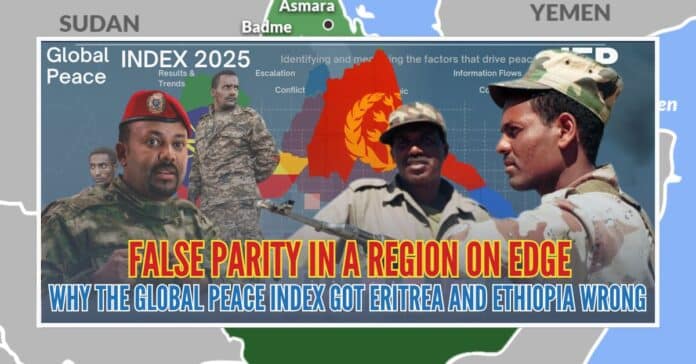
In the latest edition of the Global Peace Index (GPI), Eritrea was ranked 132nd and Ethiopia 138th out of 163 countries. At first glance, the six-point difference suggests that the two nations are nearly equal in terms of peace and stability. But here’s the problem: they are not.
Anyone familiar with the Horn of Africa its recent history, its lived realities, and the sharp asymmetry in power dynamics will see that this ranking doesn’t just flatten nuance. It distorts it. The GPI, once again, falls into the trap of false equivalence, and Eritrea ends up being painted with the same brush as the very forces that have spent decades destabilizing it.
The Problem Isn’t Just the Ranking It’s the Narrative Behind It
Produced by the Institute for Economics and Peace (IEP), the Global Peace Index is widely cited by governments, media, and development organizations. It claims to be neutral and data-driven. But neutrality, when stripped of historical context, becomes complicity.
Eritrea is portrayed as a militarized, closed-off state. Ethiopia is framed as unstable but somehow still strategic. One is boxed in as “authoritarian”; the other is treated as a fragile democracy finding its way. Yet the reality is far more layered and uncomfortable for those who cling to simplistic narratives.
Let’s remember that Eritrea has been under relentless international pressure for over 20 years, facing:
UN and U.S. sanctions based on disproven allegations.
Decades of media defamation and diplomatic isolation.
A refusal by the international community to enforce the 2002 Eritrea-Ethiopia Boundary Commission (EEBC) ruling, which granted the town of Badme to Eritrea.
None of this is reflected in the Peace Index’s metrics. Why? Because the metrics don’t measure injustice they measure surface-level symptoms, often gathered from biased sources.
Ethiopia: The Arsonist Framed as the Firefighter
Meanwhile, Ethiopia whose government has declared Red Sea access an “existential necessity” is staging military deployments near Eritrea’s border, building naval capacity it doesn’t yet have, and signing deals with breakaway regions like Somaliland to circumvent Eritrean ports altogether.
Internally, Ethiopia is fracturing. The Tigray conflict may have formally ended, but resentment simmers beneath the surface. In Amhara, a full-blown insurgency has broken out. Oromia remains restive. And Ethiopia’s political center is increasingly fragile.
Despite all this, the Peace Index treats Ethiopia’s militarization and expansionist ambitions as symptoms of a state under pressure not a threat to the region.
Eritrea, on the other hand, is accused of militarism because it prepares for war. But what choice does a country have when its neighbor:
Calls its sovereign coastline negotiable.
Signs offshore naval deals backed by foreign powers.
And historically ignored international rulings without consequences?
This isn’t militarism. This is survival.
The Index Misses the Bigger Picture.
Let’s be clear: Eritrea’s military mobilization, its partnerships with friendly countries, and its policy of national service are not accidental. They are the outcome of betrayal, broken promises, and a world order that has never taken its sovereignty seriously.
If Ethiopia is spending over $1.5 billion a year on foreign ports and rattling sabers about the Red Sea, why shouldn’t Eritrea respond with defensive preparations? The IEP’s methodology, while presented as scientific, leans heavily on:
Western media narratives, which have consistently misrepresented Eritrea.
Third-party data sets, often compiled by NGOs or think tanks with direct or indirect funding from governments with strategic interests in Ethiopia. This is not conspiracy—this is reality. Just follow the money.
Key Factor
Eritrea
Ethiopia
Peace Index Rank (2025)
132nd
138th
UN Sanctions History
Yes (2009–2018)
None
Border Ruling Compliance
Yes (EEBC, 2002)
No
Red Sea Rhetoric
Defensive (Sovereignty-focused)
Aggressive (Expansionist)
Military Deployment
Defensive, National Service
Offensive, multi-border deployments
Internal Conflict
No,
High (Tigray, Amhara, Oromia)
Foreign Military Backing
No
UAE, Russia, Iran, Türkiye
Conflict Exporting
No
Yes (Somalia, Tigray, Sudan)
The Real Cost of Lazy Metrics
It’s easy to throw countries like Eritrea into the “low peace” category. It’s harder to ask why. What you won’t find in the Global Peace Index is any meaningful acknowledgment of the geopolitical bullying, the decades-long siege, or the weaponization of development aid used against nations that refuse to fall in line.
Eritrea has never begged for aid. It has never played the victim. It has, for better or worse, insisted on dignity over dependency. That comes at a cost but it’s a cost Eritreans have chosen with open eyes.
What the GPI fails to measure is resilience. What it doesn’t track is integrity. And what it conveniently overlooks is Ethiopia’s historical and ongoing role in shaping Eritrea’s security posture.
The idea that Eritrea and Ethiopia are nearly equal in peacefulness is not just inaccurate—it’s insulting. Eritrea’s struggles are real, but they are not of its own making. It is a nation that has been punished for saying “No” to foreign domination, to aid dependency, and to dictated diplomacy.
The Peace Index wants to count tanks and troop numbers. That’s fine. But until it learns to count betrayals, sanctions, illegal occupations, and double standards, it will always remain what it is: A flawed mirror held up to a distorted world.
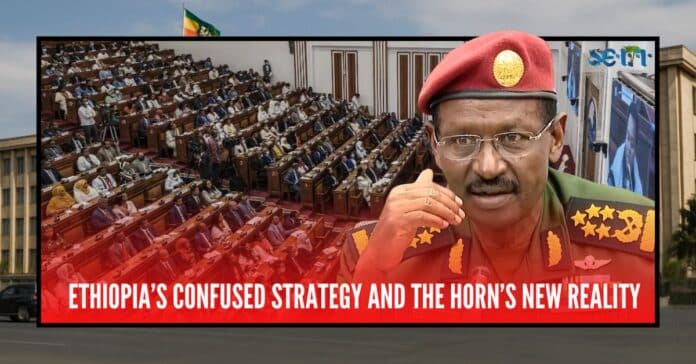
In a recent and surprising development, Ethiopia’s Chief of Staff appeared before Parliament not to brief lawmakers on national security, as is customary, but to deliver a lengthy address on diplomacy and regional affairs—topics traditionally handled by the civilian leadership. This breach of protocol raises a fundamental question: Why is a top military official addressing foreign policy in such a political forum?
This unusual intervention reveals a deeper confusion within the Ethiopian government—particularly concerning its increasingly belligerent rhetoric about acquiring a seaport “by any means necessary”—most notably one belonging to the sovereign state of Eritrea. Officials have repeatedly referred to this ambition as an “existential issue,” prompting another critical question: How can claiming the territory of a neighboring, independent state be framed as essential to national survival?
That remains a million-dollar question.
What further compounds the confusion is the glaring incoherence among Ethiopia’s top officials themselves. Just days earlier, Ethiopia’s Foreign Minister, speaking before the same Parliament, sought to downplay tensions by insisting that the country was not engaged in any “war of words” with Eritrea. He claimed that inflammatory remarks made by previous Ethiopian leaders were merely personal views that did not reflect the government’s official position. His statement was in response to a lawmaker’s question concerning the rising tensions between the two governments.
Yet this reassurance was short-lived and profoundly unconvincing. The Defense Minister had already appeared on state-run media, accusing Eritrea of various provocations and declaring that Ethiopia had built a powerful army to counter regional threats—a statement clearly aimed at Eritrea and its neighbors. She went so far as to claim that all inhabitants of Eritrea’s coastal areas are Afars and that all Afars consider themselves proud Ethiopians—a statement that triggered an angry backlash from Eritrean Afars.
The truth is starkly different: not all Eritrean coastal areas are inhabited by Afars, and Eritrean Afars are not Ethiopian, nor do they consider themselves so. The Defense Minister may not know it, but in Eritrea’s Dankalia region—home to the majority of Eritrean Afars—over 99% voted for independence in the 1993 referendum, just like the rest of the country. Her assertion is not only factually false but deeply offensive to a proud community that fought for, and continues to defend, Eritrea’s sovereignty.
The contradiction becomes even more glaring when Prime Minister Abiy Ahmed himself is repeatedly heard making statements that can only be described as beating the drums of war. These remarks leave little room for ambiguity about Ethiopia’s ambitions. Moreover, state media has consistently echoed this aggressive posture, elevating the narrative of Ethiopia’s “historic and legal right” to a seaport into what now resembles a national campaign.
Far from being isolated or personal opinions, these statements reflect a coordinated and deliberate narrative—rendering the Foreign Minister’s comments either disingenuous or dangerously out of step with reality.
Taken together, these contradictions suggest that Prime Minister Abiy Ahmed has not broken with the mindset of his predecessors, who long fantasized about turning Ethiopia into a coastal power—even if it meant perpetual conflict. This obsession has resurfaced as a strategic priority, casting a dangerous shadow over the Horn of Africa and undermining international law, which firmly upholds the sovereignty and territorial integrity of all states.
Paradoxically, the Field Marshal’s blunt remarks may prove to be a blessing in disguise. For Eritreans and other peoples of the Horn, his statements confirm what many have long suspected: the much-celebrated 2018 peace agreement between Ethiopia and Eritrea was not based on genuine reconciliation. Rather, it was a tactical pause—meant to secure Eritrea’s military support during Ethiopia’s war with the TPLF. Now that the threat has subsided, Ethiopia appears to have reverted to its expansionist ambitions.
Eritreans, who extended a hand of friendship and stood by Ethiopia in its moment of crisis, now feel deeply betrayed. The peace deal was expected to close a painful chapter and usher in a new era. But the Chief of Staff’s remarks—and those of others—make it clear: Ethiopia never truly abandoned its desire to claim Assab and other Eritrean assets. It merely postponed that ambition.
This betrayal—so openly expressed by Ethiopia’s military leadership and echoed across its political and media establishments—underscores a sobering reality: peace that is not built on mutual respect, lawful recognition of borders, and a shared commitment to regional stability is doomed to collapse.
The peoples of the Horn must now respond with greater vigilance, unity, and strategic coordination. As the Ethiopian government drifts toward another reckless path, the international community must reaffirm its commitment to sovereignty, non-aggression, and the core principles of international law—before this dangerous confusion pulls the region into yet another tragic chapter of conflict.
At Setit Media, we believe in calling things by their name—plain and clear. This piece by Abel Kebedom speaks boldly to the political noise coming out of Arat Kilo, challenging the Prosperity Party’s dangerous posturing toward Eritrea. It’s not just commentary; it’s a wake-up call grounded in truth, historical memory, and respect for sovereignty. Eritreans didn’t sacrifice for decades just to watch their independence questioned again. This article reflects the spirit of those who know where they stand and why they stand there. As always, we publish this in the interest of facts, justice, and the right of nations—especially ours—to live in peace and dignity.
It is evident that the Prosperity Party in Arat Kilo, Addis Ababa, comprises individuals who lack understanding of the aspirations of the Ethiopian people and the governments of neighboring countries. They disregard international law and treaties that govern diplomatic relations between nations. They are essentially war criminals who acquire modern weaponry, showcase it in the streets of Addis Ababa, and use it against their own citizens while threatening their neighbors with invasion. For them, war is simply a means to maintain their grip on power, and they show little concern for the current economic hardships, hunger, and instability plaguing Ethiopia. The loss of lives, displacement of people, and destruction of property that accompany war seem to be of little consequence to them.
Recently, Ethiopia’s former prisoner of war and current General, Berhanu Jula, told Ethiopia’s rubber-stamp parliament that the quarrel between Eritrea and Ethiopia originated when Ethiopia asked Eritrea to share its sovereign territory (the sea) and Eritrea refused. It is astonishing that a senior Ethiopian general believes Eritrea should surrender its territory so that Ethiopia can acquire a port and establish a navy within Eritrean borders.
There is no doubt that the ignorance exhibited by the current leadership in Arat Kilo, the Prosperity Party, has been inherited from its predecessors. However, Berhanu Jula’s comments suggest that the Prosperity Party is the least informed of all its predecessors. Unsurprisingly, the Prosperity Party made a similar request to Djibouti and Somalia, which was categorically rejected. Now, the Prosperity Party is threatening Eritrea with invasion. In light of their threats, Berhanu Jula and his party should consider a refresher course on Eritrean history.
Pre-Armed Struggle for Liberation (1889–1962)
Eritrea was colonized by Italy from 1889 to 1941, followed by a ten-year British administration until 1951. In 1952, the United Nations forced Eritrea to federate with Ethiopia. However, in 1962, Emperor Haile Selassie of Ethiopia unilaterally dissolved this federation and annexed Eritrea, which led to a 30-year armed struggle. Eritrea, which possessed its own flag, parliament, and boundaries based on colonial agreements, was turned into an administrative region of Ethiopia. Before this annexation, Ethiopia had no access to a port. It was only after Eritrea was illegally annexed that Ethiopia gained ownership of Eritrea’s two ports, Massawa and Assab. Thus, throughout history, Ethiopia only illegally controlled Eritrean ports for about twenty-nine years (1962–1991).
Armed Struggle for Liberation (1961–1991)
After 30 years of war and destruction, the Eritrean People’s Liberation Front (EPLF) expelled Ethiopian forces and achieved complete liberation in 1991. Following a referendum monitored by the UN and the AU, Eritrea became an independent country on May 24, 1993. Consequently, Eritrea, with its two ports, Massawa and Assab, was recognized as an independent African nation, while Ethiopia reverted to being a landlocked country.
After Eritrean Independence (1991–Present)
As a gesture of goodwill, Eritrea declared its ports to be free and allowed Ethiopia to use them for a nominal fee. However, in violation of the 1964 Cairo Declaration, which upheld colonial borders as sacred African boundaries, Ethiopia claimed the Badme region of Eritrea in 1998 and waged a two-year destructive war against Eritrea. Ethiopia unilaterally abandoned the use of Eritrean ports and shifted its focus to Djibouti. The then Prime Minister, Meles Zenawi, justified this move by stating that using Eritrean ports would benefit Eritrea more than it would Ethiopia.
In 2002, the Eritrea-Ethiopia Boundary Commission, referencing colonial agreements, declared Badme to be Eritrean territory. Ethiopia, however, rejected this ruling and occupied Badme and other Eritrean territories for two decades. During the 2020–2022 Tigray civil war, Eritrea retook the land that the Boundary Commission had determined to be Eritrean.
While Eritrea hoped for normalized relations with Ethiopia, the Ethiopian government requested a port and a land corridor ownership inside Eritrean sovereign territory. When Eritrea declined this request, the current Prime Minister, Dr. Abiy Ahmed, attempted to undermine colonial boundaries by replacing the 1964 Cairo Declaration with ethnic-based boundaries. He argued that, since the Afar ethnic group lives in both Eritrea and Ethiopia, the Ethiopian Afars should have a say regarding the Eritrean Red Sea. He extended this reasoning to claim that, because Somalis inhabit both Ethiopia and Somalia, the Ethiopian Somalis should have influence over the Indian Ocean. In doing so, he asserted a historical right to a port and a corridor to the sea, in violation of the 1964 OAU Declaration.
Conclusion
Contrary to the objectives of the African Union, Ethiopia has been a source of instability in the Horn of Africa. As part of its ongoing efforts to undermine Somalia, Ethiopia signed a Memorandum of Understanding (MOU) with the breakaway region of Somaliland, which is not internationally recognized. The MOU stipulates that, in exchange for a share in Ethiopian Airlines and recognition of Somaliland as an independent country, Ethiopia will acquire a 20 km coastline for building a naval base and a commercial port. This agreement suggests that Ethiopia seeks to maintain Somalia as a failed state. However, Somalia resisted this arrangement, and as a result, the MOU has been suspended.
Additionally, the Prosperity Party has requested that Djibouti allow Ethiopia to possess a seaport, land corridor, and establish a navy. Djibouti, however, rejected this request. Following this series of rejections from all three neighboring countries, the Prosperity Party is now attempting to pressure Eritrea into allowing Ethiopia to share its territory.
With these challenges, the Prosperity Party faces two options: reconcile with the fact that Ethiopia is a landlocked country and work collaboratively with its neighbors to secure sea access, as outlined by the 1982 Law of the Sea, or pursue aggressive actions against its neighbors. If I were part of the Prosperity Party, I would choose the first option. Ultimately, the leaders of the Prosperity Party, who are under significant pressure from internal issues in the Oromia, Amhara, and potentially Tigray regions, must recognize that their futile propaganda will lead nowhere. It would be wiser for them to remain silent.
Victory to the Masses and Eternal Glory to Our Martyrs.