

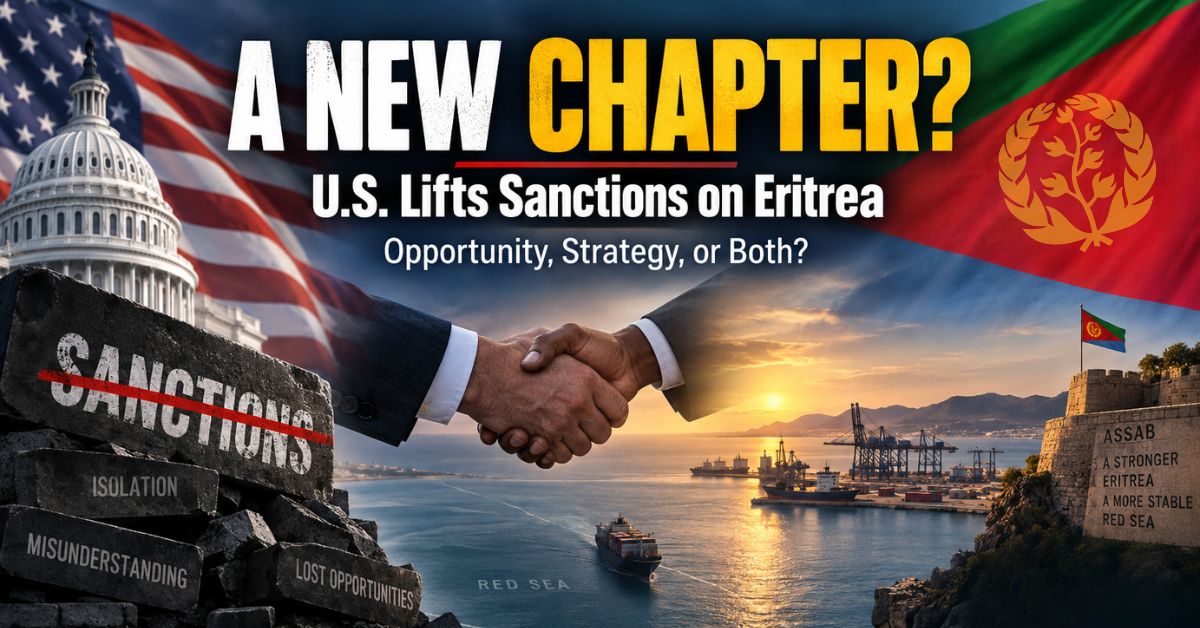
For five years, U.S. sanctions imposed during the war in northern Ethiopia hung over some of Eritrea’s most important political, military and economic institutions. On September 18, that chapter ended. The U.S. Treasury Department’s Office of Foreign Assets Control announced that the national emergency declared under Executive Order 14046 in September 2021 had expired. As a consequence, OFAC removed the individuals and entities designated under that authority from its Specially Designated Nationals and Blocked Persons List. The Ethiopia-related sanctions program is now officially listed by OFAC as inactive.
For Eritrea, those removed included the Eritrean Defense Forces, the People’s Front for Democracy and Justice, Red Sea Trading Corporation, Hidri Trust, Hagos Ghebrehiwet Weldekidan and Abraha Kassa Nemariam. That is the established legal fact. The political explanation requires greater care. According to news agencies citing a U.S. State Department spokesperson, President Donald Trump chose not to renew the national emergency “in order to advance US regional interests.” The Treasury Department’s own announcement does not provide that explanation; it states only that the emergency expired and that designations imposed under Executive Order 14046 were consequently removed. That distinction significant. But so does the phrase regional interests. The central question for Eritrea is therefore not simply why the sanctions disappeared. It is why Washington apparently believes a different relationship with Eritrea better serves American interests today.
Eritrea welcomed the change; Asmara’s initial response was positive but measured. Information Minister Yemane Gebremeskel told the Reuters that the sanctions had been unwarranted and caused considerable damage to Eritrea, adding that the government welcomed the Trump administration’s “gesture and remedial measures.” His subsequent remarks went further.
Yemane described the development as reflecting a “reservoir of constructive political goodwill” and said it could open a new chapter in relations, particularly involving investment and trade. He also confirmed that President Trump’s senior adviser for Arab and African affairs, Massad Boulos, had met Eritrean Foreign Minister Osman Saleh in Cairo.
According to Yemane, those contacts were preliminary discussions intended to prepare broader bilateral talks. This tells us something important. September 18 was not necessarily the beginning of a rapprochement. Diplomatic groundwork had already been taking place. Semafor reported earlier that Egypt had facilitated contacts as Washington explored normalization with Asmara, while Reuters reported in May that the administration was planning sanctions relief as part of a possible rapprochement.
The sanctions expiration should therefore be viewed within that broader process. What changed? Eritrea’s geography certainly did not. What changed was the strategic environment surrounding it. When Washington imposed the measures in 2021, American policy toward the Horn was dominated by the devastating Ethiopian war. In 2026, the map looks very different.
The main Tigray war ended with the Pretoria agreement in 2022. Sudan subsequently descended into another devastating conflict. Ethiopia and Eritrea have again experienced serious tensions. Addis Ababa continues emphasizing access to the Red Sea. Yemen remains unstable, while Houthi military activity has made Bab al-Mandab and Red Sea shipping an increasingly important international security concern.
Eritrea sits directly inside this geography. Reuters noted when reporting the sanctions removal that the decision comes amid the expanding Middle Eastern conflict and renewed attention to the Red Sea, where Eritrea occupies a strategically significant coastline. The Associated Press similarly placed the delisting against rising Red Sea security concerns, pointing specifically to Houthi advances in Yemen, Bab al-Mandab and the proximity of Eritrea’s southern coastline and Assab.
None of this proves that Washington ended the sanctions because it wants Assab or seeks an American military presence in Eritrea. There is no publicly verified agreement establishing such an arrangement. That line between evidence and speculation must remain clear. But geography cannot be ignored either. Washington may need Eritrea differently now.
Foreign policy is rarely permanent. States adjust when interests and circumstances change. Washington and Asmara do not have to agree about the history of the Tigray war for American policymakers to conclude that maintaining a frozen relationship with Eritrea carries increasing strategic costs. Eritrea possesses more than 1,000 kilometers of Red Sea coastline, important islands and two major ports, Massawa and Assab. Assab lies near the southern entrance to the Red Sea and the Bab al-Mandab maritime corridor.
As competition around this waterway increases, countries capable of influencing its security inevitably attract greater diplomatic attention. That creates an opportunity for Eritrea. It also creates a danger. Eritrea should not allow renewed international interest to reduce the country to a port, military facility or useful location on someone else’s geopolitical map. The opportunity should be economic as well as strategic.
The immediate economic effects of the OFAC decision should not be exaggerated. Targeted sanctions disappearing does not automatically mean American investment will arrive in Asmara tomorrow. But sanctions create more than formal legal restrictions. They create political and financial risk. Banks, investors and corporations frequently avoid transactions even when technically permissible if they fear exposure to sanctioned institutions.
Removing major Eritrean entities from the SDN list eliminates one significant layer of that uncertainty. The larger opportunity would come through normalization. Trade, mining, infrastructure, aviation, tourism, technology and financial cooperation offer Eritrea considerably more long-term value than a relationship built primarily around military calculations.
Yemane’s emphasis on investment and trade is therefore significant. He said Eritrea seeks partnerships based on mutual benefit while avoiding structural dependency. That principle deserves emphasis. Eritrea can improve relations with Washington without surrendering the independent foreign policy that has characterized the country since independence.
Critics see an accountability problem
There is another side to this debate. Human Rights Watch opposed sanctions relief before the September decision, arguing that removing pressure without accountability for alleged abuses in Eritrea and during the Tigray war could encourage impunity. The organization also explicitly connected renewed international interest in Eritrea with its Red Sea position and escalating Middle Eastern instability. Eritrea has strongly rejected many allegations made against its forces and has long argued that international narratives surrounding the Tigray conflict were selective and politicized.
Those disputes have not been resolved merely because OFAC’s program expired. But Washington has apparently decided that they should no longer sustain this particular sanctions framework. That itself represents a meaningful policy change.
Ethiopia remains part of the equation
Eritrea must also watch how renewed American engagement intersects with Ethiopia’s maritime ambitions. Ethiopia has legitimate economic reasons to seek reliable and affordable commercial access to international shipping. But commercial access and territorial sovereignty are different questions. Ports can conduct business. Transit corridors can be negotiated. Infrastructure can connect neighboring economies. None of this requires ambiguity concerning Eritrea’s internationally recognized territory. As international competition around the Red Sea increases, Eritrea should insist on maintaining that distinction.
Regional cooperation can strengthen every country involved when it is negotiated between sovereign states. It becomes dangerous when economic necessity is transformed into territorial entitlement. The sanctions are gone. The harder work begins. Eritreans have understandable reasons to welcome the end of these measures. But the country should resist turning their expiration into either triumphalism or complacency.
The world around Eritrea is changing quickly. Sudan is at war. Yemen remains unstable. Bab al-Mandab has become increasingly militarized. Ethiopia continues emphasizing maritime access. Gulf states, Egypt, Türkiye, China, Europe and the United States are all paying close attention to the Red Sea. Eritrea’s geography gives it strategic relevance within this environment. But geography alone does not produce prosperity or security. It is a Policy that does that.
If Washington genuinely wants a new relationship, Eritrea should engage from a position of sovereign equality and determine where American and Eritrean interests genuinely overlap. Normal diplomatic relations should be welcomed. Trade and investment should be expanded. Unnecessary hostility should be left behind. However Eritrea’s ports, coastline and strategic position are national assets not bargaining chips. Washington appears to be reconsidering how it approaches Eritrea. The important question is no longer simply why America changed course. It is whether Eritrea can convert this opening into a relationship that serves Eritrean interests long after today’s Red Sea crisis has passed.

