Eritrea has entered a new chapter in its journey toward scientific and health independence by launching its first genomic sequencing program. This marks a turning point in the country’s ability to detect, study, and respond to diseases using its own expertise.
For the first time, Eritrean scientists can identify and monitor viruses and bacteria inside the country without depending on foreign laboratories. This is more than a scientific achievement. It is a statement of confidence that Eritrea can protect its people through its own capacity and knowledge.
Fifteen Eritrean specialists, most of them from the National Health Laboratory, received advanced training in Asmara. The training was organized with the support of the World Health Organization’s Regional Office for Africa and the European Union’s Health Emergency Preparedness and Response Authority. For fifteen days, they worked on preparing samples, sequencing protocols, and interpreting genetic data that will help the Ministry of Health take faster and more informed action.
Dr. Saleh Mohammed, Head of the National Health Laboratory, described the moment as a major step forward. “The COVID-19 pandemic showed the world that genomic surveillance is essential. With this achievement, Eritrea is ready to take its place among countries building Africa’s health intelligence.”
Genomic sequencing helps scientists understand how diseases evolve and how resistance to medicine spreads. It gives the Ministry of Health the power to act early and accurately, making Eritrea less dependent on others during times of health crisis.
The program is part of Africa’s ten-year plan to strengthen genomic capacity across the continent from 2022 to 2032. Eritrea’s participation confirms its determination to be part of Africa’s scientific rise, guided by self-reliance and responsibility.
A senior official at the Ministry of Health said that Eritrea’s goal is not just to benefit from such programs but to contribute to the region’s knowledge and safety. “We want our laboratories to be part of Africa’s collective strength, not its weakness,” the official said.
The World Health Organization will continue to support Eritrea through technical guidance, new equipment, and follow-up training. The long-term goal is to make genomic sequencing a permanent part of the country’s public health system.
This is not just a story of technology. It is a reflection of Eritrea’s broader vision of independence, discipline, and scientific growth. At a time when global health challenges are increasing, Eritrea is quietly proving that progress does not depend on size or wealth but on willpower and commitment.
Eritrea has stepped into the genomic age with confidence. Its scientists now stand ready to protect their nation and to contribute to Africa’s collective health security with skill, pride, and purpose.
The recent resignations of BBC Director-General Tim Davie and Head of News Deborah Turness mark a turning point in the ongoing crisis of credibility facing Western media. Their exit came after an internal report revealed that a Panorama documentary had manipulated footage of Donald Trump’s January 6th speech, splicing different sections together to make it seem as though he had directly incited the Capitol riot. The BBC later admitted the edit was misleading.
For many in the Global South, especially in Africa, this scandal feels familiar—not shocking. For decades, Western media outlets have been accused of editing, filtering, and framing news about Africa to fit pre-set narratives of chaos, poverty, or repression. What is now rocking the BBC over a misrepresented American president is what Africans have endured for generations: distorted storytelling that shapes global perception and policy.
A Pattern of Selective Storytelling
Eritrea, in particular, has lived under the shadow of media misrepresentation. Since its independence, coverage of Eritrea by outlets like the BBC, CNN, and Reuters has been overwhelmingly one-dimensional. The country has been portrayed as secretive and isolated, often without context or nuance, and rarely with Eritrean voices leading the story.
During the Ethiopian civil war (2020–2022), for instance, many reports from Western media relied heavily on second-hand information, anonymous sources, or politically aligned advocacy groups. Claims about Eritrea’s role in the conflict were often published without evidence or verification, only to be quietly revised later when the facts didn’t match the narrative. Yet by then, the global image of Eritrea had already been shaped again.
When the BBC now faces backlash for cutting a Trump speech in ways that distorted reality, Africans recall how similar editing choices have framed entire nations. The difference is that when Africa is misrepresented, the consequences go beyond embarrassment they affect diplomacy, sanctions, investment, and even peace.
When Editing Becomes a Weapon
Editing is not neutral. The way images and words are cut and arranged determines meaning. The BBC’s Panorama documentary didn’t just rearrange Trump’s sentences it manufactured a perception. Viewers believed they were seeing a call to arms, when in fact the line “peacefully and patriotically make your voices heard” had been deliberately excluded.
Now, consider how that same editorial power is used in African contexts. A carefully chosen clip of a protest can portray instability. A government statement trimmed of its qualifiers can sound authoritarian. A conflict headline stripped of history can erase decades of context. When this becomes routine, it turns journalism into a form of narrative control especially when the subjects are smaller, poorer, or geopolitically vulnerable nations.
Eritrea has repeatedly challenged these portrayals, often to deaf ears. Western institutions dismiss complaints from African states as “attacks on press freedom,” even when those states are pointing to verifiable errors or omissions. The BBC’s Trump scandal now exposes the very rot Africans have long warned about: the arrogance of institutions that see themselves as beyond scrutiny.
Africa’s Turn to Tell Its Own Story
This is not about revenge or Western decline it’s about accountability and sovereignty. The BBC once symbolized global trust. If that institution can knowingly broadcast manipulated footage about the most scrutinized figure on Earth, how much easier would it be to twist narratives about a small Red Sea nation with limited media representation?
Eritrea and Africa at large must seize this moment. The global media order is changing. Regional broadcasters, independent journalists, and digital platforms now have the power to build alternative media ecosystems rooted in accuracy, dignity, and African agency. Truth must no longer be outsourced.
The BBC scandal should not only trigger internal reform in London it should also inspire a continental demand for media fairness. African leaders, media houses, and citizens must insist that international coverage follows transparent standards: full transcripts, on-record sources, context from local journalists, and accountability when errors occur.
The Bigger Lesson:- When misinformation targets Africa, it rarely makes front-page news in Europe or America. Yet those distortions ripple outward discouraging investors, justifying sanctions, and entrenching stereotypes. Eritrea’s decades-long struggle against misrepresentation shows how media narratives can become political weapons more powerful than armies.
Now that the BBC faces the same moral reckoning, perhaps the world will begin to see what Africa has seen all along: bias is not a mistake; it is a choice and one with global consequences.
The crisis at the BBC is not just a British scandal. It is a mirror reflecting the wider hypocrisy of Western media: preaching integrity abroad while practicing manipulation at home. For Eritrea, and for Africa, this is the moment to say enough—and to reclaim the narrative with truth, courage, and independence.
I. Introduction: When Data Becomes Diplomacy: In the aftermath of the Tigray war, two flagship documents from the Commission of Inquiry on the Tigray Genocide (CITG) the Productive Sector and Livelihood Assessment and the Social Sector War Damage and Loss Assessment have gained unusual authority in shaping international perceptions of the conflict. Together they claim more than 94 billion USD in total destruction, attributing the majority to the Ethiopian National Defense Force (ENDF), the Amhara regional forces (AMF), and most prominently, the Eritrean Defense Forces (EDF).
At first glance, both reports appear technocratic and data-driven, filled with economic modeling, tables, and citations of UN methodologies. Yet beneath the surface lies a narrative that paints Eritrea as the primary foreign aggressor vindictive, destructive, and beyond reason. From an Eritrean perspective, the issue is not the reality of war’s destruction, but the political architecture of evidence: how data itself can be shaped by historical resentment, cultural bias, and geopolitical intent.
II. The Charge Sheet Against Eritrea: Across both volumes, the EDF is consistently presented as the second-largest and, in some sectors, the leading perpetrator of damage. The Social Sector Executive Summary states for example:
“The Eritrean Defense Forces (EDF) inflicted 56.3 percent of the total damage in the health sector, 43.9 percent in education, and 39.6 percent in culture and heritage” (CITG Social Sector Executive Summary, p. 14).
Meanwhile, the Productive Sector Report describes the EDF’s actions in extreme terms: “The Eritrean Defense Forces were responsible for widespread damage to agricultural infrastructure, irrigation systems, and machinery, particularly in the western and central zones of Tigray” (CITG Productive Sector Report, p. 211).
Later in the same document, the authors conclude: “The prolonged siege and blockade lasting more than two years led to widespread disruption of production goods and services” (p. 280).
The rhetorical pattern is unmistakable: the ENDF is portrayed as structured, bureaucratic, and state-directed in its destruction, while the EDF is depicted as visceral, vindictive, and irrationally cruel. This distinction is not analytical it is cultural and politically motivated.
III. The Cultural Coding of Blame: Prominent Tigrayan General Migbey Haile once remarked that among Eritrean forces, “lowlanders were more ruthless than highlanders.” For casual listeners, these terms sound geographic. Yet in the historical vocabulary of Tigrayan elites, lowlander refers to Muslim Eritreans from the coastal and western plains, while highlander denotes Christian Eritreans from the central plateau.
General Migbey Haile
The implication carries an old prejudice: that Muslim Eritreans are inherently more violent, alien, and uncivilized. Such framing, when echoed in military rhetoric or academic reporting, imports sectarian assumptions into supposedly objective analysis.
When the CITG homogenizes the “Eritrean Defense Forces” as a singularly destructive actor, it unconsciously reproduces this hierarchy of perception the lowlander aggressor versus the highland victim. The data becomes an instrument of inherited prejudice disguised as quantification.
IV. The Pan-Tigrayan Lens: Embedded within parts of Tigrayan political and academic discourse is an enduring aspiration toward a “greater Tigrinya nation” a cultural and linguistic union that would blur the boundary between Tigray and Eritrea. This idea imagines Eritrea as a monolithic extension of Tigray, populated only by Christian Tigrinya-speakers, while its other communities are erased or diminished. In this ideological landscape, Eritrea’s independence is seen not as a decolonization victory but as a temporary detour from the supposed natural unity of the Axumite highlands.
Consequently, Eritrea’s sovereignty is not respected but resented. When Tigrayan elites craft narratives about the war, this resentment often seeps into their institutional language transforming post-war documentation like the CITG reports into expressions of cultural nostalgia and political reclamation.
V. Methodology as Ideology: The CITG claims to follow the UN-ECLAC Damage and Loss Assessment (DaLA) framework. However, this methodology was designed for natural disasters, not politically charged conflicts with contested territories. Several issues undermine the reports’ credibility.
The Productive Sector Report openly admits that: “Data was collected under the Tigray Interim Administration using structured surveys and institutional submissions. Western Tigray and parts of the eastern zone were excluded for security reasons” (CITG Productive Sector Report, p. 195).
That admission alone reveals a structural bias. The areas omitted are precisely those where alternative evidence or counter-narratives might have emerged. Moreover, the same document acknowledges that: “Over sixty percent of total loss is derived from projected future income rather than actual destruction” (p. 203).
By merging damage (physical loss) with loss (hypothetical income), the report inflates its estimates and turns speculative modeling into moral condemnation. The result is a pseudo-empirical weapon aimed at solidifying Tigray’s victimhood narrative.
VI. The Political Economy of Blame: The two CITG volumes serve three overlapping political purposes:
Moral Capital: They establish Tigray as the preeminent victim deserving of global sympathy.
Financial Leverage: The enormous damage valuation creates grounds for compensation claims against both Ethiopia and Eritrea.
Diplomatic Isolation: By numerically quantifying Eritrea’s alleged share of destruction, the reports provide justification for renewed sanctions and exclusion from regional reconstruction forums.
Far from being neutral post-war audits, the documents operate as instruments in a wider contest for who controls the moral narrative of the Horn of Africa.
VII. What Is Erased: Eritrea’s Security Context: The reports omit the event that ignited Eritrea’s military engagement: the November 2020 TPLF attack on Eritrean border positions and Ethiopian Northern Command bases. This omission is not trivial it erases Eritrea’s right to self-defense and reframes its intervention as unprovoked aggression.
By detaching the data from the sequence of events, the CITG constructs a story in which Eritrea simply appeared in Tigray as an agent of destruction. It turns a defensive response to cross-border assault into a moral crime. This framing reveals how selective silence can be as powerful as selective evidence.
VIII. Consequences for Eritrea’s Sovereignty and Reputation: If left unchallenged, the CITG reports will harden into diplomatic “facts.” They risk cementing Eritrea’s image as a perennial aggressor, deterring foreign investment and overshadowing its role as a stabilizing force in the Red Sea corridor.
They also compress Eritrea’s plural national identity into a caricature homogenized, militarized, and stripped of nuance. Most dangerously, they normalize the idea that Eritrea’s sovereignty is conditional, subject to the moral verdict of neighboring elites and Western-aligned institutions.
IX. Conclusion: Beyond the Arithmetic of Accusation
The CITG reports will circulate through donor conferences, policy briefings, and transitional-justice debates. They will be cited by people who have never visited Eritrea but will speak with statistical certainty about its sins.
For Eritreans, the challenge is to read these numbers historically to recognize in them not objective truth but the repetition of a pattern: data as diplomacy, measurement as morality, and statistics as the new frontier of sovereignty.
True accountability in the Horn cannot be built on numbers alone. It must begin with context, integrity, and the courage to confront bias whether it hides in rhetoric, in data tables, or in the unspoken hierarchies of who gets to tell the story.
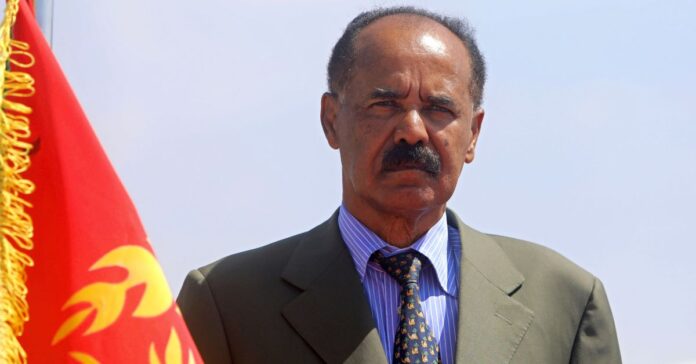
Eritrean President Isaias Afwerki said that the stability of the Horn of Africa and the Red Sea depends on the region’s own cooperation and not on external involvement. In a televised interview in Cairo, he called for African nations to take responsibility for their own security and development and warned against both foreign and regional interference.
Speaking during his visit to Egypt for the inauguration of the Grand Egyptian Museum, president Isayas Afwerki said that his country’s relations with Egypt are strategic and based on cooperation for stability and growth in the region. He described the Red Sea, the Nile Basin, and the Gulf as parts of one interconnected area that requires collective responsibility.
“No country needs foreign forces to protect its waters or borders. The region’s security must come from its own cooperation, not from outsiders,” President Isaias said.
He said that the Horn of Africa, which includes Eritrea, Sudan, Somalia, Ethiopia, Djibouti, and South Sudan, has long been of geopolitical importance. He explained that instability in one country affects the entire region. Somalia’s insecurity, he said, is not a local matter but a regional and global concern. He added that Ethiopia’s ethnic divisions and South Sudan’s internal conflicts also threaten stability.
President Isaias Afwerki said that repeated foreign interventions have complicated the situation in the Horn. “No one asked for mediators or envoys. They have become part of the problem, not the solution,” he said. He argued that the countries of the region must resolve their issues through local and regional mechanisms rather than rely on outside actors.
He described the Red Sea as an international waterway that serves the whole world but said that its protection is first and foremost the responsibility of the countries that border it. “This international waterway serves the world, but its safety is the duty of the region. We do not need foreign bases to protect our shores,” he said.
President Isaias Afwerki rejected the presence of foreign military bases in the Red Sea region, saying that allowing them invites problems and undermines sovereignty. He called for the creation of mechanisms of cooperation among Red Sea nations including Eritrea, Sudan, Djibouti, Yemen, and Saudi Arabia.
On Sudan, President Isaias Afwerki said that the violence in Al-Fashir is only one part of a wider problem. He said that Sudan is being targeted by regional and international powers and that its instability affects the entire Horn of Africa and the Red Sea. “If Sudan is not stable, the Red Sea will not be stable, nor will the Horn of Africa,” he said. He called for collective support for the Sudanese people to overcome the crisis.
President Isaias also spoke about Africa as a whole, saying that the continent continues to suffer from what he called modern forms of slavery. He said that external powers exploit Africa’s resources and keep its markets dependent. “Africa’s wealth is taken, its markets manipulated, and its people denied basic needs by external control. Africa must free itself,” he said. He called for investment in infrastructure, energy, and food systems to achieve economic independence.
Regarding the African Union, President Isaias Afwerki said that it has not met expectations but that the main responsibility lies with the member states. “The African Union did not fail on its own. The governments failed to live up to their responsibilities,” he said. He called for stronger and more accountable institutions that can represent Africa’s collective interests.
President Isaias concluded by saying that African nations must cooperate to build peace and development through self-reliance. He said that regional integration, not external intervention, is the key to lasting stability. “Africa cannot depend on others to solve its problems. It must depend on itself,” he said.
The recent statements by Ethiopian Prime Minister Abiy Ahmed delivered during a parliamentary session in response to questions from members of parliament—have raised alarm across the Horn of Africa. His remarks questioning Eritrea’s independence and hinting at a supposed Ethiopian “right” to the Red Sea, even by force, mark a perilous escalation in rhetoric.
Yet behind these fiery words lies a deeper story: one of domestic decay, political desperation, and the revival of Ethiopia’s old imperial illusions.
A Desperate Leader Confronting Internal Collapse
Abiy’s latest outburst cannot be understood apart from Ethiopia’s worseninginternal crisis. The country is engulfed in growing fragmentation, particularly in the Amhara and Oromia regions, which together represent roughly 60 per cent of Ethiopia’s population and economic base. Both regions are now in open rebellion against the federal government, and Abiy’s control is visibly weakening.
Confronted with multiple insurgencies, economic decline, and public disillusionment, the prime minister appears to be seeking an external scapegoat. By blaming Eritrea for Ethiopia’s failures, he aims to redirect popular anger outward and to rally nationalist sentiment behind a manufactured grievance.
This is an old playbook: when the domestic order falters, find a foreign enemy.
Contradictions and Historical Revisionism
Abiy’s parliamentary remarks were riddled with contradictions. On one hand, he questioned the legitimacy of Eritrea’s independence, claiming that the transitional Ethiopian government of the early 1990s lacked authority to approve it. This argument is both historically false and legally irrelevant.
Eritrea was never part of Ethiopia in a manner that required “approval” for separation. Its federation with Ethiopia was unilaterally dissolved by Emperor Haile Selassie in violation of United Nations resolutions. Eritrea’s independence was not granted by Ethiopia—it was won through a thirty-year war of liberation, and internationally endorsed through the UN-supervised 1993 referendum, in which 99.8 per cent of Eritreans voted for independence.
Ironically, Abiy himself signed the 2018 Peace Agreement with Eritrea, formally recognising its sovereignty and borders—including the port of Assab, which he now claims Ethiopia “lost unfairly”. This contradiction exposes the political opportunism driving his narrative.
Empty Threats and Military Reality
Abiy’s reckless suggestion that Eritrea could meet the fate of “Ukraine or Gaza” reveals more about his desperation than his strength.
In reality, the Ethiopian army is overstretched and demoralised, struggling to contain domestic rebellions in Amhara and Oromia. The idea that such a government could launch an external war is detached from reality. These are not the words of a confident leader—they are threats born of frustration and insecurity.
The Myth of Negotiating Sovereignty
The prime minister accused Eritrea of refusing to “negotiate” over Assab. But negotiate what, exactly? No sovereign state on earth negotiates its own territorial integrity. What Abiy proposes is not dialogue it is concession under duress.
Eritrea has consistently affirmed its readiness to cooperate on trade and port access within lawful, mutually beneficial frameworks. What it will not do is bargain away its sovereignty. Access to the sea can be achieved through respect and commerce, not revisionism and threats.
The Illusion of Mediation
Equally puzzling are Abiy’s claims that he has sought mediation from the United States, Russia, China, and African states over sea access. Port services are commercial matters, resolved through agreements, not mediation.
By invoking global powers, Abiy betrays his real motive: a quest for political endorsement of territorial ambition. No responsible state will mediate an agenda that directly undermines another nation’s sovereignty. The idea is diplomatically absurd.
Misplaced Analogies with Ukraine
Abiy’s comparison of Ethiopia’s situation to that of Ukraine reveals either deep misunderstanding or deliberate manipulation. The Ukraine conflict is primarily a confrontation between global powers, with Ukraine serving as a proxy battlefield. Eritrea, by contrast, is a small but sovereign nation defending its independence from a neighbour in turmoil.
There is no meaningful parallel. Abiy’s analogy only highlights the intellectual confusion and moral incoherence at the heart of his argument.
Eritrea’s Strategic Restraint
Eritrea’s response to Abiy’s provocations has been calm and measured. Its diplomacy is guided by two principles:
Avoiding rhetorical escalation that could inflame the region.
Strengthening regional partnerships to deter reckless adventurism.
Asmara understands that loud diplomacy serves only those seeking distraction. Eritrea has therefore chosen the path of quiet strength—asserting its sovereignty without feeding the theatrics of a faltering regime.
The Question of Recognition
Perhaps the most bizarre of Abiy’s claims is that Ethiopia lacks official documents recognising Eritrea’s independence. This is demonstrably false.
The Addis Ababa Conference of 1991, which led to the establisment of Ethiopia’s transitional government following the fall of the Derg regime, explicitly accepted Eritrea’s right to self-determination. The UN mission that supervised the 1993 referendum worked in full cooperation with Ethiopian authorities.
Furthermore, Abiy personally signed the 2018 Eritrea–Ethiopia Peace Agreement, which reaffirmed the final and binding border ruling. Recognition of that border is recognition of Eritrea’s sovereignty. To now deny this is to repudiate Ethiopia’s own international commitments.
Expansionism Disguised as Desperation
Abiy Ahmed’s rhetoric signals a dangerous return to the expansionist fantasies that once fuelled decades of conflict in the Horn of Africa. His attempt to rewrite history and question Eritrea’s independence is not a display of vision but of vulnerability.
This is not the voice of a confident leader—it is the cry of one cornered by failure. Yet the danger lies in how such rhetoric, once unleashed, can reshape public sentiment and destabilise an entire region.
The international community must therefore recognise these threats for what they are: a diversion from internal collapse, and a revival of Ethiopia’s most destructive impulses.
The Horn of Africa has paid dearly for imperial delusions in the past. It cannot afford a repeat.
When the Tigray Civil War erupted in 2020, Abiy Ahmed urgently turned to Eritrea for help, seeking rescue from the brink of defeat by the Tigray People’s Liberation Front (TPLF). Eritrea responded and decisively saved him, earning his repeated gratitude. Yet, due to his own reckless actions, Abiy Ahmed once again finds himself in dire straits. This time, the very survival of his Party and government hangs in the balance. Unlike before, he stands isolated, with no allies willing to intervene as they did during the Tigray War. The mounting pressure has exposed his desperation: resorting to fabrications, empty threats, and turning against the nation of Eritrea that once secured his position. Most troubling, during his latest address to his rubber-stamp parliament, he brazenly denied reality, attempting to deceive the public with alternative facts.
Domestic Situation.
Abiy Ahmed appears to inhabit a fantasy version of Ethiopia, utterly disconnected from the hardships faced by ordinary citizens. He grossly underestimates the intelligence and resilience of Ethiopians, expecting them to blindly swallow the fabrications he peddles. In his recent speech to the rubber-stamp parliament, the prime minister shamelessly painted an unrealistically rosy picture of the crumbling Ethiopian economy and boasted about the supposed might of his beleaguered army.
Abiy Ahmed’s leadership is marked by economic mismanagement that has left Ethiopia in a financial crisis. Despite borrowing billions of dollars from both private and governmental lenders, there are few tangible results, leading lenders to consider legal action for repayment. The Ethiopian Birr has depreciated drastically, from 50 to 170 per US Dollar within a year, causing widespread hardship. Borrowed funds from the World Bank and IMF are used for arms purchases, worsening the prospects of securing further loans. Overall, Abiy’s government faces a bleak financial reality, which he attempts to obscure through propaganda.
Abiy Ahmed’s military faces a widespread insurgency, with challenges in regions including Oromo, Amhara, Beneshangul Gumuz, and possibly Tigray, as well as rising resistance in Afar. His forces are suffering losses and increased desertion. These military setbacks further illustrate the depth of his leadership crisis and his hopeless brinkmanship.
External Situation.
Abiy Ahmed seems to target his previous savior, Eritrea, because it refused to save him again. His saber-rattling against Eritrea has no bounds. The tantrum that he recently threw in his parliament can be summarized as follows:
He does not know who signed the Eritrean independence.
Eritrea refused to give him a port that he could own.
If a war starts with Eritrea, the outcome is known, meaning Ethiopia will win.
Eritrea is destabilizing Ethiopia and sabotaging its economy.
Who Decided on Eritrean Independence?
Abiy Ahmed assumed that defeated Ethiopia had the power to grant or deny independence to Eritrea. In fact, it would be easier for him to ask his former prisoner of war generals, now threatening to invade Eritrea, who decided the Independence of Eritrea. They would have a perfect answer for him. The Truth is that the total defeat of the Ethiopian occupying army in 1991, and the capture of 100,000 Ethiopian soldiers, by the Eritrean People’s Liberation Front (EPLF), laid the ground for the independence of Eritrea. Subsequently, in 1993, in a UN, EU, and African Union-monitored referendum, using their right for self-determination, 99.8% of the Eritrean people voted for independence. Therefore, Eritreans decided on Eritrean Independence, and no one had the right to deny it.
Abiy Ahmed’s Desire to Own Eritrean Port by Hook or Crook.
The international law of the sea regulates the relationship between landlocked countries and those countries that own the nearest ports. Therefore, the relationship between Eritrea and Ethiopia cannot be outside the scope of the law. The law states:
Right of access to and from the sea and freedom of transit (Article 125)
Land-locked States shall have the right to access to and from the sea for the purpose of exercising the rights provided for in this Convention, including those relating to the freedom of the high seas and the common heritage of mankind. To this end, landlocked States shall enjoy freedom of transit through the territory of transit States by all means of transport.
The terms and modalities for exercising freedom of transit shall be agreed between the landlocked States and transit States concerned through bilateral, subregional, or regional agreements.
Transit States, in the exercise of their full sovereignty over their territory, shall have the right to take all measures necessary to ensure that the rights and facilities provided for in this Part for land-locked States shall in no way infringe their legitimate interests.”
Abiy Ahmed’s Claim of Destabilization and Sabotage, and the threat of War.
Abiy Ahmed’s Tantrum about Eritrea’s role in destabilizing Ethiopia and sabotaging its economy is simply an effort to externalize his internal problems. Eritrea does not have the means or willingness to destabilize Ethiopia or sabotage its economy. In fact, it is the Abiy Ahmed government that is recruiting, hosting, and arming so-called Eritrean Opposition groups. As to the threat of war, Abiy Ahmed knows well that Eritreans are ready to defend their country. History shows that when attacked, Eritreans punch beyond their weight, and that remains the same for generations to come. If it was difficult to occupy an inch of Eritrean land in the past, it is impossible now.
Conclusion
Abiy Ahmed is in serious trouble, and he knows it well. By using an old divide and rule strategy, he destroyed the social fabric of Ethiopia, and it is getting worse from time to time. Hoping Ethiopians will support him, now he is trying to create an external enemy for his internal economic and political woes. The good thing is that the Ethiopian people know Eritrea has nothing to do with Ethiopian internal problems. In fact, they are grateful to Eritrea for saving Ethiopia from the brink of disintegration during the 2020-2022 civil war. Accordingly, Abiy Ahmed’s effort to antagonize Ethiopians and Eritreans fell on deaf Ears, and that is frustrating him. On the other hand, the pressure exerted by Armed groups in Amhara, Oromo, and possibly Tigray will continue, and in the months to come, Abiy Ahmed’s temper will hit the roof. Fortunately, such a tantrum will not bring change in the ground. As to Eritrea, it can defend itself from invasion, but it cannot stop madmen’s tantrums.
Eternal glory to our Martyrs and Victory to the Masses.
Ethiopia’s Prime Minister Abiy Ahmed has once again opened an old wound in the Horn of Africa. Standing before his parliament, he declared that the Red Sea question is “legal, historical, geographical, and economic.” He went further, warning that Ethiopia “will not remain locked up” and suggesting that regaining access to the sea would not take as long as it took to lose it.
This is no minor statement. In a region as volatile as the Horn of Africa, words from a head of government carry consequences. Abiy’s remarks are not mere reflection; they are an open challenge to Eritrea’s sovereignty—a call that dangerously borders on the language of aggression.
A Question of Law and History
Abiy Ahmed’s narrative begins from a false premise that Ethiopia once possessed and then lost the Red Sea. The truth is simpler and well-documented: Ethiopia has never had a sovereign claim over the Red Sea coast. Historically, the ports of Massawa and Assab were part of the Italian colony of Eritrea beginning in 1890. When Eritrea was illegally federated and later annexed by Emperor Haile Selassie in the 1950s, Ethiopia’s access to the sea came through occupation, not ownership. That annexation was condemned by the United Nations and opposed by the Eritrean people, who launched a thirty-year struggle for liberation.
Eritrea’s independence in 1993 affirmed by a UN-supervised referendum in which 99.8 percent voted in favor restored the country’s rightful borders. The international community, including Ethiopia itself, recognized this outcome. The Algiers Agreement of 2000, following the bloody 1998–2000 Ethiopian invasion, reaffirmed the sanctity of Eritrea’s borders based on the colonial treaties of 1900, 1902, and 1908 all of which place Assab squarely within Eritrea’s sovereign territory.
To question that now, three decades later, is to question international law itself.
Abiy’s Revisionism and Imperial Echoes
Abiy’s speech reflects a broader trend in Ethiopia’s leadership: reviving imperial nostalgia to rally a divided nation. The Prime Minister’s claim that Ethiopia’s landlocked status is “unnatural” echoes the mindset of earlier rulers who viewed Eritrea not as a neighbor but as a possession. Haile Selassie sought to erase Eritrea’s autonomy through forced federation. Mengistu Hailemariam tried to bomb it into submission. Both failed. Eritrea’s independence stands as one of the most decisive rejections of imperial expansion in modern African history.
Now, Abiy seeks to resurrect that failed dream in a new form under the language of “geography” and “economic necessity.” He claims population pressure justifies Ethiopia’s pursuit of a port. But population size has never been a legal argument for sovereignty. If that logic held, populous countries could claim territory from smaller ones a principle long rejected by the United Nations, the African Union, and every post-colonial charter that protects the integrity of African borders.
The Dangerous Duality of Abiy’s Words
Abiy speaks of “peace” and “dialogue,” yet his words carry the tone of inevitability. This duality soft words with sharp edges defines his recent political rhetoric. When he tells parliament that Ethiopia “will not stay locked up whether one likes it or not,” it sounds less like diplomacy and more like a veiled threat.
History has seen this pattern before. Leaders who begin with claims of “natural rights” often end with military adventurism. And in a country already battling internal conflict in Amhara, Oromia, and Somali regions, the temptation to redirect public anger toward an external target is as old as politics itself.
Abiy’s approach also risks turning Ethiopia’s maritime ambitions into a continental crisis. Djibouti, Sudan, and Somalia all maintain strategic interests along the Red Sea corridor. Ethiopia’s assertion of “inevitability” could easily destabilize regional relations and invite new rounds of foreign interference the very dynamic Africa has long sought to escape.
Eritrea’s Strategic silence
Eritrea has remained publicly silent in the face of Abiy’s remarks, as it has in the past. That silence is often misread as indifference. It is not. Eritrea’s restraint comes from strategic maturity and confidence in its sovereignty. The country does not debate its independence; it defends it through quiet strength.
For Eritreans, Assab is not just a port. It is a symbol of identity a reminder that sovereignty is sacred, not negotiable. The Eritrean people know what it cost to be free: tens of thousands of lives, decades of sacrifice, and a nation rebuilt from rubble. They will not tolerate lectures on legitimacy from those who once denied their right to exist.
Arrogance and Amnesia
Abiy’s comments about finding “houses without people” in Assab are particularly arrogant. Development is not the yardstick of sovereignty. Eritrea’s choices its pace of growth, its urban planning, its foreign partnerships are internal matters. The implication that Eritrea’s coastline is “underutilized” and therefore open to negotiation is both insulting and dangerous. That line of thinking belongs to colonialism, not modern Africa.
In making such remarks, Abiy also ignores the deliberate and systematic policies that led to the very conditions he now mocks. For decades, previouse Ethiopian regimes pursued strategies of containment and economic strangulation against Eritrea. Instead of fostering coexistence after the 1993 referendum, Ethiopia sought to isolate the young nation diplomatically and economically. Addis Ababa lobbied tirelessly for international sanctions, portraying Eritrea as a regional spoiler while positioning itself as an “anchor state.” Those sanctions, imposed between 2009 and 2018, crippled Eritrea’s access to global finance, trade, and development assistance.
Eritrea’s underdevelopment, therefore, was not the product of neglect or failure it was the outcome of external sabotage. Ethiopia’s political elite worked hand in hand with powerful Western allies to contain Eritrea’s independence, hoping that economic suffocation would achieve what war could not. Abiy Ahmed, instead of acknowledging this history, now uses its consequences as justification for a renewed claim over Eritrea’s territory. It is a cynical inversion of truth: punish a nation for decades, then blame it for the scars you inflicted.
The Fracture After Pretoria
Abiy’s remarks also shed light on the souring of Ethiopia–Eritrea relations after the Pretoria Agreement of 2022, which ended the Tigray war. Once allies on the battlefield, Addis Ababa and Asmara have grown cold since that accord. Eritrea openly criticized the deal as a US-brokered attempt to rescue the TPLF the same group responsible for years of hostility and war.
Abiy, meanwhile, now frames Eritrea as “uncooperative” and evasive. In truth, Eritrea has refused to be a pawn in Ethiopia’s shifting internal politics. It will not be used as a stepping stone for Abiy’s domestic ambitions or a bargaining chip in his disputes with the West.
Eritrea’s Red Line
Let there be no misunderstanding: Eritrea’s territorial integrity is not up for debate. The Red Sea, Assab, and Massawa are Eritrean by history, by law, and by the will of the people. Any attempt political or military to challenge that status will be met with the same unwavering resolve that broke the back of Ethiopian and foreign armies before. Eritrea has survived isolation, sanctions, propaganda, and war. It will survive rhetoric, too.
Eritrea does not seek confrontation. But Eritreans have never shied away from defending what is theirs. Peace cannot be achieved through threats, nor can friendship be built on falsehoods. Abiy Ahmed’s government must understand that revisiting colonial borders is a Pandora’s box once opened, it will consume not just Eritrea, but the very stability of Ethiopia itself.
A Region at a Crossroads
The Horn of Africa stands at a delicate moment. Global powers are already circling the Red Sea, from American and Chinese naval bases in Djibouti to Gulf state investments along the African coast. Ethiopia’s belligerence risks inviting new external players into an already crowded theater. The region needs cooperation on trade, climate, migration, and security not grandstanding about lost seas and ancient grievances.
If Abiy Ahmed truly seeks regional prosperity, he should start by stabilizing his own house. Ethiopia’s problems are not born of geography but of governance. A nation that cannot hold its provinces together should not dream of expanding beyond its borders.
The Call for Regional and International Clarity
Abiy’s remarks demand a clear response from African institutions. The African Union, headquartered in Addis Ababa, must not remain silent while one member state publicly flirts with expansionism against another. The principle of “respect for borders inherited at independence” enshrined in the AU Charter is the cornerstone of African peace. If it is eroded here, it will crumble everywhere.
International partners must also recognize the danger of enabling such rhetoric. Those who once praised Abiy as a reformer must now confront the darker evolution of his politics. Ethiopia’s instability cannot be exported as maritime ambition.
The Final Word
Eritrea’s red line has been crossed rhetorically, but not yet physically. The world must make sure it stays that way. The right to the Red Sea is not Ethiopia’s to claim. It belongs to Eritrea by history, by blood, and by international law.
Abiy Ahmed’s words have exposed the old imperial ghost haunting Ethiopia’s modern politics. But ghosts do not rule the living. Eritrea’s independence was born out of resistance to precisely this kind of thinking. And if history teaches anything, it is that those who challenge Eritrea’s sovereignty never prevail.
The Horn of Africa cannot afford another war born of ego and delusion. Eritrea’s message is clear: sovereignty is sacred, peace is precious, and the Red Sea will never again be a playground for empire.
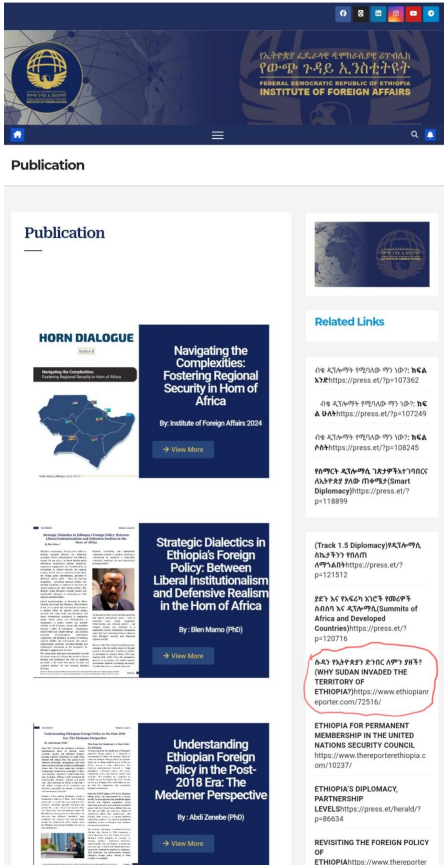
The piece framed Sudan’s reassertion of control in the al-Fashaga region as an act of aggression inspired by Egypt and encouraged by foreign powers.
That article is still prominently displayed at the Federal Democratic Republic of Ethiopia | Institute of Foreign Affairs website, showing the symbiotic working relationship between the two.
According to the author — identified as a senior analyst at Ethiopia’s Institute for Strategic Affairs — Sudan’s actions were motivated by seven factors: an “un-demarcated border,” Egyptian pressure over the Nile and the Grand Ethiopian Renaissance Dam, Sudan’s internal political turmoil, supposed U.S. and Gulf support for Khartoum, Ethiopia’s temporary military weakness due to the Tigray conflict, and a lingering “sense of historic victory” dating back to the 19th-century Mahdist wars.
The article portrayed Ethiopia as a victim of opportunistic neighbors, unfairly targeted at a moment of domestic fragility. It proposed renewed bilateral dialogue and “informal diplomacy” by the Ethiopian diaspora to correct international misunderstanding. Nowhere did it acknowledge that the land in question lies west of the 1902 Anglo–Ethiopian boundary—a line accepted by both countries for nearly a century and still regarded as the international frontier.
This piece exemplifies a wider Ethiopian discourse: when neighboring states act within the limits of treaty boundaries, Ethiopian official media and policy circles often describe such actions as invasions. The contradiction between rhetoric and record provides the starting point for understanding Ethiopia’s territorial politics over the past three decades.
A Chronological Analysis of Map Expansion, Legal Defiance, and the Politics of Victimhood
1 of 6
Imperial Legacy and the Colonial Boundary Framework (1900–1974)
The modern territorial shape of Ethiopia was largely defined through a series of colonial-era treaties negotiated between Emperor Menelik II and the European powers that surrounded his empire.
The 1900, 1902, and 1908 treaties with Italy and Britain delineated Ethiopia’s northern and western borders with Eritrea and Sudan. Although rough in detail, these agreements established the principle of uti possidetis juris — the idea that colonial-era frontiers would be the starting point of modern sovereignty.
During the reign of Haile Selassie, Ethiopia largely respected these treaties while extending influence internally over peripheral areas such as the Ogaden and Gambella. The Emperor’s government saw itself as the guardian of African sovereignty against colonial partition and hosted the Organization of African Unity (OAU) in 1963, whose founding charter adopted the principle of respecting inherited boundaries.
In practice, however, Ethiopian administrations viewed these borders as flexible instruments of imperial security rather than as permanent frontiers. The notion that neighboring states occupied “historically Ethiopian lands” would become a recurring element in the political discourse of subsequent regimes.
Revolutionary Turbulence and the Boundary Status Quo (1974–1991)
The Derg military regime maintained most of the imperial boundaries but was preoccupied with internal insurgencies. In the north, the Eritrean liberation struggle evolved into a full-scale war of independence. In the east, Ethiopia fought Somalia’s attempt to annex the Ogaden (1977–78).
The Derg’s foreign policy was grounded in the rhetoric of “anti-imperialist defense of territorial integrity.” Yet by the late 1980s, Ethiopian forces controlled only part of Eritrea, and the boundary with Sudan was effectively porous. The Derg’s collapse in 1991 opened the door for new boundary politics under the Ethiopian People’s Revolutionary Democratic Front (EPRDF).
III. The EPRDF Era and the Redefinition of Boundaries (1991–1997)
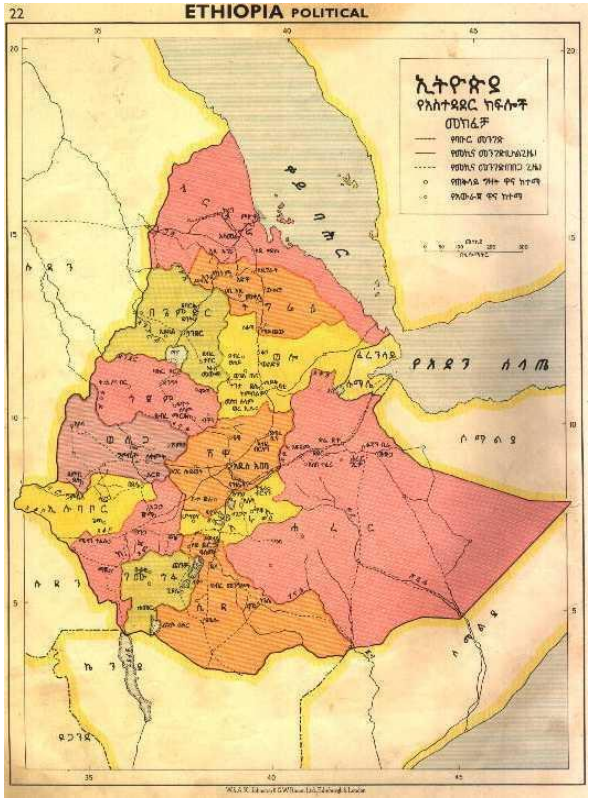
The EPRDF came to power with strong Tigrayan leadership and a revolutionary vision of ethnic federalism. One of its earliest administrative tasks was to produce new regional boundary maps for the federal republic. Between 1993 and 1997, the Ethiopian Mapping Authority issued a series of revised atlases that quietly shifted Ethiopia’s northern and western borders.
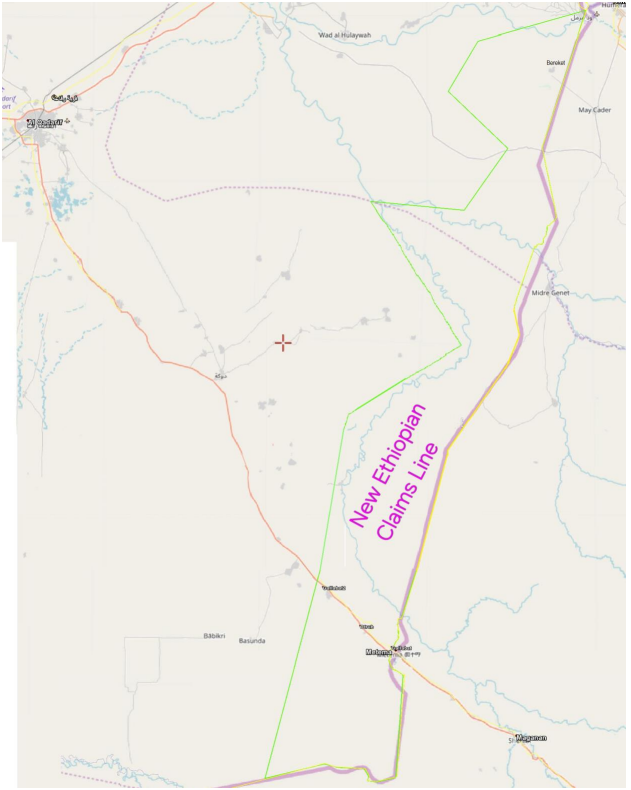
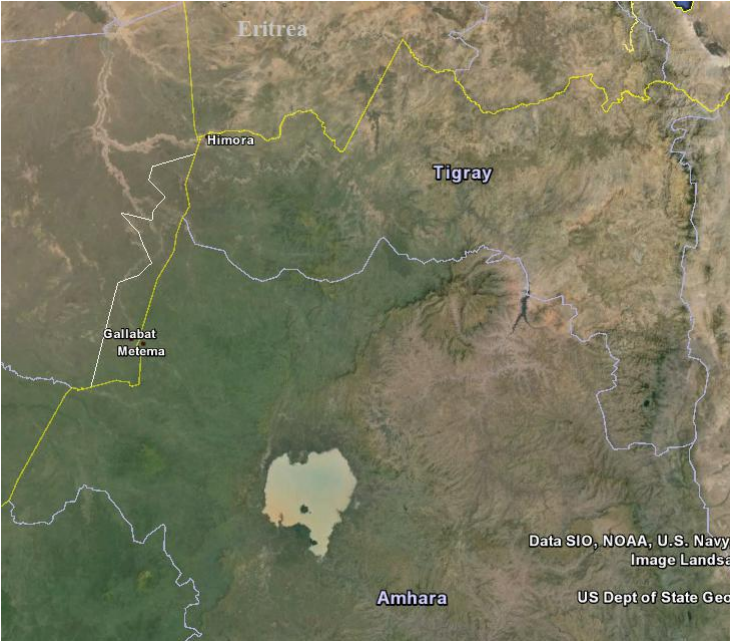
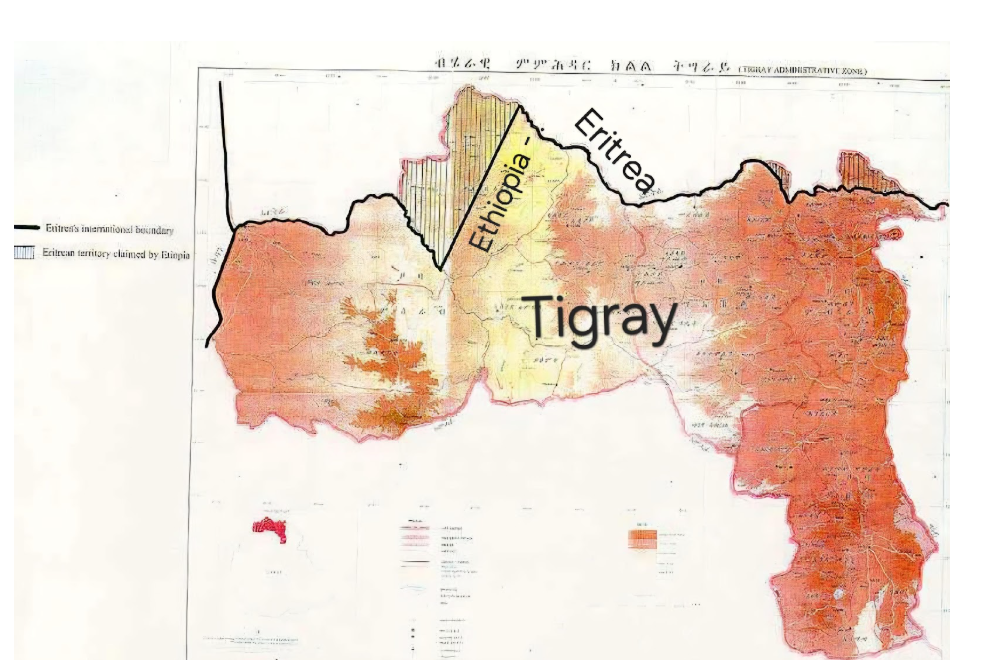
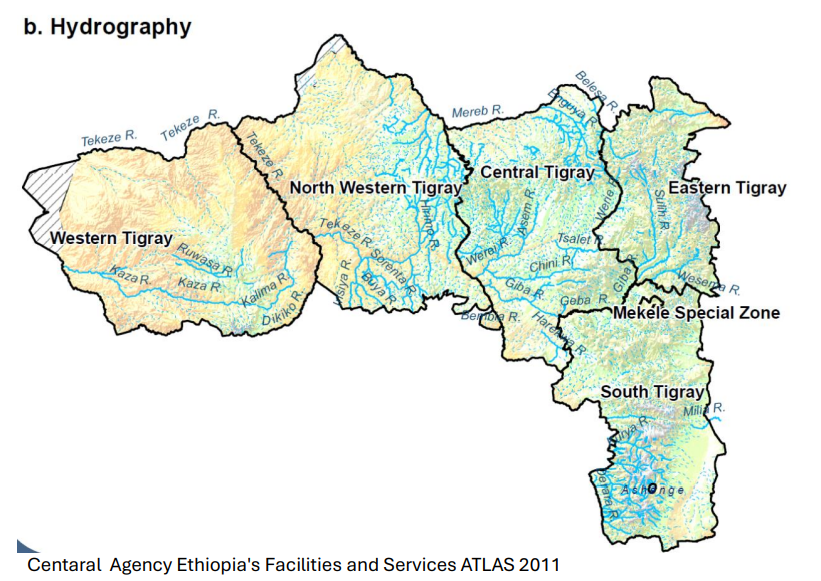
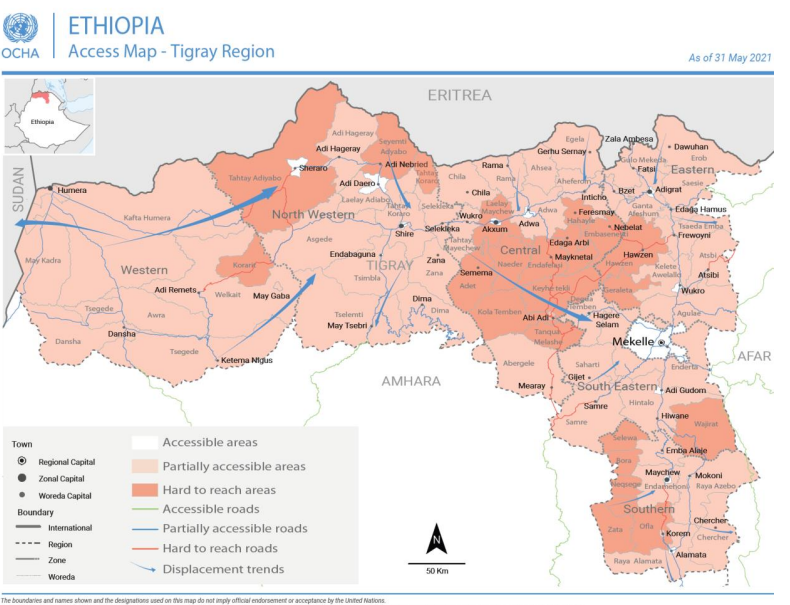
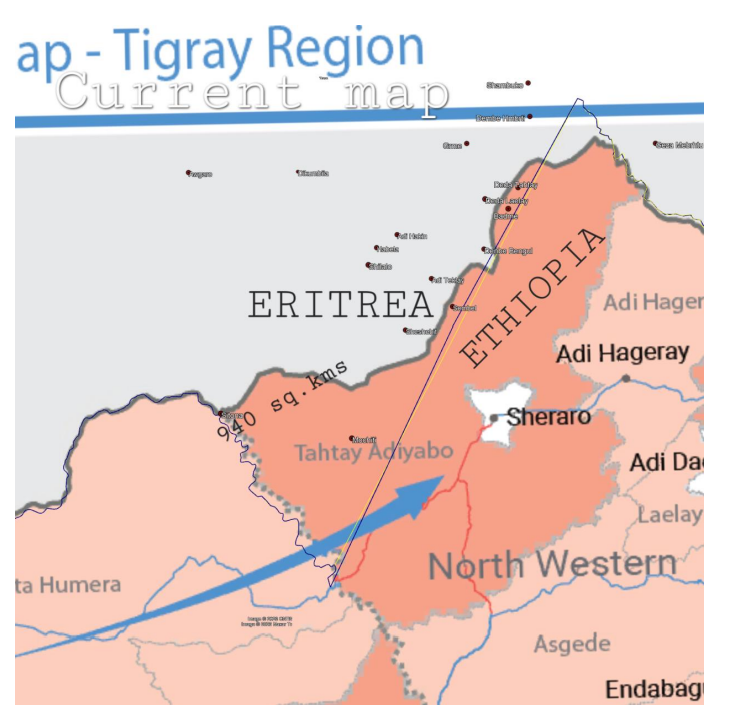
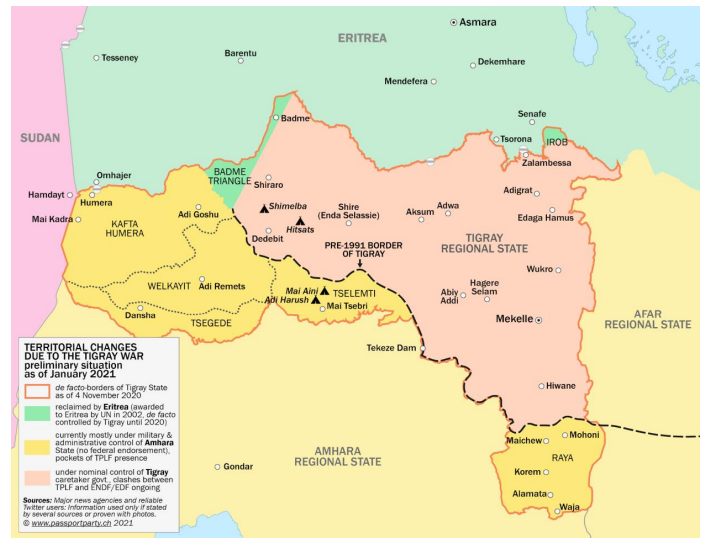
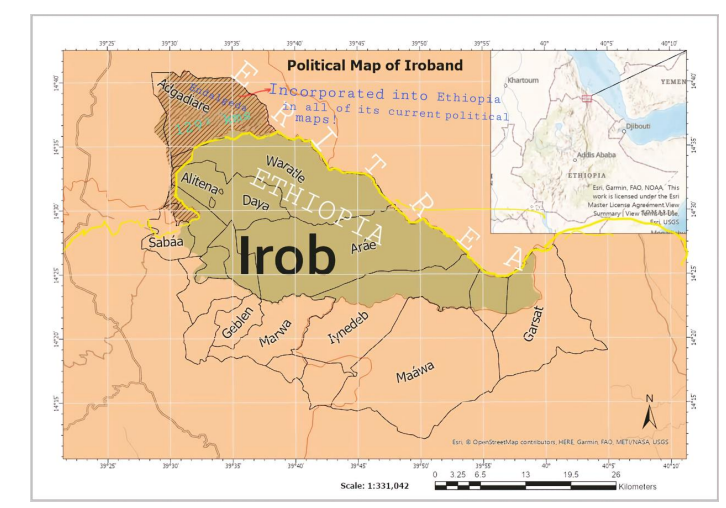
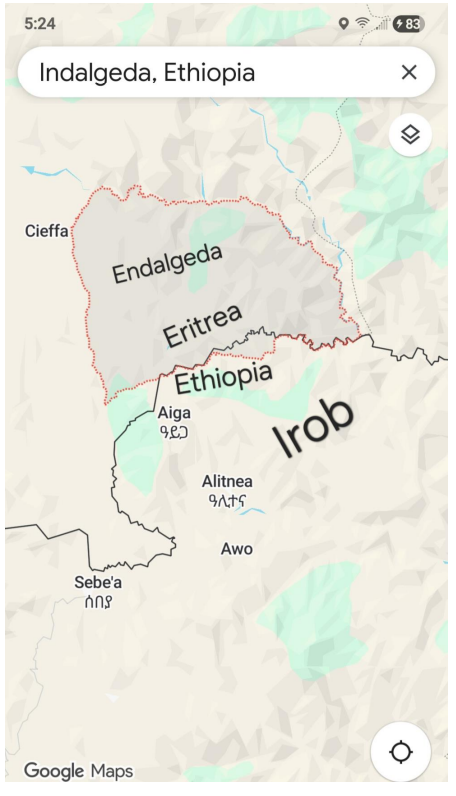
In the north, the Tigray Region was mapped to include Badme, the Irob highlands, and the Mereb–Belesa corridor — all territories historically administered from Eritrea under the 1900–1908 treaties. In the west, Amhara regional maps extended beyond the 1902 Anglo–Ethiopian line into Sudan’s al-Fashaga and Gallabat districts.
These changes were presented as “administrative rationalization” after the fall of the Derg, but they marked the beginning of a new expansionist pattern: unilateral cartographic incorporation of territories that lay outside Ethiopia’s internationally recognized boundaries.
The Eritrea War and the Birth of a Victim Narrative (1998–2002)
The publication of Ethiopia’s 1997 national atlas triggered formal protests from Eritrea, which viewed the inclusion of Badme and other northern villages inside Tigray as a violation of the 1900 boundary treaty. Tensions escalated into the Eritrea–Ethiopia war (1998–2000).
Ethiopia framed the conflict as a response to an “Eritrean invasion” of its territory, a claim that resonated with domestic audiences but contradicted earlier map alterations. The subsequent Eritrea–Ethiopia Boundary Commission (EEBC) — established under the Algiers Agreement of December 2000 — investigated the historical treaties and ruled in April 2002 that Badme, Irob (Endalgeda), and the Mereb–Belesa sector belonged to Eritrea.
The EEBC’s ruling was “final and binding” under international law. Eritrea accepted it; Ethiopia rejected implementation while claiming to “accept the decision in principle.” This legal paradox — acknowledging the authority of the court while refusing compliance — set the tone for the next two decades.
Post-2002: Legal Defiance and Cartographic Entrenchment (2002–2018)
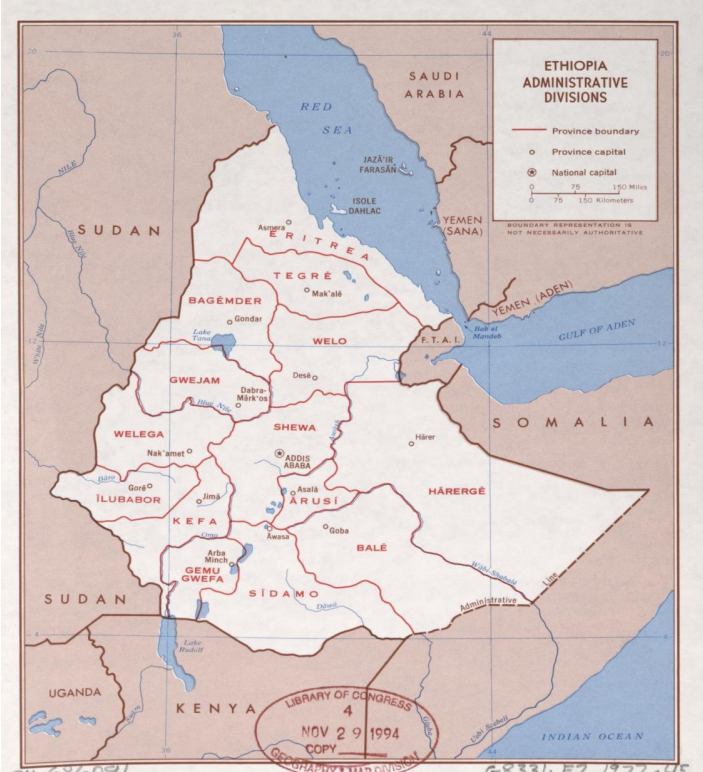
After 2002, Ethiopia continued to occupy the EEBC-awarded territories while publicly portraying Eritrea as the intransigent party. The official narrative emphasized peace and dialogue, but national atlases and administrative datasets retained the pre-2002 maps, depicting the awarded areas as part of Tigray.
Internationally, Ethiopia’s refusal to implement a binding ruling eroded its moral standing as a champion of African unity. Domestically, however, the stance served a nationalist purpose: it reinforced a sense of victimhood and external encirclement that successive governments used to consolidate internal unity.
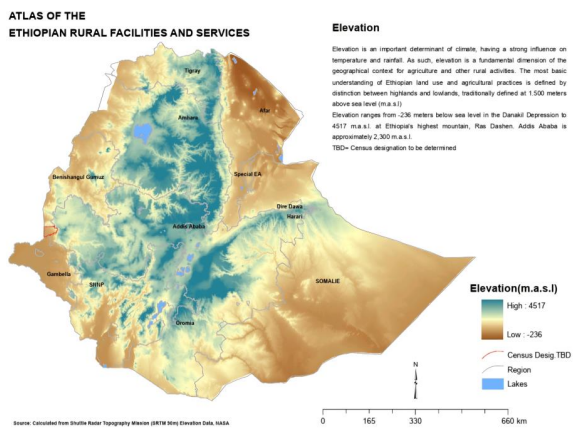
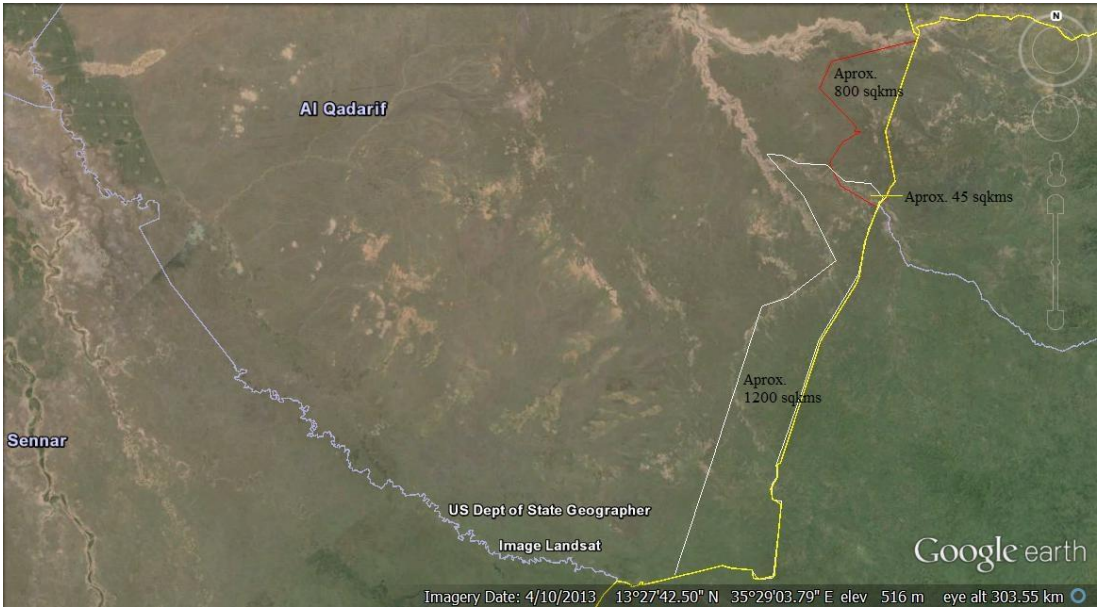
Meanwhile, the same cartographic approach appeared on the western frontier. In Amhara regional maps and the 2011 “Atlas of Rural Facilities and Services”, large portions of Sudan’s al-Fashaga and Gallabat were shown inside Ethiopia. These maps normalized the post-1995 occupation of fertile Sudanese farmland by Ethiopian settlers protected by local militias.
The Al-Fashaga Question and the Return of the Pattern (1995–2025)
The 1902 Anglo–Ethiopian Agreement fixed the western boundary clearly along a surveyed line that has been recognized internationally ever since. For decades, both sides respected it. The situation changed in 1995, when Sudan’s internal instability after the attempted assassination of Egyptian President Hosni Mubarak in Addis Ababa created a security vacuum.
Ethiopian regional forces and Amhara militias moved westward, seizing al-Fashaga, Jabal al-Tayyar (Mount Dagleish), and Gallabat. For over two decades, Ethiopian farmers cultivated these lands under local administration, while Addis Ababa insisted that the border was “un-demarcated.”
Sudan, meanwhile, maintained its adherence to the 1902 line. When Ethiopia became engulfed in the Tigray conflict in 2020, Sudanese forces re-entered the disputed zone to restore control up to the treaty boundary. Ethiopia denounced the move as a “Sudanese invasion,” reproducing almost word-for-word the victim narrative used against Eritrea twenty years earlier.
By 2025, diplomatic negotiations remain frozen: Sudan insists on the 1902 boundary, while Ethiopia demands joint demarcation — a tactic that effectively postpones withdrawal and sustains its claims.
VII. The Broader Regional Context
Ethiopia’s conduct stands in contrast to the continental principle of respecting inherited borders, articulated in the OAU Resolution AHG/Res.16(I) of 1964. That principle — uti possidetis juris — became the foundation of Africa’s post-colonial stability.
Ethiopia, ironically a founding member of the OAU, has violated that very principle more than once.
In the Ogaden (eastern Ethiopia), Addis Ababa uses Somali irredentism to justify heavy militarization and strict control, even though the boundary with Somalia was long settled by the 1897 treaty. In the north and west, it alters maps and defends the resulting disputes as acts of self-defense.
This duality — expansion in fact, victimhood in narrative — has characterized Ethiopia’s external relations since the 1990s. It secures domestic legitimacy but undermines regional trust.
VIII. International and Legal Assessment
International law is clear:
Boundaries established by colonial treaties remain binding unless both parties agree otherwise or an international tribunal revises them. Ethiopia’s actions along both the Eritrean and Sudanese frontiers therefore amount to unilateral alterations of recognized international boundaries, a breach of the Vienna Convention on the Law of Treaties (1969) and of the African Charter principle of territorial integrity.
When Eritrea and Sudan reasserted control over these areas — through the EEBC enforcement in the north and through troop deployment in al-Fashaga — they were acting within the limits of their legal boundaries, not as aggressors.
Consequences for Ethiopia’s Diplomatic Credibility
Ethiopia’s pattern of map manipulation and defensive rhetoric has had three major consequences:
Erosion of Legal Credibility: Having refused to implement a binding international decision, Ethiopia weakened its position to invoke international law against its neighbors.
Regional Distrust: Both Eritrea and Sudan view Ethiopia as a boundary revisionist power rather than a reliable partner.
Loss of Moral Authority: Ethiopia’s long-standing image as Africa’s symbol of anti-colonial integrity now sits uneasily beside its record of disregarding colonial boundaries when inconvenient.
Conclusion
Over the past three decades, Ethiopia has followed a consistent sequence in its border relations:
Cartographic Expansion – Redefining maps and administrative units beyond treaty lines.
Legal Defiance – Rejecting or stalling the enforcement of international boundary rulings.
Victim Narrative – Portraying neighborly reassertions of borders as external aggression.
This pattern emerged in the Eritrean frontier (1997–2002), reappeared in the Sudanese borderlands (1995–2025), and echoes even in Ethiopia’s handling of its eastern Somali frontier.
It reveals a state simultaneously invoking international law for protection while quietly reshaping borders in its favor — a contradiction that has become central to Ethiopia’s regional diplomacy.
Until Ethiopia reconciles its mapmaking practices with the legal boundaries it helped codify through the OAU, it will continue to oscillate between being the architect of African territorial integrity and its most persistent violator.
The Role of International Actors and Institutional Weakness
The international system’s uneven enforcement of boundary law has been a major reason Ethiopia has been able to maintain de-facto control over disputed territories for so long. The issue is less deliberate conspiracy than a pattern of institutional incentives, data inertia, and diplomatic caution that together have produced permissive conditions.
Diplomatic Calculus in the Horn of Africa
Ethiopia has long been a strategic partner for peacekeeping, counter-terrorism, and humanitarian logistics. Because Addis Ababa hosts the African Union and the UN’s main regional offices, Western governments and the UN Secretariat have often treated it as an indispensable interlocutor. This has generated a reluctance to apply sanctions or explicit cartographic corrections that might be interpreted as hostile acts. In practice, the desire to preserve Ethiopia’s cooperation in regional security has outweighed the enforcement of boundary rulings.
The UN’s Administrative Neutrality Trap
After the 2002 Eritrea–Ethiopia Boundary Commission award, the UN Cartographic Section adopted a policy of non-publication of political maps for both states until physical demarcation could occur. The intention was neutrality, yet the outcome was paralysis: by withholding maps, the UN avoided acknowledging Eritrea’s legal entitlement, while UN field offices continued to operate with Ethiopia’s pre-2002 administrative datasets. The same occurred along the Sudanese border, where humanitarian agencies used Ethiopian regional polygons for logistical convenience. The technical neutrality thus translated into de-facto acceptance of unlawful maps.
Data Supply Asymmetry
UNOCHA and other humanitarian agencies depend on “Common Operational Datasets” supplied by host governments. Eritrea does not provide such datasets, while Ethiopia does. The result is a data asymmetry: all operational cartography in the Horn of Africa is anchored in Ethiopian, not Eritrean, shapefiles. Humanitarian mapping therefore reproduces Ethiopia’s version of boundaries, not because of policy preference but because of available data. Over time this has normalized the expanded Ethiopian map in international information systems.
Western Development Agencies
Large development partners—USAID, the EU, and the World Bank—use Ethiopian government base maps for infrastructure and agricultural projects. These datasets incorporate disputed areas such as al-Fashaga and Badme within Ethiopia’s project zones. The repetition of those boundaries across donor reports and GIS portals gives them a quasi-official international appearance, even though they contradict international law. None of these institutions possess an enforcement mechanism to require alignment with treaty boundaries.
Selective Enforcement and Global Politics
Elsewhere—Crimea, Northern Cyprus, Western Sahara—the UN and major powers have insisted on strict cartographic conformity with legal boundaries. In the Horn of Africa, by contrast, the same actors have tolerated ambiguity in the name of humanitarian access and regional stability. The inconsistency has weakened the authority of uti possidetis juris and encouraged Ethiopia to view map manipulation as a low-risk diplomatic strategy.
Summary
The persistence of Ethiopia’s boundary practices cannot be explained by national policy alone. It reflects a broader international environment that prizes stability and access over legal precision. Through administrative inertia, risk avoidance, and dependence on host-country data, the UN and major donors have unintentionally reinforced Ethiopia’s portrayal of contested territories as domestic space. This has allowed an unlawful status quo to harden into apparent normality, at least in global information systems.
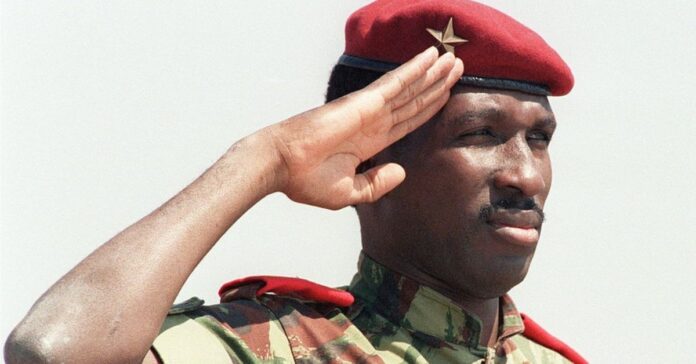
On October 15, 1987, Africa lost one of its most visionary sons. Thomas Sankara, President of Burkina Faso, was assassinated in a coup d’état orchestrated by his former comrade Blaise Compaoré—with the discreet complicity of French intelligence. His death was more than a political crime; it was the silencing of a dream. Sankara embodied the idea of a self-reliant and just Africa, free from the grip of debt, neocolonialism, and cultural domination. Born in 1949 into a modest Catholic family that hoped he would enter the priesthood, Sankara chose the army instead—yet he redefined what it meant to be a soldier. He was a pacifist in uniform, a jazz guitarist in fatigues, a Marxist who refused dogma. His mind combined discipline and imagination, rigor and creativity. In 1983, leading a group of young officers, he overthrew the pro-Western government of Jean-Baptiste Ouédraogo. The following year, he renamed the country Burkina Faso—“the land of upright people”—thus symbolically severing ties with its colonial past. But Sankara’s revolution went far deeper than symbolism. “Our revolution cannot be imported or exported,” he declared. “It must be rooted in our own realities.” He fought illiteracy, child labor, forced marriage, and female genital mutilation. He launched massive vaccination campaigns and planted millions of trees to halt desertification. To cut waste, he sold the government’s Mercedes fleet and replaced it with modest Renault 5s. He reduced his own salary and lived simply. More than anything, he spoke a new political language: one that ordinary people could understand—the language of African dignity.
2. Debt as the Modern Form of Slavery
Sankara was no romantic dreamer. He was a clear-eyed critic of economic dependency and a shrewd reader of global power. At the 1987 summit of the Organization of African Unity in Addis Ababa—just months before his death—he delivered one of the most prophetic speeches of the twentieth century. “Debt,” he said, “is still colonialism, with the colonizers transformed into technical assistants. Those who lent us money are the same who colonized us—and now they want us to pay for our own oppression.” For Sankara, debt was not a moral issue but a structural weapon. Paying it meant sentencing millions to poverty, depriving Africa of the means to fund schools, hospitals, and infrastructure. “If we don’t pay, our creditors won’t die,” he warned. “But if we do, we will.” His proposal was radical yet simple: a united African front refusing to repay illegitimate colonial debts, redirecting those resources to build their own future. “Let us consume what we produce, and produce what we consume,” he urged—a principle that cut to the heart of Africa’s dependency. But such defiance was intolerable to the global order. Too independent for Paris, too socialist for Washington, too honest for his fellow African leaders, Sankara had become dangerous. His assassination was not merely a betrayal—it was a message to every leader who dared to imagine an Africa standing on its own feet.
3. A Concrete Pan-Africanism
What made Sankara different from many pan-African orators was his pragmatism. He did not romanticize Africa; he worked to rebuild it from within. In an era marked by the collapse of socialist experiments and the corruption of postcolonial elites, he sought to create a model of endogenous development—anchored in education, public health, gender equality, and environmental restoration. He made women’s emancipation a cornerstone of his revolution. He appointed women to high office, outlawed polygamy in the civil service, and denounced patriarchy as a form of internal colonization. “There is no true revolution without the liberation of women,” he declared, turning feminism into a state policy long before it was fashionable to do so. Sankara’s leadership was participatory and pedagogical. He explained public budgets in town squares and discussed policy in schools and marketplaces. Despite his authoritarian streak, his charisma inspired loyalty rather than fear. He represented a politics of service rather than privilege. His pan-Africanism was equally grounded in action. He envisioned a continent united not by slogans but by shared projects and mutual accountability. “Those who indebted us,” he told his peers, “are the same who colonized us. We had nothing to do with this debt.” It was a declaration of intellectual sovereignty—a manifesto for a liberation Africa has yet to complete.
4. The Living Legacy of a Revolutionary
Nearly forty years after his assassination, Thomas Sankara remains one of Africa’s most revered and studied figures. His calm, lucid voice—captured in speeches and grainy recordings—still resonates in a world that has changed its forms but not its hierarchies. The multinational corporations he denounced continue to exploit African resources; foreign bases remain entrenched in the Sahel; public debts still strangle national budgets. Yet his legacy endures—not as a monument, but as a seed. In Burkina Faso, where new generations of leaders invoke his name, Sankara has become a symbol of integrity and resistance. Across Europe, young people rediscover him as a rare example of moral coherence and visionary politics. His face adorns murals from Ouagadougou to Paris, his words echo in classrooms and songs. Like Che Guevara, he has become an icon—but unlike many icons hollowed by commodification, Sankara’s image retains its ethical force, alive and uncorrupted. Thomas Sankara never demanded the impossible; he demanded justice. He believed that Africa could sustain itself, that freedom was not a gift but a conquest. And for that conviction, he gave his life—falling with a final cry: “You can kill Sankara, but you can never kill the ideas.” Today, those ideas continue to walk on the feet of millions of young Africans who refuse to be debtors to anyone—except their own future.
The Montevideo Convention on the Rights and Duties of States, signed in 1933 in Uruguay by twenty American republics including Argentina, Brazil, Chile, Mexico, and the United States, was never a European or African affair. Yet its principles became the backbone of customary international law, defining what makes a state a state beyond recognition or political mood swings. Ironically, this Latin American treaty now exposes the hypocrisy of Ethiopia’s campaign against Eritrea’s sovereignty and the ganazo mentality that drives it.
1. The Four Pillars of Statehood and Eritrea’s Strength
Article 1 of the Convention outlines four criteria for statehood: a permanent population, a defined territory, an effective government, and capacity for international relations. Eritrea meets each one without question.
Permanent Population: Eritrea’s people are permanent in every sense, rooted in an identity forged through colonization, war, and endurance. Ethiopia’s argument that migration weakens Eritrea’s legitimacy is dishonest. People fleeing hardship do not erase a nation; they prove its resilience.
Defined Territory: Eritrea’s borders were defined by the 1900, 1902, and 1908 treaties between Italy and Ethiopia and reaffirmed by the Eritrea–Ethiopia Boundary Commission (EEBC) in 2002. Ethiopia’s refusal to implement the ruling and its historical encroachments violate both Article 1 and the non-intervention principle of Montevideo.
Effective Government: Eritrea has a functioning state apparatus. International law does not judge governance by popularity contests but by effectiveness.
Capacity for Foreign Relations: Eritrea maintains embassies, signs treaties, and engages globally. Ethiopia itself has held peace talks and signed agreements with Eritrea, which makes its current “non-existent state” argument both absurd and self-incriminating.
2. Ethiopia’s Breach of Every Montevideo Principle
The Montevideo Convention was designed to protect weaker nations from the predations of stronger ones. Ethiopia’s actions toward Eritrea have violated nearly every principle it stands for.
Non-Intervention: From diplomatic isolation campaigns to economic blockades, Ethiopia’s actions breach Article 8’s commitment to non-interference.
Sovereign Equality: Ethiopia’s tone toward Eritrea reeks of paternalism, the same colonial arrogance Latin America rebelled against when drafting Montevideo.
Recognition Independence: Article 3 states that a state’s existence is independent of recognition by others. Ethiopia’s current rhetoric suggesting it can “rescind” recognition is not just baseless; it’s legally illiterate.
3. The Hidden Strategy: Containment, Exodus, and Collapse
Ethiopia’s long game against Eritrea has been a war of attrition disguised as diplomacy. Through sanctions, border tensions, propaganda, and manufactured crises, Addis Ababa pursued a strategy to weaken Eritrea without direct invasion. The logic was cruelly simple.
Create refugee outflows to hollow out the population.
Cut off trade and credit to cripple the economy.
Spread disinformation to fracture Eritrean unity.
Wait for collapse, then step in under the mask of “humanitarian rescue.”
It was not just hostility; it was calculation. Ethiopia hoped Eritrea would bleed silently, its youth scattered and its economy strangled, until the state itself became a ghost ripe for repossession.
4. Ganazo Mentality and Imperial Nostalgia
Behind this policy is a dangerous blend of ganazo mentality and imperial nostalgia—the loud posturing of power without the substance of legality or restraint. Ethiopia’s political establishment continues to dream of the imperial era, when control over the Red Sea was a symbol of greatness. This nostalgia has mutated into arrogance, a belief that Eritrea’s independence was a historical accident that must one day be corrected.
This mindset mistakes volume for vision and aggression for strategy. It has led Ethiopia to violate every principle the Montevideo Convention was designed to protect. Instead of respecting sovereignty and equality, it clings to fantasies of dominance and entitlement.
5. The Historical Irony
The Montevideo Convention, born from Latin America’s defiance of imperial control, has come full circle as Eritrea’s legal and moral shield. The Convention was drafted by nations tired of domination, determined to define sovereignty as a right, not a favor. Eritrea stands today as their spiritual heir.
Eritrea meets the Convention’s standards in every respect. Ethiopia, consumed by ganazo pride and imperial nostalgia, violates them in every act.
Verdict:
Eritrea stands firm under the Montevideo Convention. Ethiopia stands guilty of undermining its principles through aggression, interference, and containment. The ganazo mentality that drives its policy is the ghost of empire masquerading as strategy. The Montevideo Convention was written to restrain exactly that kind of ambition, to ensure that sovereignty is not dictated by noise, but protected by law.





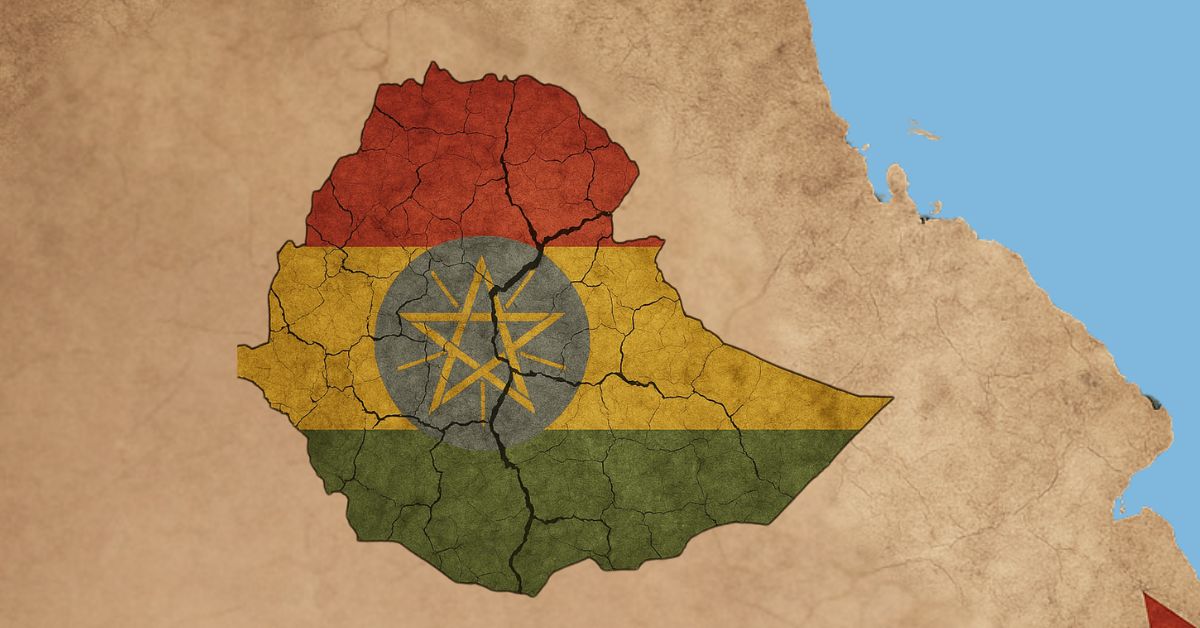 Abiy’s speech reflects a broader trend in Ethiopia’s leadership: reviving imperial nostalgia to rally a divided nation. The Prime Minister’s claim that Ethiopia’s landlocked status is “unnatural” echoes the mindset of earlier rulers who viewed Eritrea not as a neighbor but as a possession. Haile Selassie sought to erase Eritrea’s autonomy through forced federation. Mengistu Hailemariam tried to bomb it into submission. Both failed. Eritrea’s independence stands as one of the most decisive rejections of imperial expansion in modern African history.
 Let there be no misunderstanding: Eritrea’s territorial integrity is not up for debate. The Red Sea, Assab, and Massawa are Eritrean by history, by law, and by the will of the people. Any attempt political or military to challenge that status will be met with the same unwavering resolve that broke the back of Ethiopian and foreign armies before. Eritrea has survived isolation, sanctions, propaganda, and war. It will survive rhetoric, too.