-
A Vision for a Free Africa
On October 15, 1987, Africa lost one of its most visionary sons. Thomas Sankara, President of Burkina Faso, was assassinated in a coup d’état orchestrated by his former comrade Blaise Compaoré—with the discreet complicity of French intelligence. His death was more than a political crime; it was the silencing of a dream. Sankara embodied the idea of a self-reliant and just Africa, free from the grip of debt, neocolonialism, and cultural domination.
Born in 1949 into a modest Catholic family that hoped he would enter the priesthood, Sankara chose the army instead—yet he redefined what it meant to be a soldier. He was a pacifist in uniform, a jazz guitarist in fatigues, a Marxist who refused dogma. His mind combined discipline and imagination, rigor and creativity.
In 1983, leading a group of young officers, he overthrew the pro-Western government of Jean-Baptiste Ouédraogo. The following year, he renamed the country Burkina Faso—“the land of upright people”—thus symbolically severing ties with its colonial past. But Sankara’s revolution went far deeper than symbolism. “Our revolution cannot be imported or exported,” he declared. “It must be rooted in our own realities.”
He fought illiteracy, child labor, forced marriage, and female genital mutilation. He launched massive vaccination campaigns and planted millions of trees to halt desertification. To cut waste, he sold the government’s Mercedes fleet and replaced it with modest Renault 5s. He reduced his own salary and lived simply. More than anything, he spoke a new political language: one that ordinary people could understand—the language of African dignity.
2. Debt as the Modern Form of Slavery
Sankara was no romantic dreamer. He was a clear-eyed critic of economic dependency and a shrewd reader of global power. At the 1987 summit of the Organization of African Unity in Addis Ababa—just months before his death—he delivered one of the most prophetic speeches of the twentieth century.
“Debt,” he said, “is still colonialism, with the colonizers transformed into technical assistants. Those who lent us money are the same who colonized us—and now they want us to pay for our own oppression.”
For Sankara, debt was not a moral issue but a structural weapon. Paying it meant sentencing millions to poverty, depriving Africa of the means to fund schools, hospitals, and infrastructure. “If we don’t pay, our creditors won’t die,” he warned. “But if we do, we will.” His proposal was radical yet simple: a united African front refusing to repay illegitimate colonial debts, redirecting those resources to build their own future.
“Let us consume what we produce, and produce what we consume,” he urged—a principle that cut to the heart of Africa’s dependency. But such defiance was intolerable to the global order. Too independent for Paris, too socialist for Washington, too honest for his fellow African leaders, Sankara had become dangerous. His assassination was not merely a betrayal—it was a message to every leader who dared to imagine an Africa standing on its own feet.
3. A Concrete Pan-Africanism
What made Sankara different from many pan-African orators was his pragmatism. He did not romanticize Africa; he worked to rebuild it from within. In an era marked by the collapse of socialist experiments and the corruption of postcolonial elites, he sought to create a model of endogenous development—anchored in education, public health, gender equality, and environmental restoration.
He made women’s emancipation a cornerstone of his revolution. He appointed women to high office, outlawed polygamy in the civil service, and denounced patriarchy as a form of internal colonization. “There is no true revolution without the liberation of women,” he declared, turning feminism into a state policy long before it was fashionable to do so.
Sankara’s leadership was participatory and pedagogical. He explained public budgets in town squares and discussed policy in schools and marketplaces. Despite his authoritarian streak, his charisma inspired loyalty rather than fear. He represented a politics of service rather than privilege.
His pan-Africanism was equally grounded in action. He envisioned a continent united not by slogans but by shared projects and mutual accountability. “Those who indebted us,” he told his peers, “are the same who colonized us. We had nothing to do with this debt.” It was a declaration of intellectual sovereignty—a manifesto for a liberation Africa has yet to complete.
4. The Living Legacy of a Revolutionary
Nearly forty years after his assassination, Thomas Sankara remains one of Africa’s most revered and studied figures. His calm, lucid voice—captured in speeches and grainy recordings—still resonates in a world that has changed its forms but not its hierarchies. The multinational corporations he denounced continue to exploit African resources; foreign bases remain entrenched in the Sahel; public debts still strangle national budgets. Yet his legacy endures—not as a monument, but as a seed.
In Burkina Faso, where new generations of leaders invoke his name, Sankara has become a symbol of integrity and resistance. Across Europe, young people rediscover him as a rare example of moral coherence and visionary politics. His face adorns murals from Ouagadougou to Paris, his words echo in classrooms and songs. Like Che Guevara, he has become an icon—but unlike many icons hollowed by commodification, Sankara’s image retains its ethical force, alive and uncorrupted.
Thomas Sankara never demanded the impossible; he demanded justice. He believed that Africa could sustain itself, that freedom was not a gift but a conquest. And for that conviction, he gave his life—falling with a final cry: “You can kill Sankara, but you can never kill the ideas.”
Today, those ideas continue to walk on the feet of millions of young Africans who refuse to be debtors to anyone—except their own future.
Thomas Sankara: The Assassinated African Dream
Montevideo and the Eritrean Case: A Mirror Ethiopia Refuses to Face
The Montevideo Convention on the Rights and Duties of States, signed in 1933 in Uruguay by twenty American republics including Argentina, Brazil, Chile, Mexico, and the United States, was never a European or African affair. Yet its principles became the backbone of customary international law, defining what makes a state a state beyond recognition or political mood swings. Ironically, this Latin American treaty now exposes the hypocrisy of Ethiopia’s campaign against Eritrea’s sovereignty and the ganazo mentality that drives it.
1. The Four Pillars of Statehood and Eritrea’s Strength
Article 1 of the Convention outlines four criteria for statehood: a permanent population, a defined territory, an effective government, and capacity for international relations. Eritrea meets each one without question.
Permanent Population: Eritrea’s people are permanent in every sense, rooted in an identity forged through colonization, war, and endurance. Ethiopia’s argument that migration weakens Eritrea’s legitimacy is dishonest. People fleeing hardship do not erase a nation; they prove its resilience.
Defined Territory: Eritrea’s borders were defined by the 1900, 1902, and 1908 treaties between Italy and Ethiopia and reaffirmed by the Eritrea–Ethiopia Boundary Commission (EEBC) in 2002. Ethiopia’s refusal to implement the ruling and its historical encroachments violate both Article 1 and the non-intervention principle of Montevideo.
Effective Government: Eritrea has a functioning state apparatus. International law does not judge governance by popularity contests but by effectiveness.
Capacity for Foreign Relations: Eritrea maintains embassies, signs treaties, and engages globally. Ethiopia itself has held peace talks and signed agreements with Eritrea, which makes its current “non-existent state” argument both absurd and self-incriminating.
2. Ethiopia’s Breach of Every Montevideo Principle
The Montevideo Convention was designed to protect weaker nations from the predations of stronger ones. Ethiopia’s actions toward Eritrea have violated nearly every principle it stands for.
Non-Intervention: From diplomatic isolation campaigns to economic blockades, Ethiopia’s actions breach Article 8’s commitment to non-interference.
Sovereign Equality: Ethiopia’s tone toward Eritrea reeks of paternalism, the same colonial arrogance Latin America rebelled against when drafting Montevideo.
Recognition Independence: Article 3 states that a state’s existence is independent of recognition by others. Ethiopia’s current rhetoric suggesting it can “rescind” recognition is not just baseless; it’s legally illiterate.
3. The Hidden Strategy: Containment, Exodus, and Collapse
Ethiopia’s long game against Eritrea has been a war of attrition disguised as diplomacy. Through sanctions, border tensions, propaganda, and manufactured crises, Addis Ababa pursued a strategy to weaken Eritrea without direct invasion. The logic was cruelly simple.
Create refugee outflows to hollow out the population.
Cut off trade and credit to cripple the economy.
Spread disinformation to fracture Eritrean unity.
Wait for collapse, then step in under the mask of “humanitarian rescue.”
It was not just hostility; it was calculation. Ethiopia hoped Eritrea would bleed silently, its youth scattered and its economy strangled, until the state itself became a ghost ripe for repossession.
4. Ganazo Mentality and Imperial Nostalgia
Behind this policy is a dangerous blend of ganazo mentality and imperial nostalgia—the loud posturing of power without the substance of legality or restraint. Ethiopia’s political establishment continues to dream of the imperial era, when control over the Red Sea was a symbol of greatness. This nostalgia has mutated into arrogance, a belief that Eritrea’s independence was a historical accident that must one day be corrected.
This mindset mistakes volume for vision and aggression for strategy. It has led Ethiopia to violate every principle the Montevideo Convention was designed to protect. Instead of respecting sovereignty and equality, it clings to fantasies of dominance and entitlement.
5. The Historical Irony
The Montevideo Convention, born from Latin America’s defiance of imperial control, has come full circle as Eritrea’s legal and moral shield. The Convention was drafted by nations tired of domination, determined to define sovereignty as a right, not a favor. Eritrea stands today as their spiritual heir.
Eritrea meets the Convention’s standards in every respect. Ethiopia, consumed by ganazo pride and imperial nostalgia, violates them in every act.
Verdict:
Eritrea stands firm under the Montevideo Convention. Ethiopia stands guilty of undermining its principles through aggression, interference, and containment. The ganazo mentality that drives its policy is the ghost of empire masquerading as strategy. The Montevideo Convention was written to restrain exactly that kind of ambition, to ensure that sovereignty is not dictated by noise, but protected by law.
Read the full text of the Convention: Montevideo Convention on the Rights and Duties of States (PDF)
War of Narratives: Eritrea at the Center of a Shifting Horn
A quiet but intense information war is unfolding across the Horn of Africa, with Eritrea once again at the center of competing narratives about sovereignty, security and the Red Sea.
During the first week of October, three publications and one diplomatic document converged to portray Eritrea as both unstable and obstructive. Together, they created a single storyline that regional observers say could shape how international institutions perceive future relations between Asmara and Addis Ababa.
The Economist’s Familiar Portrayal
On Oct. 2, The Economist magazine described Eritrea as “Africa’s most secretive dictatorship facing an existential crisis.”
The article claimed Ethiopian Prime Minister Abiy Ahmed intends to “gain control of one of Eritrea’s Red Sea ports,” reviving speculation that Addis Ababa could use force to regain maritime access.
Eritrea’s Information Minister Yemane G. Meskel denounced the piece on X (formerly Twitter), calling it “grotesquely speculative” and “vindictive.” The government said the British publication’s reporting recycled “outdated ideological perspectives” and ignored Eritrea’s right to self-determination.
The Economist (4-10 Oct. 205 Edition) continues to excel in notoriety to churn out another grotesquely speculative report against Eritrea. As in previous cases, its chronic problem is two-fold: i) vindictive excesses of a disgruntled HOA reporter who was booted out from the…
— Yemane G. Meskel 🇪🇷 (@hawelti) October 6, 2025
Analysts argue the timing of the story reinforces a broader campaign to frame Eritrea’s sovereignty as conditional and Ethiopia’s ambitions as inevitable.
Horn Review’s Legal Provocation
Two days before The Economist’s issue appeared, the regional think tank Horn Review published an essay titled “Eritrea Unraveled: The Case for Ethiopia’s Reversal of State Recognition.”
The piece claimed that Ethiopia’s 1993 recognition of Eritrea’s independence was “premature, unconstitutional and reversible.” It cited the Montevideo Convention to suggest that Eritrea no longer meets international criteria for statehood because of population flight, political repression and economic stagnation.
Legal experts contacted by Setit Media rejected the argument as “lawfare” the use of legal language to achieve political ends. They noted that Eritrea’s independence was affirmed through a UN-supervised referendum and recognized by the African Union, making its sovereignty irreversible under the continental principle of uti possidetis juris, which preserves colonial-era borders.
Ethiopia’s Letter to the United Nations
On Oct. 2, Ethiopia’s Ministry of Foreign Affairs sent a formal letter to UN Secretary-General António Guterres accusing Eritrea of funding insurgent groups and colluding with remnants of the Tigray People’s Liberation Front. The letter, signed by Foreign Minister Gedion Timothewos Hessebon, said Eritrea’s “ultimate objective is to destabilize and fragment Ethiopia.”
Addis Ababa alleged that Asmara has armed militias in the Amhara region and backed a TPLF splinter faction. The two-page correspondence warned that Ethiopia’s “policy of maximum restraint is not indefinite,” even as it asserted the government’s commitment to pursue sea access “through peaceful means.”
Diplomatic observers viewed the letter as an attempt to internationalize what has been a bilateral dispute, positioning Ethiopia as a victim of external aggression while reaffirming its ambition to secure Red Sea access.
Coordinated Messaging
Taken together, The Economist article, the Horn Review essay and the Ethiopian letter reflect a synchronized message, according to regional analysts: Eritrea as the source of instability, Ethiopia as the aggrieved power seeking order.
Setit Media’s review of the sequence shows the narratives moving in stages first through Western journalism, then regional commentary, and finally formal diplomacy. Each step reinforced the next.
“This is how perception management works,” one researcher that Setit spoke to said. “First you describe Eritrea as failing, then question its legitimacy, and finally justify action in the name of peace.”
Eritrea’s Challenge
Eritrea has maintained a characteristically reserved posture. Officials in Asmara have not issued new statements beyond Minster Yeman G.Meskel’s rebuttal. Analysts caution, however, that in the modern information environment, silence can be misinterpreted as acquiescence.
Communications specialists urge Eritrea to adopt a more proactive strategy: documenting facts, engaging African institutions and challenging narratives that undermine its legitimacy.
“Eritrea’s sovereignty was earned, not granted,” said a former diplomat familiar with the 1993 independence process. “But if others tell the story louder and faster, they can reshape how that sovereignty is perceived.”
The Broader Red Sea Context
The dispute unfolds as power competition intensifies along the Red Sea. Sudan remains fragmented, Egypt expands its naval presence, and Gulf States pursue influence through port investments.
Eritrea’s coastline especially the ports of Assab and Massawa has become a symbolic prize in the region’s new maritime chessboard. Ethiopia’s repeated references to sea access underscore that geography remains destiny in the Horn of Africa.
Setit’s View
Setit Media maintains that Eritrea’s independence, affirmed by international law and three decades of sovereign governance, cannot be revoked by editorial campaigns or diplomatic pressure.
The events of early October demonstrate that the struggle over Eritrea’s image has replaced earlier military confrontation with a battle of narratives. In this contest, the most powerful weapon is not the missile, but the message.
Eritrea’s task is clear: respond not with outrage but with evidence, clarity and confidence.
Because in today’s Horn of Africa, sovereignty is defended not only by borders but by words.
Letter to My Country
Eritrea in an Italian Satire Show
A few nights ago, during a well-known Italian satire show, a comedian joked: “The only ones still refusing to recognize the State of Palestine are the United States and a few third-world countries… like Eritrea and Italy.” The audience laughed. I didn’t. There was something painful in that laughter — a sting of truth mixed with distortion. My homeland, Eritrea, does not deserve to be reduced to a punchline. It is a nation born out of one of Africa’s longest and most courageous struggles for liberation, built upon unimaginable sacrifices and guided by an unshakable belief in freedom.
To think that today Eritrea is remembered not for its dignity or independence but for its silence toward other oppressed people — the Palestinians — is deeply unsettling. I keep asking myself: how can a country that once stood so clearly against colonialism and injustice still withhold recognition from the State of Palestine, as more than 150 nations have already done, including nearly all African countries? This is not a matter of diplomatic formality. It is a question of conscience and historical coherence.
Memories of Solidarity: When Eritrea and Palestine Walked Together
In the 1970s and 1980s, during Eritrea’s war of independence, a deep bond united the Eritrean People’s Liberation Front (EPLF) and the Palestine Liberation Organization (PLO). The two movements saw themselves as sister struggles — parallel quests for self-determination. This was not rhetoric. There were joint statements, exchanges of experience, and genuine mutual recognition born out of shared pain and defiance. Both peoples knew the price of freedom and the weight of injustice.
Even after independence, Eritrea’s Ministry of Foreign Affairs consistently reaffirmed solidarity with the Palestinian cause, supporting its right to statehood. That is why the government’s current position feels so difficult to understand. Why, after decades of moral and political alignment, does Eritrea remain silent now — at the very moment when the Palestinian tragedy has reached its most unbearable point, with constant bombardments, occupation, and thousands of civilian deaths?
Some might argue that the “two states for two peoples” formula is outdated or unrealistic. But that cannot justify withholding recognition. First, a people’s right to exist must be acknowledged; only then can coexistence be defined. Eritrea, more than most nations, knows the cost of liberation. To remain neutral or silent now is to forget that history. Recognizing Palestine is not an ideological act — it is a moral one, consistent with the values that gave Eritrea its very soul.
An Appeal for Coherence: Freedom Is Universal or It Is Nothing
Across Africa today, almost every nation has recognized Palestine — from South Africa to Senegal, from Algeria to Nigeria. Only two countries on the continent, Eritrea and Cameroon, have yet to do so. This is not a statistic; it is a moral question. Eritrea, which has long aspired to be a symbol of independence and dignity, now appears isolated on an issue that lies at the very heart of its founding ideal: the right of peoples to self-determination.
To withhold recognition of Palestine now, when the International Court of Justice has warned of a “plausible risk of genocide,” is to miss a moral opportunity. Silence, when it becomes institutional, is no longer prudence — it becomes surrender. Those of us in the diaspora, watching protests and debates across the Western world, feel this contradiction deeply. We wonder why our government, which once spoke so clearly for justice, now remains voiceless before a people whose struggle mirrors our own.
This letter is not an accusation but an appeal — an invitation to rediscover Eritrea’s moral strength and historical coherence. To recognize Palestine is not to take sides; it is to affirm a principle: freedom is indivisible. If it applies only to ourselves, it ceases to be freedom. In a world that too often confuses power with right, Eritrea could once again remind the world — as it once did — that the dignity of nations is not negotiable.
That is why I ask, as a citizen and as a son of this land, that our government clarify its position and take the step that would align Eritrea once more with its own history of justice, courage, and integrity. Because our independence, if it cannot recognize the independence of others, risks becoming only a memory — not an example.
When Strategic Cooperation Becomes Reckless: Russia’s Naval and Nuclear Agreements with Ethiopia
Executive Summary
In 2024, Ethiopia and Russia signed agreements expanding cooperation in nuclear energy and naval defense. Both governments present these deals as developmental, but Ethiopia’s enduring political fragility, unresolved internal conflicts, and strained relations with its neighbors make such projects especially risky. These agreements may worsen instability in the Horn of Africa and undermine Russia’s credibility in Africa.
Key finding: Absent regional safeguards, Russia’s naval and nuclear cooperation with Ethiopia is reckless and risks being viewed as a form of negligence with predictable civilian and regional consequences.
Background
Ethiopia’s Fragility: For over fifty years, Ethiopia has cycled through authoritarian rule, ethnic conflict, and humanitarian crises. Active violence in Tigray, Amhara, and Oromia continues to displace millions (Council on Foreign Relations, 2024).
Russian Engagement: In September 2024, Ethiopian Prime Minister Abiy Ahmed met with President Vladimir Putin, announcing expanded cooperation in nuclear energy, energy projects, and military technology (Kremlin, 2024).
Naval Agreement: Ethiopia and Russia signed a naval cooperation pact in 2024, signaling Moscow’s broader push into Red Sea security (Fanamc, 2024; ICDS, 2023; ICWA, 2024).
Risks and Implications
Domestic Risks
Ethiopia lacks the institutional capacity to regulate nuclear facilities or protect naval assets.
New agreements risk empowering factions, aggravating ethnic conflict, and diverting resources from humanitarian relief.
Regional Risks
Naval ambitions may alarm neighbors such as Eritrea, Djibouti, and Somalia.
Disputes over Red Sea access could spill into broader Horn of Africa instability.
Global Risks
Militarization in Ethiopia may entrench great-power competition in a fragile region, raising risks for Red Sea maritime security and global trade.
Russia’s reputation as a cautious African partner may erode if cooperation destabilizes its allies.
Policy Options
- Restraint in Bilateral Deals
Russia should pause or scale down nuclear and naval initiatives until Ethiopia demonstrates improved stability and governance.
Ethiopia should prioritize peacebuilding and security-sector reform over new militarization.
- Continental Framework
Reframe nuclear and naval projects as African Union initiatives rather than bilateral ventures.
Regional distribution (e.g., one project per African region) would spread benefits and reduce political risk.
- Continental Security Protection
Facilities should be secured by an AU protection force, insulated from global rivalries.
Neutrality, rotation across regions, and rights-based rules of engagement are critical safeguards.
Recommendations
For Ethiopia:
Suspend sensitive military and nuclear cooperation until peace agreements are consolidated.
Rebuild trust with neighbors before advancing Red Sea or naval ambitions.
For Russia:
Return to a cautious, non-escalatory Africa policy.
Avoid initiatives that risk inflaming conflict within friendly states.
For the African Union:
Lead in designing continental frameworks for strategic projects.
Ensure accountability, transparency, and neutrality in any nuclear or naval initiative.
Conclusion
Russia’s naval and nuclear agreements with Ethiopia may appear ambitious, but under current conditions they risk worsening Ethiopia’s instability, straining regional relations, and undermining continental security. Without continental ownership, regional safeguards, and insulated protection mechanisms, such projects remain reckless gambles that could do more harm than good.
—
References
Council on Foreign Relations. (2024). Conflict in Ethiopia. Global Conflict Tracker. https://www.cfr.org/global-conflict-tracker/conflict/conflict-ethiopia
Fanamc. (2024, September 12). Ethiopian and Russian navies sign cooperation agreement. https://www.fanamc.com/english/ethiopian-russian-navies-signcooperation-agreement/
International Centre for Defence and Security (ICDS). (2023, June 26). Russia and the Red Sea since 2022: Militarised foreign policy or strategy of conflict?
Indian Council of World Affairs (ICWA). (2024, February 16). Russia’s new naval ambitions in the Red Sea. https://www.icwa.in/show_content.php? lang=1&level=1&ls_id=13073&lid=7980
Kremlin. (2024, September 3). Meeting with Prime Minister of Ethiopia Abiy
Ahmed. http://en.kremlin.ru/events/president/news/78072
Ethiopia’s Sea Access Gambit: Between Diplomacy, Military Revisionism, and Propaganda
Ethiopia’s Maritime Puzzle
Since losing its coastline with Eritrea’s independence in 1993, Ethiopia has wrestled with dependence on Djibouti for over 95 percent of its imports and exports. For years, this reliance has fueled unease in Addis Ababa about sovereignty, security, and economic growth.
Now, a new chapter is unfolding. Between 2023 and 2025, Ethiopian leaders have swung between fiery threats, unilateral port deals, military revisionism, and diplomatic appeals. Ethiopia’s calculated ambiguity about its quest to the sea outlet is bereft of stealth.
From Abiy’s Warning to Somaliland’s Deal
In October 2023, Prime Minister Abiy Ahmed warned parliament that Ethiopia “must acquire a port” and, if denied justice, “we will fight.” The bluntness alarmed Eritrea and Somalia.
By January 2024, Addis Ababa pursued a different path: a controversial Memorandum of Understanding with Somaliland. The deal promised Ethiopia access to Berbera port and potential military basing in exchange for possible recognition of Somaliland’s independence. Mogadishu denounced the move as illegal, Egypt rallied to Somalia’s side, and the region braced for escalation.
Taye’s Softer Line at the UN
Fast forward to September 2025. Speaking before the UN General Assembly, President Taye Atske-Selassie struck a more conciliatory note: “All that Ethiopia asks for is access to the sea.”
Gone were the threats of 2023. The statement echoed international law, which recognizes landlocked states’ rights to transit but only through agreements with coastal neighbors.
Generals Raise the Stakes
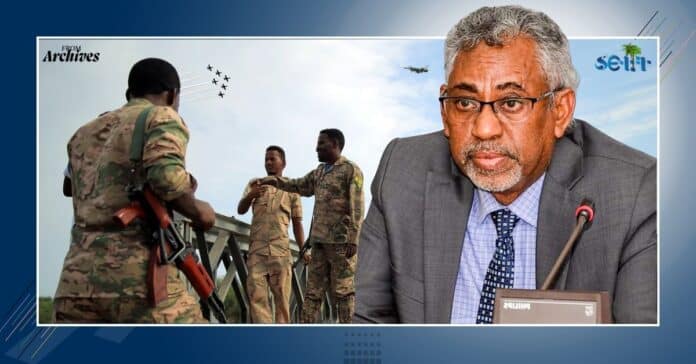
Yet, behind the podium diplomacy lies a harder edge. In September 2025, Major General Teshome Gemechu, a senior Ethiopian defense official, openly questioned the legitimacy of Eritrea’s 1993 independence. He suggested that the Red Sea port of Assab had been wrongly ceded, hinting at unfinished business.
Similarly, Brigadier General Bultii Taaddasaa, Chief Executive Officer of Ethiopia’s Military War College, features prominently in Ethiopia’s strategic discourse. His influence shapes how the officer corps frames questions of sovereignty, access, and regional order (see video here: https://youtu.be/Pl3x-oDK1DA?si=1vzql8V6q0LZ-dkZ).
Propaganda as Pretext
Alongside these voices, Ethiopian state and allied media have amplified a narrative that Eritrea is backing insurgencies in both Tigray and Amhara.
One striking video, titled “የሽግግር መንግስት የባህር በር አሳልፎ የመስጠት መብት የለውም” (“The Transitional Government Has No Right to Cede the Sea Port”), is available here: https://youtu.be/hhgmWdL4A1U?si=0ILGU9g-Uzjwl_-T. It asserts that no government has the right to give away a port, framing maritime access as a matter of national betrayal.
But the narrative stretches credibility. The Tigray People’s Liberation Front (TPLF) has historically despised Eritrea — from the 1998–2000 border war to the recent Tigray conflict, where it accused Eritrea of atrocities. Branding TPLF as an Eritrean proxy is politically convenient, but factually dubious.
Why This Matters
- Dual messaging — At the UN, Ethiopia presents moderation; at home, generals and propagandists float sovereignty revisionism.
2. Legal limits — International law provides rights of transit, not territorial claims.
3. Regional instability — Eritrea views such rhetoric as existential. Somalia is already destabilized by the Somaliland deal. Djibouti fears being sidelined. Egypt sees an opportunity to exploit Ethiopia’s overreach.
The Horn’s Precarious Balance
The Horn of Africa is no stranger to war over borders. The 1998–2000 Ethiopia–Eritrea war cost tens of thousands of lives. A return to sovereignty disputes would risk dragging the region into another cycle of conflict, at a time when drought, displacement, and economic fragility already burden millions.
Ethiopia faces a stark choice: pursue negotiated, contractual access through Djibouti or Somalia — preserving regional stability — or indulge revisionist claims and propaganda, risking regional war and international isolation.
The Bottom Line
Ethiopia’s maritime rhetoric is more than a policy debate; it is a struggle between moderation and militarism. If Addis Ababa’s diplomats prevail, the country may secure fair access through law and negotiation. If its generals and propagandists dominate, the Horn of Africa could face yet another destabilizing crisis.
Ethiopia’s calculated ambiguity about its quest to the sea outlet is bereft of stealth.
Roots and Diaspora: An Unbreakable Bond
I returned to my beloved country, Eritrea, between August and September, and spent about three weeks there enough time to observe daily life up close. From the mild climate of the highlands down to the lowlands, one can sense a striking richness: the country’s ethnic and linguistic diversity, the spicy aromas of the markets, and the many voices mingling in the squares. For me, hearing my mother tongue, Tigrinya, spoken everywhere was almost magical. It brought childhood memories to the surface and allowed me to feel, almost physically, the strength of my roots.
Living in the Eritrean diaspora in my case in Italy, where I arrived at the age of twelve—teaches one to recognize and appreciate many aspects of a “second homeland.” Yet the land of one’s origins remains an essential point of reference, something one can never renounce. With these impressions still vivid, I will set down a few observations formed during my stay. My perspective is that of someone who belongs to the diaspora but has never severed the bond with the land of birth. Moreover, it is precisely the power of that bond that makes the persistence of a troubling phenomenon more painful: Eritrea’s massive emigration and the resulting demographic fragility.
The lack of regular censuses and reliable statistics on migration flows prevents us from defining an exact picture, but the trend is clear: a negative migratory balance undermines the foundations of any sustainable development strategy. The skills and human capital of the diaspora—an extraordinary potential driver of growth—are not being used as they should be. Policies are needed to encourage the return of Eritreans abroad and to promote investments, starting with sectors that require relatively low start-up costs, such as tourism and related services.
Structural Deficits and the Infrastructure Gap
This demographic challenge is closely tied to deficiencies in infrastructure and basic services. More than thirty years after independence, everyday life in Eritrea is still marked by intermittent electricity supply, inadequate water and transport networks, and a labor market that remains fragmented and only partially formalized.
Asmara provides a telling example: local mobility relies almost entirely on taxis. For visitors from the diaspora who benefit from favorable currency exchange—this may seem inexpensive, but for residents it is costly. Traveling from one city to another often takes a full day, with heavy costs in time and money for both families and businesses. Yet Eritrea’s modest size and geographical configuration would make it feasible to build two railway lines and a small network of main highways capable of connecting the country’s key regions with relative ease.
The absence of a comprehensive infrastructure plan limits not only quality of life but also internal trade and productive investment, with negative consequences for overall economic competitiveness.
The Myth of Self-Sufficiency and Its Consequences
To understand these delays, one must examine the country’s economic policy choices. Since independence, the government has pursued a rigid interpretation of the principle of self-sufficiency. In certain strategic sectors—such as energy production or the management of dams, crucial in a context of climate change and water scarcity—this approach may be understandable. However, it has evolved into an all-encompassing paradigm with penalizing consequences.
Historical experience shows that planned economies have never worked in the long term: wherever they have been implemented, they have produced structural imbalances, inefficiencies, and barriers to innovation. Eritrea’s decision to adopt an almost entirely state-driven economic model has discouraged the emergence of a genuine private sector, stifling the entrepreneurial initiative of both residents and the diaspora.
Moreover, the country’s weak integration into international banking and financial circuits—something not entirely attributable to sanctions, since restrictions on the Swift payments system date only from 2019 has deepened economic isolation. What is needed is not merely a balanced mix of public intervention and market dynamics, but also a simple and transparent bureaucracy and, above all, basic institutions capable of offering legal and regulatory certainty to those willing to invest.
Alternative Paths to Development: Comparative Lessons and Economic Theories
Autarky is far from the only option available to a post-colonial country with limited natural resources but a global diaspora rich in human capital. Economic scholarship offers a wide range of models: from Soviet-style planned economies whose inefficiency is historically proven to mixed economies that combine public intervention with market mechanisms, and to export-oriented industrialization strategies pioneered in various Asian countries.
Recent history demonstrates that the combination of a strong public sector and a dynamic private sector can deliver both resilience and sustainable growth. Eritrea, by contrast, has often concentrated state action in low-productivity sectors without fostering a context that encourages productive diversification.
The experience of other African economies that have undertaken gradual liberalization—maintaining state control over strategic sectors while opening to private capital and foreign investment—shows that total self-sufficiency is not a prerequisite for economic sovereignty. On the contrary, it can hinder the strengthening of those institutions which, as Douglass North argues, are the true engine of long-term development.
Toward a Strategic Rethink
Acknowledging the limits of Eritrea’s current model does not mean overlooking the country’s objective challenges: the legacy of a long war of independence, regional tensions, and the complex balance of power in the Horn of Africa. However, to continue attributing internal difficulties solely to external factors risks becoming an alibi that paralyzes reform.
A strategic rethink should begin with some essential priorities: strengthening basic infrastructure, guaranteeing essential services, promoting private entrepreneurship—especially that of the diaspora—and easing access to banking and financial instruments.
In an interdependent world, an economy that chooses to close itself off risks perpetuating dependence on emigration and intensifying the outflow of human capital. Only a well-balanced combination of public intervention and market openness can create the conditions for inclusive development and lasting social peace.
The strength of Eritrea’s cultural roots and the enduring sense of belonging within the diaspora show that intangible resources are abundant. What is required is for these resources to be matched by institutions capable of translating the country’s potential into tangible progress for present and future generations.
⸻
Bibliography
Asmerom, Kidane. Eritrea’s Political Economy: Nationalism and Development. London: Routledge, 2020.
Clapham, Christopher. The Horn of Africa: State Formation and Decay. London: Hurst, 2017.
North, Douglass C. Institutions, Institutional Change and Economic Performance. Cambridge: Cambridge University Press, 1990.
Tronvoll, Kjetil, and Daniel R. Mekonnen. The African Garrison State: Human Rights and Political Development in Eritrea. Woodbridge: James Currey, 2014.
World Bank. Eritrea Country Economic Memorandum: Shaping the Future. Washington, DC: World Bank, 2022.
Eritrea Between Campism and Democracy
Following Daniel Mulugeta’s article, published on August 11, 2025, in Setit as a response to Ann Garrison’s piece in the Black Agenda Report, it seems essential to broaden the discussion on Eritrea’s political condition and on the narratives surrounding it. Mulugeta’s intervention had the merit of cutting through ideological simplifications, contrasting Garrison’s portrayal of Eritrea as a defiant, sovereign nation with the reality of a political system frozen for decades. He reminded readers that both the 1994 Charter and the 1997 Constitution—documents drafted by Eritreans for Eritreans—could have paved the way for gradual political participation, but were soon shelved. Since 2002, parliament has not convened; the PFDJ congress has been suspended since 1994; and several key ministries remain leaderless. Within this institutional vacuum, the Eritrean diaspora remains split between those who support the government as a bulwark of sovereignty and those who denounce its absence of rights and accountability, without either side finding solid democratic legitimacy. This is where the debate can be expanded by introducing a broader analytical category: campism, a concept Étienne Balibar has used to describe the tendency to reduce international politics to a binary choice of alignment, for or against the West, regardless of the internal nature of the regimes concerned.
Campism emerged in the Cold War, when the world was divided into two rigid blocs: the capitalist camp led by the United States and the socialist camp under the Soviet Union. In that environment, legitimacy was not measured by domestic institutions but by geopolitical positioning. As Balibar suggests, campism is not so much a coherent theory as an ideological reflex: the enemy of my enemy is my friend. Even today, this reflex survives in parts of the Western left, leading to support for authoritarian governments solely because they oppose Washington or Brussels. The logic appears simple: the West has a long record of colonialism, coups, and economic domination, so any government resisting it must represent emancipation. Yet this view fails to account for what truly matters—the lived realities and aspirations of ordinary people. It is indeed true that the United States orchestrated the overthrow of democratically elected governments in Latin America, Asia, and Africa, with the CIA often playing a central role and European powers such as France and the United Kingdom also implicated. But to acknowledge these historical crimes does not mean suspending judgment on regimes that repress their citizens. In this sense, campism risks turning a legitimate critique of neo-colonialism into a convenient alibi for authoritarianism.
Eritrea provides a telling example of the limits of campism. Supporters of the government often describe Isaias Afwerki as the guardian of sovereignty, the leader who defended the nation against foreign interference after a long history of colonial domination. Such arguments resonate strongly with a people who have endured Ottoman, Italian, British, and Ethiopian rule. Yet opposition voices—both inside Eritrea and in the diaspora—point to equally undeniable realities: systematic violations of human rights, indefinite military conscription, arbitrary arrests, and the dismantling of any independent civic space. The problem is that this opposition also struggles to build a democratic base of legitimacy, precisely because the regime has dismantled the institutional framework that might have allowed alternatives to emerge. The result is a sterile polarization: government supporters retreat behind the rhetoric of anti-imperialism, while critics are dismissed as foreign agents or tools of Ethiopia and the West. In both cases, campism functions as the interpretive filter: legitimacy is defined not by institutions or rights, but by alignment in a geopolitical contest. This logic leaves unaddressed the central question: how can Eritrea build an internal democratic compact that transcends the stalemate between the regime and its opponents?
Eritrea’s experience illustrates that campism is not merely a theoretical notion but a real obstacle to political imagination. Persisting in the logic of “camps” obscures the most pressing questions: how to build representative institutions, how to secure the rule of law, and how to reconcile sovereignty with freedom. It is undeniable that the West cannot claim moral superiority, given centuries of colonial exploitation and the neo-colonial practices that have stifled democratic experiments in the Global South. But this does not mean that demands for liberty and democracy are foreign impositions. On the contrary, they are universal aspirations that cannot be erased by an abstract anti-imperialism. Eritrea, like other nations, faces the dual challenge of protecting national sovereignty while granting citizens meaningful rights. To move beyond campism is to recognize that freedom is not an imported concept but a condition of dignity for all political communities. Only by embracing this universality can the aspirations of the Eritrean people—so often silenced by competing narratives of power—find their rightful place in the broader struggle for emancipation.
Bibliography
Balibar, Étienne. On Universals: Constructing and Deconstructing Community. New York: Fordham University Press, 2020.
Bayart, Jean-François. The State in Africa: The Politics of the Belly. Cambridge: Polity Press, 2009.
Clapham, Christopher. Africa and the International System: The Politics of State Survival. Cambridge: Cambridge University Press, 1996.
Mamdani, Mahmood. Citizen and Subject: Contemporary Africa and the Legacy of Late Colonialism. Princeton: Princeton University Press, 1996.
Young, Crawford. The Postcolonial State in Africa: Fifty Years of Independence, 1960–2010. Madison: University of Wisconsin Press, 2012.
Playing with Fire on the Red Sea: Addis Ababa’s Assab Miscalculation
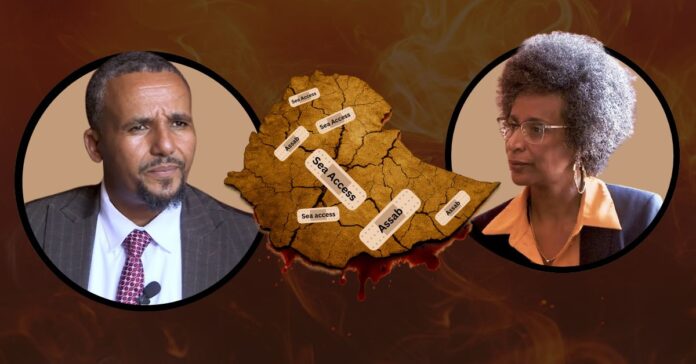
The Ethiopian Prime Minister has now spoken openly about invading and occupying the Eritrean port city of Assab. This is not mere bluster. It signals intent against a sovereign neighbour and a direct challenge to the core norms of international law sovereignty, territorial integrity and the prohibition on the use of force.
What makes this escalation more dangerous is the deafening silence from the UN, AU, IGAD and much of the wider international community. Speaking out is not about supporting Eritrea which is fully capable of defending itself but about defending the rules that prevent war. When threats to alter borders by force go unrebuked, those rules erode, and every frontier in the region becomes vulnerable.
This moment did not arise in a vacuum. For two years, Addis Ababa has normalised talk of “sea access”: senior officials repeating the line, state media elevating it into a national agenda. The campaign’s opening gambit was the controversial MoU with the breakaway region of Somaliland an episode that brought diplomatic isolation rather than practical access.
The latest step threatening to take Assab turns narrative into menace.
The facts, however, do not bend to rhetoric. Assab is Eritrean: colonial-era treaties, Eritrea’s UN-recognised independence in 1993, and the Ethiopia–Eritrea Boundary Commission ruling all affirm this. Geographically, the city lies more than sixty kilometres inside Eritrean territory. Politically, the Prime Minister himself signed the Asmara and Jeddah agreements in 2018, explicitly pledging to respect sovereignty and territorial integrity.
The pime Minister also knows Eritrea’s decisive role in Ethiopia’s darkest hour. In 2021, when the TPLF advanced towards Addis Ababa, Eritrean support helped avert state collapsesomething the Prime Minister acknowledged in parliament. To threaten the very neighbour that helped prevent disintegration is poor statecraft and corrosive to any future regional trust.
Why revive expansionist fantasies now? Partly to distract from deepening economic strain and spiraling ethnic tensions; partly to service the designs of external patrons eager to redraw the Red Sea map, deny Eritrea control over its ports, and secure Ethiopian access at Eritrea’s expense. This is theatre in place of policy, with real risks for the Horn.
There is a lawful path if access is genuinely needed: leases, corridors and joint ventures—arrangements that deliver mutual benefit without violating borders. That is how responsible states behave; not through threats, distortions or faits accomplis.
The international community should act before it is too late. If another deadly conflict is not averted now, Eritrea will have no choice but to use all available means to defend itself and its territorial integrity. In that event, the consequences will rest squarely with Ethiopia—and with those international actors whose silence enabled escalation.
The task is clear: speak up now. Condemn the rhetoric, reaffirm the red lines, and insist on rules-based solutions. Eritrea’s sovereignty is non-negotiable; Assab is Eritrean. Rolling back incendiary talk and recommitting to the 2018 pledges is the only credible way to keep the Red Sea and the region out of the fire.
Prosperity Party: “Thoughts are free, talk is cheap, and action is expensive. What’s your worth?”
After being saved from collapse by the intervention of the Eritrean Army during the 2020-2022 Tigray civil war, the Ethiopian government under Abiy Ahmed has launched a relentless propaganda campaign. For three years, Ethiopian Television and its allied YouTube channels have paraded academicians, army generals, ministry officials, and Prosperity Party leaders, all echoing the urgent claim that Ethiopia must possess a port and a corridor to the sea—even if it means violating the sovereignty of a neighboring country. Though their arguments are muddled and inconsistent, they center around three main themes.
1.Historical Context.
Eritrea’s independence was fully recognized by Ethiopia 30 years ago, on May 24, 1993, and Eritrea became a respected member of both the United Nations and the African Union. The current Ethiopian government initially upheld this recognition, but now, in a desperate attempt to rewrite history, the Abiy administration and its propaganda machine have begun to cast doubt on Eritrea’s legitimate statehood. This abrupt shift is not only baseless but also exposes Ethiopia’s inability to support its historical claims—claims that were conclusively settled when Eritrea gained its independence. The Eritrea-Ethiopia Boundary Commission officially delimited the border, and Prime Minister Abiy Ahmed himself accepted the decision unconditionally, even earning a Nobel Peace Prize for his commitment. Thus, any argument by the Prime Minister invoking history is utterly groundless and serves only as a smokescreen to distract Ethiopians from the severe economic, political, and security crises consuming their country.
2.Population Size and Ethnicity.
Ethiopia’s population and ethnicity argument was even more illogical and invalid. There is no premise that a country that has uncontrolled population growth must claim the sovereign land of a neighboring country. The easiest and most logical way to align your population growth with your resources is introducing family planning. China’s one-child policy could be a good example of how to control explosive population growth in Ethiopia. Also, countries often augment their economy through the division of labor, international trade, and acceptable diplomatic norms. The Ethiopian problem is lack of peace. As to the ethnicity argument, international borders in Africa are drawn by colonizers, and the African Union, headquartered less than a couple of miles from PM Abiy’s office, accepted and ratified them many years ago. PM Abiy’s attempt to change the 1964 Cairo treaty that accepted the colonial boundaries as sacrosanct African boundaries shows his ignorance about international law and associated treaties.
3.UN Convention on Landlocked Countries and Access to the Sea.
Ethiopian propaganda also mentioned the UN convention on access of landlocked countries to the sea, which is often called the law of the Sea 1982. It is true that the convention provided landlocked countries with the right of access to and from the seas and freedom of transit. That is what Ethiopia is currently getting from Djibouti’s Port. One thing that the Ethiopian propaganda does not mention is that the UN Convention is related to access to the sea, not ownership of a port or the corridor. Also United Nations Convention on the Law of the Sea 1982 states “Transit states shall have the right to take all measures necessary to ensure that the rights and facilities provided for in this Part for land-locked states shall in no way infringe their legitimate interests”. Ethiopia’s request for complete ownership of a port and its corridor to the sea contradicts with the law of the sea 1982. Accordingly, neighboring countries, including Eritrea, have the right to reject Ethiopia’s request to talk about port and corridor ownership out rightly.
The claim that the Ethiopian Government’s propaganda is neutralizing Opposition to planned aggression against Eritrea.
In the above analysis, we have made clear that PM Abiy’s Government is delusional and has not valued argument that supports its claim to a port and its corridor in the sovereign land of a neighboring country. Now the Ethiopian government’s propaganda has shifted to the threat of war. They are claiming that the purpose of their propaganda is to neutralize any opposition to their planned aggression against a neighboring country, Eritrea. Their claim affirms that the Prosperity Party intends to invade Eritrea, and it is a clear violation of international law. Such Ethiopia’s official declaration of aggression on a neighboring country allows Eritrea to take pre-emptive defensive action. However, for Eritrea, doing that would be to fall into Abiy’s trap. The Abiy government is politically, economically, and militarily weak, and sooner or later it is going to fall. That is why it is engaged in desperate cheap propaganda directed at neighboring countries, including Eritrea.
Conclusion
Currently, the Ethiopian Prosperity government has declared war on neighboring countries, especially Eritrea. However, it knows that a war against Eritrea is costly, and it may destroy its government in less than a month. That is why it is full of cheap propaganda and zero action. Whatever the case is the Abiy Ahamed government can neither scare Eritrea nor being successfully hide the Political, Economic, and Security problems in Ethiopia. As to Eritrea, it has 80 years of experience in neutralizing successive Ethiopian rulers’ propaganda and aggression.
“The dogs bark, the camel continues its journey”.
Victory to the Masses and Eternal Glory to Our Martyrs