

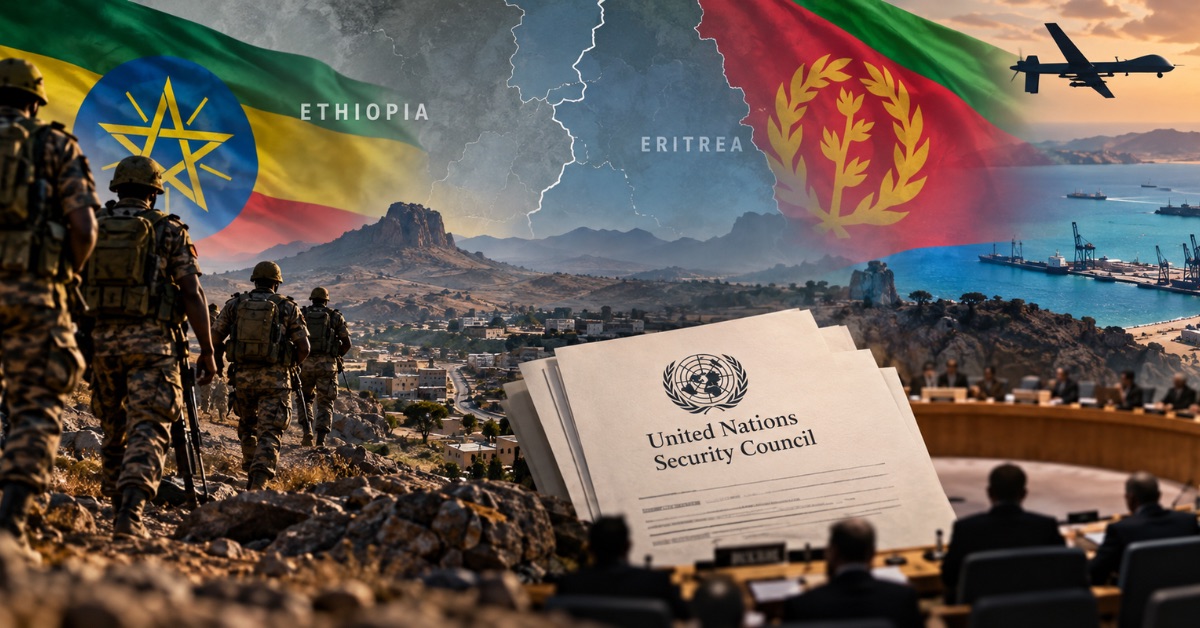
There is something deeply troubling about how quickly allegations of an Eritrean invasion have become an international narrative. What began as reports of troop movements in northern Ethiopia has reached the United Nations Security Council, where Addis Ababa is now invoking its right to self-defense. Yet fundamental questions about the alleged incursion remain unanswered.
This matters because the word invasion is not an ordinary accusation. It carries legal and political consequences. Once accepted internationally, it can influence diplomatic decisions, shape public opinion and provide justification for military action. The question is whether the evidence has caught up with the seriousness of the claim.
Ethiopia alleges that Eritrean forces crossed into Tigray and advanced deep into its territory. Eritrea rejects the accusations and argues that Addis Ababa is constructing a justification for military action connected to its longstanding ambition to acquire sovereign access to the Red Sea. Both governments have now presented their competing positions to the Security Council.
For Eritrea, the danger is not simply what Ethiopia alleges. It is what Ethiopia might do if that allegation becomes internationally accepted before it has been independently established.
How an Allegation Becomes an Accepted Narrative
The sequence deserves attention. Ethiopian officials accused Eritrea of military involvement as federal forces intensified their offensive against the TPLF. International outlets reported alleged Eritrean movements, citing residents, anonymous officials and commanders associated with the federally aligned Tigray Peace Force. Conflict monitors published assessments, and those reports circulated widely.
On October 9, Ethiopian Foreign Minister Gedion Timothewos informed the Security Council that Eritrean infantry and mechanized forces had allegedly advanced as far as 60 kilometers into Ethiopia. Addis Ababa described the situation as an all-out invasion and invoked Article 51 of the UN Charter.
But what has been independently established?
The Associated Press reported that Ethiopia’s letter did not identify the areas allegedly occupied or provide supporting evidence. This does not prove the allegations false. It does, however, expose the gap between a government’s declaration and the evidence available for public scrutiny.
The Critical Threats Project’s October 9 assessment also acknowledged that reports of Eritrean military movements had been only partially corroborated. Several international outlets and ACLED relied substantially on overlapping sources, including local residents, anonymous Ethiopian officials and federal-aligned military commanders.
That distinction is important. Five reports relying on the same witness are not five independent confirmations. Repetition can give an allegation the appearance of certainty without resolving its underlying weaknesses.
Adigrat and the Questions That Remain
The latest developments around Adigrat illustrate the problem. On October 10, Reuters reported that Ethiopian federal forces and allied fighters had entered the city, roughly 30 kilometers from Eritrea’s border. Residents described seeing Ethiopian soldiers and military vehicles, although Reuters could not independently confirm who controlled the city.
The same reporting referred to allegations that Eritrean troops had previously operated in the area and withdrawn following Ethiopian drone strikes. Reuters stated that it could not independently verify the alleged Eritrean incursion.
These are separate claims requiring separate evidence. Seeing Ethiopian soldiers in Adigrat does not establish that they displaced Eritrean troops.
Open-source investigators have geolocated some circulating footage to the Adigrat–Idaga Hamus corridor. But confirming a location does not necessarily establish the identity of the soldiers, the recording date or the circumstances of their presence. Some imagery is demonstrably more recent than the 2020–2022 war, so it would also be inaccurate to dismiss all circulating material as recycled footage.
Communications restrictions make verification difficult, although they do not make eyewitness reporting impossible. What matters is whether the available accounts and images independently establish the claims being made.
So far, the publicly available evidence has not conclusively established the full scale and circumstances of the invasion described by Ethiopia.
When Reporting Becomes Part of the Conflict
The Channel 4 News controversy shows why these distinctions matter.
On October 9, Channel 4’s international editor, Lindsey Hilsum, acknowledged that outdated opening footage had been used in a report titled “Horn of Africa crisis: Why is Eritrea invading Ethiopia?” She said the piece was being taken down.
The mistake does not prove that every allegation of Eritrean military involvement is fabricated. But it raises a legitimate concern about how disputed events are presented as established facts.
A headline declaring an invasion, accompanied by outdated footage, can leave an impression that later corrections struggle to undo. When similar allegations are repeated across multiple outlets, audiences may not realize that the reporting relies on overlapping sources.
The media’s responsibility is not to defend Ethiopia’s account or Eritrea’s response. It is to establish what happened, distinguish allegations from verified facts and explain the limitations of the evidence.
Otherwise, journalism risks becoming part of the struggle to establish a politically useful narrative.
Eritrea’s Response and the Red Sea Question
On October 10, Eritrean Foreign Minister Osman Saleh responded to Ethiopia’s Security Council communication, rejecting its invocation of self-defense and accusing Addis Ababa of preparing a war against Eritrea.
Saleh argued that Ethiopia’s allegations must be understood against its three-year campaign for sovereign access to the Red Sea. He also attributed a particularly serious statement to Ethiopian Deputy Chief of Staff General Abebaw Tadesse, alleging that the general described Assab as the ultimate objective of the war and Mekelle as an intermediate destination.
If independently authenticated, that statement would be important evidence concerning Ethiopia’s military intentions. For now, it remains an allegation in Eritrea’s official diplomatic letter, requiring confirmation through an original recording or transcript.
But the wider dispute over the Red Sea is not speculative.
On October 13, 2023, Prime Minister Abiy Ahmed publicly elevated Ethiopia’s maritime access into a major national strategic objective, linking it to the country’s economic future and historical circumstances. Although he initially emphasized peaceful negotiations, subsequent discussions about sovereign maritime access raised understandable concerns in Eritrea.
Ethiopia has a legitimate interest in using regional ports. Its economy depends on maritime trade, and negotiated commercial arrangements could benefit both countries. But access to a port and sovereignty over that port are fundamentally different matters.
Assab and Massawa belong to Eritrea, whose independence was confirmed by the 1993 referendum and internationally recognized. Ethiopia’s economic needs cannot create a territorial entitlement to its neighbor’s coastline.
That history makes Eritrea’s concerns about the possible use of invasion allegations as a justification for military action worthy of serious examination. It does not, by itself, prove that Ethiopia has ordered an invasion of Eritrea.
Before the Narrative Becomes the Justification
The confrontation is unfolding at a dangerous moment. Ethiopian federal forces have advanced through northern Tigray, fighting has moved closer to Eritrea’s border, and the Pretoria peace framework is under renewed strain. The United Nations has called for an immediate ceasefire and urged respect for sovereignty and territorial integrity.
For civilians, another regional war would be devastating. Communities are already struggling with displacement, disrupted services and the consequences of earlier fighting. Expanding the conflict would deepen that suffering on both sides of the border.
Ethiopia has the right to defend its territory against an actual armed attack. Eritrea has precisely the same right. Neither country’s security concerns justify acquiring another state’s sovereign territory.
The international community must therefore insist on independently verifiable evidence of the alleged incursion while examining Eritrea’s warnings about Ethiopia’s broader military intentions. Official accusations, eyewitness accounts, geolocated images and verified military actions must not be treated as interchangeable.
Eritrea does not need to establish that every report against it was fabricated to demand proper scrutiny. Nor should Ethiopia’s allegations become accepted facts simply because they have been repeated by officials, conflict monitors and international news organizations.
An allegation is not a verdict. Repetition is not independent verification. And self-defense must never become a justification for territorial ambition.
Eritrea’s independence is not a historical mistake awaiting correction. Its Red Sea coastline is not a prize to be claimed through military pressure. Before another war is justified in the name of sovereignty, the sovereignty of both countries must be respected.

