

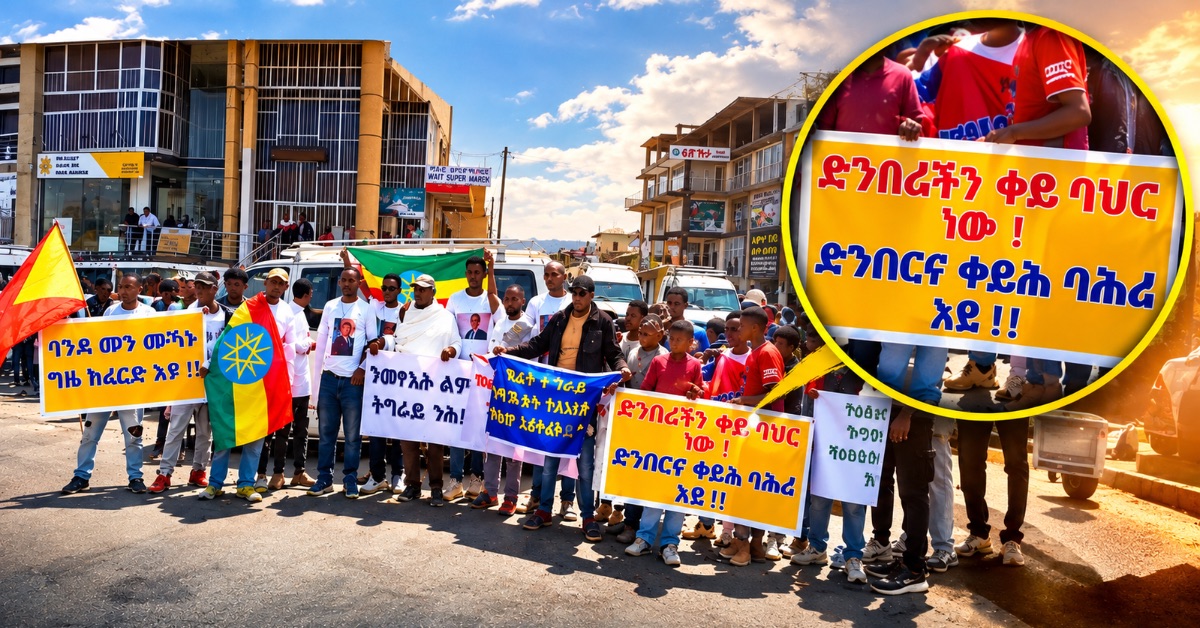
At a time when Ethiopia is accusing Eritrea of violating its sovereignty, a banner displayed during Getachew Reda’s visit to Tigray has exposed a troubling contradiction. Among demonstrators waving Ethiopian flags, one banner carried a message that went far beyond welcoming federal authorities: “Our border is the Red Sea!”
The photographs, independently verified by Setit Media as taken on October 11, were shared on Facebook by Dr. Abreham Belay, a senior Ethiopian government official. The banner was clearly visible among demonstrators expressing support for the federal government.
The timing could hardly be more sensitive. Just two days earlier, Ethiopia had formally accused Eritrea of invasion before the United Nations Security Council, invoking its right to self-defense. Eritrea rejected the allegation and warned that Addis Ababa was attempting to justify military action against its territory.
Now, amid those accusations, a slogan suggesting that Ethiopia’s border extends to the Red Sea has appeared during a politically significant visit and been circulated by a senior government figure.
The banner is more than an isolated political slogan. Displayed during Getachew Reda’s visit and subsequently shared by senior Ethiopian official Dr. Abreham Belay, it reflects a broader political mood surrounding Ethiopia’s Red Sea ambitions. Its message is particularly revealing in the context of the ongoing war in northern Ethiopia, where questions about military objectives and Eritrea’s sovereignty have become increasingly intertwined. And it reinforces concerns that the conflict is being viewed by Ethiopian government not merely as a struggle for control of Tigray, but as part of a wider ambition to reach the Red Sea through Eritrean territory.
A Maritime Ambition Three Years in the Making
The controversy cannot be separated from Prime Minister Abiy Ahmed’s campaign for maritime access.
On October 13, 2023, Abiy publicly elevated Ethiopia’s access to the Red Sea into a major national strategic objective. He argued that Ethiopia’s growing population, economic development and future security required dependable maritime access, portraying its landlocked position as a historical and strategic disadvantage.
Although Abiy initially emphasized peaceful negotiations, the subsequent debate increasingly blurred the distinction between commercial access to ports and sovereign control over a coastline. That distinction is fundamental.
Ethiopia has every right to negotiate maritime access. Its economy depends heavily on international trade, and agreements with neighboring countries could benefit the wider region. But commercial access does not confer sovereignty over another country’s territory.
Eritrea’s independence followed a thirty-year liberation struggle and was confirmed by the 1993 referendum. Its sovereignty, including its Red Sea coastline, is internationally recognized. Assab and Massawa are Eritrean ports. Ethiopia’s historical use of Assab does not establish a continuing territorial entitlement.
The issue became more contentious after Ethiopia’s January 2024 maritime memorandum with Somaliland, which Somalia opposed on sovereignty grounds. That dispute demonstrated how Ethiopia’s pursuit of maritime access could become a wider regional confrontation.
Against this background, the banner displayed in Tigray cannot simply be dismissed as politically insignificant. Its message reflects a territorial idea that has become part of Ethiopia’s broader public debate over the Red Sea.
From Mekelle to Assab
Getachew Reda’s return comes amid a rapidly changing military situation in northern Ethiopia. Federal forces and their allies have advanced through Tigray, including into Mekelle, while operations have moved closer to Eritrea’s southern border.
On October 10, Eritrean Foreign Minister Osman Saleh sent a letter to the Security Council accusing Ethiopia of preparing a war of aggression under the pretext of self-defense.
Saleh also attributed a September 27 statement to Ethiopian Deputy Chief of Staff General Abebaw Tadesse, alleging that the general described Assab as the ultimate objective of the war and Mekelle as an intermediate destination.
That quotation requires independent authentication through an original recording or transcript. Nevertheless, it raises an important question about whether Ethiopia’s operations in northern Tigray could become entangled with its maritime ambitions.
The newly documented banner adds to the need for clarity. It does not prove that Ethiopia has decided to invade Eritrea, but its appearance during a senior political visit, followed by its circulation on an official’s social media account, warrants public explanation.
The International Law Ethiopia Cannot Ignore
The legal principle is clear. Article 2(4) of the UN Charter prohibits threats or the use of force against another state’s territorial integrity or political independence. The African Union similarly recognizes respect for borders existing at independence.
Economic necessity, historical grievances and strategic ambitions do not override those principles.
If Ethiopia were to threaten military force to acquire Assab or impose sovereignty over Eritrean territory, such conduct would violate fundamental principles of international law. Any armed attempt to seize Eritrean territory would constitute a flagrant violation of its sovereignty and territorial integrity.
A banner carried by demonstrators is not itself proof of an internationally wrongful act by the Ethiopian state. Nor does sharing photographs automatically establish official endorsement. But the circulation of this particular message by a senior official makes it reasonable to ask whether Addis Ababa explicitly rejects territorial claims against Eritrea.
The distinction between peaceful maritime access and territorial entitlement should leave no room for ambiguity.
Sovereignty Cannot Be a One-Way Principle
Ethiopia’s October 9 invasion allegation remains contested. International reporting has documented eyewitness accounts and assessments of alleged Eritrean movements, but the publicly available evidence has not conclusively established the full scale and circumstances of the invasion described by Addis Ababa.
Ethiopia has the right to defend its territory against an actual armed attack. Eritrea has precisely the same right. Neither country’s security concerns justify violating the other’s internationally recognized borders.
The international community should demand independent evidence concerning the alleged incursion while examining the political context in which the accusation emerged. That includes Ethiopia’s maritime rhetoric, Eritrea’s warnings of possible aggression and territorial slogans appearing during politically significant events.
For the people of both countries, the consequences of another war would be devastating. Northern Ethiopia is already struggling with renewed fighting, displacement and disrupted essential services. Expanding the conflict across the Eritrean border would deepen the suffering and destabilize the wider Horn of Africa.
The banner displayed during Getachew Reda’s visit may not be an official declaration of Ethiopian policy. But its message deserves scrutiny, especially when a senior government official publicly shares photographs containing it at a moment of extraordinary regional tension.
Ethiopia cannot insist that its own borders are inviolable while leaving doubts about its respect for Eritrea’s. The Red Sea may be vital to Ethiopia’s economy, but Eritrea’s coastline is not Ethiopian territory.
That is not a matter of competing historical interpretations. It is a principle of international law, and it must apply equally to both countries.

