

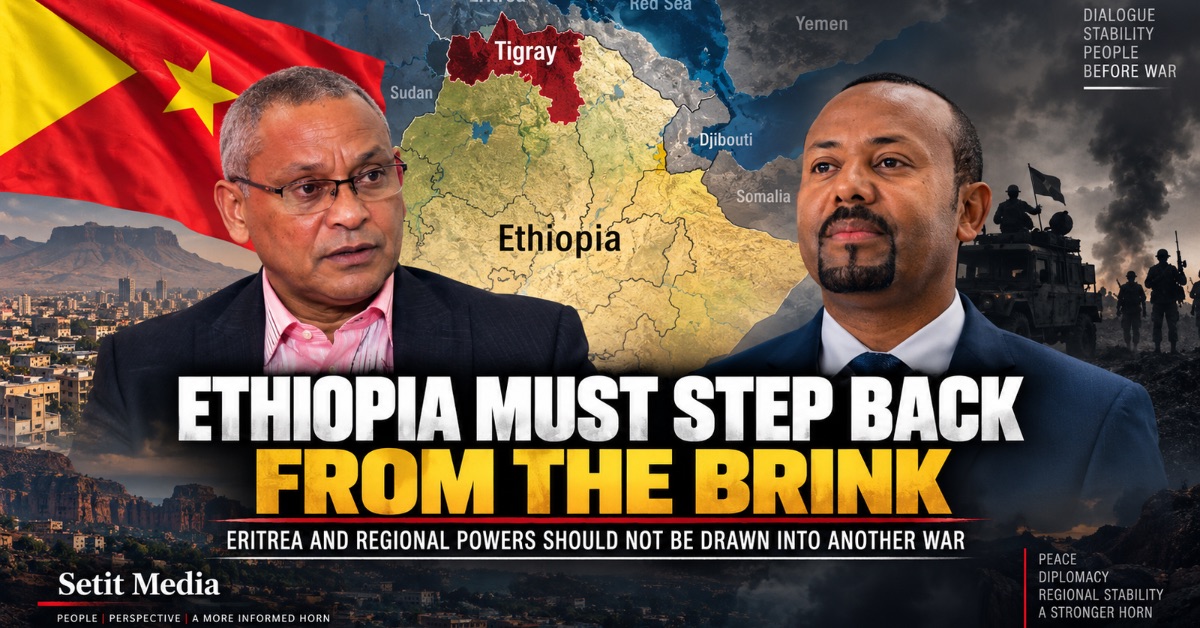
The developments unfolding in northern Ethiopia should alarm everyone who remembers what the last war cost the peoples of the Horn of Africa.
On Wednesday, Tigrayan forces seized Mekelle’s Alula Aba Nega International Airport from federal police, according to three local sources cited by Reuters. Ethiopian Airlines subsequently suspended flights to Mekelle, Axum and Shire. Hours later, Tigray’s regional government announced that its forces had entered what it described as a “defensive war” against Ethiopian federal troops. At the time of Reuters’ report, the federal government had not publicly responded.
These developments follow the announcement only days earlier of a new alliance of armed Ethiopian organizations opposed to Prime Minister Abiy Ahmed’s government. The coalition brings together forces from several parts of Ethiopia, including factions that fought one another during the devastating 2020–2022 war. Reuters has cautioned that substantial political and territorial differences remain among the groups.
Whatever political grievances exist among Ethiopia’s competing actors, the direction is dangerous.
Setit Media calls for immediate de-escalation.
Ethiopia has already experienced the consequences of attempting to resolve fundamental political disputes through military force. Another major war could produce another humanitarian emergency, deepen Ethiopia’s internal fragmentation and destabilize neighboring countries.
The first responsibility therefore belongs to Ethiopians themselves.
The federal government and Tigrayan authorities should halt further escalation and restore political communication. Other armed movements should likewise recognize that expanding the battlefield will not resolve the country’s political crisis.
The Pretoria agreement of November 2022 was imperfect and important provisions remained disputed or unimplemented. But abandoning political mechanisms altogether would return northern Ethiopia to a path whose consequences are painfully familiar.
Eritrea Should Exercise Strategic Restraint
For Eritrea, the situation requires exceptional discipline.
Addis Ababa has accused members of the newly announced opposition coalition of receiving Eritrean support. Eritrea has denied allegations that it supports Ethiopian rebels. Those accusations should therefore be reported for what they currently are: claims by the Ethiopian government, not independently established facts.
Setit Media believes Eritrea’s interests are best protected by remaining outside Ethiopia’s emerging internal military confrontation.
That does not mean Eritrea should ignore developments across its southern frontier.
Asmara has every reason to maintain military readiness, closely monitor movements near the border and prepare for refugee flows, armed infiltration or other consequences of instability. No responsible state can neglect threats developing near its territory.
But readiness is different from intervention.
Unless fighting reaches Eritrea’s immediate borders or creates a direct threat to Eritrean territory and population, Eritrea should avoid active military participation in Ethiopia’s conflict.
Eritrea does not need another war. Its strategic priority should be safeguarding its sovereignty, strengthening its economy, improving the lives of its people and protecting its stability.
Entering another Ethiopian internal war prematurely could expose Eritrea to unnecessary military, diplomatic and economic costs while giving competing Ethiopian factions an external actor to blame for fundamentally Ethiopian political problems.
The strongest Eritrean position is therefore not passivity. It is armed vigilance combined with strategic restraint.
Protect the border. Maintain readiness. Keep diplomatic channels open. But do not volunteer Eritrean lives for a conflict that Ethiopians themselves must ultimately resolve.
Ethiopia Must Not Become a Battlefield for Regional Powers
There is another danger that deserves equal attention.
The Horn of Africa is increasingly entangled with rivalries involving wealthy and militarily capable Middle Eastern powers. Reuters reported earlier this year that competition between Saudi Arabia and the United Arab Emirates was influencing alliances and conflicts across the Horn.
Reuters also reported in February that Ethiopia was hosting a camp training fighters for Sudan’s Rapid Support Forces, illustrating how regional conflicts are increasingly drawing in actors from Africa and the Middle East.
Those developments offer a warning.
The Horn cannot afford to become an arena where outside powers finance local factions, build proxy networks and pursue geopolitical competition through African conflicts.
That principle should apply to everyone — the UAE, Saudi Arabia, Egypt, Türkiye, Iran, Israel, the United States and any other external actor seeking influence in the region.
For the UAE in particular, whose political, commercial and security footprint across the Horn has expanded considerably, restraint is essential. Setit Media is not asserting without evidence that Abu Dhabi is directing today’s confrontation in Tigray. But the broader regional lesson is clear: external powers should not finance, arm or politically encourage Ethiopian factions toward another war.
The same standard must apply regardless of which Ethiopian faction an outside power prefers.
The peoples of the Horn should not become pieces on somebody else’s geopolitical chessboard.
Addis Ababa Also Has a Choice
De-escalation cannot mean demanding restraint only from Tigray, Eritrea or foreign governments.
The Ethiopian federal government carries its own responsibility.
Political disputes cannot indefinitely be managed through military pressure, drone strikes, arrests or the exclusion of opponents from political life. Nor should Ethiopian nationalism be redirected toward neighboring states as a substitute for resolving domestic political disagreements.
Ethiopia’s territorial integrity and Eritrea’s sovereignty are not contradictory principles.
Ethiopia has legitimate economic interests in reliable commercial access to maritime trade. Eritrea has an equally unquestionable sovereign right to determine how its ports and territory are used.
Those issues should be negotiated commercially and diplomatically — never through threats, coercion or military calculations.
Remember What the Last War Cost
The temptation during moments like this is to analyze maps, alliances and military capabilities.
But wars are ultimately experienced by ordinary people.
The 2020–2022 northern Ethiopian war devastated communities across Tigray, Amhara and Afar, displaced millions and caused enormous loss of life. Eritrea was pulled directly into that conflict. The political consequences continue to shape relations throughout the region.
The Horn does not need a sequel.
A second large-scale northern Ethiopian war could intersect with instability in Sudan, tensions between Ethiopia and Eritrea, Red Sea competition and the rapidly changing security environment across the Middle East.
This is precisely why restraint should begin before armies reach national borders rather than afterward.
Eritrea’s Strength Should Be Measured by What It Protects
There will inevitably be voices arguing that Eritrea should exploit Ethiopia’s internal divisions. That would be shortsighted.
A permanently fractured and violent Ethiopia would not automatically make Eritrea safer. Chaos across a long shared frontier can produce armed movements, refugees, trafficking networks, economic disruption and opportunities for foreign military intervention.
Eritrea’s national interest is better served by a neighboring Ethiopia that is peaceful enough not to threaten Eritrean sovereignty and stable enough to conduct normal relations between two independent states.
That does not require Eritrea to solve Ethiopia’s political problems.
It requires Eritrea not to inherit them.
The message from Asmara should therefore be simple: Eritrea will defend its territory and sovereignty without hesitation, but Ethiopia’s internal political future must be decided by Ethiopians.
The message from Addis Ababa and Mekelle should be equally clear: another war will deepen wounds that have barely begun to heal.
And the message to Abu Dhabi and every other external capital competing for influence in the Horn should be unmistakable:
Help extinguish the fire. Do not finance the flames.
The region has sacrificed enough lives to wars shaped by political ambition, historical grievances and external competition.
Eritrea should remain vigilant. Ethiopia’s competing forces should step back. Regional powers should exercise restraint.
The Horn of Africa needs fewer battlefields and more states capable of resolving their differences without creating another generation shaped by war.

