

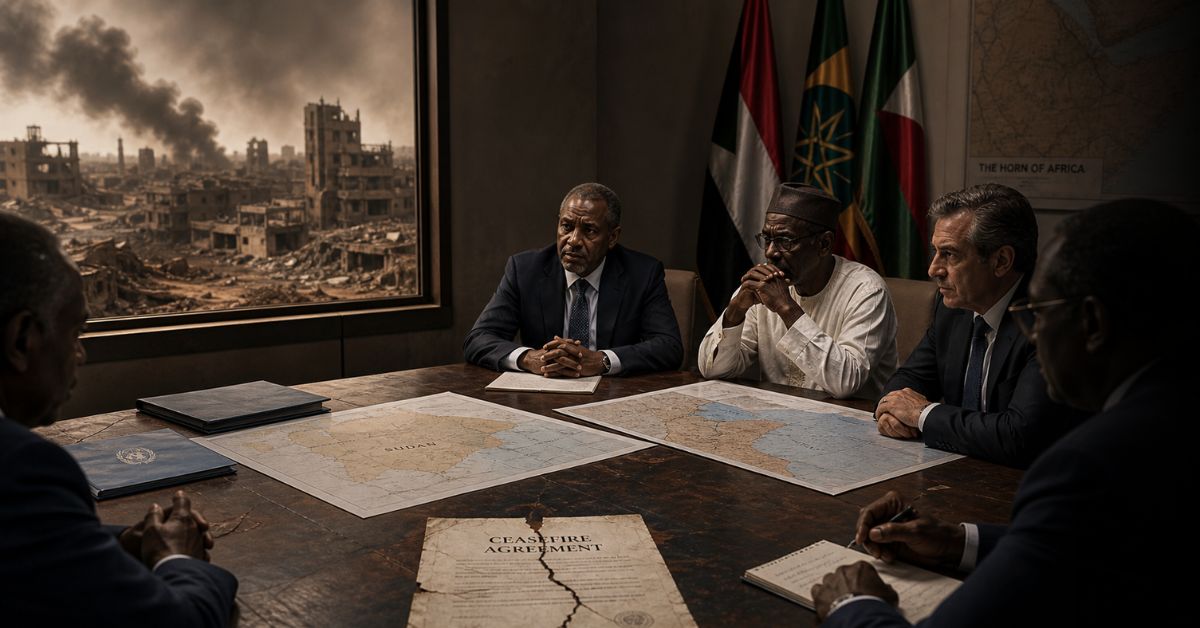
Successful peace processes depend upon correctly identifying the forces that sustain a conflict. When that diagnosis is incomplete, even the most determined diplomatic efforts are unlikely to produce lasting peace. Sudan illustrates this dilemma with particular clarity. More than three years after the outbreak of its devastating civil war, numerous regional and international initiatives have sought to end the fighting. Conferences have been convened, ceasefires announced, and mediation mechanisms established, yet the conflict continues while the humanitarian catastrophe deepens. Millions have been displaced, tens of thousands have lost their lives, and entire communities have been devastated. The question is no longer whether Sudan needs peace, but why repeated efforts to secure it have failed to produce a meaningful breakthrough.
One recent attempt to answer this question appeared in an article published by the Middle East Forum on 9 July 2026 entitled “Sudan’s War, Iran’s Return, and the Ethiopia Blind Spot in U.S. Policy.” Its author, Blen M. Diriba—an Ethiopian legal and policy analyst, Executive Director of Horn Review, and an Associate Researcher at Ethiopia’s Institute of Foreign Affairs—argues that one of the principal shortcomings of current diplomatic efforts is the failure to recognise Ethiopia’s central role in any future settlement of Sudan’s conflict.[1]
Her article performs an important service by reminding readers that Sudan’s war cannot be understood solely through the actions of the Sudanese Armed Forces (SAF) and the Rapid Support Forces (RSF). It correctly situates the conflict within the wider geopolitical realities of the Horn of Africa and the Red Sea and argues that neighbouring countries inevitably have legitimate interests in Sudan’s stability. On that broader proposition, I find myself in full agreement.
Where I respectfully differ is in identifying what I believe to be the real blind spot.
In my view, the principal weakness of current peace efforts is not the failure to place Ethiopia at the centre of diplomatic initiatives. Rather, it is the persistent failure to confront the external military, financial, and logistical support that has enabled the conflict to continue despite repeated mediation efforts. Equally troubling is the reluctance of many international actors to hold those responsible for sustaining the conflict politically accountable. As a result, diplomacy has concentrated overwhelmingly on persuading the Sudanese belligerents to negotiate while paying comparatively little attention to the wider regional dynamics that continue to fuel the war.
This distinction is far from academic. Every peace process rests upon an understanding of the conflict it seeks to resolve. If that understanding is incomplete, the resulting diplomatic strategy is unlikely to address the real causes of the war. The problem, therefore, is not simply one of mediation; it is first and foremost one of diagnosis. Unless the nature of the conflict is properly understood, even well-intentioned diplomatic initiatives are unlikely to achieve the lasting peace that Sudan so desperately needs.
Misdiagnosing the Conflict
One of the fundamental weaknesses in much of the international debate is the continued tendency to portray Sudan’s war primarily as a confrontation between the SAF and the RSF. While these remain the two principal military protagonists, such a description no longer reflects the full reality of the conflict. Over the past three years, Sudan’s civil war has evolved into a regionalised and increasingly internationalised conflict sustained by actors, interests and networks extending well beyond Sudan’s borders.
This evolution is evident not only in the growing involvement of regional powers but also in the increasingly transnational character of the conflict itself. External military assistance, financial support, logistical networks, political backing and the recruitment of foreign fighters have all become integral to the continuation of hostilities. Reports have documented the recruitment of foreign combatants, including Colombian mercenaries as well as recruits originating from neighbouring countries such as Chad, South Sudan and Ethiopia. The United States has itself imposed sanctions on individuals and companies allegedly involved in recruitment networks for Colombian fighters, underscoring the extent to which the conflict has become embedded within transnational systems rather than remaining a purely domestic struggle.[2]
The internationalisation of the conflict extends well beyond the recruitment of foreign fighters. Credible investigative reporting has documented allegations concerning external military assistance, logistical support and supply networks involving regional actors. These reports, taken together, suggest that the trajectory of the conflict is being influenced not only by decisions taken in Khartoum or on the battlefield, but also by political, financial, and military decisions taken beyond Sudan’s borders.[3]
The Missing Dimension: The Real Blind Spot
Recognising that Sudan’s conflict has become increasingly regionalised inevitably changes the way one thinks about peace. If external actors have become integral to sustaining the conflict, then diplomacy cannot be directed exclusively at the Sudanese belligerents. Negotiations between the SAF and the RSF remain indispensable, but they are no longer sufficient. A peace process that focuses only on those fighting the war while overlooking those enabling it is unlikely to produce a durable settlement.
Perhaps the most troubling aspect of the international response is not the absence of information, but the absence of corresponding action. Over time, credible reporting has increasingly drawn attention to external military assistance, logistical networks, and financial support linked to the conflict. Yet these revelations have rarely been matched by sustained diplomatic efforts aimed at disrupting the regional structures that continue to fuel the war. In many respects, international diplomacy has concentrated on managing the consequences of the conflict rather than addressing one of its principal causes.
This imbalance became particularly evident as the humanitarian situation deteriorated. International concern understandably intensified following the catastrophic developments in and around Al Fasher, where the scale of civilian suffering became impossible to ignore.[4] However, while humanitarian diplomacy became more urgent, comparatively less attention was devoted to the broader regional mechanisms that had contributed to prolonging the conflict. Humanitarian assistance remains indispensable, but it cannot substitute for addressing the political and military dynamics that continue to sustain the war.
The same imbalance is reflected in the design of successive peace initiatives. Considerable effort has been invested in bringing the Sudanese parties to the negotiating table, yet comparatively little attention has been devoted to the external actors whose policies, resources, and networks have significantly influenced the course of the conflict. This is not to suggest that negotiations between the Sudanese parties are unnecessary. On the contrary, no lasting settlement can be achieved without them. The difficulty lies in assuming that negotiations alone can succeed while the wider regional environment remains largely unchanged.
It is precisely here that I believe the current approach falls short. Diplomacy has tended to treat external involvement as a secondary complication rather than as a central feature of the conflict itself. Consequently, much of the international effort has been directed towards persuading the belligerents to compromise, while insufficient emphasis has been placed on reducing the incentives and capabilities that allow the conflict to continue. Peace initiatives have therefore sought to end the fighting without adequately confronting the conditions that make continued fighting possible.
The consequences of this approach are increasingly apparent. As long as external military assistance, financial resources, and logistical support continue to reach the parties to the conflict, diplomacy alone is unlikely to achieve the breakthrough that Sudan so desperately needs. Wars are rarely sustained by military decisions alone. They endure because political, financial, and logistical systems continue to make them possible.
A conflict sustained from beyond a country’s borders cannot be resolved solely within those borders.
Regional Ownership: Why Neighbours Matter
Recognising the regionalisation of Sudan’s conflict does not mean that neighbouring countries should determine Sudan’s political future. Nor does it imply that responsibility for resolving the conflict should shift away from the Sudanese people themselves. On the contrary, any lasting settlement must remain fundamentally Sudanese-owned. However, it would be equally mistaken to overlook the indispensable role that neighbouring states can play in facilitating such a process.
Sudan’s neighbours are not simply interested observers. They are the countries most directly affected by the conflict. They have absorbed successive waves of refugees, confronted the consequences of cross-border insecurity, and lived for decades with the political, economic, and humanitarian effects of instability in Sudan. More importantly, they possess a deeper understanding of Sudan’s political, social, tribal, and cultural dynamics than more distant actors. Their geographical proximity, historical interaction, and extensive cultural and ethnic ties provide knowledge that no international conference can replicate. Any credible peace initiative should therefore involve neighbouring states as genuine partners rather than treating them as peripheral participants.
At the same time, proximity alone does not automatically qualify a state to serve as an effective peace broker. It is important to distinguish between being a regional stakeholder and being an impartial facilitator. Every neighbouring country has legitimate interests in Sudan’s stability. The challenge is to ensure that those interests contribute to peace rather than complicate it.
This distinction has become increasingly important as the conflict has evolved. Not all neighbouring states have adopted the same approach. Some have been perceived as providing political platforms or forms of tacit legitimacy to parallel governing structures, while others have been accused by the Sudanese government of supporting one of the belligerents. Whether those accusations are accepted or disputed is ultimately less important than their effect on the peace process itself. A mediation initiative cannot command the confidence of all parties if one of the principal participants believes that some of those facilitating the process have themselves become part of the conflict.
This helps explain why successive diplomatic initiatives have struggled to gain the confidence of the Sudanese government. On numerous occasions, Khartoum has either declined to participate in particular mediation efforts or publicly questioned their credibility, arguing that states accused of supporting one side of the conflict cannot simultaneously present themselves as neutral brokers.[5] Whether or not every allegation is ultimately substantiated is not the central issue. The more important point is that peace processes depend not only on influence but also on confidence. Without confidence in the impartiality of those facilitating negotiations, diplomacy inevitably loses credibility.
It is against this broader background that proposals to place Ethiopia at the centre of Sudan’s peace process should be assessed. Ethiopia unquestionably has legitimate interests in developments in Sudan. The two countries share a long border, unresolved differences over al-Fashaga, continuing disagreements concerning the Grand Ethiopian Renaissance Dam (GERD), concerns relating to refugees and cross-border security, and a common interest in regional stability. These are legitimate bilateral issues that any future Sudanese government will inevitably have to address through dialogue with Addis Ababa.
However, legitimate strategic interests should not automatically translate into a leading role in shaping another country’s internal political settlement. The issues dividing Sudan and Ethiopia are fundamentally bilateral and are best resolved through negotiations between two sovereign governments. They do not, in themselves, justify placing Ethiopia at the centre of Sudan’s internal peace process. Moreover, Ethiopia’s role cannot be viewed entirely independently of the wider regional context, including its close strategic relationship with the United Arab Emirates and the allegations that have emerged concerning external logistical support linked to the conflict. [3]
Among Sudan’s neighbours, Eritrea occupies a distinctive position. Unlike some neighbouring states, it has no outstanding territorial or strategic disputes with Sudan that could directly influence its approach to the conflict. From the outset of the war, Eritrea has consistently affirmed Sudan’s sovereignty and territorial integrity while advocating a Sudanese-owned political process free from external interference.[6]
Eritrea’s potential contribution extends beyond the consistency of its official position. It also derives from its long historical relationship with Sudan, extensive cross-border communities and deep cultural and ethnic ties that provide a nuanced understanding of Sudan’s internal dynamics. These characteristics do not confer upon Eritrea a privileged role in determining Sudan’s future. Rather, they make it a constructive regional partner capable of supporting international efforts aimed at facilitating a genuinely Sudanese-led political process.
Neighbouring countries should therefore neither be ignored nor treated uniformly. Their respective roles should be assessed according to the contribution they can make to a credible and inclusive peace process. Those genuinely committed to respecting Sudan’s sovereignty and territorial integrity while supporting a Sudanese-owned solution should be encouraged to contribute constructively. Conversely, states whose actions are perceived as sustaining the conflict should be encouraged—through sustained diplomatic engagement—to align their policies with the broader objective of ending the war.
Towards a More Credible Peace Process
International actors should continue their efforts to bring Sudan’s devastating conflict to an end. Negotiations between the Sudanese parties remain indispensable, and no durable settlement can be imposed from outside. However, the international community must also recognise that the conflict is no longer sustained solely by the decisions of the Sudanese belligerents. It has become increasingly dependent upon external military, financial, and logistical support, as well as wider regional rivalries that continue to shape its course.
Consequently, a peace strategy directed exclusively at persuading the warring parties to negotiate is unlikely to succeed unless it is accompanied by an equally determined effort to reduce the external support that continues to fuel the conflict. Equally important is the need to engage Sudan’s neighbours in a more meaningful and balanced manner—not because they should determine Sudan’s future, but because they possess unique knowledge of the country’s dynamics and are themselves directly affected by the outcome of the conflict.
Ultimately, the objective should not be to redesign the negotiating table by elevating one regional actor over another. It should be to create the conditions in which the Sudanese themselves can negotiate a settlement free from external military, financial, and political interference. Only then will diplomacy address not merely the symptoms of the conflict, but its underlying causes.
The real blind spot in Sudan’s peace efforts is not who has been invited to the negotiating table. It is the persistent failure to confront those forces that continue to sustain the conflict while overlooking the constructive role that genuinely impartial neighbouring states can play in helping the Sudanese find their own path to peace.
References
[1] Blen M. Diriba, “Sudan’s War, Iran’s Return, and the Ethiopia Blind Spot in U.S. Policy,” Middle East Forum, 9 July 2026.
[2] U.S. Department of the Treasury, Treasury Sanctions Recruitment Network Enabling War in Sudan, 17 April 2026.
Reuters, US imposes sanctions targeting Colombian recruitment network linked to Sudan conflict, 17 April 2026.
[3] Reuters Investigations, reports concerning external military assistance, logistical support and regional involvement in Sudan’s conflict (2024–2026).
[4] Reuters, reports on the humanitarian crisis and fighting in Al Fasher.
United Nations Office for the Coordination of Humanitarian Affairs (OCHA), situation reports on Sudan, particularly those relating to Al Fasher and Darfur.
[5] Official statements issued by the Ministry of Foreign Affairs of the Republic of the Sudan concerning mediation initiatives, external interference, and the role of regional actors (2024–2026).
[6] Official statements issued by the Government of the State of Eritrea and the Ministry of Information of Eritrea affirming Sudan’s sovereignty and territorial integrity and supporting a Sudanese-owned political process.

