

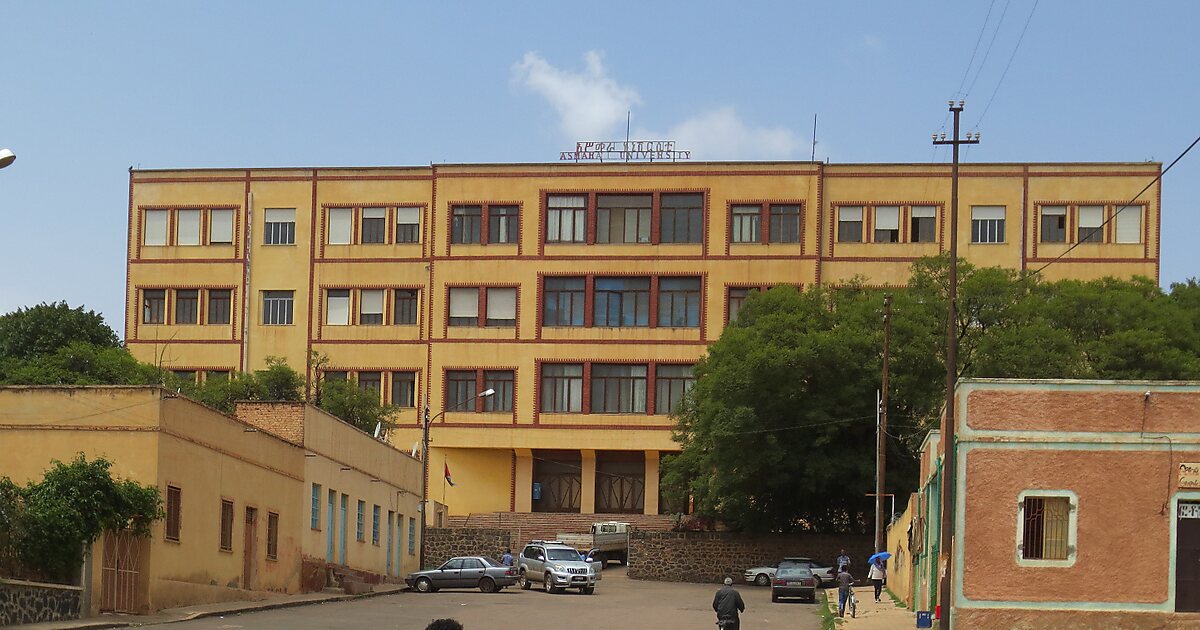
This article does not argue that every former University of Asmara student followed the same path or bears the same responsibility. Some returned to Eritrea and served inside national institutions, some carried out their duties quietly under difficult conditions, and some in the diaspora tried in good faith to support justice and public life from abroad. The argument here is narrower and more specific: a significant pattern emerged within part of the educated class, and that pattern deserves critical examination because of its consequences for Eritrea’s nation-building project.
The debate around the University of Asmara should begin with a simple distinction: the restructuring of Eritrea’s higher-education system was not the same thing as the destruction of higher education. The University of Asmara had long been Eritrea’s only accredited university, but by the early 2000s it could admit only about 1,200 new students a year and served roughly 5,000 students in total, far below the needs of a country trying to build institutions across all regions. When the university stopped enrolling new students in 2003 and its last cohort graduated in 2007, its faculties were dispersed into seven regional colleges as part of a deliberate national restructuring. Measured purely in access, the reform expanded annual intake to roughly 4,000 to 5,000 students, raised total enrollment to around 14,000, and produced about 23,000 graduates between 2008 and 2015.
This matters because the core strategic decision was sound. External quality-assurance reviewers noted that dispersing higher education beyond Asmara was intended to widen access, ease pressure on student housing in the capital and place learning closer to the country’s regional needs. The reform also broadened the academic map of the country by expanding fields such as medicine, dentistry, optometry, mining and engineering. From a nation-building perspective, this was a rational shift from a capital-centered elite model toward a more distributed national system.
The real weakness lay elsewhere: not in the idea of decentralization, but in the gap between structural reform and institutional capacity. Tadesse Mehari, who served in senior academic leadership at the University of Asmara and later headed the National Commission for Higher Education, described a system attempting to harmonize standards, revise curricula and align training with national priorities. But the same interview also revealed the scale of the shortage in qualified staff: Eritrea had only about 15 local professors and 25 local associate professors, while roughly 30% of faculty were expatriates. A system can be reorganized on paper much faster than it can produce the lecturers, researchers and administrators needed to make that reorganization fully effective.
That shortfall is central to understanding the University of Asmara legacy. The old campus itself was repurposed rather than abandoned, now housing the Orotta School of Medicine and Dental Medicine, the law school and part of Asmara College of Health Sciences. The state also built partnerships with more than 30 foreign universities and sought help from Eritrean professionals abroad for teaching and research. In other words, the framework for a broader and more regionally rooted higher-education system was created, but its success depended on whether an educated class would treat its training as a public duty or a private asset.
That moral question becomes sharper because higher education in Eritrea was tied directly to state service. Graduates received their qualifications only after completing 18 months of national service, including military training and community work, and most were assigned to ministries and public offices. The design of the system therefore made an explicit claim: education was to serve nation-building, not simply personal mobility. The central problem raised by the University of Asmara experience is that too many beneficiaries of that system did not respond in the same spirit.
The first major rupture appeared in the South Africa scholarship program. Around 1999 to 2001, hundreds of Eritrean students, including University of Asmara students and graduates, were sent to South Africa under a World Bank-supported human-resources scheme intended to train professionals for Eritrea’s development. Around 600 Eritrean students were in South Africa when the September 2001 political crackdown unfolded inside Eritrea. Many then chose not to return, with some seeking asylum in South Africa and later moving onward to Europe and North America.
The political context cannot be ignored. The crackdown was real, and fear of repression was real. But a fair assessment must hold two facts at once: some former University of Asmara students and scholarship recipients did return home and their decision deserves recognition as an act of national commitment under difficult conditions, while the cohort as a whole still represented a profound loss to Eritrea’s institutional development because the country invested scarce resources in training professionals who largely did not come back. For a poor state trying to expand colleges, recruit faculty and build technical capacity, that was not just a migration story; it was a setback in nation-building.
A second rupture emerged in Eritrean refugee camps in Ethiopia during the years when indefinite national service and repression drove large numbers of Eritreans to flee. The critique preserved in Eritrean civic and opposition archives is that some educated refugees, including former students, used their academic background and familiarity with asylum systems to move themselves through resettlement channels faster while the weakest remained behind. That claim should be handled carefully because it does not apply to every individual and is not supported by a full quantitative record. Even so, it identifies a serious ethical issue: whether education in moments of crisis is used to protect the vulnerable or simply to accelerate one’s own escape.
The third and longest rupture unfolded in the diaspora political sphere. Across multiple academic and policy studies, Eritrean opposition politics abroad is described as fragmented, weakly institutionalized and unable to agree on a coherent roadmap for change. Umbrella alliances repeatedly broke down under regional, ethnic, religious and personal rivalries, and no durable all-embracing organization emerged. This matters because many of the actors involved came from the very strata that had benefited from higher education, scholarships and asylum mobility.
The deeper criticism, then, is not merely that the diaspora opposed the government. It is that much of diaspora political life failed to transform education and exile into disciplined institution-building. Eritrea’s higher-education system was actively seeking expertise through foreign partnerships and diaspora engagement, yet the broader political and professional contribution from abroad remained inconsistent and often overshadowed by organizational fragmentation. From an Eritrea-first standpoint, the problem is not dissent itself but the inability to turn education, mobility and relative safety into a serious national project grounded in both justice and sovereignty.
Part of the explanation may lie in the civic culture that higher education reproduced. Accounts linked to Eritrean civic archives describe campus life at the old university as affected by regional and sectarian tendencies, including clustering around regional identity and concern over religiously defined associations in a national institution. Those same lines later appeared in diaspora politics. A university that fails to cultivate a strong national civic ethic may still produce degree holders, but it will struggle to produce citizens capable of transcending narrower loyalties when political strain intensifies.
The most balanced conclusion is therefore a double one. Eritrea was right to move from a single university in Asmara to a broader network of regional colleges, and that decision should be defended as a strategic nation-building reform. At the same time, the University of Asmara experience exposed a weakness in the moral and civic record of part of the educated class: too many treated public investment as a ladder out rather than a burden of service. That judgment should not erase the former students who returned and served inside Eritrea’s institutions, but it should sharpen the standard by which future graduates are judged.
The future of Eritrean higher education will depend less on whether institutions are centralized or dispersed than on what kind of citizen they form. If regional colleges produce graduates with technical skill but weak public responsibility, the cycle will repeat. If they combine professional competence with national discipline, civic seriousness and a willingness to serve under strain, then the decentralization of higher education will be remembered not merely as an administrative reform but as one of the foundations of Eritrea’s long-term state development.
Sources
• University World News, “Strengthening higher education in a time of peace” (2015): https://www.universityworldnews.com/post.php?story=20151212095823223
• EHREA archive, background and commentary on Eritrean migration, the demise of Asmara University, and refugee-related issues: http://www.ehrea.org/unia.php
• Social and secondary reporting referencing Eritrea’s higher-education restructuring into regional institutions, surfaced in prior research results.
• Jeberti.com, “Eritreans abroad demand democracy back home”: http://www.jeberti.com/index.php/english/866-eritreans-abroad-demand-democracy-back-home
• TandF Online, “Assumed to Have a Race: Everyday Encounters of Refugees with Racial Ascription in South Africa”: https://www.tandfonline.com/doi/full/10.1080/15562948.2019.1677975
• SSRN, “The Plight of Eritrean Students in South Africa”: https://papers.ssrn.com/sol3/papers.cfm?abstract_id=1537485
• Human Rights Watch, “They Are Making Us into Slaves, Not Educating Us”: https://www.hrw.org/report/2019/08/09/they-are-making-us-slaves-not-educating-us/how-indefinite-conscription-restricts
• Frontline / documentary-related reporting noting that around 600 Eritrean students were studying in South Africa during the 2001 crackdown, surfaced in prior research results.
• Amnesty International, “Just deserters: Why indefinite National Service in Eritrea has created a generation of refugees”: https://www.amnesty.org/en/documents/afr64/2930/2015/en/
• Bertelsmann Transformation Index 2026, Eritrea country report: https://bti-project.org/en/reports/country-report/ERI
• Martin Plaut, “Eritreans stranded in hostile South Africa”: https://martinplaut.com/2015/07/03/eritreans-stranded-in-hostile-south-africa/
• NOREF / ETH Zurich-hosted PDF, “Eritrean Opposition Parties and Civic Organisations”: https://www.files.ethz.ch/isn/187262/9f9d5d39afa27ee550f5632f9b6d03e4.pdf
• Diva Portal thesis, “The Eritrean Diaspora Opposition Movements”: https://www.diva-portal.org/smash/get/diva2:1676042/FULLTEXT01.pdf
• GIGA / ETH Zurich-hosted PDF, “The Eritrean Diaspora: Savior or Gravedigger of the Regime?”: https://www.files.ethz.ch/isn/171573/wp236_hirt.pdf

