Let me start by mentioning the obvious, Eritrea is rarely examined with patience. It is more often assessed through borrowed lenses that flatten history, ignore security realities, and confuse restraint with stagnation. When Eritrea refuses prescribed paths, it is labeled immobile. When it withstands pressures that fracture other states, that endurance is treated as accidental. This habit misses the more honest accounting: what Eritrea has consciously preserved, what it has deliberately deferred, and what now demands adjustment rather than denial.
Recent analysis contributed by In On Africa (IOA) offers a useful reference point precisely because it avoids caricature. It acknowledges that Eritrea has extracted tangible benefit from shifting regional and global conditions while remaining constrained by its own political and economic architecture. That duality is not a flaw in logic. It is the operating environment Eritrea has chosen—shaped by lived experience, not abstract theory.
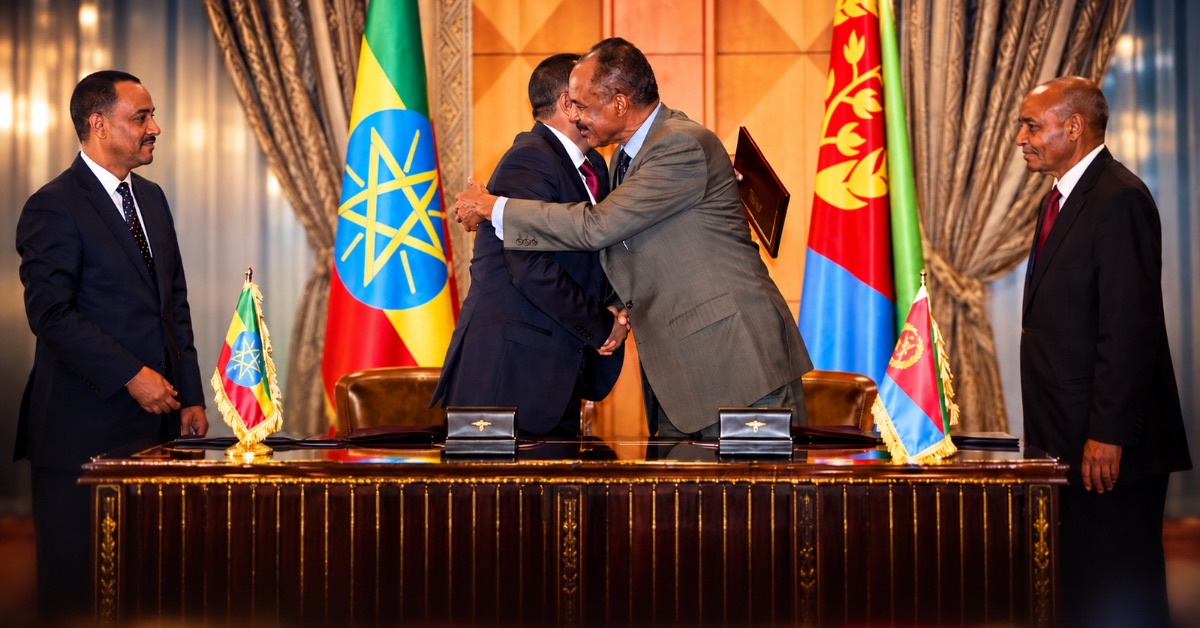
The easing of hostilities with Ethiopia altered Eritrea’s external posture in measurable ways, though never as definitively as some narratives suggest. For decades, Eritrea functioned under conditions shaped by war preparedness, border closure, and sanctions. Partial normalization reduced pressure. Limited trade routes reopened. Transport links resumed. The sense of permanent encirclement softened. These changes did not transform the economy, but they reduced friction. For a small state, reduced friction is not cosmetic. It is structural relief.
Yet that relief has proven fragile. Ethiopia has in recent months escalated its rhetoric on Red Sea access and maritime “rights,” presenting strategic entitlement as economic necessity. For Eritrea, this language is not theoretical. It echoes a long history in which sovereignty was challenged not only through arms, but through normalization of coercive claims dressed up as regional logic. When a much larger neighbor speaks loosely about access rather than negotiation, Eritrea’s caution ceases to look ideological and begins to look empirical.
This external context matters when assessing Eritrea’s internal restraint. Economic openness cannot be evaluated in isolation from security environment. Infrastructure integration, regulatory liberalization, and cross-border dependence are weighed against credible risks, not imagined threats. Eritrea’s policy posture reflects this arithmetic. One may argue it has been over-applied, but it cannot be dismissed as irrational.
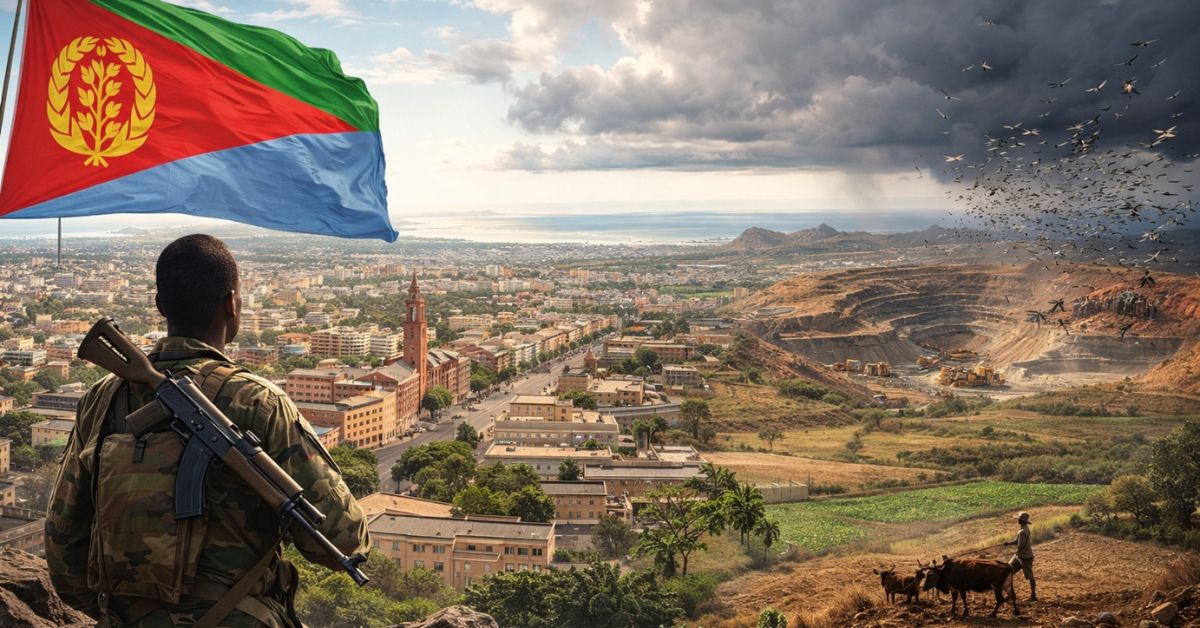
At the same time, global commodity dynamics have intermittently worked in Eritrea’s favor. Higher prices for gold, copper, zinc, and potash have strengthened export earnings and supplied foreign exchange otherwise difficult to secure. The mineral sector, long spoken of as future promise, has become a present stabilizer. It cushions the balance of payments and supports macroeconomic control.
Stabilization, however, is not expansion. GDP growth remains modest according the report, and here precision matters. Mining cannot carry a national economy, particularly one with a young population and limited private-sector depth. Eritrea’s economic base remains narrow, and its structure centralized. Resource income has been used largely to maintain balance rather than to drive diversification. That choice has insulated the economy from volatility, but it has also limited spillover into employment, entrepreneurship, and innovation.
Agriculture reveals the limits of this approach most clearly. Eritrea’s rural sector should be the backbone of resilience and food security. Instead, it remains exposed to drought, erratic rainfall, and recurring pest outbreaks—now predictable features of climate stress across the Horn. Without sustained investment in irrigation, storage, inputs, and adaptation, agriculture cannot stabilize livelihoods or absorb labor productively. Stability without productivity risks freezing vulnerability in place.
These outcomes are not technical accidents. They reflect priorities shaped by history. Eritrea’s state-centered economic model has delivered discipline, relative price stability, and minimal external debt. In a continent where debt distress has become a recurring crisis, this restraint is not trivial. Eritrea has refused to mortgage future generations for short-term growth or surrender policy autonomy in exchange for liquidity.
But restraint extracts its own price. Eritrea lacks a formal, transparent, and predictable investment framework. Decisions often appear negotiated rather than codified. For a narrow set of state-aligned projects, this can function. For broader domestic initiative and diaspora capital, it does not. Capital does not demand indulgence; it demands rules. The absence of clear frameworks concentrates activity around the state, where incentives are weak and timelines slow.
Governance dynamics reinforce this rigidity. Eritrea’s model prioritizes cohesion, security, and control—priorities forged in liberation and hardened by isolation. They preserved the state. They also produced side effects that can no longer be treated as temporary. Indefinite national service, restrictions on movement, arbitrary detention, and the absence of institutional legal recourse have eroded trust between citizen and state.
Trust does not register neatly in national accounts, yet it governs behavior. Human capital is not only education and skills; it is confidence and continuity. When young Eritreans cannot see a credible transition from sacrifice to stability, they do not plan investments. They plan exits. Migration, stripped of slogans on both sides, is an economic signal of deferred opportunity.
None of this negates Eritrea’s achievements. Social order has largely held in a volatile region. Debt exposure remains low. Urban centers function rather than implode. These outcomes are the product of deliberate choices informed by hard memory. Many states are now renegotiating sovereignty under the weight of debt. Eritrea is not among them.
Urbanization trends reflect controlled stability. Eritrea has avoided explosive sprawl. Asmara has not collapsed into informal chaos. Secondary towns retain coherence. Rural areas, though strained, have not emptied entirely. But control cannot anchor this balance indefinitely. Opportunity must eventually replace restriction as the foundation of stability.
Opportunities exist, but they require calibration, not rupture. Regional trade can expand on Eritrea’s terms—through reciprocity, not coercion. Eritrea’s ports are assets, not concessions. Integration must strengthen sovereignty, particularly in a climate where Ethiopian rhetoric increasingly blurs the line between cooperation and entitlement.
Mineral wealth can anchor development if paired with value addition and skills transfer. Tourism can grow if predictability replaces discretionary obstruction. National service can be modernized through timelines and civilian pathways without weakening preparedness.
Eritrea does not face a theatrical crossroads. It faces an accumulation problem. Policies designed for survival under pressure have produced side effects that can no longer be deferred indefinitely. The task is not abandonment of restraint, but refinement of it.
Eritrea has proven it can withstand pressure—sanctions, isolation, and renewed rhetoric alike. The harder test is whether it can now convert endurance into opportunity, stability into confidence, and control into consent without exposing itself to the vulnerabilities it spent decades resisting.
The balance sheet is clear. Much has been preserved. What has been deferred must now be allowed to mature, even as vigilance remains non-negotiable.
One last note, I will watch President Isayas Interview, and try to give my opinion regarding the economic recovery, if he talks about it.
Awet Nhafash