

Kampala and the Weight of History
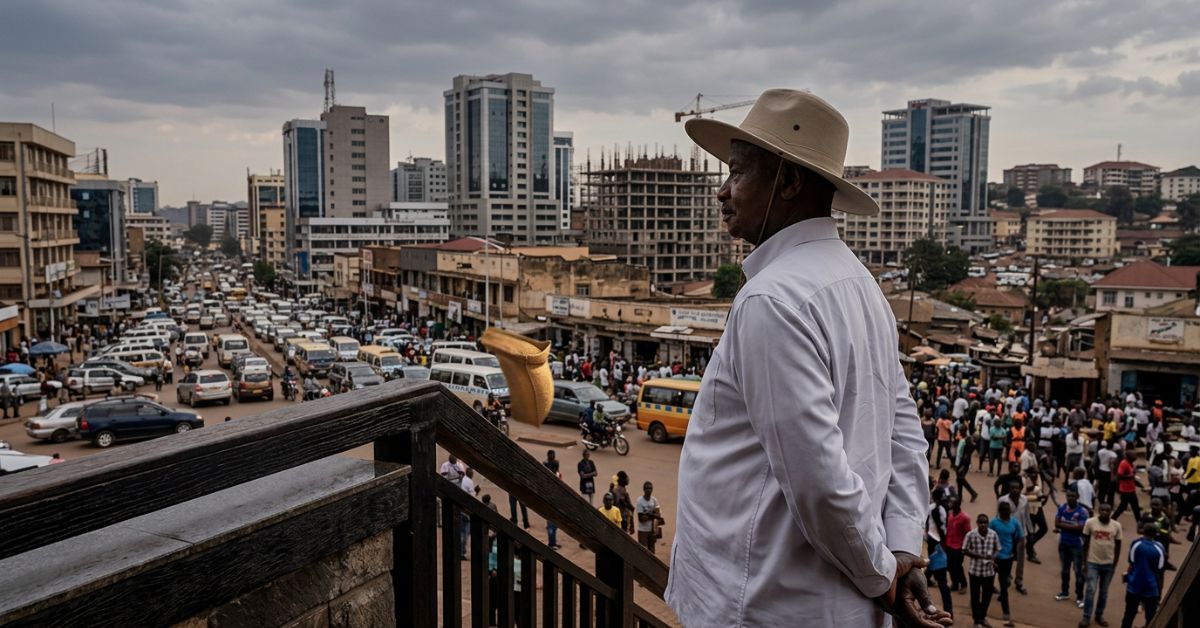
For personal reasons, I have spent the past several weeks in Kampala, Uganda’s capital — a vibrant, contradictory city where snarled traffic, new building sites, and the energy of an extraordinarily young population coexist alongside the ragged edges of a modernization still incomplete. By coincidence, my stay overlapped with one of the defining political moments in recent African history: the seventh inauguration of Yoweri Museveni, who was reelected president in January 2026 with 71.6 percent of the vote and an official turnout of 52.5 percent. At 81, having governed since 1986, Museveni belongs to that rare category of leaders whose biography has become indistinguishable from the history of the country itself.
For anyone arriving in Uganda today, it is difficult to dismiss what has been achieved over these four decades. When Museveni came to power, the country was emerging from generations of dictatorship and civil war. Under Idi Amin and Milton Obote, Uganda had been a country of repression, violence, and economic ruin. The relative stability of recent decades — the expansion of the economy, Kampala’s growing regional weight, the state’s ability to preserve a degree of internal cohesion — represents a genuine achievement, and one that explains why a significant portion of the population still regards Museveni as the guarantor of order and continuity.
And yet, moving through the city in the days surrounding the inauguration, what struck me was not so much enthusiasm as a kind of normalization. Kampala did not feel animated by popular fervor; it felt orderly, almost administrative. Some supporters of the National Resistance Movement, the ruling party, wore its customary yellow, while daily life went on as though it were any other day. The impression was not of a new beginning, but of a predetermined story quietly reaffirming itself.
The question that kept presenting itself was simple enough: how long can a political system built on the continuity of a single man sustain itself before stability loses its original meaning and becomes, instead, the indefinite suspension of democratic renewal?
The Ceremony of Permanence
The inauguration ceremony, held in Kampala, had the unmistakable tone of a celebration of sheer political endurance. Wearing a traditional straw hat and a white shirt, Museveni enumerated his government’s achievements and credited the military with having secured the country’s safety. In his address, he paid tribute to Julius Nyerere, the historic president of Tanzania, underscoring the symbolic and political continuity between his personal trajectory and the liberation movements of East Africa.
Numerous African heads of state were in attendance, including the presidents of the Democratic Republic of Congo and Burundi, and the leaders of Somalia, South Sudan, and Mozambique, as well as Tanzania’s president. Their presence gave the event a regional dimension, signaling that Museveni continues to be regarded as a central figure in the political and security landscape of East Africa and the Great Lakes region. The United States was represented by a senior State Department official — a sign of the pragmatic relationship Washington maintains with a partner deemed strategically convenient.
The ceremony’s language was that of continuity. There was no talk of succession, no talk of transition; the themes were consolidation, the fight against corruption, and further economic development. Museveni promised to reduce residual poverty and to steer Uganda toward middle-income status, with particular emphasis on improving public services, especially in healthcare.
In formal terms, this was a routine presidential inauguration. In substantive terms, the ritual carried the meaning of a renewed personal consecration. After four decades in power, each reelection inevitably resembles less a transfer of power and more a dynastic reaffirmation — even if it takes place within the formal scaffolding of constitutional procedure.
The Opposition and the Limits of Democracy
Museveni’s main challenger was Bobi Wine, the former musician and leader of the National Unity Platform, who received 24 percent of the vote. As in previous elections, Wine alleged pressure, intimidation, and irregularities at polling stations, contesting the credibility of the entire process. The opposition also chose to boycott the inauguration ceremony, refusing to lend it any symbolic legitimacy.
The more revealing fact is not simply the electoral result but the distance between how power is organized and the expectations of an overwhelmingly young population. The majority of Ugandans were born after Museveni was already president. For entire generations, the peaceful transfer of power has remained a theoretical concept rather than anything they have ever witnessed.
Yusuf Serunkuma, a professor at Makerere University, described this latest inauguration as a permanent fresh start — a particularly apt phrase for capturing the feeling of a system that perpetually promises transformation while reproducing the same configuration of power. The country continues to wrestle with widespread poverty, inequality, and persistent social problems, even as political renewal remains indefinitely deferred.
Democracy is not measured by the mere existence of elections, but by the real possibility that power can change hands. When a leader wins for the seventh consecutive time, the question is not only a legal one; it is political and cultural. Elections risk becoming not a vehicle for change but a mechanism for ratifying a balance of power that was never really in question.
Stability Is Not Enough
It would be shallow to ignore what Museveni has meant for Uganda. In a country that has known disorder and violence, stability is no small thing. But stability is a means, not an end. Its function should be to create conditions for stronger institutions, broader participation, and eventually the peaceful transfer of power.
When stability instead becomes the all-purpose justification for one man’s indefinite hold on power, it risks becoming the opposite of democracy. Order cannot be the alibi for stagnation, nor can the memory of past achievements stand in indefinitely for the work of building what comes next.
The question of succession, too, remains unresolved. In recent years, the name most frequently mentioned was that of Muhoozi Kainerugaba, Chief of Defense Forces and the president’s son, who has since stated that he does not intend to run in the 2031 elections, pointing instead to his uncle, Salim Saleh, as a possible candidate. This uncertainty is itself a reminder of how thoroughly the political system revolves around the president’s family and inner circle.
From where I stood in Kampala, Museveni’s seventh term presents itself as a paradox of contemporary politics. It is at once the symbol of an undeniable stability and the sign of a democracy that struggles to imagine itself beyond its founding leader. After four decades of his rule, Uganda’s real test is not simply to preserve the order it has built, but to prove that stability can outlast the man who made it.

