
This article first appeared in Arabic on Siyassa.org.eg and is republished here in English with the author’s permission. Setit Media presents this translation as part of our mission to uphold truth, credible journalism, and serious public understanding.
Introduction
What is unfolding in the Horn of Africa is no longer a limited disagreement over commercial transit facilities, nor a diplomatic tension that can be managed by reassuring statements or technical formulas. It is a regional crisis with deep legal and geopolitical implications. More importantly, it is a test of whether the rules that protect sovereignty and territorial integrity still carry real meaning in the Red Sea and the wider Horn of Africa.
The present crisis is not the result of an emergency circumstance, nor the product of a passing misunderstanding. It is a direct reflection of Ethiopia’s declared ambition to obtain what its leadership describes as “sovereign access to the sea”. This ambition has been presented in several changing forms: sometimes as a legal right, sometimes as a historical entitlement, and at other times as an existential or economic necessity that cannot be postponed. Yet the diversity of the language does not change the essence of the matter. The real problem lies in the move from legitimate contractual access, which international law recognises for landlocked states, to a sovereign claim that reopens questions of borders and territorial jurisdiction in an extremely sensitive region.
Most importantly, none of these descriptions, regardless of their political formulation, creates under contemporary international law any right to acquire sovereignty over the territory of another state. There is no legal rule that grants a landlocked state the right to impose its sovereignty over the coast of a sovereign state. Nor does any modern principle permit the acquisition of territory outside the framework of treaties, mutual recognition, and free consent. The United Nations Charter enshrines the sovereign equality of states and prohibits the threat or use of force against the territorial integrity or political independence of any state. The difference between a “right of access” and a “sovereign right” is therefore not a linguistic detail. It is the dividing line between legitimate cooperation and the redefinition of the foundations of the international system itself.
In a region such as the Red Sea, where global trade routes intersect with the competition of regional and international powers, this shift becomes a matter of collective security, not merely a limited economic issue.
First: The Ethiopian Vision as Presented by Decision-Makers
For criticism to be coherent and fair, the Ethiopian vision must first be presented as it appears in official and semi-official discourse. This vision rests on three main pillars: national security, the economy, and the problem of near-total dependence on the ports of others. From a national security perspective, Addis Ababa argues that a country of Ethiopia’s demographic and geographic size cannot remain confined within land borders, and cannot link the security of its foreign trade to the decision of one or two coastal states. From an economic perspective, it argues that high transport costs, fees, and insurance charges weaken the competitiveness of exports and imports, and make development hostage to logistical bottlenecks beyond the direct control of the state.
As for dependence on the ports of others, the Ethiopian argument points to the fact that most of Ethiopia’s foreign trade passes through Djibouti, and that this reliance creates strategic vulnerability in the event of political, security, or commercial crises. This point should not be denied in principle. Landlocked states do indeed face structural challenges in accessing global markets. International law has addressed this problem by recognising the right of access to the sea and freedom of transit, not by granting sovereign rights over the territory of coastal states.
The weakness in the Ethiopian discourse begins when it moves from diagnosing a real problem to proposing a remedy that is unlawful. Economic need, however serious, does not become a basis for acquiring sovereignty over the coast of another state. National security, however important, does not give a state the right to redefine the borders of its neighbours or to pressure them under the heading of “existential necessity”. Here precisely lies the essence of the matter: the distinction between commercial access and a sovereign right. The former can be regulated through fair and mutually beneficial agreements; the latter collides directly with the principles of sovereignty and territorial integrity.
Second: The Formation of the Modern Ethiopian State and the Limits of Legitimacy
To understand the depth of the controversy, it is necessary to return to the historical context in which the modern Ethiopian state, in its internationally recognised form, took shape. Ethiopia as we know it today did not emerge as a continuous extension of an ancient imperial entity with fixed borders. Its modern political boundaries were formed in the late nineteenth century during the reign of Emperor Menelik II, who expanded the Kingdom of Shewa northwards and southwards in the context of the redrawing of the maps of the Horn of Africa amid European colonial competition.
On 1 January 1890, Eritrea was officially declared an Italian colony. The modern Eritrean entity therefore took shape in international legal terms before the completion of the expansion of the modern Ethiopian state within its contemporary borders. This chronology is not a secondary detail. It is a decisive element in understanding the nature of political entities in the region. If Eritrea took shape as a defined and recognised entity before the consolidation of modern Ethiopia’s borders, the claim that it was an original part of that state contradicts both historical and legal facts.
Modern Ethiopia, as internationally recognised before the federal union with Eritrea, was a landlocked state with no direct coastline on the Red Sea. It did not lose a maritime outlet that had formed part of its stable legal entity, nor were coasts that fell within its internationally recognised borders taken away from it. Therefore, portraying the “loss of the sea” as a historical grievance rests on a confusion between recognised legal arrangements and temporary situations that arose under exceptional circumstances.
Ethiopia’s temporary access to the sea came as a result of United Nations General Assembly Resolution 390(V) of 1950, which approved a federal union between Eritrea and Ethiopia. This arrangement came into effect in September 1952, before being unilaterally terminated in 1962 through the annexation of Eritrea and the abolition of its federal status.
From the standpoint of international law, annexation, however long it lasts, does not create a legitimate historical right. It raises questions of legality and accountability. For this reason, Eritrea’s independence, achieved after de facto liberation in 1991 and confirmed through a United Nations-supervised referendum in 1993, was not secession from a mother state. It was the termination of a situation created by unilateral annexation and the exercise of the right of self-determination.[1] Invoking history to justify contemporary sovereign claims overlooks a basic truth: legitimacy in the international system is built on treaties and mutual recognition, not on civilisational narratives or selective readings of the past.
Third: The Legal Framework – Right of Access, Not Sovereign Right
The United Nations Charter, the Constitutive Act of the African Union, and the United Nations Convention on the Law of the Sea all draw clear boundaries between what is lawful and what is unlawful. The principle of sovereign equality and the prohibition of the threat or use of force are not merely abstract moral language. They are foundational rules designed to protect international stability and prevent political ambition from turning into the coercive alteration of borders.
The United Nations Convention on the Law of the Sea of 1982, which entered into force in 1994, grants landlocked states the right of access to the sea and freedom of transit through fair and equitable contractual arrangements. It does not grant them any sovereign right over the territory or ports of other states. Similarly, the African framework entrenches the principle of respect for the borders existing at independence, a principle that has been central to preventing border conflicts on the continent.[2]
Accordingly, turning the “right of access” into a “sovereign right” is not legal development. It is a move into direct collision with the founding principles of the modern international order, foremost among them the inadmissibility of acquiring territory by force or political pressure. This is where the test lies: will these principles remain real red lines, or will they become texts open to reinterpretation under the pressure of political discourse and geopolitical interests?
Fourth: Landlocked States in Africa – A Real Problem and a Cooperative Solution
Ethiopia is not unique in facing the problem of landlocked geography. Africa has sixteen landlocked or developing landlocked states, including Ethiopia, Uganda, Rwanda, Burundi, Mali, Niger, Chad, Zambia, Zimbabwe, Botswana, Lesotho, Eswatini, South Sudan and others.[3] Most of these states have addressed their challenges through transit agreements, trade corridors, customs cooperation, road and rail links, and joint infrastructure projects, not through sovereign claims over the coasts of their neighbours.
This is the essential idea that needs to be developed rather than merely rejecting sovereign claims. The practical path is not to close the door to Ethiopia’s legitimate economic needs, but to place them within forms of cooperation that do not affect sovereignty. Several alternatives are possible: long-term port-use agreements, free logistics zones, commercial corridors with regional or international guarantees, transparent transit fees, joint road and rail links, and customs and security cooperation that protects the rights of the coastal state and the needs of the landlocked state at the same time.
In this sense, legal rejection of the sovereign claim should not appear as rejection of cooperation. It should appear as a defence of the very rule that makes cooperation possible. Coastal states can offer practical solutions, but they cannot, and should not be asked to, relinquish their sovereignty or accept ambiguous arrangements that could later be transformed into a political or military fait accompli.
Fifth: Structural Drivers and the Link Between the Internal and the External
Ethiopia’s maritime ambition cannot be read in isolation from its internal context. Ethiopia faces deep challenges in managing its ethnic diversity, prolonged internal conflicts, and growing economic and security pressures. In such environments, a sovereignty-related external issue may become a tool of political mobilisation, redirecting internal debate towards a unifying external cause. Maritime claims may then be presented as a “solution” to structural domestic crises rather than as a normal path of cooperation with neighbouring states.
This link between the internal and the external is not a passing political accusation. It is a recognised entry point in analysing the behaviour of states facing crises of legitimacy or internal pressure. When internal consensus weakens, border or symbolic issues may acquire heightened mobilising power. The Ethiopian maritime discourse cannot therefore be separated from the need to produce a national issue that cuts across internal divisions, even if this comes at the expense of calming relations with neighbours or respecting the sensitivities of the Red Sea.
Sixth: Regional and International Actors – From Generalisation to a Network of Interests
At the same time, the Red Sea has become an open arena of competition between regional middle powers and major international actors seeking to strengthen their military and logistical presence. But a general reference to “regional and international powers” is not enough to understand the nature of the current crisis. Although the Red Sea has become a space in which the interests of many actors intersect, the present crisis, linked to Ethiopia’s pursuit of what is called “sovereign access to the sea”, appears more closely connected to dynamics of influence led by some regional powers, foremost among them the United Arab Emirates, with an indirect presence of Israeli interests in the security of the Red Sea and Bab el-Mandeb.
The UAE, by virtue of its investments in ports and logistics and its growing presence in the Horn of Africa, is an actor that cannot be ignored in any serious reading of maritime transformations in the region. Its name has previously been linked, through DP World, to the arrangements concerning Berbera Port, including the 2018 agreement that referred to a possible Ethiopian stake in the project.[4] Israel, because of its strategic position and security concerns related to navigation in the Red Sea, remains interested in any arrangements that may affect the balance along the opposite African coast.
This dimension has become more important as the Israeli-Iranian conflict has widened and as Red Sea security has become linked to the role of forces allied with Iran in Yemen, especially around Bab el-Mandeb. This passage is no longer merely an international trade route; it has become part of a wider security equation connected to the Gulf, Israel, the Suez Canal, and global energy and trade movements. The Houthi attacks on shipping in the Red Sea since late 2023 have shown how a non-state actor, supported by or aligned with a regional power, can affect global trade routes and the calculations of major powers.
Therefore, any rearrangement of influence on the African coast of the Red Sea may acquire a meaning that goes beyond Ethiopia itself and enters calculations of deterrence, monitoring, alliances, and regional competition. Understanding the crisis requires looking at how Ethiopian ambition intersects with the interests of these actors, rather than explaining it simply as the economic need of a landlocked state. The maritime file here is not about commercial transit alone. It is part of a wider network of calculations linked to ports, maritime security, alliances, and the redistribution of influence in the Red Sea.
Seventh: The Red Sea – The Figures of Power and the Reality of Sensitivity
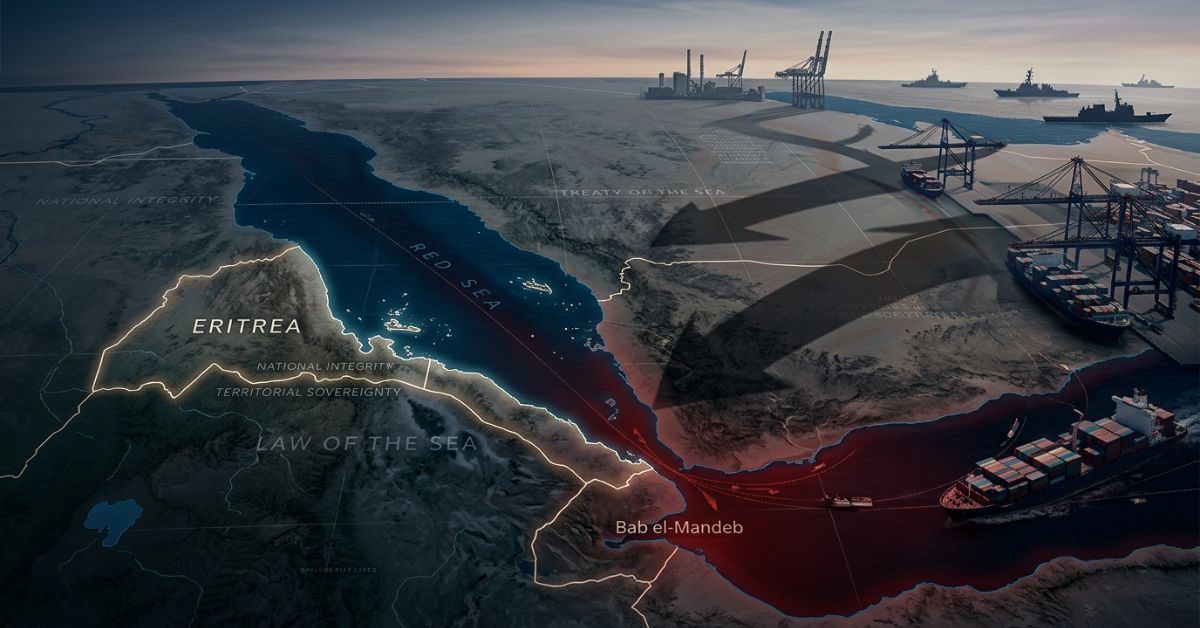
The Red Sea is not merely a regional passage. It is one of the world’s most important economic arteries and a geopolitical crossroads at which energy security, trade movement, and supply chains are shaped. The Red Sea-Bab el-Mandeb-Suez Canal axis links Europe to Asia and the Gulf to the Mediterranean, and represents a strategic node in global supply chains. United Nations and international estimates indicate that the Suez Canal handled around 12 to 15 per cent of global trade in 2023, while a large part of container traffic between Asia and Europe either passes through, or is affected by, the Red Sea.
Energy data also show that oil flows through Bab el-Mandeb fell sharply after the Red Sea disruptions, from an average of around 8.7 million barrels per day in 2023 to around 4 million barrels per day during part of 2024. This illustrates the sensitivity of the passage to security risks.[5] Any sustained disruption in this corridor is immediately reflected in insurance and transport costs, then in the prices of goods, energy, and consumption, especially in importing and developing economies.
Beyond that, the Red Sea has become a space where military investments, strategic ports, and security alliances intersect. Naval bases, logistical arrangements, and long-term partnership agreements all mean that any attempt to redefine “sovereignty” in this space goes beyond the region and touches international economic security.
Eighth: What Is Required in Practice?
First, the legal principle must be established with clarity: the rights of landlocked states are contractual, not sovereign. Under no circumstances should the need for maritime access be transformed into a claim that affects the territorial integrity of coastal states or diminishes their sovereignty. This does not mean denying Ethiopia’s economic needs or underestimating the difficulty of its position as a landlocked state. It means placing those needs within a clear legal framework that prevents them from being turned into sovereign pressure or a pretext for reopening border questions. International law does not close the door to access to the sea, but it strictly distinguishes between access organised by agreement and claims to sovereign rights over the territory of others.
Second, practical alternatives for cooperation must be developed instead of relying on general political responses. The rejection of sovereign claims becomes stronger and more convincing when accompanied by realistic avenues that meet legitimate economic needs without undermining sovereignty. These alternatives may include long-term port-use agreements, secured transit corridors, free zones inside the ports of coastal states, joint investments in roads and railways, arbitration mechanisms for commercial disputes, customs and security coordination, and transparent and reviewable service fees. Regional cooperation frameworks can also be established to guarantee the regular movement of trade, prevent the politicisation of ports, and provide the landlocked state with a degree of logistical stability without turning commercial facilities into sovereign rights or permanent security presence.
Third, any future arrangements should be based on mutual benefit, not coercion. Coastal states are not required to give up their sovereignty, but they can benefit economically from their geographic position by developing ports, logistics, storage, transport, insurance, and maritime maintenance services. In return, Ethiopia can obtain stable and diversified commercial access that reduces transport costs and excessive dependence on a single corridor. In this sense, geography can be transformed from a source of tension into an arena of integration, provided cooperation is based on mutual recognition, respect for borders, and legal clarity.
Fourth, the most affected coastal states should strengthen their diplomatic and security coordination within the framework of international law. Deterrence here does not necessarily mean military confrontation. It means preventing the creation of a new fait accompli that threatens stability and undermines confidence in the rules-based system. This includes coordinating collective positions, rejecting unilateral sovereign claims, strengthening joint maritime cooperation to protect international navigation, and establishing regular regional consultation mechanisms to assess strategic risks. Coordination should also include information exchange, monitoring movements that may affect the security of sea lanes, and developing a unified diplomatic discourse that clearly distinguishes between legitimate cooperation and claims that affect sovereignty.
Fifth, the African Union, the United Nations, and regional bodies, including IGAD, the Arab League, and the Red Sea coastal states, should affirm their practical commitment to the principles of territorial integrity and the inadmissibility of changing borders by force or political pressure. It is not enough to issue general statements about stability. The message must be clear: transit rights and economic cooperation are negotiable; sovereignty and territorial integrity are not. Tolerance of such behaviour does not threaten one state alone. It threatens the very idea of international law as the reference point that regulates relations between states.
Sixth, the Red Sea should, as far as possible, be insulated from bloc politics and proxy conflicts. The more ports and maritime routes become instruments in struggles for influence between regional and international powers, the more economic cooperation declines and the greater the risks of miscalculation and escalation become. What is required is not only to address Ethiopian ambition in itself, but to place it within a broader vision for Red Sea security, based on respect for the sovereignty of coastal states, freedom of navigation, preventing the militarisation of ports and islands, and ensuring that the need of landlocked states for maritime access does not become a gateway for redistributing influence or creating ambiguous security arrangements.
Conclusion: What Is Really Being Tested?
The issue today is not merely maritime access, nor a simple dispute over a port or a trade corridor. It is a test of the credibility of the international system itself in an extremely sensitive region. If sovereignty can be redefined on the basis of shifting political discourse, or if economic necessities can be presented as sovereign rights, then regional stability becomes inherently fragile and borders become subject to bargaining under the pressure of force or geopolitical inducement. In such a situation, it is not only one state that is harmed. The rule on which modern international relations are built is harmed: borders are not altered by coercion, and the needs of states, however legitimate, are not solved at the expense of the sovereignty of other states.
At the same time, protecting sovereignty does not mean closing the door to cooperation, nor denying the real challenges facing landlocked states in accessing markets and ports. The real challenge is to formulate a balanced equation that allows landlocked states fair and stable access to the sea, allows coastal states to preserve their sovereignty and security, and at the same time prevents regional and international powers from turning legitimate economic needs into instruments for re-engineering influence in the Red Sea. This cannot be achieved through slogans or escalation, but through clear agreements, secure corridors, transparent commercial arrangements, and legal guarantees that protect transit rights without opening the door to ambiguous sovereign claims.
The practical solution, therefore, does not lie in imposing facts on the ground, nor in invoking history to justify contemporary claims. It lies in returning to the rules whose necessity has been proven in Africa and the world: respect for borders, non-use of force or threat of force, mutual recognition, and cooperation based on shared interests. The clearer the rules, the more possible cooperation becomes. When these rules disappear, ports and maritime corridors turn from opportunities for economic integration into arenas of competition and conflict.
The Red Sea has never been merely a body of water. It has always been a space of trade, civilisational interaction, and strategic competition. Its stability today requires legal clarity, responsible balance, and recognition that protecting international rules is not a theoretical luxury, but a condition for collective security. The question facing the region, and indeed the world, is not simply who has access to the sea. It is what kind of international order we are prepared to defend: one based on sovereignty, cooperation, and law, or one that allows economic need and geopolitical ambition to become justifications for reopening borders and conflicts.
Brief References and Notes
[1] On the legal and historical formation of Eritrea: Eritrea was declared an Italian colony on 1 January 1890; United Nations General Assembly Resolution 390(V) of 2 December 1950 established the federal arrangement between Eritrea and Ethiopia; and Eritrea’s April 1993 referendum was conducted under United Nations supervision.
[2] United Nations Charter, especially Article 2(1) on sovereign equality and Article 2(4) on the prohibition of the threat or use of force; United Nations Convention on the Law of the Sea, 1982, Part X, Articles 124-132, especially Article 125 on the right of landlocked states to access to and from the sea and freedom of transit; see also the Constitutive Act of the African Union, Article 4(b), and OAU Resolution AHG/Res.16(I), Cairo 1964, on respect for borders inherited at independence.
[3] UN-OHRLLS and UNCTAD lists and reports on landlocked developing countries, indicating 32 landlocked developing countries globally, including 16 in Africa.
[4] On the UAE role and Berbera Port arrangements, see DP World and Reuters reports on the 2018 agreement referring to a possible Ethiopian stake in the Berbera Port project alongside DP World and the Somaliland Port Authority.
[5] On the sensitivity of the Red Sea and Bab el-Mandeb: UNCTAD, 26 January 2024, on disruptions to global trade in the Red Sea and Suez Canal; U.S. Energy Information Administration, 11 October 2024, on the decline in oil tanker transits through the Red Sea; and UN Security Council and Reuters reports on Houthi attacks on shipping since late 2023.