A tool that promises more than it delivers
Sanctions are routinely presented as a clean alternative to military force. In reality, they are a blunt instrument with a poor track record — particularly when deployed unilaterally. This article examines the legal distinction between multilateral and unilateral sanctions, reviews the empirical evidence on their effectiveness, and applies both lenses to the case of Eritrea. The central argument is that sanctions, especially of the unilateral variety, tend to consolidate the regimes they target while transferring the burden onto civilian populations.
1. A Tool That Promises More Than It Delivers
In the vocabulary of international politics, sanctions are often presented as a ‘clean’ alternative to force — a way to apply pressure without resorting to war. The logic appears straightforward: if you strike a country in its economic or financial interests, its leadership will be compelled to reconsider its choices. But this framing significantly oversimplifies a mechanism that, in practice, is far more uncertain.
Sanctions do not act on abstract entities. They operate on concrete political systems — systems with entrenched elites, security apparatus, informal networks, and adaptive capacities that are routinely underestimated. It is precisely this capacity for adaptation that explains why, in the majority of cases, the instrument fails to produce the expected results.
As a substantial body of scholarship has noted, sanctions rarely function as a direct lever for change. More often, they generate indirect effects that are difficult to control, and sometimes the opposite of what was intended. The promise of an effective, non-violent intervention runs up against a reality defined by ambiguous and frequently disappointing outcomes.
2. The Only Legitimate Sanctions
Before any assessment can be made, a point of principle must be established. The only sanctions that can claim legitimacy under international law are those adopted by the United Nations Security Council. This is not a procedural technicality — it is a substantive distinction.
Multilateral sanctions arise from a collective process and exist within a recognized legal framework, with the declared objective of responding to threats to international peace and security. Unilateral sanctions are an altogether different matter. They are decisions taken by individual states — typically major powers — that extend their political will beyond their own borders. They carry no international mandate, and for precisely that reason, they must be considered illegitimate under international law.
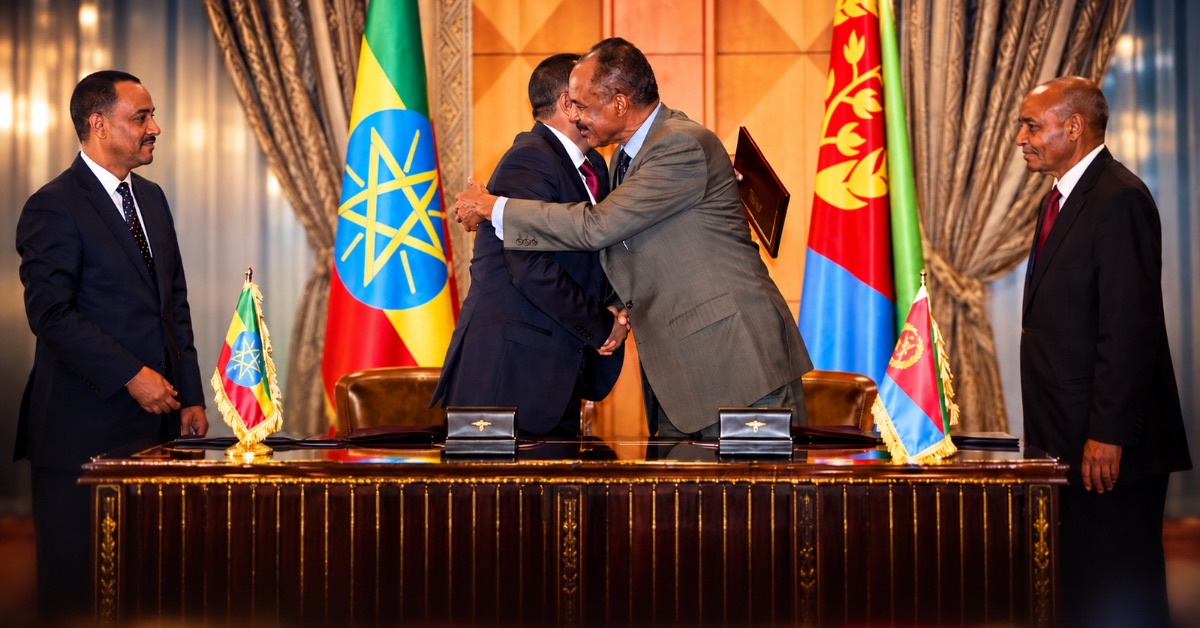
In the case of Eritrea, the distinction is concrete and current. The United Nations sanctions, introduced in 2009 and strengthened in 2011, were lifted in 2018. What remains today is a collection of unilateral measures, primarily American, targeting specific individuals and entities — often through instruments such as asset freezing and financial restrictions. To continue speaking generically of ‘sanctions’ without distinguishing between these two levels is not merely imprecise. It actively contributes to a misleading narrative.
3. Do They Work? The Evidence Says Rarely
When the analysis moves from the normative to the empirical, the picture becomes even starker. Systematic studies — among them those of Gary Clyde Hufbauer, Jeffrey Schott, and Kimberly Ann Elliott, alongside the critical analyses of Robert Pape and Daniel Drezner — consistently show that sanctions have a limited success rate, particularly when the objectives are ambitious. Where positive results do occur, they tend to involve narrow, discrete goals rather than structural transformations.
The explanation is relatively straightforward. Sanctions generate economic costs, but they do not automatically translate into political change. Ruling elites have strong incentives to hold firm, and the means to do so: control of resources, suppression of dissent, and the construction of alternative networks. Moreover, as several studies have shown, sanctions can actually strengthen a regime’s internal cohesion — providing a justification for tightened control and a ready-made narrative of resistance against an external enemy.
In the meantime, the most immediate consequences fall on the population: inflation, scarcity of goods, reduced access to essential services and markets. This gap between stated objectives and actual outcomes is one of the central reasons why many scholars regard sanctions as a blunt instrument — particularly when deployed extensively and unilaterally.
4. Eritrea: Convenient Explanations and a More Complex Reality
In discussions about Eritrea, sanctions have become a recurring explanation for a range of domestic problems: economic stagnation, the absence of reform, institutional weakness. It is an explanation that has some basis in reality, but it becomes problematic when it is used as the sole or primary lens.
Following the lifting of UN sanctions in 2018, the formal context shifted significantly. Yet this shift did not translate into any comparably evident transformation at home. This data point suggests that internal factors play a determining role. Unilateral sanctions may limit access to certain resources or financial circuits, but they alone cannot account for the absence of structural reform or independent institutions.
When sanctions become the only explanatory framework, they risk functioning as an alibi — redirecting attention away from domestic dynamics (political, economic, institutional) and toward external factors. A more rigorous reading requires holding both dimensions together, without reducing complexity to a single cause.
5. Who Actually Pays the Price
The most critical issue concerns the concrete effects of sanctions, particularly unilateral ones. Designed to target governments and their leaderships, they end up falling directly on the population. Financial and trade restrictions translate into rising prices, shrinking economic opportunity, and diminished access to essential goods and services. In less open environments, these effects are magnified.
External pressure does not necessarily weaken power — it often reinforces it. Resources concentrate in the hands of the state or entrenched elites; the margins for economic autonomy narrow; dependence deepens. This is the central paradox of sanctions: a tool conceived to change a government’s behavior can end up consolidating it, while transferring the costs onto society at large.
Conclusion
An honest conclusion must start here. Sanctions are not a simple solution to complex problems. They may have a limited role to play, in specific contexts and with well-defined objectives. But unilateral sanctions in particular remain a tool without international legitimacy — frequently ineffective, and potentially counterproductive.
In the Eritrean case, acknowledging this does not mean denying the weight of external pressures. It means refusing to let those pressures become a total explanation. Because when analysis comes to rely on a single cause, the risk is not merely oversimplification. The risk is a failure to understand at all.
Key References
Hufbauer, G.C., Schott, J.J., Elliott, K.A. & Oegg, B. (2007). Economic Sanctions Reconsidered (3rd ed.). Peterson Institute for International Economics.
Pape, R.A. (1997). Why Economic Sanctions Do Not Work. International Security, 22(2), 90-136.
Drezner, D.W. (1999). The Sanctions Paradox: Economic Statecraft and International Relations. Cambridge University Press.
UN Security Council Resolution 1907 (2009) and Resolution 2023 (2011) on Eritrea. Lifted by Resolution 2444 (2018).