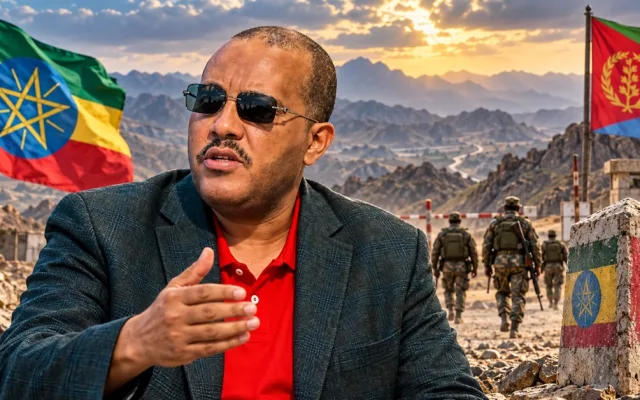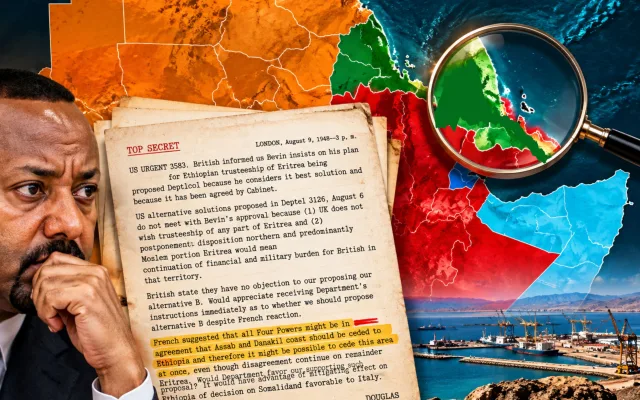
Those who listened to the recent interview General Tsadkan gave to the Ethiopian Prosperity Party-controlled media can’t help but scratch their heads. The interview indicates that he is very desperate, eager to seize power, and as usual, planning revenge. Especially his narration of the 1998-2000 Ethio-Eritrea border war, his decision to invade Eritrean sovereign territory, Assab, and how it all ended are full of lies and contradictions. Now he has a new horse called a prosperity party, and he would do anything to use it to climb to power. Fortunately, almost all of his past attempts ended in failure, and his current attempt may even end badly. To understand Tsadkan’s downward spiral from power and his repetitive failed attempts to come back, we need to dig a little deeper.
He was chief of staff of the Ethiopian Defense Forces (ENDF) from 1991 to 1998.
When the border problem between Eritrea and Ethiopia started in Badme and Bada areas (1996–1998), he was the chief of staff of the Ethiopian Defense Forces. He was also a member of the Ethio-Eritrean committee tasked to resolve the border problem before it erupted into a full-fledged war. Right before the full-fledged war, he oversaw the brigade that crossed into Eritrea through Adi Murug (Bada) and dismantled the Eritrean administration, closed schools, and expelled teachers from the area. His friend Gebru Asrat was the president of the Tigray region, doing his bidding in the border areas. Both, stationed in Addis Ababa, are still beating the drums of war. Thus, we can safely conclude that General Tsadkan was the architect of the 1998–2000 Ethio-Eritrea border war that led to the perishing of 100,000 Ethiopian soldiers.
During the 1998–2000 Ethio-Eritrea War
During the 1998–2000 Ethio-Eritrea border war, General Tsadkan planned to attack Eritrea on the Tserona front, Egri Mekel. He intended to break the Eritrean defense line using close to 12,000 infantry, 5,000 Tigrayan civilians with donkeys, and a large 20th mechanized division. As written by General Yohannes Gebremeskel and by Tesfaye Gebreab, it was carnage.
After the war ended in a complete defeat, General Tsadkan himself said, “I led many battles in my career. I have fought in many wars. I have seen a lot. I have never experienced this kind of utter failure. It is bad.” His army was decimated, and Tsadkan had to flee ten miles away to save his life, crying on the way.
In a war review conducted in Infara (Tigray), General Tsadkan’s crying continued, and it was decided he should be fired and gradually pass his position to General Samora Yonus. In revenge for his defeat in Egri Mekel, Tsadkan ordered his army to rape Eritrean women in Kohito and other areas around Senafe, Eritrea. Such crimes are documented in the Red Cross office in Geneva, Switzerland.
Also, after losing hope in his plan to march to Asmara, the capital city of Eritrea, Tsadkan ordered the capture the port city of Assab. Recently, Tsadkan gave an interview to the Ethiopian government-owned media about his decision to do so. His interview was full of lies and exaggerations. Let’s expose his lies one by one.
1. He claimed that the Ethiopian Army pushed the Eritrean Army up to 18 km from Assab.
Tsadkan knows that that did not happen. The Eritrean Army withdrew from the Bure front, 71 Kms away from Assab, after the Eritrean government accepted the Mediator’s proposal that required Eritrea to leave 25 miles demilitarized zone between the two countries. However, in violation of the agreement, the Ethiopian army followed the withdrawing Eritrean Army and launched an attack. So, the Ethiopian Army did not push the Eritrean Army, and Tsdakan was telling a lie.
2. He blamed Meles for stopping the war in Assab.
Gebru Asrat’s book clearly indicated that the attack on Assab was launched after Meles declared the war was over. Meles declared the war was over on June 1st, 2000, and the war in Assab continued till June 17. According to Gebru’s book, individuals in the TPLF who were not happy with the war ordered the attack. Previously, Tsadkan himself admitted ordering the attack; thus, Gebru was referring to Tsadkan. Also, Herman Cohen, the then Undersecretary in the US State Department indicated that the Ethiopian side asked the mediators preparing the signing of the secession of hostilities in Algeria to delay it by a few days so that the Ethiopian Army could occupy Assab and gain an upper position in the negotiation. The attack ended in a disastrous defeat of the Ethiopian invading army and Ethiopia was forced to sign the cessation of hostilities agreement on June 18, 2000. Gebru also described the humiliating defeat in Assab, but still, he tried to blame Meless. Now Tsadkan wants to try again. “You cannot teach an old dog a new trick.”
After the 1998–2000 Border War
After being dismissed as chief of staff, General Tsadkan acquired substantial wealth, raising questions regarding its source. Despite having a limited pension, he acquired properties, including villas in Addis Ababa and shares in a Tigray beer factory. Some speculate this wealth resulted from activities during or after the war, but details and evidence remain unclear.
During the 2020–2022 Tigray War
Up to the time leading to the Qeerroo (Oromo youth) revolt that expelled the TPLF from the federal government seat in Addis Ababa, General Tsadkan was writing articles supporting the revolt against the TPLF. Later, he became a regular in Prime Minister Abiy Ahmed’s office.
Surprisingly, when Ethiopia and Eritrea made peace, Tsadkan reversed course, fled to Tigray, and became one of the top people who secretly decided and planned the gruesome attack on the Northern Command. This attack sparked the Tigray War and led to the immense suffering of the Tigrayan people. If Tsadkan was an Ethiopian Nationalist, why did he conspire to attack the Ethiopian National Defense forces he once led?
After the TPLF army entered Mekelle, June 28th, 2021, and continued its attack on the Ethiopian Army, Tsadkan was sure he was going to capture the Federal Government Seat, Addis Ababa, and realize his long dream to be the Prime Minister of Ethiopia. He declared no negotiation with the Prosperity Party because, in his mind, the war was ending. Surprisingly, the TPLF army was defeated and had to return to Tigray. Again, Tsadkan blamed the TPLF and America for their defeat.
Pretoria Agreement and Tsadkan’s Unfulfilled Wishes
After the 2020–2022 devastating Tigray war, the Tigray People’s Liberation Front (TPLF) signed a peace agreement on November 2, 2022, in Pretoria, South Africa. The peace agreement required the establishment of a provisional government in the Tigray region of Ethiopia. When the selection of the members of the provisional government started, General Tsadkan, who made a name for himself by claiming to be a leader of the Tigray Defense Force (TDF), was rejected by the army. Yet GSTS (Tigrayan Scholars in Diaspora) and their bosses in the Prosperity Party brought him to the Tigray for provisional administration as their representative. Equipped with the Endorsement, he was ready to destroy the Tigrayan social fabric and create a very dangerous political turmoil in Tigray. The brazen move by the Tsadkan and its readiness to throw Tigray into a sub-regional conflict is very scary, to say the least. The late Ethiopian Prime Minister Meles Zenawi’s decision to expel Tsadkan, from the Army and the TPLF was right, and the TPLF should have seen the dangers of bringing him to power.
He requested the Deployment of the Ethiopian Army to places bordering Eritrea.
In his new book titled “Azurit”, another senior inner-circle Tigrayan general, Yohannes Gebremeskel, lists General Tsadkan among the few Tigrayans who secretly met, decided, and planned an attack on the Northern Command. The Northern Command was attacked by 200,000 Tigray Special Forces and militia on November 4, 2020. General Tsadkan, who was fired by Meles Zenawi for his dismal war planning in the Tserona front during the 1998–2000 Ethio-Eritrea border war, was very eager to return to power not only in Tigray but also in the federal government. The irony is that the Northern Command, which he decided and planned to attack and dismantle, was called by him to come to the Ethiopian Eritrean border to protect him from the TPLF and TPLF-loyal generals. Why was General Tsadkan, who built his name as a leader of the TDF during the 2020–2022 Tigray War, afraid of the TDF?
After he fled from Tigray in 2025.
After realizing that his sinister agenda to grab power in Tigray failed, he fled to the United States. General Tsadkan has already moved his family to the United States. While he is conspiring to ignite wars in Ethiopia, his children are graduating from reputable and expensive colleges in the USA. After he made sure that the relationship between Eritrea and Ethiopia was battered, he returned from the US to Ethiopia, and currently he is continuing his old and failed project to dismantle Tigray and hoping to ignite war between Eritrea and Ethiopia. Tsadkan, who secretly conspired and planned an attack on the Ethiopian defense forces, is now in Addis Ababa, instigating another war between Eritrea and Ethiopia. People may think that this can only happen in a movie. Yet, unfortunately, this is a reality in Ethiopian politics.
Conclusion: –
Tsadkan’s agenda is laced with revenge and greed for power. Will he succeed? Time will tell. One thing is clear, though. It would not be long before he packs and flees to the US for good. I mean, if he is lucky. Otherwise, the prosperity party may decide to take action before he flees. It is highly likely that this time he may not be as lucky as before.
Awet N’hafsh and Eternal Glory to Our Martyrs