
What Political Agency Really Means
In the language of the social sciences, agency is not a decorative concept. It is the point at which history stops looking like fate and becomes a field of choice. To speak of political agency is to ask who acts, how they act, and with what room for decision inside contexts shaped by material constraints, institutions, economic hierarchies, and international pressures. Much of contemporary social theory moves within this tension between structure and action. Anthony Giddens described structures as sets of rules and resources that both limit and enable action. Charles Tilly showed that the modern state does not arise from abstract design but from conflict, bargaining, and collective mobilization. Amartya Sen linked agency to the substantive freedom to shape one’s own life, shifting the focus of development from income alone to capabilities and choice.
In political life this means rejecting two opposite shortcuts. The first is determinism, the belief that everything can be explained by global structures, economic dependency, or historical legacies. The second is the myth of the heroic individual who bends history by sheer will. Agency lies in the space between. Individuals, elites, movements, armies, and civil societies operate within real constraints, but they are never mere objects. They interpret, calculate, misjudge, and learn. In moments of crisis, when institutions weaken and uncertainty widens, this capacity becomes more decisive, not less. Political choices do not disappear under pressure. They grow heavier. To speak of agency, ultimately, is to return politics to the realm of responsibility.
African States Between External Constraints and Convenient Sovereigntism
Debates about African states often trap the question of agency between two mirror narratives. The first emphasizes colonial legacies, arbitrary borders, dependent economies, and subordinate integration into global markets. These are real factors, and they have profoundly shaped institutions and opportunities for development. The second narrative, less examined but equally powerful, presents itself as radically autonomous and anti-Western. Some leaders claim a full recovery of sovereignty, invoke pan-Africanism, and denounce Western financial institutions, only to replace one dependency with another by shifting alignment toward China or Russia.
Here lies a central ambiguity. Rejecting the West does not automatically translate into political autonomy. Often it produces new asymmetric alliances, opaque exchanges between resources, security, and political backing, and forms of externalized regime survival. The language of foreign pressure becomes a rhetorical tool to justify the closure of domestic political space, the marginalization of opposition, and the militarization of the state. Agency does not disappear in this process. It is exercised, but in a specific direction: the preservation of power. Explaining every failure as externally imposed produces a perverse effect. It absolves ruling elites, reduces societies to spectators, and turns geopolitics into a permanent excuse. Yet the choices of leaders, the role of armed forces, the quality of institutions, and the vitality of civic movements remain decisive variables. Dependency is a condition, not a destiny.
Sudan After 2019: The Window That Closed
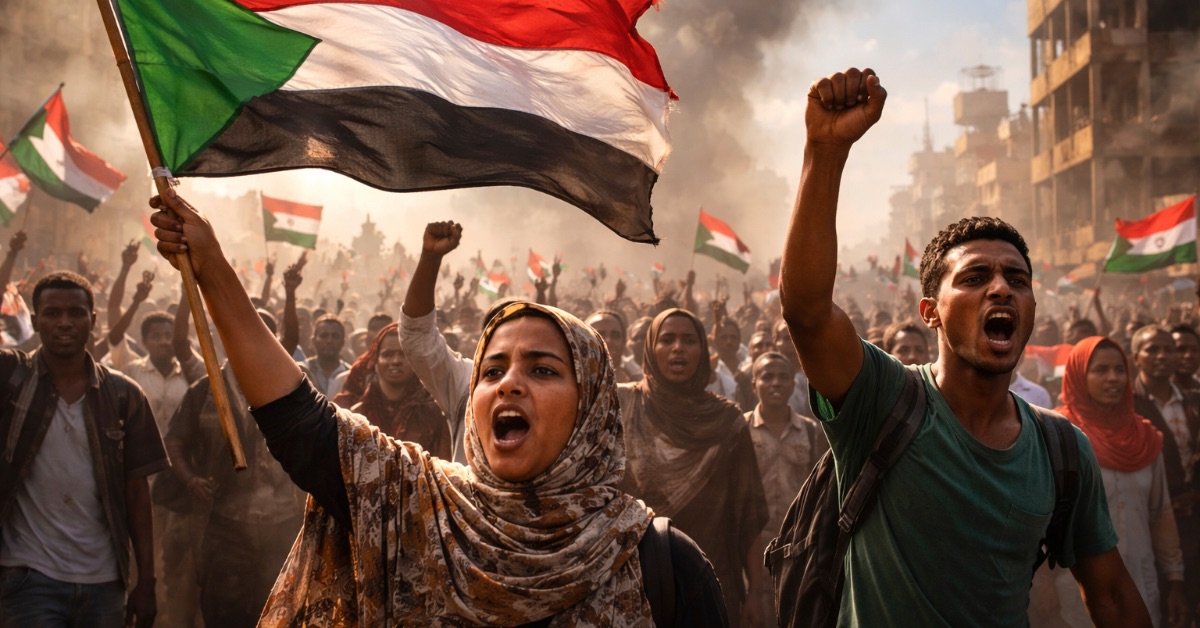
The fall of Omar al-Bashir in 2019 opened a rare political space in Sudan. A broad, intergenerational civilian mobilization, with strong female leadership, forced a transition that, though fragile, contained a real project of institutional reconstruction. At that moment Sudanese society displayed a clear form of collective agency. It was not only protest. It was political vision.
That window gradually closed under the pressure of two armed poles. On one side stood the national army led by Abdel Fattah al-Burhan. On the other were the Rapid Support Forces commanded by Mohamed Hamdan Dagalo. Their competition for power devolved into open war, devastating urban life, the economy, and social cohesion. Regional and international actors have fueled the conflict through political, financial, and military support. External interference exists, and it matters. But the central dynamic remains an internal struggle over control of the state. The two generals are not bit players in someone else’s script. They are actors with networks, economic interests, and personal ambitions. They chose to subordinate the transition to military competition. In that choice, agency reveals its hardest edge: responsibility.
External Interference and Internal Responsibility
An interpretation that places foreign interference at the center captures a real part of the problem, but becomes misleading when it claims to explain everything. If every crisis is only the result of external maneuvering, then no local leadership is responsible, no society is a subject, and no decision carries weight. Such a view ends up denying precisely what it claims to defend: the political dignity of peoples.
In the Sudanese case, the same civilian forces that demonstrated remarkable political intelligence in 2019 were gradually sidelined by armed actors who favored control over institutional construction. Had the military leadership consolidated that transitional path instead of bending it to personal rivalry and entanglement with outside interests, a decisive part of today’s crisis might have been contained. Interference would not have disappeared, but it would have encountered stronger institutions and a less militarized political sphere. Recognizing Sudanese agency does not minimize international responsibility. It means rejecting a narrative that turns geopolitics into a total explanation and systematically removes internal actors from the consequences of their choices. Deep crises always emerge from the interaction between external pressures and domestic decisions. Remove one variable from the equation, and analysis gives way to simplification, which, in time, becomes part of the problem it claims to describe.
Bibliography
Giddens, Anthony. The Constitution of Society: Outline of the Theory of Structuration. Berkeley: University of California Press, 1984.
Tilly, Charles. Coercion, Capital, and European States, AD 990–1992. Cambridge, MA: Blackwell, 1992.
Sen, Amartya. Development as Freedom. New York: Alfred A. Knopf, 1999.