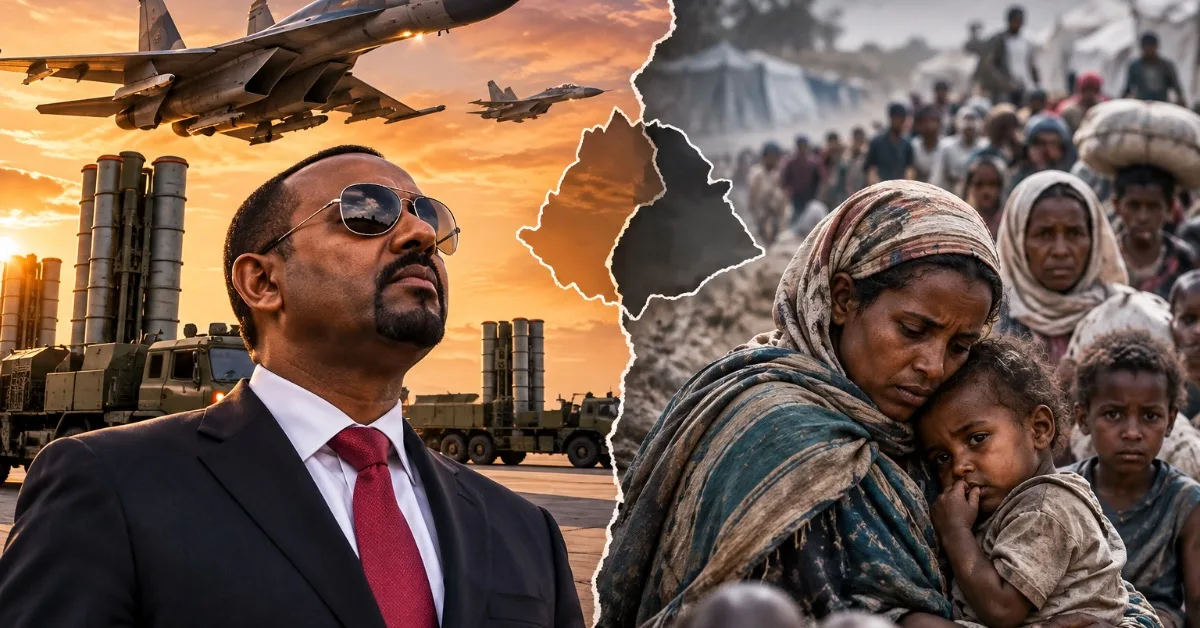
There is something deeply unsettling about a government celebrating the arrival of advanced fighter jets while millions of its citizens remain in desperate need of humanitarian assistance. That is the uncomfortable picture emerging from Ethiopia, where Prime Minister Abiy Ahmed has announced the acquisition of 12 Russian-made Su-35 fighter jets and plans to obtain four batteries of the sophisticated S-400 air-defence system. For a country still struggling with the consequences of devastating wars, widespread displacement, food insecurity and economic hardship, the announcement raises a question that cannot be brushed aside: what exactly are the government’s priorities?
The timing makes the announcement particularly striking. Ethiopia has not recovered from the destruction caused by the two-year war in Tigray, and renewed fighting in the north threatens to reverse what little progress has been made towards stability. Conflict continues to affect communities in Amhara and Oromia, while humanitarian organisations struggle to reach vulnerable populations across the country. Yet, against this backdrop, the Ethiopian government is presenting the acquisition of some of Russia’s most advanced military equipment as a major national accomplishment.
According to the European Commission, an estimated 21.4 million Ethiopians required humanitarian assistance in 2024, including millions who needed food support. No updated nationwide figure has been officially agreed for 2026, but the humanitarian emergency has certainly not disappeared. Only this month, the United Nations announced an additional $8.5 million in emergency funding to assist more than 202,700 vulnerable people in conflict-affected areas. That money is intended to help provide necessities such as healthcare, nutrition, shelter and sanitation. These are basic services that millions of Ethiopians should not have to depend on international donors to receive.
Now consider the other side of the picture. Based on comparable international arms contracts, 12 Su-35 fighter jets and four S-400 batteries could represent a military package worth several billion dollars. The actual price paid by Ethiopia remains unknown, as do the financing arrangements. It would therefore be misleading to claim that Addis Ababa has already spent a particular amount. Nevertheless, even the possibility of such an expensive military commitment deserves serious scrutiny when the country’s humanitarian needs remain so overwhelming.
Nobody disputes Ethiopia’s right to defend itself. Like every sovereign nation, it has legitimate security concerns and a responsibility to protect its territory. But national defence should not become an excuse to avoid difficult questions about public spending, political judgement and the welfare of ordinary citizens. A government that can negotiate sophisticated weapons agreements should also be expected to demonstrate equal determination in rebuilding destroyed schools, restoring healthcare facilities, helping displaced families return home and addressing the political disputes that continue to fuel violence.
The contradiction becomes even more troubling when Ethiopia’s recent history is considered. The war in Tigray caused immense suffering, destroyed infrastructure and displaced communities on a massive scale. The Pretoria Agreement was supposed to mark a turning point, replacing military confrontation with political settlement. Four years later, its implementation remains incomplete, tensions persist and renewed fighting has again placed civilians at risk. The lesson should be obvious: Ethiopia’s most serious security problems cannot be solved by military hardware alone. They are fundamentally political problems that require political solutions.
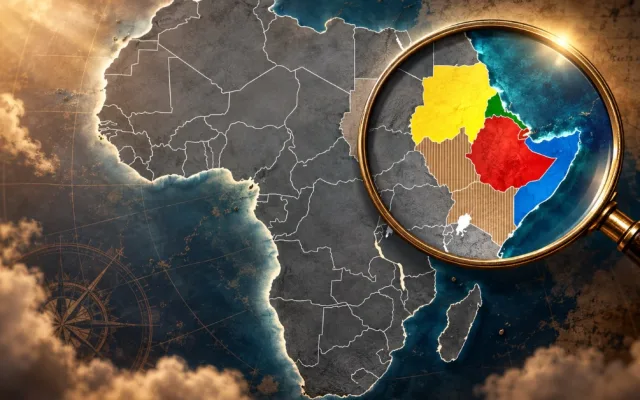
The same concern applies to Ethiopia’s deteriorating relationship with Eritrea. Since October 2023, Ethiopian leaders have repeatedly elevated the question of access to the Red Sea into a matter of national security and strategic necessity. Such rhetoric has understandably alarmed Eritrea, whose sovereignty and internationally recognised borders cannot be made conditional on Ethiopia’s economic or geopolitical ambitions. Ethiopia has every right to pursue commercial access to ports through peaceful agreements, but it has no entitlement to another country’s territory. Against this background, the acquisition of advanced combat aircraft inevitably raises questions about the direction of Addis Ababa’s regional security policy, even though the purchases themselves do not prove an intention to attack Eritrea.
There is a difference between building military capabilities for legitimate defence and allowing military power to become a substitute for diplomacy. The Horn of Africa has already paid an enormous price for conflicts driven by territorial ambitions, political rivalry and the failure of leaders to resolve disagreements peacefully. Another confrontation between Ethiopia and Eritrea would be disastrous for both countries and especially for civilians who have barely recovered from previous wars. The region needs restraint, not another arms-driven escalation.
What makes the latest announcement particularly difficult to reconcile with Ethiopia’s circumstances is the contrast between the government’s apparent confidence in pursuing military agreements and the continuing dependence of vulnerable citizens on international humanitarian assistance. Foreign governments and aid agencies are being asked to help feed displaced families, treat malnourished children and restore essential services, while the Ethiopian public has been given little information about the financial obligations associated with these new weapons.
This is ultimately a question of accountability. How much will the aircraft and air-defence systems cost? Are they being purchased through loans or deferred-payment arrangements? What will Ethiopia spend on maintenance, training and ammunition? Will these commitments affect future public budgets? These questions deserve clear answers, particularly when so many people are struggling to meet their most basic needs.
For the Ethiopian people, real security means more than having powerful fighter jets in the sky. It means being able to farm without fear of displacement, send children to school without worrying about airstrikes, receive medical treatment without depending on emergency donations and live under a political system capable of resolving disputes without repeatedly resorting to war.
Ethiopia does not lack military ambition. What it urgently needs is a political leadership willing to give peace, economic recovery and the wellbeing of its people the same attention it gives to military modernisation.
The real irony is not simply that Ethiopia is acquiring expensive weapons while millions need assistance. It is that a government celebrating its growing military strength has yet to demonstrate that it can deliver the most fundamental measure of national security: peace and dignity for its own people.