

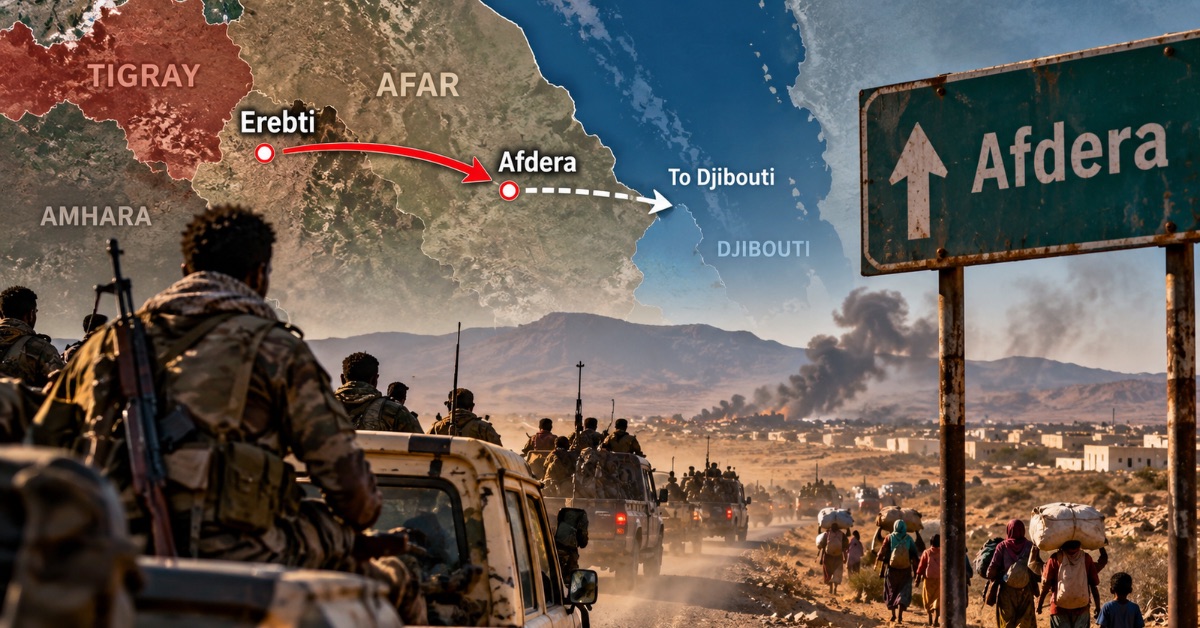
Tigrayan and allied forces have reportedly captured Erebti in Ethiopia’s Afar region and are advancing toward Afdera, marking a significant expansion of the renewed war in northern Ethiopia beyond Tigray.
AFP reported that Erebti fell on Sunday, citing a humanitarian source, while forces involved in the offensive were moving toward Afdera, roughly 100 kilometers farther east.
The reported advance represents one of the most significant battlefield developments since the latest conflict erupted and could increase pressure on the Ethiopian federal government as fighting pushes deeper into Afar.
At least 150,000 people have reportedly been displaced in Afar, according to the humanitarian source cited by AFP. The figure remains difficult to independently verify because of insecurity and communications disruptions affecting conflict areas.
Why Afdera Matters?
The direction of the offensive could prove more consequential than the capture of Erebti itself.
Afdera lies deeper inside Afar and closer to the strategic transportation network connecting Ethiopia with Djibouti. Landlocked Ethiopia depends overwhelmingly on the Djibouti corridor for its international maritime trade, including critical fuel and commercial supplies.
A sustained eastward offensive would therefore raise questions about whether the military objective extends beyond securing territory around Tigray.
If forces continue moving toward infrastructure connected with Ethiopia’s Djibouti supply routes, the Afar campaign could potentially place economic and logistical pressure on Addis Ababa, in addition to stretching federal military resources across another front.
There is not yet sufficient independently verified information to conclude that the Djibouti corridor itself is under immediate threat.
However, the direction of the reported advance makes developments in Afar particularly important to watch.
From “Defensive War” to an Expanding Offensive
Tigray’s authorities have described the renewed confrontation with the federal government as a “defensive war.”
The reported capture of Erebti and advance toward Afdera, however, could intensify questions about the geographical and political objectives of the campaign as operations extend farther outside Tigray.
The fighting is no longer confined to a confrontation over Tigray itself.
Armed organizations opposing Prime Minister Abiy Ahmed’s federal government are operating across several fronts, including parts of Afar and Amhara, significantly broadening the geography of the conflict.
The TPLF is part of a recently announced seven-group anti-government alliance, although the degree of operational coordination among all members remains unclear.
Conflict monitoring has indicated that the TPLF, the Amhara Fano National Movement and the Afar Revolutionary Democratic Unity Front, also known as Ugugumo, are among the organizations actively fighting federal forces in northern Ethiopia.
Humanitarian Pressure Mounts in Afar
The reported displacement of approximately 150,000 people underscores the rapidly growing civilian consequences of the Afar offensive.
Communities in Afar already experienced extensive displacement and destruction during the 2020–2022 northern Ethiopia war.
Renewed fighting therefore risks reopening a region that had only begun recovering from the previous conflict.
Communications disruptions elsewhere in northern Ethiopia are also making independent verification increasingly difficult, while renewed drone warfare has added another layer of concern for civilians.
A drone strike hit the building housing Tigrai TV in Mekelle on September 27 as military operations continued across northern fronts.
Regional Tensions Rising Alongside the Fighting
The battlefield developments are unfolding alongside increasingly serious accusations of foreign involvement.
Ethiopia’s Chief of General Staff, Field Marshal Birhanu Jula, has accused Eritrea of financing and supporting Ethiopian armed organizations fighting the federal government.
He has also alleged involvement by Egypt and Sudan as part of a broader regional effort against Ethiopia.
Those allegations have not been independently established.
Sudan has rejected accusations that it is supporting Ethiopian armed groups, Egyptian sources have denied Cairo’s involvement, and Eritrea has rejected Ethiopian allegations that it is supporting armed organizations operating against Addis Ababa.
The accusations nevertheless demonstrate how rapidly Ethiopia’s internal conflict is becoming intertwined with existing geopolitical tensions across the Horn of Africa.
Afar Becomes a Front to Watch
For the immediate course of the war, however, the advance from Erebti toward Afdera may be more consequential than the competing diplomatic accusations.
The critical questions are now whether the advancing forces can hold Erebti, whether they continue toward Afdera, how the Ethiopian National Defense Force responds, and whether the offensive eventually threatens infrastructure linked to Ethiopia’s Djibouti trade corridor.
If the advance continues eastward, the Afar front could shift from a secondary theater of the northern Ethiopian conflict into one of its most strategically important battlefields.
And if the objective is ultimately to place pressure on Ethiopia’s principal commercial connection to the outside world, the battle for Afar could become far more significant than a struggle over individual towns.
For now, Erebti has emerged as the latest reported territorial loss for the federal side, while Afdera becomes the next location to watch.

