
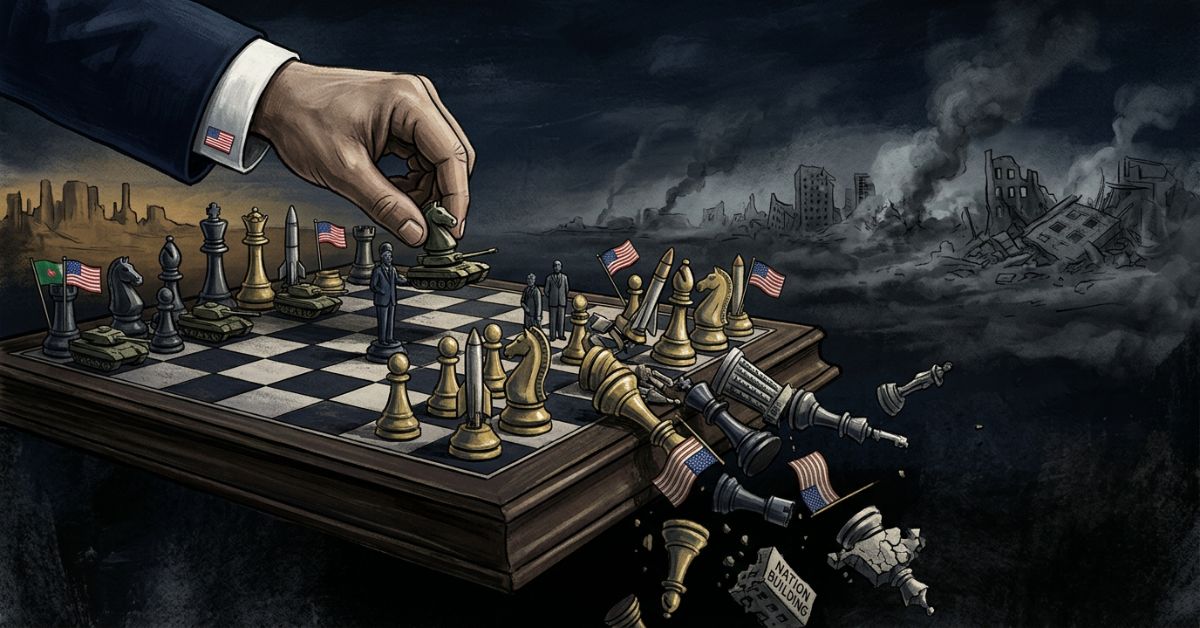
THE AMERICAN PARADOX
For nearly eighty years, American foreign policy has oscillated between sweeping global ambitions and consistently disappointing results. The gap is hard to ignore. No other power has ever assembled a comparable concentration of resources devoted to strategic planning. Elite universities, research institutions, sophisticated military establishments, intelligence agencies, and think tanks work continuously on the analysis of international scenarios. Layer on top of that advanced modeling, simulation, and theoretical frameworks such as game theory.
And yet the overall record remains defined by repeated failure. From Vietnam to Iraq, through Afghanistan and more recent crises, the same difficulty keeps resurfacing: an inability to convert material superiority into durable political outcomes. The argument here is not that the United States lacks competence, but that the competence it possesses is systematically misapplied. Decision-making appears fragmented, shaped by competing interests, and driven by an enduring overconfidence in the ability to manage complexity.
SUEZ AS A REVEALING EXCEPTION
The 1956 Suez Crisis stands as a rare counterexample — one of the few moments in its postwar history when American foreign policy displayed a strategic clarity it has rarely managed at any other point. By siding against France and Britain, and finding a point of convergence with the Soviet Union, Washington helped bring the curtain down on European colonial ambition in the region. This was not idealism. It was a coherent expression of realist national interest: supporting the old colonial powers would have weakened America’s standing in the emerging world and handed an advantage to its principal rival.
The episode demonstrates that a more selective and self-aware foreign policy was achievable. That is precisely why it remains an outlier. In the decades that followed, the capacity to read international balances of power steadily eroded, giving way to interventions driven more by political impulse and ideological momentum than by any clear ordering of priorities.
SOPHISTICATED THEORY, DISTORTED DECISIONS
One of the more striking features of this record is the distance between the quality of analysis and the weakness of the decisions that follow from it. Many of the foundational theories of international relations were developed in the United States and continue to be refined there. Realism counsels restraint and an honest reckoning with the limits of power; rational choice theory and game theory both presuppose coherence in the pursuit of objectives.
In practice, however, these frameworks are routinely ignored or applied selectively. Decision-making is shaped by inter-agency competition, bureaucratic inertia, and short electoral cycles. Decisions are not the product of a unified rational actor but of negotiated compromises among institutions with divergent interests. In this environment, even the most rigorous analysis tends to be diluted or reframed to fit the moment. The problem is not the absence of rationality but its dispersal.
THE MIDDLE EAST AND THE REPETITION OF ERROR
The Middle East provides the clearest illustration of this pattern. The invasion of Iraq destabilized the regional order and produced consequences directly contrary to its stated aims. The Afghanistan experience demonstrated how difficult it is to build functioning institutions in radically unfamiliar contexts. More recently, the decision to align American policy with the Israeli government’s posture toward Iran — an alignment that amounts to reckless aggression — represents a further step in this accumulation of self-inflicted failures.
Rather than consolidating its position, Washington has contributed to escalating tension while steadily narrowing the space for diplomatic resolution. The paradox repeats itself: the United States neglects its allies, then turns to them for support in managing crises it helped generate. The pattern holds — ambitious objectives, uncertain execution, counterproductive results, and eventual retreat.
INTERNAL INCENTIVES AND THE LIMITS OF POWER
The deeper causes of this pattern lie in structural features of American domestic politics that are difficult to override. The political system is calibrated for short-term decision-making, routinely driven by electoral and media imperatives. The relationship between policymakers and analytical expertise remains dysfunctional. Analysis is produced in abundance but rarely drives final decisions. The military-industrial complex creates persistent pressure to reach for military instruments even when they are not the most effective ones available.
Compounding all of this is a stubborn belief in the controllability of events. Recent history consistently demonstrates otherwise: complex environments, local dynamics, and cultural factors place sharp limits on what external intervention can achieve. Military superiority does not translate into lasting political results. What emerges is the portrait of a power capable of analyzing the world with considerable precision, yet far less capable of turning that knowledge into coherent action. The recurrence of these failures is not accidental. It is structural — and for that reason it will keep repeating.