The Word and Its History
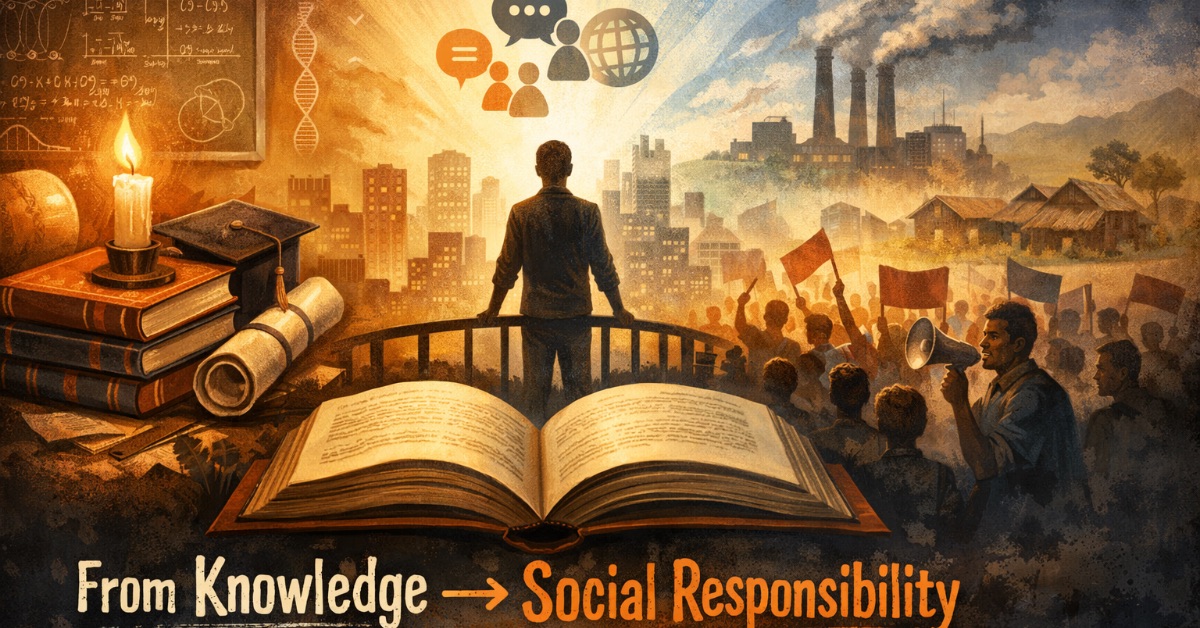
In Europe, the figure of the intellectual takes shape when knowledge ceases to be a private possession and becomes a public voice. It does not coincide with the professor or the specialist confined within a single discipline, but with someone who feels compelled to speak when society moves through tension and crisis. This figure emerges in direct engagement with concrete history, at moments when reality raises questions that cannot remain merely technical. Thinkers such as Antonio Gramsci clarified that every society produces intellectuals, though not all play the same role. Traditional intellectuals tend to see themselves as separate from social conflicts, guardians of a knowledge that appears neutral. Organic intellectuals, by contrast, are bound to the lived experience of social groups, translating needs, tensions, and aspirations into language, ideas, and worldviews. Later figures such as Jean-Paul Sartre insisted on a similar point. An intellectual is not the person who knows the most, but the one who accepts that knowledge demands involvement. It is not a comfortable position. It is a responsibility.
Education Is Not Yet Public Thought
This is where a common misunderstanding begins. Education is often equated with intellectuality. Yet if that were true, literacy alone would suffice to make someone an intellectual, and with the expansion of higher education almost everyone would qualify. Clearly this is not what the term means. A person may hold degrees, advanced training, refined expertise, and still remain enclosed within the boundaries of a profession. Such a person is a highly qualified professional, essential to the functioning of society, but not necessarily an intellectual in the full sense. The distinction becomes clear through examples. An engineer who designs infrastructure performs an essential task. That engineer becomes an intellectual when reflecting publicly on the model of development those projects promote, on their social and environmental consequences, on collective priorities. A physician is highly educated. That physician becomes an intellectual when engaging public debates about inequality in healthcare, the ethics of treatment, or health policy. The intellectual does not remain confined to private reflection. The intellectual steps beyond a narrow field and turns expertise into an interpretation of the concerns that affect society as a whole. The contribution is not only information, but meaning.
Common Usage and the Word ምሁር in Eritrea
This distinction becomes especially clear in Eritrea. In everyday language, the word ምሁር, mihur, is often used to describe anyone with higher education. A university graduate, a fluent speaker, someone with formal credentials may easily be labeled a scholar. Yet here a shift occurs. Education automatically becomes cultural prestige. In a deeper Eritrean sensibility, however, mihur means something more. It does not refer simply to a person who has accumulated knowledge, but to someone who connects knowledge to society. One may hold a degree in economics and be an excellent civil servant, and still not perform an intellectual function. One becomes a mihur in the fuller sense when attempting to read collective problems, to discuss economic choices in public, to identify contradictions between official narratives and lived reality, and to articulate possible paths of change. The transition is not from ignorance to culture, but from private competence to public speech.
Knowledge as Public Action
The intellectual does not operate only in isolation from public life. Engagement takes concrete forms in public life. Intellectuals write articles, editorials, essays, and pamphlets. They participate in conferences, organize meetings, and foster debates. They edit journals, curate publications, and collaborate with others in shaping cultural and political conversations. In doing so, they help orient discussion, build shared vocabularies, and make alternatives thinkable. In sociological terms, one may speak of an intellectual class composed of those who possess cultural capital and seek to transform it into symbolic influence, into the capacity to shape public opinion. In the Eritrean context, this function is not confined to universities. Elders who safeguard customary law, religious authorities who interpret moral texts, and masters of oral tradition who transmit memory and worldview perform similar roles when they link knowledge to collective life. They offer interpretations, give form to problems, and help the community understand itself. Here the central point becomes clear. The intellectual, or the mihur in its fuller sense, is not the one who has studied the most, but the one who feels that knowledge carries an obligation toward others. Knowledge becomes a public responsibility, and culture ceases to be private property.