Introduction: The End of a Rules-Based Fiction
The unipolar world order that followed the Cold War is coming to a definitive close. In a candid speech at the World Economic Forum in Davos (2026), Canadian Prime Minister Mark Carney openly admitted that the so-called “rules-based international order” was always only “partially false” – a convenient fiction that masked great power dominance . Carney recalled that Western leaders “participated in the rituals” of this order, privately aware of its double standards, but kept up symbolic compliance to “avoid trouble” . “We knew the story of the international rules-based order was partially false — that the strongest would exempt themselves when convenient, that trade rules were enforced asymmetrically,” Carney confessed, noting how international law was applied with varying rigor depending on who was accused . This frank acknowledgment marks the end of an era: the end of a U.S.-led global system that claimed mutual benefit and rules for all, even as it largely served the strongest powers.
Carney’s address set the tone by invoking Václav Havel’s notion of “living within a lie.” In Havel’s parable, a shopkeeper places a sign in his window proclaiming a slogan he doesn’t believe, merely to signal obedience . Likewise, countries have long performed rituals of fealty to a “rules-based order” they knew was imperfect. As Carney put it, “we placed the sign in the window… and largely avoided calling out the gaps between rhetoric and reality” . That complacent bargain has now collapsed. The global consensus that papered over power imbalances is unravelling, and even Western middle powers now concede that the old order’s stability rested on “pleasant fiction” . The stage is set for a historic inflection point – a rupture rather than a gentle transition. “Let me be direct. We are in the midst of a rupture, not a transition,” Carney stated bluntly , signaling that the post-Cold War unipolar moment is definitively over.
The Legacy of Unipolar Order: Stability and Subordination
The unipolar order that emerged after 1991 was often justified in idealistic terms: a “rules-based” framework to ensure global stability, free trade, and collective security under U.S. leadership. In practice, as now admitted, it was a “pleasant fiction” that preserved U.S. primacy even as it offered other nations some benefits . This order’s legacy is paradoxical. On one hand, it provided public goods – “open sea lanes, a stable financial system, collective security, and frameworks for resolving disputes” under American hegemony . Many countries in the Global South did profit, to a degree, from integration into this system through access to markets and development aid. On the other hand, the order entailed a clear hierarchy: “the strongest would exempt themselves when convenient” and enforce rules to their advantage . Weaker states often found that norms were invoked selectively, and promises of equal rules were in part a myth. In Carney’s words, “international law applied with varying rigour depending on the identity of the accused or the victim” .
Crucially, the unipolar system also demanded compliance – real or performative – from lesser powers. Many governments felt pressure to align with U.S. policies or risk political and economic repercussions. Rather than truly rules-based, the order functioned as a patronage system where allies were rewarded and dissenters penalized. Carney noted that even U.S. allies “avoided calling out the gaps between rhetoric and reality” because they benefited from the lie as long as their own prosperity and security were assured . This was “the bargain” of the unipolar era: go along with the dominant power’s system, and in return enjoy stability. However, this bred a form of “living within a lie” – a habit of symbolic compliance by middle powers and developing countries, who often bit their tongue on double standards in order to get along . Nations placed the placard of acquiescence in the proverbial window to signal cooperation, even when they privately chafed at unequal treatment.
For countries in the Global South, the unipolar legacy is mixed. Some gained development assistance and conflict mediation via multilateral institutions championed by the West. Yet many also experienced the sharp edges of an order that could quickly turn coercive. The “rules” did not prevent punitive sanctions, military interventions, or biased arbitration when the interests of the hegemon were at stake. Eritrea, for example, saw the UN and powers hesitate to enforce an international border ruling in its favor after 2002, and later suffered sanctions that it regarded as unjust . Such episodes reinforced the view in Asmara and beyond that the “rules-based order” often masked “a system of intensifying great power rivalry, where the most powerful pursue their interests” with impunity . In sum, the unipolar order’s legacy includes decades of relative global stability and economic integration, but also a trail of unresolved grievances in the Global South about sovereignty compromised and promises unfulfilled.
A Multipolar “Rupture”: Strategic Autonomy and Weaponized Integration
Today, the world is entering an emerging multipolar order defined less by universal rules and more by raw competition. Carney described a stark new reality: “Every day we’re reminded that we live in an era of great power rivalry, [where] the strong can do what they can and the weak must suffer what they must” . In this environment, the old assumptions no longer hold. Great powers are explicitly weaponizing global integration – turning economic links into leverage. “Great powers have begun using economic integration as weapons,” Carney warned, “tariffs as leverage, financial infrastructure as coercion, [and] supply chains as vulnerabilities to be exploited.” . This is a profound shift: globalization, once sold as a win-win engine of mutual growth, is now openly “subordinated to geopolitical rivalry” . Trade wars, sanctions, tech decoupling, and even the control of critical resources have become instruments of power politics.
For many countries, especially middle powers and developing states, these trends pose a dilemma. The implicit bargain of the old order – silence in exchange for stability – “no longer works” . Instead, nations face a future where “when the rules no longer protect you, you must protect yourself.” . This imperative is driving a turn toward strategic autonomy. Around the world, states are rushing to secure their own food supply, energy, critical minerals, and technological capacity . Carney observed that “many countries are drawing the same conclusions – that they must develop greater strategic autonomy in energy, food, critical minerals, finance and supply chains.” The impulse is understandable: a country that cannot feed or fuel itself, or defend itself, has few options in a volatile multipolar climate .
Yet pursuing self-reliance in an atmosphere of zero-sum rivalry comes with risks. If every nation becomes a siloed fortress, the world economy could fragment, leaving all sides poorer and more insecure. “A world of fortresses will be poorer, more fragile and less sustainable,” Carney cautioned . Likewise, the emerging multipolarity is not a tranquil balance-of-power; it is “a contested system of spheres of influence [and] geopolitical tensions” in which global norms may be weaker . In such a climate, middle and small states could be squeezed between giants or find their interests trampled as rules give way to might. The international system itself is exposed to “profound instability” as it rapidly shifts from unipolarity to multipolar competition . These geopolitical cracks in the old architecture present both an opportunity and a danger: space for new actors to assert themselves, but also fewer guarantees for the weak. The key question is how nations of the Global South can navigate this rupture to their advantage, rather than becoming collateral damage in great power contests.
From Compliance to Integrity: Middle Powers Banding Together
One clear theme from Davos was a call for middle powers to change their strategy. No longer, Carney argued, should countries “go along to get along” in hopes that compliance with a superpower will buy them safety . “It won’t,” he bluntly added . Instead, he urged those in the “middle” of the global hierarchy – neither superpower nor insignificant – to exercise collective agency. “The middle powers must act together, because if we’re not at the table, we’re on the menu,” Carney said, invoking a striking metaphor . Rather than competing against each other for a great power’s favor, these nations should coordinate and build coalitions of their own . Indeed, when middle powers only negotiate one-by-one with a hegemon, they end up bargaining from weakness and “accept what’s offered”, often performing sovereignty while “accepting subordination.” . To escape that trap, likeminded countries need to “combine to create a third path with impact.”
Acting together also means standing on principle and integrity, not just convenience. Carney suggested that the so-called “power of legitimacy and rules” can still be strong if wielded collectively . This requires honesty: “Stop invoking [the] rules-based international order as though it still functions as advertised. Call it what it is – a system of intensifying great power rivalry…using economic integration as coercion.” In practical terms, “living in truth” for middle powers means consistently upholding the same standards for all sides. As Carney noted, if they “criticize economic intimidation from one direction, but stay silent when it comes from another, we are keeping the sign in the window.” In other words, selectively objecting to only one superpower’s abuses while ignoring another’s is just a new form of the old lie. Genuine integrity would involve calling out violations of sovereignty and law regardless of who commits them – a stance that requires courage and unity among smaller states.
Crucially, building resilience is part of this strategy. Carney emphasized developing a “strong domestic economy” to reduce vulnerabilities . Diversifying trade and technology partners is not only good economics, it provides insurance against coercion . “Countries earn the right to principled stands by reducing their vulnerability to retaliation,” Carney observed . In short, middle powers should fortify themselves at home – energy independence, food security, financial stability – and cooperate abroad to withstand pressure. Where the old order asked them for compliance, the emerging approach asks for integrity and collective resilience. We see this mindset taking hold in various forms: for example, medium-sized nations forming issue-based alliances or “plurilateral” agreements that exclude superpowers, or coordinating positions in multilateral forums to amplify their voice. By acting together on their own terms, these countries aim to transform their role from passive rule-takers to proactive shapers of new norms.
Opportunities for the Global South in a Multipolar World
As the Western-led order frays, the Global South is finding new latitude to chart its own course. Freed from a singular hegemon’s shadow, developing nations can seek diverse partners and pursue policies aligned with their own interests. In fact, “as the Western-led order frays, the Global South is rising to craft its own economic and diplomatic path in a multipolar world.” Many emerging economies are now driving global growth and looking beyond the traditional North-South aid paradigm. They are deepening South-South trade, investing in regional supply chains, and leveraging their youthful populations and natural resources to gain bargaining power . Unlike during the unipolar era, where alignment with Washington or its allies was often expected, most Global South states are now “multi-aligned.” This means they engage pragmatically with all major powers – striking infrastructure deals with China, security cooperation with the US, technology partnerships with Europe, etc. – without binding themselves exclusively to any bloc . Such flexibility allows middle and low-income countries to maximize opportunities: for instance, securing investment on better terms or accessing multiple sources of financing and technology.
New South-led institutions and alliances are also emerging. The BRICS grouping (Brazil, Russia, India, China, South Africa) has expanded its vision, attracting interest from dozens of developing nations eager for alternatives to Bretton Woods institutions. Regional development banks, trade agreements outside Western frameworks, and forums like the “Global South Summit” are giving these countries greater collective influence. If managed wisely, a more multipolar system could become more inclusive – with global rules reflecting input from Asia, Africa, and Latin America rather than just the G7. Indeed, by 2026 the international system is set to be not only more multipolar but potentially more representative of diverse interests, provided rising powers from the South take on responsible roles .
For Africa and the Horn of Africa specifically, multipolarity can open space to assert regional priorities long overshadowed by big power agendas. Countries may now have a chance to prioritize economic integration within Africa – such as the African Continental Free Trade Area – under their own terms, without as much external dictate. They might also capitalize on great power competition: for example, attracting infrastructure funding from China’s Belt and Road Initiative while simultaneously leveraging U.S. and European interest in countering that influence to negotiate better deals or security support. The cracks in the old system give savvy leaders room to maneuver, playing one side against another or choosing a path entirely of their own. Eritrea’s neighborhood has seen this dynamic: Gulf Arab states, Turkey, China, the U.S., and EU are all vying for partnerships in the Horn of Africa – which means countries like Eritrea, Ethiopia, and Sudan have multiple suitors rather than a single patron. With careful strategy, they can avoid dependency on any one power and secure investments with fewer strings attached. In short, the opportunity for Global South nations lies in exploiting the greater strategic autonomy available – crafting development models that suit their conditions, asserting sovereignty in international forums, and building coalitions that amplify their voice globally.
New Geopolitical Risks and Challenges for the Global South
On the flip side, the multipolar moment brings significant risks. The erosion of a single rules framework means that smaller states can more easily become arenas for proxy contests or great power spheres of influence. The emerging order is being shaped by “a contested system of spheres of influence, [heightened] geopolitical tensions, and [a diminished] common denominator” of global norms . Without a strong multilateral referee, power politics can run rampant. For many developing countries, this raises the danger of being pulled into rival camps or punished for refusing to pick a side. For example, a country that welcomes Chinese investment might face Western trade retaliation; conversely, one that signs a security pact with the U.S. might invite overtures or pressure from Russia and China. The Horn of Africa is unfortunately familiar with such tug-of-war dynamics – recall how Cold War rivalries and the War on Terror both played out through client relationships in the region. A multipolar world could see new forms of intervention or destabilization as major powers jostle for footholds (such as ports, bases, or resource concessions) in strategically located nations.
Economic fragmentation is another challenge. If global trade splinters into blocs (e.g. a U.S./EU-led bloc and a China/Russia-led bloc with separate technology standards and payment systems), developing countries may struggle to navigate the divided landscape. Those with fragile economies could be hit hard by volatility in currency values, sanctions on partners, or breakdowns in supply chains. For instance, countries heavily indebted to or reliant on one major power could suffer if that patron’s rivalry leads to sudden funding cutoffs or asset freezes. The weaponization of finance – such as exclusion from dollar-based systems – has already been seen in cases like Iran and could be applied more broadly. Carney’s Davos remarks underscored this risk, noting how “financial infrastructure [can serve] as coercion” and supply dependencies become strategic vulnerabilities . The lesson is that interdependence now cuts both ways: it can assure prosperity in good times, but be turned into leverage in conflict.
Moreover, global problems that require collective action – climate change, pandemics, migration crises – could worsen if great power rivalry stymies cooperation. A divided UN Security Council or a weakened World Trade Organization leaves smaller countries with fewer avenues to seek justice or resolve disputes. Weaker international law enforcement means that if a small nation’s sovereignty is violated (by aggression or proxy militias), it may not receive timely help or solidarity. Many African and Asian nations worry that a might-makes-right era could permit regional hegemons to throw their weight around more freely. In the Horn of Africa, for example, one could imagine more unilateral interventions by powerful neighbors under the guise of security or economic interest if global oversight slackens. Finally, internal governance problems in developing states could be exacerbated: authoritarian leaders might feel emboldened when there is no unified external pressure for democracy or human rights. The challenge for the Global South, therefore, is to avoid the pitfalls of multipolarity – being divided and ruled by larger powers, or becoming overly dependent on one new patron – while seizing its opportunities. This demands astute diplomacy, diversification, and an emphasis on regional solidarity to avoid isolation.
Eritrea’s Sovereign Stance: Resisting Unipolar Dominance
Eritrea offers a unique and instructive case of a small nation that has long prioritized sovereignty and self-reliance above all else. Even at the height of unipolarity, Eritrea charted an independent course, often at great cost. Since achieving independence in 1993 after a 30-year liberation war, Eritrea’s leadership (headed by President Isaias Afwerki) has been deeply suspicious of external domination – whether by superpowers or international financial institutions. The country famously adopted a policy of minimal foreign aid and external loans, arguing that dependency would compromise its hard-won independence. In fact, by the mid-2000s Eritrea had scaled down or stopped accepting most foreign aid, insisting that such aid “undermines the sovereignty of recipient states.” Instead, the government embraced a philosophy of “self-reliance,” attempting to mobilize domestic resources and Diaspora contributions to meet development needs. As one official commentary put it, “to be a self-reliant country in a continent plagued by the virus of ‘other-reliance’ is what makes Eritrea a target” for pressure . In Eritrea’s view, nations that “grovel at the feet of the rich and powerful just to be fed” sacrifice their dignity – a mindset that Eritrea’s leaders have refused to accept, even during droughts and hardship.
This uncompromising stance can be seen as historical resistance to unipolar dominance. Eritrea not only declined the tutelage of Western donors, it also stood outside many integration schemes that it believed would infringe on its autonomy. The government maintained tight control over the economy and external commerce, resulting in “isolation from global free market trade.” Eritrea remained one of the few African countries not to join the World Trade Organization or take IMF structural adjustment loans, and it only belatedly signed onto the African Continental Free Trade Agreement. Such wariness stemmed from a conviction that global economic integration often comes with strings attached – “aid packages arriving with an appalling number of strings…create a confusion of priorities upon the recipient”, as President Afwerki once remarked . He and his party viewed Western-backed globalization as a potential threat to Eritrea’s policy independence and socialist-influenced development path.
Unsurprisingly, this posture led to friction with the U.S. and its allies. Eritrea fell out with Washington early on, and by the late 2000s it was hit by UN sanctions (ostensibly over regional conflicts). Asmara perceived these measures as punishment for refusing to align with U.S. regional policy – essentially, the cost of insisting on an independent path . “The various assaults against Eritrea [were] to punish the country for the ‘crime’ of the rejection of subservience,” an Eritrean Ministry of Information analysis contended . The government saw its isolation not as a failure, but as a badge of principled resistance: “pursuit of self-reliance…is the real threat that Eritrea poses to the…system of hegemony” designed by global powers . In other words, Eritrea’s very defiance of the unipolar “rules” was, in its eyes, a challenge to the world order’s inequities. This narrative of martyrdom for sovereignty has deeply shaped Eritrea’s political identity. While it resulted in economic stagnation and international pariah status for years, it also meant Eritrea never became a client state or proxy. As the unipolar era ends, Eritrea’s long-held stance appears vindicated to some degree – the inequities and double standards it railed against are now openly acknowledged by erstwhile defenders of the system .
Eritrea’s Cautious Engagement in a Shifting Global Landscape
With the geopolitical tectonic plates shifting, Eritrea is carefully adjusting its foreign relations to capitalize on the multipolar opening while safeguarding its core principle of sovereignty. As President Afwerki recently noted, the world’s move from a unipolar to a multipolar order brings greater complexity but also the chance for a “more just and equitable international order” based on mutual respect . Asmara no longer faces a monolithic Western front; it now has alternate partners who respect its non-aligned stance. In recent years, Eritrea has strengthened ties with emerging powers: China has become a key economic partner (providing loans and investing in mining projects), and Russia has found in Eritrea a willing diplomatic ally on issues like Ukraine. Indeed, Eritrea welcomed the global power shift as “an opportunity,” with Afwerki stating “the unipolar global order is beginning to unravel.” This unraveling, he suggested, validates Eritrea’s long resistance to U.S. pressure and allows it to “claim space within a new world order.” In practical terms, Eritrea is forging deeper links with the BRICS axis. Afwerki has held multiple meetings with China’s President Xi Jinping – Beijing praised the “deep bond of friendship in an uncertain and unstable world,” signaling firm support for Eritrea . Eritrea has also openly aligned with Russia’s critiques of Western hegemony; in mid-2023, Afwerki even urged Moscow to lead an anti-hegemonic global struggle, framing the Ukraine war as part of a fight in which Africa must take sides . Such moves demonstrate Eritrea’s intent to be “on the table” with new power centers rather than isolated on the menu.
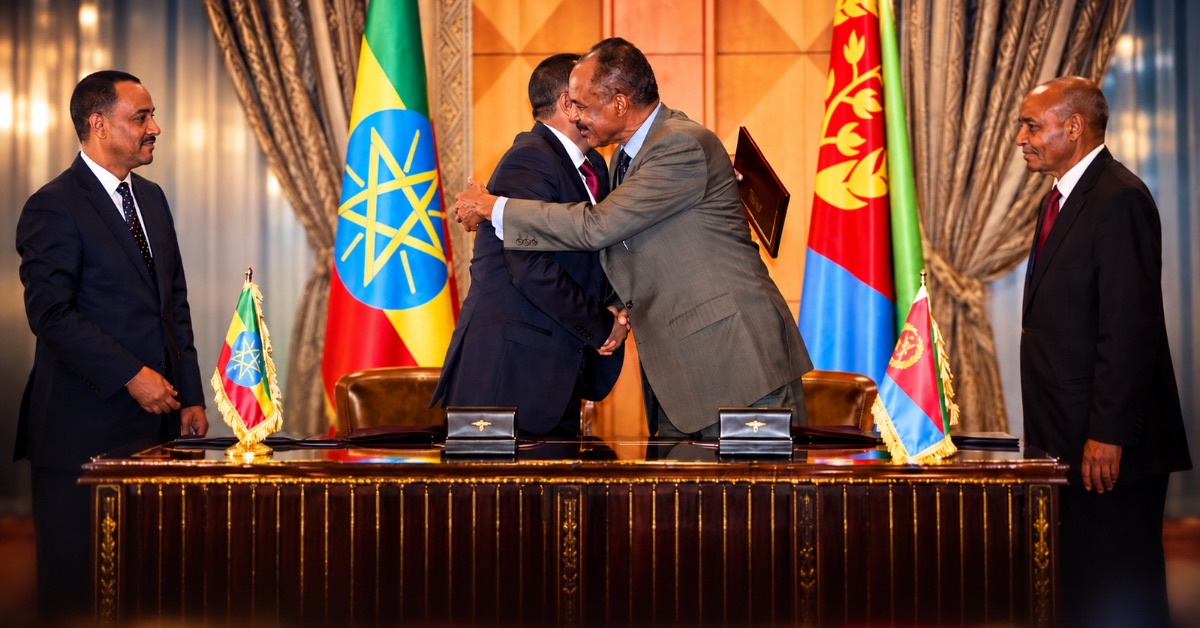
The Horn of Africa nation is also recalibrating its regional posture. After decades of hostility with neighbors (Ethiopia, Djibouti, Sudan) partly fueled by external meddling, Eritrea sees value in regional self-reliance and cooperation. It played a key role in the 2018 peace with Ethiopia, ending a 20-year stalemate without heavy outside mediation. Along with Ethiopia and Somalia, Eritrea briefly formed a “Horn of Africa Cooperation” trilateral forum in 2019 aimed at solving regional issues ourselves – an initiative reflecting the desire to keep the Horn’s affairs in local hands, free from excessive superpower or neo-colonial intervention . Eritrea has advocated for Red Sea literal states to jointly manage their security and resources, cautioning against great power rivalry in these strategic waters. Such an “Eritrea-first” lens on multilateralism means Asmara will engage in collective efforts only if they uphold equality and sovereignty. For instance, Eritrea has cautiously participated in the African Union and IGAD (Intergovernmental Authority on Development) again after years of boycott, but it consistently voices against hierarchical decision-making that favors big states. President Afwerki emphasizes that a multipolar world order must be based on fairness and cooperation – “equal partnership among states” – if it is to deliver stability . This suggests Eritrea will champion reforms that give smaller nations an equal say, whether in the UN system or regional bodies.
All the same, Eritrea remains wary of over-integration. The leadership in Asmara is unlikely to suddenly embrace globalization or dependency just because the West’s dominance is diluted. If anything, Eritrea will double down on building self-reliance at home as a shield against unpredictability. Carney’s dictum that “sovereignty…will increasingly be anchored in the ability to withstand pressure” resonates strongly with Eritrea’s approach. This means continuing to invest in agriculture for food security, developing local industries (albeit slowly), and maintaining control over strategic sectors. Eritrea will seek foreign investment but on its own terms – for example, insisting on joint ventures in mining and retaining state ownership in critical infrastructure . The government has even been willing to forego opportunities rather than accept conditionalities that it perceives as compromising (such as IMF loans that demand policy changes, or NGO aid that might influence local priorities). In a multipolar context, Eritrea can leverage competition to obtain assistance with fewer strings. We see this in how it negotiates with China: Chinese firms build roads and ports in Eritrea, and in return Eritrea grants mining concessions – a transactional relationship with less lecturing about internal governance than Western aid would entail . However, such alignments carry their own risks: high indebtedness to new patrons, or becoming entangled in their rivalries. Eritrea’s challenge will be to maintain its balancing act – welcoming investment from various partners (China, Gulf states, Europe) but not becoming beholden to any. Thus far, Asmara has shown itself adept at playing hardball and extracting what it can while yielding little in political concessions.
Multilateralism and Regional Resilience: An Eritrea-First Lens
In the emerging world order, Eritrea and countries like it will have to creatively rethink multilateralism. The old multilateral institutions (from the UN to the World Bank) are viewed with skepticism in Asmara, given their history of bias and hierarchical control by big powers. Eritrea’s preference is for “coalitions of the willing” that reflect shared interests rather than universal bodies that might impose on national sovereignty. This aligns with Carney’s notion of “building coalitions that work – issue by issue, with partners who share enough common ground to act together.” For example, Eritrea might favor “plurilateral” agreements on specific goals: a regional pact on Red Sea maritime security strictly among coastal states, or a development initiative among Horn of Africa countries to jointly build infrastructure (roads, power grids) linking their economies. Such arrangements can strengthen collective resilience by pooling resources and presenting a united front, all while sidestepping distant arbiters. We have already seen the Horn of Africa states discuss integrating their electric grids and transportation networks – plans that could reduce reliance on overseas aid and facilitate intra-African trade . Eritrea, despite its prior isolation, stands to gain from these projects if it can trust that they are mutually beneficial and devoid of neocolonial agendas.
Regional cooperation is particularly vital in the Horn of Africa, a region that has historically been fragmented and vulnerable to outside interference. An Eritrea-first perspective on regionalism would prioritize sovereign equality: no single country (however large, like Ethiopia) should dominate the others, and external powers should not be allowed to play client states against each other. Eritrea has floated the idea of a Horn of Africa “forum” where all states – Eritrea, Ethiopia, Djibouti, Somalia, Sudan, South Sudan, and perhaps Kenya/Uganda – come together to address conflicts and economic ties without outside mediators. The underlying principle is “African solutions to African problems.” If successful, such a bloc could collectively bargain with external investors and powers, thereby preventing divide-and-rule tactics. For example, a coordinated Horn position on Red Sea maritime rights could ensure that outside navies (American, Chinese, or others) respect the region’s interests, or that the terms of port investments are not exploitative. Eritrea often cites the Non-Aligned Movement traditions – the idea that developing nations should unify to increase their leverage globally. In practice, this could mean Asmara investing diplomatic capital in the G77 coalition at the UN or South-South initiatives where it feels its voice won’t be marginalized.
Throughout all these engagements, national sovereignty remains the north star for Eritrea. Multilateralism is seen not as an end in itself, but as a means to bolster sovereignty through strength in numbers. Eritrea will likely continue to reject any cooperation that smells of dependency or paternalism. Its representatives frequently call for the UN and international bodies to respect the choices of nations and to abandon coercive measures like sanctions in favor of dialogue. Indeed, Eritrea’s experience on the UN Human Rights Council (to which it was elected in 2022) has been to champion non-interference, arguing for constructive engagement over naming-and-shaming. This stance appeals to many in the Global South who similarly resent what they view as Western double standards on human rights and governance. As multipolarity takes hold, countries like Eritrea will push for multilateral norms that protect sovereignty – for example, stricter prohibitions on unilateral sanctions, or UN reforms giving greater voice to Africa and Asia. They will also advocate collective resilience mechanisms: sharing best practices on self-reliance, forming regional rapid-response teams for disasters (to not depend solely on Western NGOs), and developing joint financial tools (perhaps an African Monetary Fund) to reduce reliance on dollar-based systems.
Importantly, Eritrea’s emphasis on sovereignty does not equate to isolation in this new era. Rather, it seeks interdependence without dependency – cooperation with others on equal footing. The Eritrean leadership often invokes the ideal of mutual self-reliance: each nation standing on its own feet, yet supporting one another through trade and aid that empower rather than weaken. As one Eritrean commentary put it, “the experience of Eritrea can serve as a starting point…for cooperation based on mutual interdependence” among African countries . The nation envisions a regional and global order where no country is forced to choose between poverty with sovereignty or riches with servility. That is a high bar to meet, but the cracks in the old system offer a chance to move in that direction.
Navigating a New Multipolar Era: An Eritrea-Focused Roadmap
As the unipolar world order fades into history, Eritrea and similar Global South nations face a delicate but potentially rewarding path forward. They must leverage the opportunities of multipolarity – greater agency, diverse partnerships, and the ability to assert their own development models – while vigilantly managing the risks of a more anarchic international arena. The following strategic approaches, viewed through an “Eritrea-first” lens, outline how these countries can navigate the cracks in the old system to build strategic autonomy on their own terms:
- Strengthen Domestic Self-Reliance: Prioritize food security, energy sufficiency, and essential industries at home. As Carney observed, “a country that can’t feed itself, fuel itself or defend itself has few options” . Eritrea’s long-standing focus on self-reliance – from agriculture to avoiding debt – should continue, as a resilient domestic foundation is the best insurance against external shocks or coercion.
- Diversify External Partnerships: Embrace a multi-aligned foreign policy to avoid overdependence on any single great power. Engaging with a range of partners (China, Russia, the EU, the U.S., regional powers) allows small nations to extract benefits from each relationship while maintaining balance. For instance, Eritrea can welcome Chinese investment in mines and European markets for its products, and still seek a “constructive and principled engagement” with the U.S. on regional security . By not putting all eggs in one basket, countries preserve flexibility.
- Build Issue-Based Coalitions and South-South Alliances: In a world of fluid alignments, collaborate with other middle powers and developing countries on specific goals. Whether it’s a coalition to negotiate better terms for mineral exports, a bloc of non-aligned states opposing unlawful sanctions, or a regional Horn of Africa pact on infrastructure, acting in concert amplifies influence. “Middle powers must act together… if we’re not at the table, we’re on the menu,” is a lesson small states should heed . Collective efforts can also share the “cost of strategic autonomy” by pooling resources for mutual benefit .
- Stand on Principle with Consistency: Adopt a foreign policy that upholds core values – sovereignty, territorial integrity, non-aggression – consistently in all cases, not selectively. As Carney challenged, call out violations of international law by any actor, friend or foe . Eritrea and its peers gain moral credibility and long-term partners’ trust by demonstrating integrity. This might mean, for example, speaking against the breach of any country’s borders (as a matter of principle) even if committed by a preferred ally. Consistent integrity helps build the “power of legitimacy” that can restrain larger powers when wielded by a united smaller states .
- Leverage Multilateral Forums for Equal Voice: Continue pushing for reforms and using platforms (UN General Assembly, African Union, Non-Aligned Movement) to assert the perspectives of smaller nations. An Eritrea-first approach would be to ensure these forums are not simply echo chambers for big power interests but serve as arenas where Global South countries can set agendas (e.g. development financing rules, security guarantees for small states). By actively participating and sometimes leading on issues (such as Eritrea championing an African initiative for Red Sea security), these nations can shape emerging norms in their favor.
- Foster Regional Integration and Collective Resilience: Invest in neighborly cooperation that reduces external dependency. This includes regional trade, joint infrastructure, and conflict resolution mechanisms. In the Horn of Africa, Eritrea can deepen ties with Ethiopia, Somalia, Sudan and others through projects that connect economies – from power grids to transport corridors – thereby making the region more self-sustaining. A stable, economically interlinked neighborhood is less susceptible to divide-and-rule and can collectively negotiate with external powers from a position of strength. As Carney noted, “risk management comes at a price, but that cost… can also be shared.” The Horn of Africa states pooling their risk through integration exemplifies this principle.
Ultimately, Eritrea’s guiding star will remain national sovereignty and dignity. The multipolar era, if approached wisely, can validate Eritrea’s longtime mantra that nations big or small have the right to determine their own destiny free of coercion. “Nostalgia is not a strategy,” as Carney said – there is no going back to the unipolar “business as usual.” For countries like Eritrea, this is for the best. The task now is to seize the moment of rupture to build a fairer order. That means taking down the old sign of false compliance and, instead, raising a new banner of truth: a commitment to an international system that truly respects the sovereignty and development aspirations of all nations, not just the most powerful . Eritrea and its Global South peers have paid a high price under the old order’s injustices; in the emerging multipolar world, they intend to ensure that their resilience, solidarity, and principled stance earn them an equitable place at the table – not as compliant subjects, but as confident partners shaping their own future.
Sources:
- C.J. Atkins, People’s World – “Carney’s Davos confession: Globalization’s ‘rules-based order’ was a lie” (Jan 21, 2026)
- Times of India – “‘Rules-based order a fiction’: Canadian PM says West excused US hegemony; Mark Carney hints at rupture” (Jan 21, 2026)
- Mark Carney – WEF Davos 2026 Address (full transcript via World Economic Forum)
- Mark Carney – WEF Davos 2026 (on middle powers and sovereignty)
- Aparna Bharadwaj et al., BCG – “In a Multipolar World, the Global South Finds Its Moment” (Apr 22, 2025)
- Nadia Batok, Meer – “A new world order emerges: The shifting dynamics of global power” (Apr 15, 2025)
- Shabait (Eritrea Ministry of Information) – “Self-reliance key to Eritrea’s independence and development” (Sept 6, 2017)
- BTI 2024 Eritrea Report – Bertelsmann Stiftung (2024)
- Horn Review – “Eritrea and the United States: Prospects and Limits of a Diplomatic Reset” (Sept 3, 2025)
- Abdullahi Salad, Dawan Africa – “Eritrean President Advocates for Equal Global Partnerships to Foster Stability” (Jan 13, 2026)