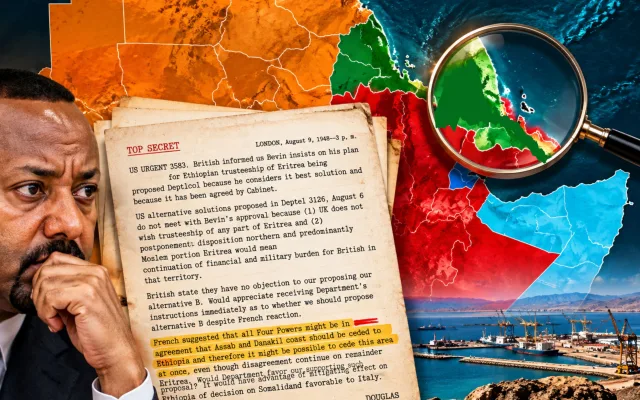

There are interviews that introduce a politician, and there are interviews that expose the environment that produced him. Getachew Reda’s appearance on Head to Head did the latter. It offered a window into a restless Ethiopian political system, spoken through the voice of a man who has learnedperha ps painfully that survival in Ethiopian politics requires constant reinvention.
The Getachew who appeared in London was not the wartime spokesman who once hurled accusations with the confidence of a man who believed the world was on his side. This version was softened, cautious, almost pastoral. His tone floated like incense pleasant, but used to mask something heavier underneath. What he tried to hide with gentleness revealed more than his words intended.
This is not a story about Getachew’s personal evolution. It is a story about what his evolution signals, although he stated that he has “just grown,” not evolved.
Reassurance as a Red Flag
When asked whether Ethiopia and Eritrea were drifting toward war, Getachew offered a sentence so vague it seemed designed to blur the very fear it sought to address: “I don’t expect that to lead to war, at least not in the foreseeable future.”
Such language is not assurance. It is the kind of phrasing politicians use when the horizon holds more uncertainty than they can safely admit, or in Getachew’s case, it seems he is deliberately attempting to mislead. He then appealed to sentiment: “I believe President Isaias and Prime Minister Abiy will find it in their hearts to… diffuse the crisis.”
Invoking “hearts” in a geopolitical crisis is an attempt to replace clarity with warmth. Nations do not defend their sovereignty with emotion. They defend it with truth, legitimacy, and preparedness.
And while Getachew comforted the audience with soft imagery, someone on the panel refused to indulge the theatre. The suddenly found uncomfortable honesty of Professor Tronvoll.
A known TPLF advocate, Professor Kjetil Tronvoll broke the polite atmosphere with a direct statement: “I think the war is coming, and it’s coming pretty soon.” His explanation was not rooted in speculation. It was rooted in Ethiopia’s own public record: PM Abiy Ahmed’s speeches, and state-run media programs. The professor stressed, with a warning tone:
“Ethiopia is ticking off every box of claiming a right to self-defense accusing Eritrea of destabilization… submitting a letter to the UN… saying: ‘We want peace, but not for too long.’”
Ethiopia always prepares its conflicts on paper long before it prepares them on the ground. Anyone who lived through the long arc of Eritrea’s struggle knows this pattern well. Documents precede mobilization. Narrative precedes action.
Getachew’s attempt to soften the outlook could not eclipse this reality. Ethiopia’s Elite: Not Misspeaking, but Signaling While he whispers diplomacy abroad, the Ethiopian political class is speaking with striking clarity at home. In case anyone asks for proof;-
Abiy Ahmed: “We will correct the historical error. Ethiopia will not remain landlocked.” Field Marshal Birhanu Jula: “We will make any sacrifice to secure Ethiopia’s access to the sea.” Ambassador Nebiyu Tedla: “Maritime access is an existential necessity.” and so on….
Each statement is a stone in the same structure. This is not spontaneous rhetoric. It is a carefully aligned posture. Getachew in London speaks like a man trying to keep a bridge from burning. His government speaks like a state preparing the ground for justification.
A Man Rewriting Himself
Throughout the interview, Getachew seemed engaged in the delicate task of reshaping his past positions to fit his new political context. He once accused Abiy Ahmed of authoritarian excess. He now says he supports “restoring Ethiopia’s greatness.” He once warned of Abiy’s dangerous posture toward Eritrea. He now insists he never predicted conflict. He once spoke clearly about genocide. Now he speaks as if the truth is a puzzle with missing pieces.
Such shifts are not ideological maturity. They are the survival mechanics of Ethiopian elite politics, where principles bend before ambition and memory becomes a tool rather than a guide.
Yet even within his evasions, truths slipped out: admissions of fallout with Eritrea, acknowledgment of instability in Ethiopia, recognition of political fracture. The unspoken tension was louder than anything he articulated.
Biserat Lemesa and the Fantasy of a “Lost Coast”
If Getachew avoided direct contradiction, Biserat Lemesa walked confidently into historical distortion. He declared that Ethiopia “lost its coastal territories” through a flawed process. This is not simply wrong it is the foundation of a dangerous narrative.
Ethiopia never possessed a coastline as a sovereign state. The only time Ethiopia had control over the Red Sea was during its illegal annexation of Eritrea, achieved by dismantling the UN-mandated federation. That control was occupation, not ownership.
You cannot lose a coastline that never belonged to you in the first place. (How many times should we say this?) Biserat’s comment was not an error. It was a rhetorical construction a seed planted to justify future claims. Ethiopia’s coastal amnesia has become the intellectual fuel of its renewed expansionist aspiration.
This is my reflection on the interview, and I guess like every Eritrean I am smart enough to recognize the pattern here. Eritrea does not need prophetic warnings to understand what is unfolding. This region has danced to these beats before.
Step by step, Ethiopia is rehearsing a familiar sequence: Create a grievance. Declare it existential. Mobilize legal arguments (so they think). Move forces under the language of “self-defense.” Frame ambition as necessity. Professor Tronvoll saw the pattern that Eritrea knows and lived.
Conclusion
Getachew’s gentleness cloaked a system that is preparing the intellectual ground for confrontation. Biserat’s revisionism attempted to turn annexation into inheritance. Abiy’s rhetoric frames expansion as correction. This is not about the sea. It is about narrative invention. And Eritrea must guard that front with the same vigilance it guards its borders.
Something that Ethiopian elites need to remember clearly is that Ethiopia did not “lose” a coastline. It lost an occupation. Eritrea did not “take” ports from Ethiopia. Eritrea defeated the occupying army and reclaimed what was always its own historically, legally, and morally.
Something else that needs to be clear to Ethiopian elites is that Eritrea’s sovereignty is not negotiable. Its coastline is not a colonial accident. Its borders are not a misprint. The Red Sea is Eritrea’s window to the world earned in struggle, affirmed in law, and protected with unbroken resolve. And that is the truth no amount of revisionism can erase.